





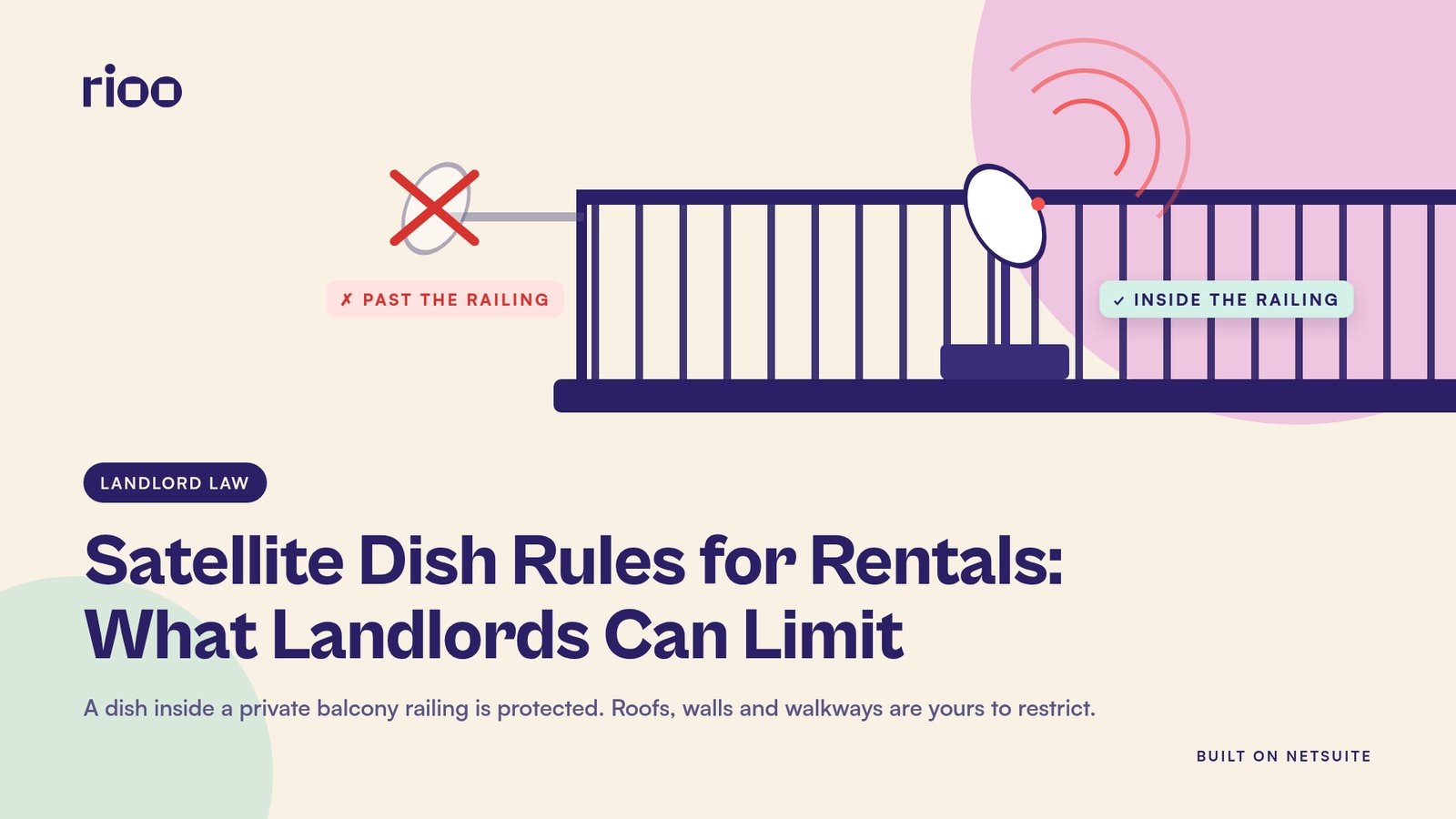
A landlord can control where and how a resident mounts a satellite dish, but cannot ban one from a balcony, patio or yard that the resident alone uses. That comes from a federal rule, the FCC's Over the Air Reception Devices rule, and it overrides lease clauses that say otherwise. Roofs, exterior walls and shared spaces are different. You can keep dishes off those.
The rule also reaches satellite internet dishes and many fixed wireless antennas. That is why these requests now come up for internet service as well as TV. This guide covers what the rule protects and which lease terms still hold. It also sets out a routine for answering a resident who has just put one up. It reflects the rule as of November 2026. Check current text and local law with counsel before you change a lease.
What does the federal rule protect?
The rule is 47 C.F.R. Section 1.4000, often called OTARD. It took effect in October 1996. The FCC's OTARD information page sets out the details. In short, it protects three kinds of antennas:
- Satellite dishes one meter (39.37 inches) or less across, including dishes that send and receive internet service.
- Antennas one meter or less used for wireless cable or fixed wireless internet.
- Antennas that pick up local TV broadcasts, whatever their size.
It covers renters as well as owners. Renters were added on 22 January 1999. Fixed wireless antennas at the customer's end were added on 25 May 2001. The rule does not cover ham radio, CB radio or AM and FM radio antennas.
The test is whether a restriction impairs the antenna. A rule impairs it if it unreasonably delays installation, unreasonably raises the cost, or stops the resident getting an acceptable signal. You can read the rule itself in the Electronic Code of Federal Regulations.
Where can a renter put a dish?
Protection depends on one idea: exclusive use. The resident must have an area that only they, and people they allow, can enter and use. Your right to enter for repairs or inspections does not change that.
| Location | Protected by the rule? | What you can do |
|---|---|---|
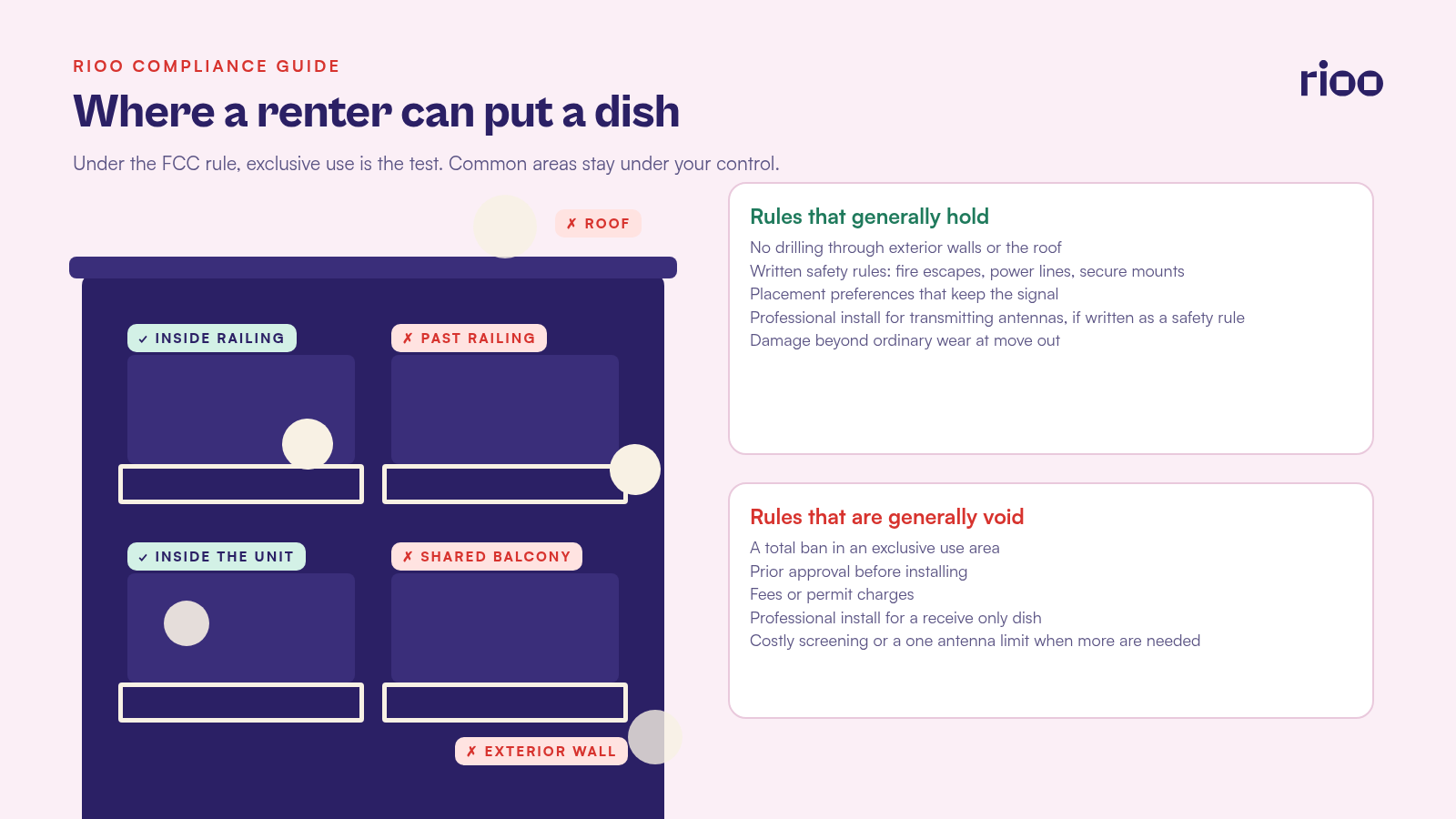
| Private balcony, dish wholly inside the railing | Yes | Set reasonable safety and placement rules |
| Private patio or terrace | Yes | Same as above |
| Inside the unit, by a window | Yes | Ask that it does not block a fire exit |
| Yard of a rented house or manufactured home | Yes | Set placement preferences that keep the signal |
| Dish or arm hanging past the balcony railing | No | Require it to sit inside the railing line |
| Roof of an apartment building | No | Prohibit it, or offer a managed roof location |
| Exterior wall, or drilling through one | No | Prohibit drilling and wall mounts |
| Balcony shared with, or reachable from, another unit | No | Treat it as common area |
If a resident has no outdoor area of their own, the rule still lets them place an antenna inside the unit. It does not give them a right to the roof. The roof is common area, and so are hallways and walkways. If you lease roof space to carriers, our rooftop cell tower lease checklist covers that separate deal.
Which lease rules still hold?
A good antenna policy is short and written down. These kinds of rules are generally enforceable:
- No drilling through exterior walls or the roof. Rules that prevent damage to the building are reasonable.
- Safety rules with a stated reason. Examples are no antennas on fire escapes, a set distance from power lines, and a secure mounting method. The safety reason must be written in the policy or a document residents can easily get.
- Placement preferences that keep the signal. You can prefer a corner of the balcony if that spot does not block the signal or add real cost. Write the preference down and give it to every resident.
- Paint to blend in. This can be acceptable if it does not affect reception or add unreasonable cost.
- Professional installation of transmitting antennas. Satellite internet dishes send signals as well as receive them. A clearly defined, written safety rule may require a professional installer for these.
- Historic preservation rules. These apply to buildings listed on, or eligible for, the National Register of Historic Places.
- Damage at move out. Your normal deposit rules still cover damage beyond ordinary wear.
Which lease rules are void?
Older leases often carry antenna clauses that the rule now overrides. These are generally prohibited inside an exclusive use area:
- A total ban on dishes or antennas.
- A requirement to get your approval before installing. A simple notice after installation may be allowed, as long as it does not delay anything.
- A fee, permit charge or extra cost to put one up.
- Professional installation for a receive only dish, such as a TV dish.
- A limit of one antenna when the service needs more than one.
- Costly screening, such as landscaping to hide a small dish.
If your lease still has an outright ban, stop enforcing it and fix it at the next renewal. Sending a lease violation warning letter over a protected dish creates a dispute you are likely to lose.
How should staff answer a resident who put one up?
Treat the dish as a notice to log and answer. A steady routine keeps the response calm and the same for every resident.
- Day 0. Staff notice the dish, or the resident tells you. Log it on the unit record with a photo taken from outside.
- Day 1. Send your written antenna guidelines with a friendly note. Ask the resident to confirm the dish sits wholly inside their balcony or patio and that nothing was drilled into the wall.
- Day 3 to 7. If a safety point needs a look, send a proper notice of entry before you go in. Check the mount, the cable path and the railing line.
- Day 7 to 14. If something breaks your written rules, explain the issue and the fix in writing. Offer a choice of compliant spots and a reasonable time to move it.
- Move out. Note the dish at the move out inspection. Charge only for damage beyond ordinary wear.
How might one request play out?
Here is a fictional example. Cobalt Flats is a 140 unit building with private balconies. On Monday 4 January 2027, a resident in unit 512, Imani, sets up a satellite internet dish about 20 inches wide.
The leasing manager, Tom, sees it from the parking lot. The dish sits on a clamp arm fixed to the railing. The arm holds it about 10 inches past the railing, over the walkway below. The cable runs through a gap in the sliding door.
Tom's first instinct is to cite the lease, which says "no satellite dishes." He checks the policy instead and sends this note:
"Hi Imani, thanks for letting us know about your internet dish. You're allowed to have one on your balcony. Our one ask is that the whole dish sits inside the railing, because the space past it is over a shared walkway. A weighted stand on the balcony floor works well. We've attached our antenna guidelines."
Imani replies that her app shows a tree blocking the view from inside the railing. Tom asks if she can try the opposite corner. She does, and the signal is clear. She moves the dish onto a weighted stand there on 9 January.
At her move out in 2028, the inspection finds two small scuffs on the balcony floor from the stand. That is ordinary wear, and nothing is charged. The old "no dishes" line in the lease was removed at the next renewal round.
What should the antenna clause in your lease say?
Keep the clause short and point to a separate policy you can update. A plain version might read:
"Resident may install antennas and satellite dishes covered by federal law within the Premises. Resident may also install them on a balcony or patio for Resident's exclusive use. All installations must follow the Community Antenna Guidelines. Antennas may not be placed on or extend over common areas, including roofs, exterior walls and walkways. Antennas may not be attached by drilling into the building exterior. Resident is responsible for damage beyond ordinary wear."
Then keep the guidelines to one page: where dishes may go, approved mounting methods, the written safety reasons and who to contact. Have counsel review both before use.
Do condos and HOAs follow the same rule?
Yes. The rule covers condominium, cooperative and homeowner association rules too. Owners can install on property they own or exclusively use, and associations can restrict common elements. An association generally cannot require prior approval through an architectural committee for a protected dish. Our guide to the HOA architectural review process covers how to carve dishes out of that review.
Quick answers on dishes and antennas
Can a landlord charge a fee or extra deposit for a dish?
A fee to install one is generally treated as an unreasonable cost. The normal security deposit still covers damage beyond ordinary wear. Ask counsel before adding any antenna specific deposit.
Does the rule cover satellite internet dishes?
Yes, if the dish is one meter or less across. The rule covers dishes that send and receive fixed wireless signals by satellite.
Can I require my own installer?
Not for a receive only dish. For a transmitting antenna, a clearly written safety rule may require professional installation, applied the same way to everyone.
What about a ham radio antenna?
The OTARD rule does not cover amateur radio. A separate FCC rule, 47 C.F.R. Section 97.15, deals with local government limits on ham antennas. Lease terms on amateur antennas are generally enforceable, though state law can add its own rules, so check with counsel.
Can I make a resident remove a dish at move out?
Yes. Asking the resident to take the dish and mount with them, and to repair damage beyond ordinary wear, is a normal move out term.
Antenna notices and records in RIOO
RIOO keeps the record of each antenna conversation on the lease and unit. With RIOO's tenant communication tools, staff can send the antenna guidelines from a template and share documents. The thread stays on the resident's record, so the next manager sees what was agreed. Notices can go to a whole building when you update the policy. At move out, the inspection record shows whether a mount left damage, which keeps any deposit deduction tied to evidence.