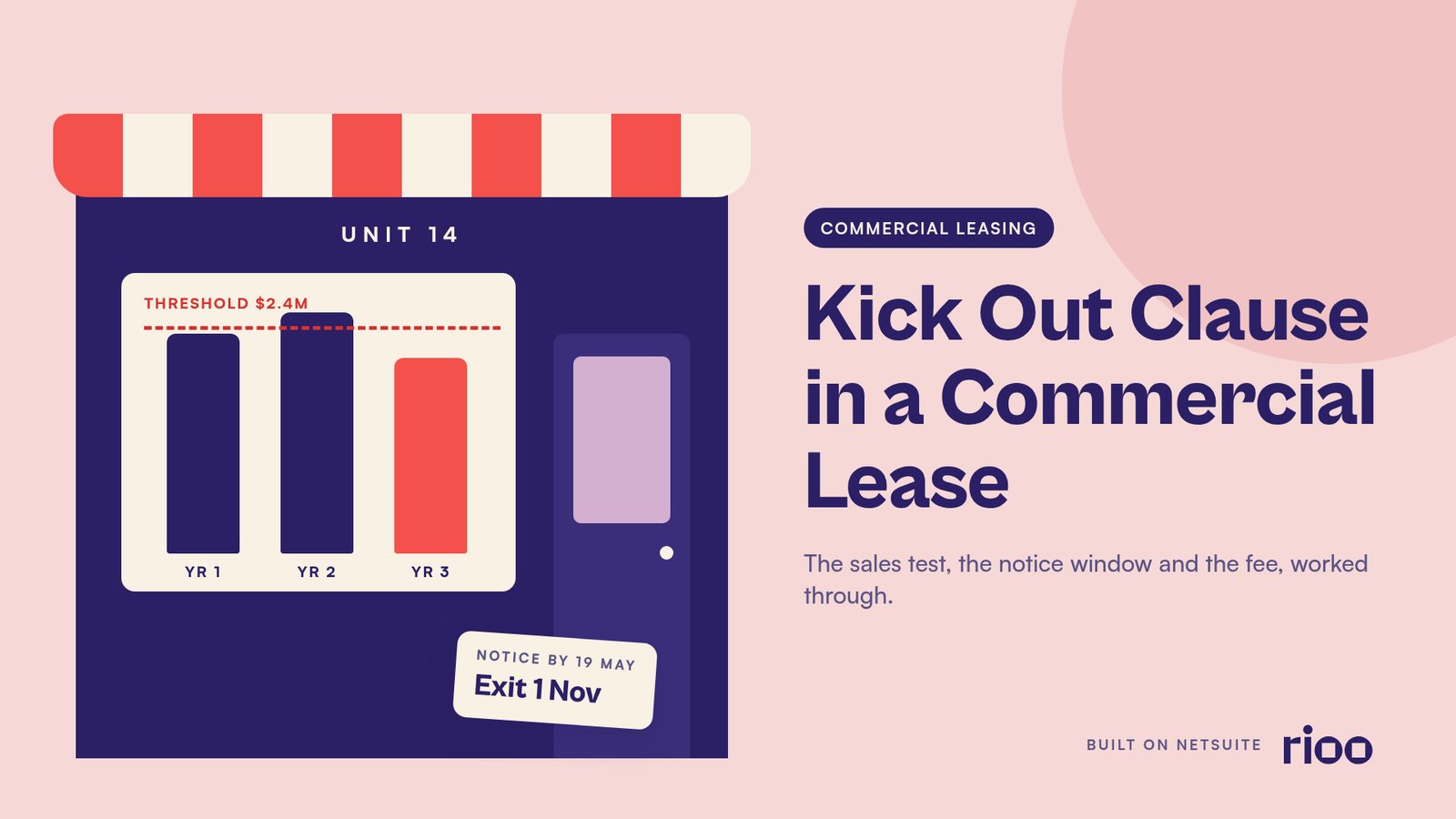
What happens when a new store never reaches the sales everyone expected at signing? Without a kick out clause, the tenant keeps paying rent for the full term, and the landlord keeps a weak store in a good space. With one, either side may have an agreed way out.
A kick out clause is a lease right that lets one party end a commercial lease early if a stated condition is met. In retail, the condition is usually sales. A tenant kick out lets the tenant leave if gross sales stay below a set figure over a set period. A landlord kick out lets the landlord take the space back on similar terms. A well drafted clause fixes the test, the notice window, the exit date and any fee, which leaves far less to argue about when the numbers come in.
Two kinds of kick out, side by side
The same name covers two rights that pull in opposite directions. Read which one you have before you read anything else in the clause.
| Tenant sales kick out | Landlord kick out | |
|---|---|---|
| Who can end the lease | The tenant | The landlord |
| Usual trigger | Gross sales below a threshold in a set lease year | Gross sales below a threshold, or a planned redevelopment |
| Why it is agreed | Tenant limits the risk of a new location | Landlord can replace a weak store, often where percentage rent matters |
| Who usually pays | Tenant pays a termination fee | Landlord may repay part of the tenant's unamortized build out |
| Common limits | One window, tenant open and not in default | Notice period long enough for the tenant to relocate |
Office and industrial leases have early termination options too. They tend to run on a date rather than on sales. This guide stays with the retail sales test, because that is where the arithmetic trips people up.
How the sales test is written
Four parts decide whether a kick out works the way both sides think it does.
The measurement period
The clause names a period, such as "the third full lease year." Partial first years cause trouble. If the store opened on 15 February, check whether lease year one ends on the anniversary or on the next 31 January. Write the answer into your abstract.
The threshold
The threshold is a gross sales figure, sometimes per square foot. It only means something if "gross sales" is defined the same way as in the percentage rent clause. Online orders picked up in store, returns, gift card sales and sales tax are the usual gaps. Our retail sales reporting guide covers how those statements are collected and checked.
The notice window
The right is usually open for a short time after the annual sales statement. Sixty or ninety days is typical. Miss it and the right lapses for good, or until the next test year if the lease allows a second one.
The fee
Landlords spend money to open a store. They pay for improvements, a leasing commission and sometimes free rent. The termination fee usually returns the part of that spend not yet recovered through rent, plus a few months of rent while the space is relet.
The Fernhill Square exit, dated and costed
This is a fictional example with simple numbers. Fernhill Square is a neighborhood shopping center.
A clothing tenant signs a ten year lease for Unit 14, 2,400 square feet, at $36.00 per square foot. Base rent is $86,400 a year, or $7,200 a month. The lease starts on 1 February 2023. The landlord pays $180,000 in tenant improvements and a $48,000 leasing commission.
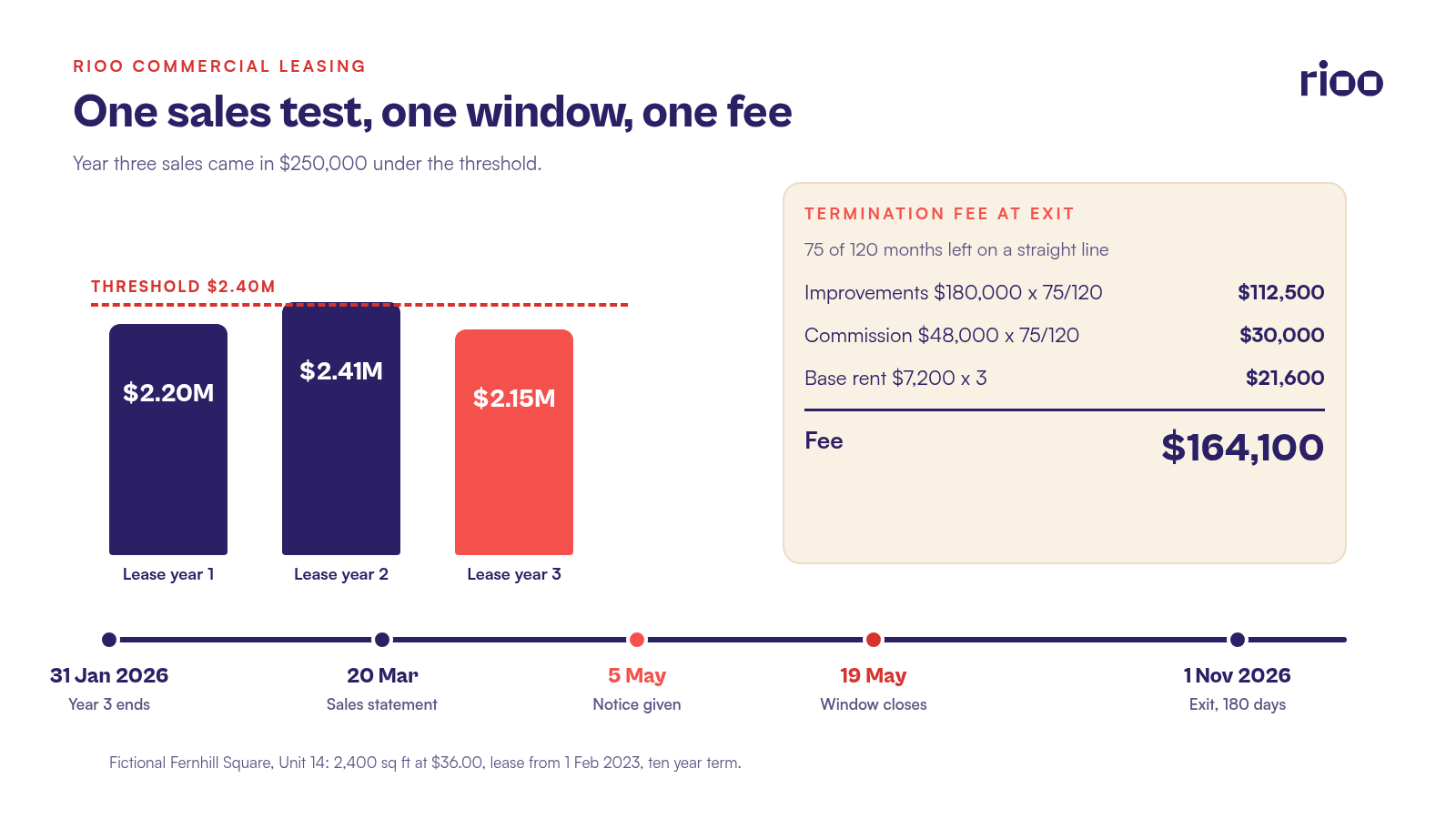
The kick out clause says this. If gross sales for lease year three are under $2,400,000, the tenant may terminate. Notice must be given within 60 days after it delivers the year three sales statement. Termination takes effect 180 days after notice. The fee is the unamortized improvements and commission, on a straight line over 120 months, plus three months of base rent.
Lease year three ends on 31 January 2026. The tenant reports gross sales of $2,150,000 on 20 March 2026. That is $250,000 under the threshold, so the right is open until 19 May.
The tenant's real estate manager emails on 5 May: "We are exercising the year three sales termination right under section 4.6. Please confirm the effective date and the fee." The effective date is 180 days later, 1 November 2026. By then, 45 of the 120 months have passed, so 75 months remain.
| Item | Working | Amount |
|---|---|---|
| Unamortized improvements | $180,000 x 75 / 120 | $112,500 |
| Unamortized commission | $48,000 x 75 / 120 | $30,000 |
| Three months of base rent | $7,200 x 3 | $21,600 |
| Termination fee | $164,100 |
Two questions come up at once. First, is the fee due with the notice or on the exit date? The clause should say. Second, does the tenant pay rent through October? Yes. Rent continues until the effective date unless the parties agree otherwise in writing.
Points to settle before you sign
Use this list whether you act for the landlord or the tenant. Each point closes a gap that tends to surface only at exercise.
- Same sales definition everywhere. Point the kick out test at the gross sales definition in the percentage rent clause, word for word.
- Certified statements. Require the year end statement to be certified by an officer, with the landlord's audit right applying to it.
- Open and operating. State that the tenant must have traded for the whole test year. A store that closed for eight weeks to refit should not count low sales from that gap.
- No default. Say whether the right falls away if the tenant is behind on rent when it gives notice.
- Guarantor release. Say whether a guarantee ends on the exit date or covers the fee too.
- Interaction with other clauses. A kick out can overlap with co tenancy remedies and with a continuous operation clause. Decide which one controls if two apply in the same year.
- Restoration. Confirm whether the tenant must remove its fixtures and restore the unit on exit.
Running the clause after signing
A kick out right lives for years before anyone uses it. Lease administration is what keeps it from becoming a surprise.
Put three dates in the critical date list on the day of signing
The end of the test year, the sales statement deadline and the last day of the notice window. Give each one a named owner on the landlord side.
Watch sales against the threshold every month
If monthly sales reporting shows the tenant tracking 10 percent under the threshold by month six of the test year, the asset manager should know then. Use the time to talk to the tenant about marketing, hours or a rent restructure. Waiting for the year end statement leaves no room to act.
Plan the accounting before notice arrives
Exercise changes the lease term. The fee, the remaining straight line rent balance and any unamortized improvement asset all need treatment. Our post on early lease termination fees and settlement accounting walks through the entries. Confirm the treatment with your accountant.
When the notice lands on your desk
Treat a kick out notice like any other option exercise. Check it against the lease before anyone replies with a view.
- Log the date received and how it arrived. Compare it with the notice clause, which may require courier or a named address.
- Check the window. Was the sales statement delivered, and is the notice inside the 60 days that follow it?
- Check the sales figure. Compare the certified statement with the monthly reports. If the gap looks odd, raise the audit right now, before the window closes on your side.
- Check the conditions. Open and operating for the full year, no default, any guarantor terms.
- Send a written confirmation of the effective date, the fee, the payment date and the restoration duties.
- Tell leasing the same day. 180 days is not long to find the next tenant for a retail space.
Where RIOO fits
RIOO commercial lease administration turns commercial leases into structured records on NetSuite, with abstracted terms, critical dates, options, escalations and recoveries. A kick out right can sit in that record as an option with its own notice window, next to renewals and break options. The same lease drives billing and lease accounting, so the termination date and fee do not have to be keyed in again by finance. In RIOO for malls and retail, percentage rent runs on the gross sales tenants report. Those same figures are on hand when a kick out threshold needs checking.
What landlords and tenants ask about kick outs
Is a kick out clause the same as a break clause?
They are close cousins. A break clause usually lets a party leave on a set date. A kick out clause usually depends on a condition, such as sales below a threshold.
Can a tenant use a kick out if sales are low because of road construction outside?
Only if the clause allows it or excludes that period. Some clauses adjust the test year for events outside the tenant's control. Many say nothing, and then the reported number decides.
Do landlords ever agree to a tenant kick out?
Yes, often for a new concept or a first store in a market. The fee and the single window are what make it acceptable to the landlord.
Does the landlord have to accept a late notice?
No. Notice windows are usually strict. A landlord may choose to accept a late notice, but should do it in writing so it does not reopen the right in later years.
What should a lease abstract record for a kick out?
Record who holds the right, the test period, the threshold and the sales definition used. Add the notice window, the effective date rule, the fee formula, any conditions and the section number.