On the morning after Christmas, the recycling bins at a 96 unit community are packed with 41 boxes that nobody flattened. Four bags sit on the ground because the bins are full. Somebody has left a mattress against the dumpster enclosure. The hauler will not take the mattress, and the overflow pickup costs extra.
Apartment trash rules prevent that morning, or at least make it rarer and cheaper. Good rules say what goes where, when it goes out, how bulk items are booked, and what happens when someone ignores the rules. Put them in the lease or the community rules, give residents a one page version at move in, and enforce them the same way for everyone. Fees should match a real cost, be written in the lease, and follow local law.
Six rules that cover nearly every complaint
Trash complaints repeat. Six short rules answer nearly all of them. Write each one so a resident can follow it without asking.
1. Bags go inside the bin, closed
Nothing on the floor of the trash room, beside the chute or next to the dumpster. If the bin is full, take the bag back and tell the office.
2. Boxes are flattened and go in recycling
One unflattened box fills a recycling bin. Say "flatten all boxes" in plain words and post it at the bin.
3. Nothing in hallways or on doorsteps
Bags left outside a door draw pests and block exits. Fire codes in many areas require clear corridors, so this rule protects residents as well as the carpet.
4. Chutes take small, tied bags only
No boxes, glass, hangers or loose items down a chute. A jammed chute can take a building's trash out of service for a day.
5. Bulk items are booked, never dumped
Furniture, mattresses, appliances and large electronics need a booked pickup. More on this below.
6. Hazardous items stay out
Paint, batteries, motor oil, propane cylinders and medical sharps go to a local drop off point. Give residents the address.
Keep the rules in the same voice as your other community rules, such as your quiet hours policy. Residents read a short, calm list. They skip a page of warnings.
Bulk items need their own path
Bulk items cause the largest bills. They also cause arguments, because nobody saw who left them.
Give residents a booking route
Offer a bulk pickup request through the resident portal or the office. Set a regular day, such as every second Tuesday, and a cut off time. Tell residents the cost before they book.
Price it at your cost
If your hauler or junk removal vendor charges $85 per item, charge the resident $85. A flat, published price is easier to defend than a fee that changes with the mood of the office.
Plan for move out season
Move out week is when mattresses and sofas pile up. Add a line to the move out instructions: book large items at least five days before the move date, or leave nothing behind. Items left in the unit after move out are a separate matter, handled through your abandoned property process and local law.
From a bag in the hallway to a fee
Enforcement works when every resident gets the same steps in the same order. Write the ladder down and follow it.
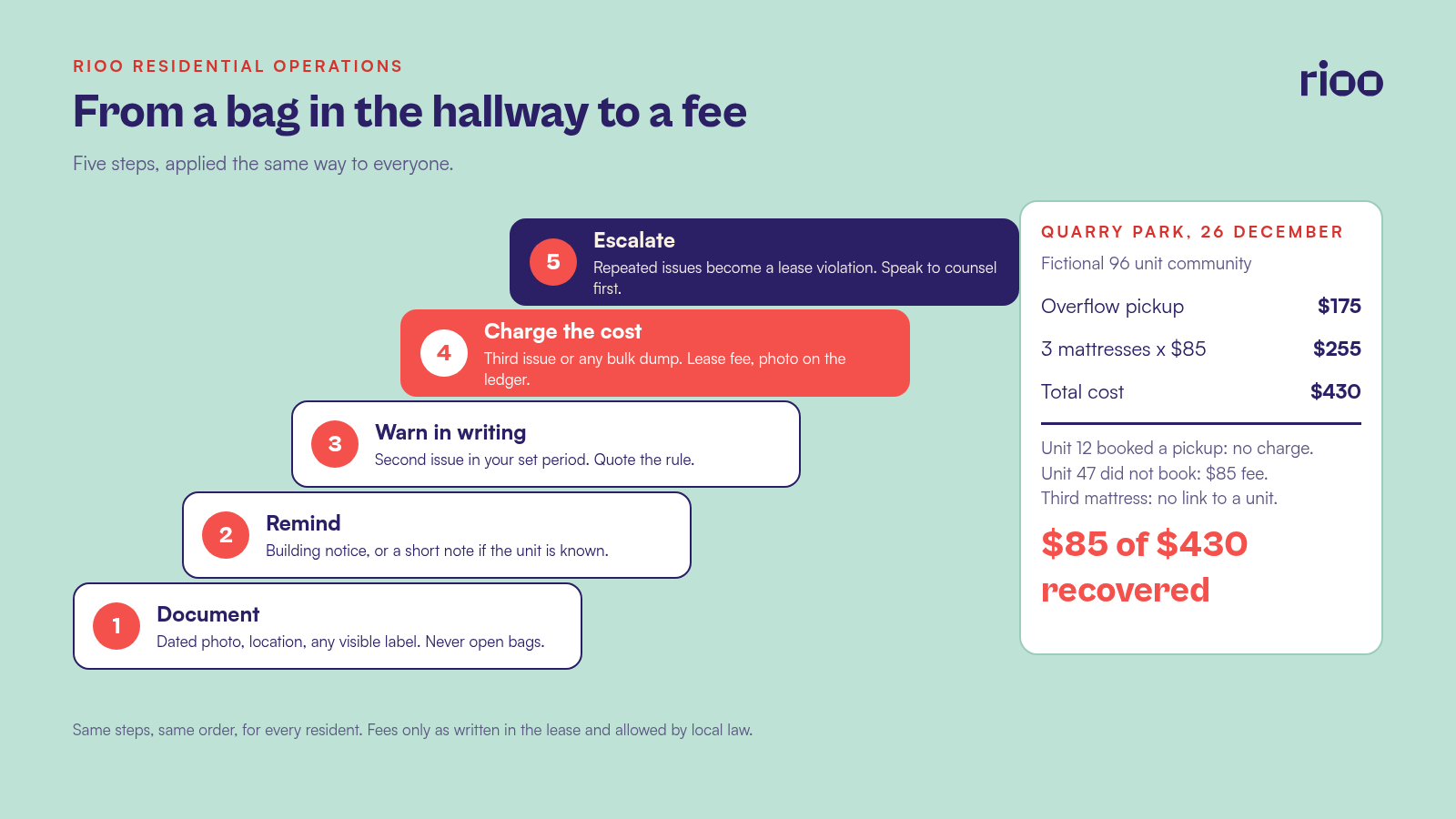
- Document. Take a dated photo. Note the location and any clue to the unit, such as a delivery label. Never open a bag to search it.
- Remind. For a first issue, send a friendly building wide reminder if you cannot link it to a unit. If you can, send a short note to that resident.
- Warn in writing. A second issue from the same unit within your set period gets a written warning that quotes the rule. Our lease violation warning letter guide has wording to adapt.
- Charge the cost. A third issue, or any bulk dump, gets the fee your lease allows, posted to the resident ledger with the photo attached.
- Escalate. Repeated issues become a lease violation matter. Talk to counsel before any notice that could lead to termination.
What one holiday weekend cost a 96 unit community
Here is a fictional example. Quarry Park is a 96 unit community with one dumpster enclosure and a recycling area. The hauler's contract includes two pickups a week. An extra overflow pickup costs $175. The bulk vendor charges $85 per item.
On Saturday, 26 December, the porter photographs the enclosure at 7:10 a.m. Three mattresses are leaning on the fence. The recycling bins are packed with whole boxes, and four bags sit on the ground. The community manager, Lena, books an overflow pickup for $175 and a bulk collection of three mattresses for $255. Total cost: $430.
Two of the mattresses lean against empty boxes from new mattress deliveries, with shipping labels for Unit 12 and Unit 47. The third has nothing near it. Lena checks the bulk booking list. Unit 12 had booked a pickup for Tuesday, 29 December, and put the mattress out three days early. Unit 47 had not booked at all.
She calls Unit 12 first. "You booked for Tuesday, which is great. The mattress just went out on Saturday, so we had to move it. There is no charge this time. Next time, please keep it inside until the morning of pickup." Unit 12 thanks her and cancels the Tuesday booking.
A box label alone is thin evidence for a charge, so Lena checks the enclosure camera, which the community's policy allows. The clip from Christmas night shows the mattress and the box arriving together from the Unit 47 stairwell. Unit 47 gets the posted $85 bulk fee on the ledger, with the photo and the clip noted. The resident disputes it by email: "That mattress was already there when I put mine out." Lena replies with the time on the clip. The fee stays.
The third mattress cannot be linked to anyone. Lena sends a building wide notice on Monday with the bulk booking link, the $85 price and a reminder to flatten boxes. Of $430 spent, $85 is recovered. The other $345, the overflow pickup, Unit 12's mattress and the unlinked one, goes to the property's operating costs. A month later, she reviews whether a second January pickup would cost less than the overflow calls.
Set up the trash room so the rules are easy to follow
Rules fail when the room works against them. Check four things on your next walk.
- Capacity. Count how often bins are full before pickup day. If it happens every week, the contract is too small, and no notice will fix that.
- Signs at eye level. Use pictures as well as words, and show the recycling items your hauler accepts.
- Light and a clear path. A dark enclosure with a heavy lid invites bags on the ground.
- A place to flatten boxes. In December, a clear table beside recycling saves a lot of whole boxes.
Fees that hold up
Trash fees are small, but they reach many residents. Keep them clean.
- Put the fee in the lease or the rules residents signed. A fee invented after the fact invites a dispute.
- Match the fee to a real cost. Keep the vendor invoice with the charge.
- Check local law. Some states and cities limit the fees landlords can charge, or require them to be disclosed in a set way. Confirm with counsel before adding a new fee.
- Apply the same ladder to everyone. Uneven enforcement is a fair housing risk, even for trash.
- Allow for accommodations. A resident with a disability may not be able to carry bags to a far enclosure. That is a reasonable accommodation request, and the answer might be a closer bin or a pickup at the door. Follow your reasonable accommodation process.
If you offer door to door trash collection for a monthly fee, treat it as an amenity charge. Our guide to amenity billing in multifamily covers how to bill and disclose it.
Where RIOO fits in community rules
RIOO keeps the pieces of a trash problem on the same records. Residents can request a bulk pickup through the tenant portal, and that request becomes a tracked task or work order on the unit. When a cleanup is billed back, the approved work order cost becomes a charge on the lease, with the work order and photos attached as evidence. RIOO tenant communication tools send building notices and individual reminders, and each message stays tied to the lease and unit. When a resident disputes a charge, the photo, the warning and the reply are in one place.
What residents and site staff ask about trash
Can a landlord charge a tenant for leaving trash in the hallway?
Often yes, if the lease or community rules include the fee and local law allows it. Keep the charge tied to a real cost and keep the photo.
Who pays for bulk items a resident dumps on the way out?
The departing resident, usually through the move out statement, if your lease and local deposit rules allow the deduction. Itemize it with the vendor cost.
Can we search trash bags to find out who left them?
Avoid it. It raises privacy concerns and staff safety risks. Use labels that are visible from outside, booking records and camera footage where your policy allows.
How often should we remind residents about trash rules?
At move in, before the holidays and before move out season. Short reminders at those three points do more than a long notice once a year.
Should trash rules differ for townhomes with their own carts?
Yes. Add cart placement, pickup day and when carts must come back from the curb. Many towns set those times, so check the local rules.