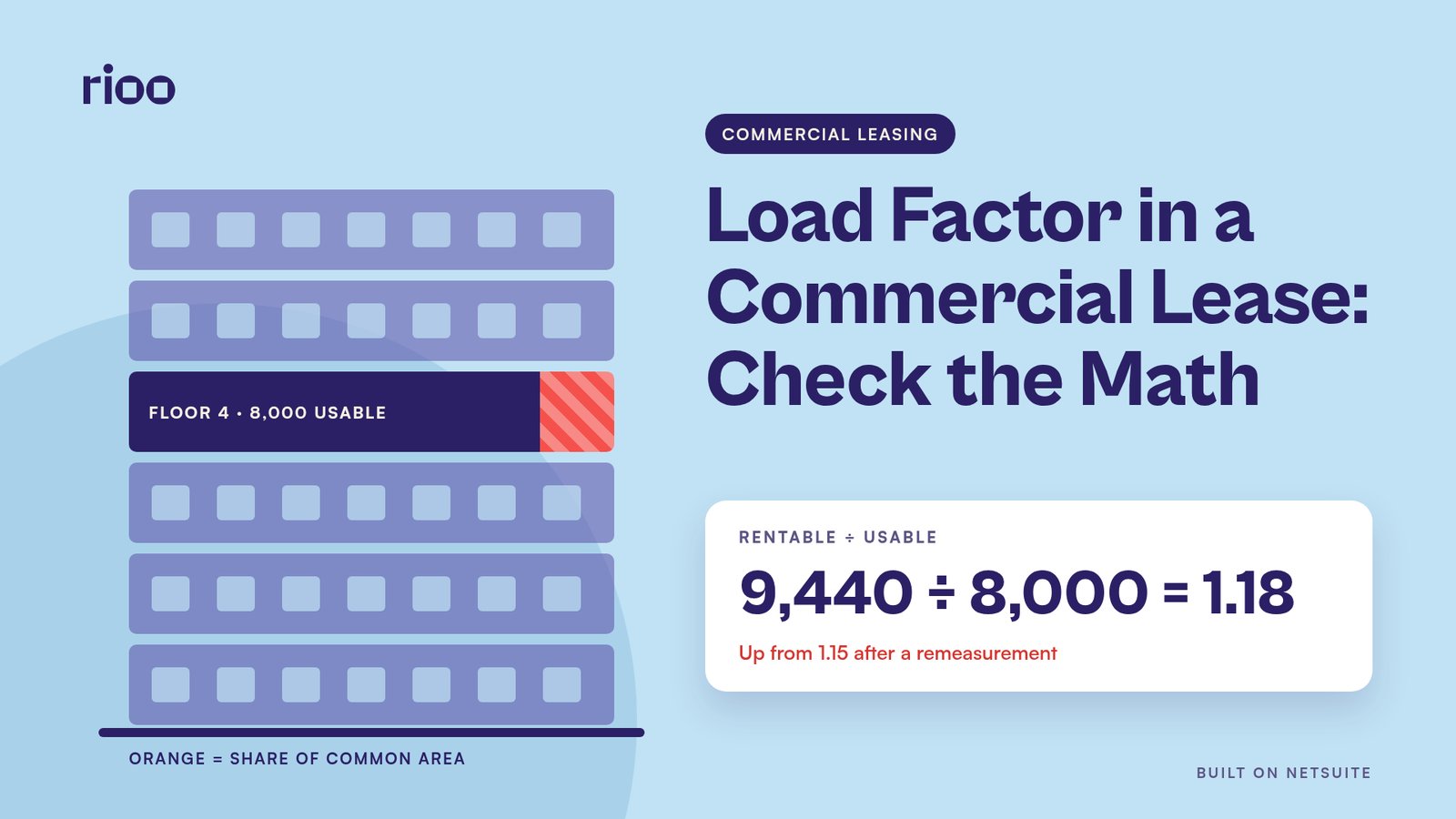
Two office tenants on the same floor can pay the same rent per square foot and still pay for very different amounts of space. The gap sits in one number that few people look at again after the lease is signed. That number is the load factor.
Load factor is the ratio of rentable square feet to usable square feet. You find it by dividing rentable area by usable area. A load factor of 1.15 means a tenant pays rent on 15 percent more area than it occupies. That extra share covers its part of lobbies, corridors, restrooms and other common areas. Rentable area then drives base rent and, in many leases, the tenant's share of operating costs. My view is simple. Check the load factor at every renewal and after any remeasurement, because the number moves and small changes cost real money.
The math, in three lines
Every load factor question comes back to the same two areas. Usable area is the space a tenant occupies on its own. Rentable area is usable area plus a share of the common space.
Floor load factor
On a floor with several tenants, the shared corridor, restrooms and elevator lobby on that floor are divided among them. A tenant that takes the whole floor uses the corridor as its own space, so its floor share is smaller.
Floor load factor = floor rentable area ÷ floor usable area.
Building load factor
The main lobby, loading dock, mail room and shared amenity space serve the whole building. Their area is spread across every floor.
Building load factor = building rentable area ÷ building usable area.
Turning usable into rentable
Rentable area = usable area × load factor. A tenant with 8,000 usable square feet and a load factor of 1.15 leases 9,200 rentable square feet. At $34.00 per rentable square foot a year, base rent is $312,800.
Some markets quote a loss factor instead. It shows the share of rentable area a tenant cannot occupy. The formula is 1 minus usable ÷ rentable. A 1.15 load factor equals a loss factor of about 13 percent. Same building, different way of saying it.
Why the number drifts after signing
A load factor is a measurement of a building at one point in time. Buildings change. These are the changes that push it up or down.
A floor goes from one tenant to several. A new corridor turns usable space into common space. The tenants left on that floor now share more common area.
The building adds an amenity. A fitness room, a tenant lounge or a conference center is often measured as shared space. Everyone's share of building common area rises.
The lobby or the ground floor is rebuilt. A bigger lobby or a new bike room changes the building common area. A smaller one changes it the other way.
The building is remeasured under a newer standard. Measurement standards are updated from time to time. A newer version can count some spaces differently, so the same walls give different numbers.
The records disagree. The lease says 9,200 square feet. The rent roll says 9,150. The operating cost schedule uses 9,240. Nobody notices until a tenant's auditor asks.
That last one is easy to avoid. It is also the first thing worth checking when you take over a building.
A worked example: Harbor Point at renewal
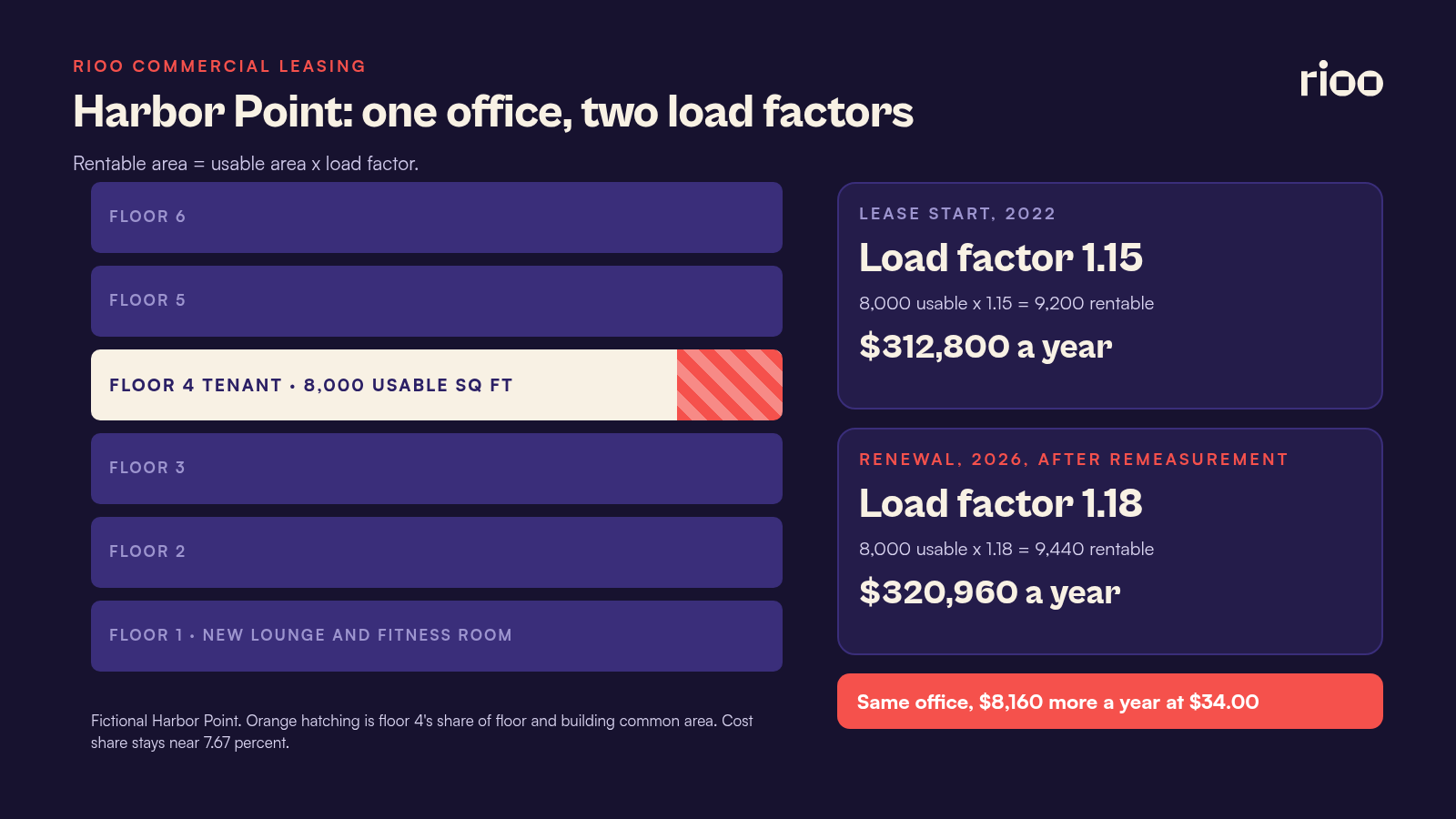
This is a fictional example. Harbor Point is a six floor office building. The tenant on floor 4 has 8,000 usable square feet. Its lease started in 2022 with a load factor of 1.15, so it pays on 9,200 rentable square feet at $34.00. Base rent is $312,800 a year. Its pro rata share of operating costs is 9,200 ÷ 120,000, or 7.67 percent.
In 2025 the owner converted part of the ground floor into a tenant lounge and fitness room. A new measurement put the building load factor at 1.18. Building rentable area rose to 123,130 square feet.
The renewal proposal goes out in November 2026. It shows the tenant on 9,440 rentable square feet. At the same $34.00, base rent becomes $320,960. That is $8,160 more a year, or $40,800 over a five year term, for the same office.
The cost share barely moves. It is 9,440 ÷ 123,130, which is still about 7.67 percent. Every tenant's rentable area rose by the same proportion. So the tenant's share of costs stays flat, while its base rent goes up by the full amount.
The tenant's finance director calls the same week.
"Our office has not changed. Why are we paying for 240 more square feet?"
"The building was remeasured after the lounge and fitness room opened. Your share of common space went up, and that shows in rentable area. I can send you the measurement summary and the floor plan."
"Our lease says rentable area is fixed at 9,200 for the term."
"For the current term, yes. That clause ends with the term. The renewal is where the new figure applies. Let's talk about it before you decide."
Now the landlord has a choice. It can hold the new area and the same rate. It can keep the area at 9,200 for the renewal. Or it can use the new area and drop the rate to about $33.14, which keeps rent close to $312,800. The right answer depends on the market. What matters is that the manager saw the number before the tenant did.
What to check before every renewal
None of this takes long. It takes a habit.
- The area clause. Is rentable area stated as a fixed figure for the term, or is it subject to remeasurement? Does that carry into renewal options?
- The measurement standard named in the lease. If the building was remeasured under a newer version, note it in the renewal file.
- Floor or building factor. A tenant moving from a full floor to part of a floor will see a different factor. Explain it before the proposal goes out.
- One area figure everywhere. The lease, the rent roll, the cost schedule and the abstract should agree. Our lease abstraction checklist lists where area belongs in the abstract.
- The cost base. If the lease has a base year or expense stop, a change in area changes the math. Our post on the expense stop lease shows how the stop is calculated.
- Occupancy adjustments. If costs are grossed up for occupancy, check that the gross up uses the current building area. See our CAM gross up example.
- The date of the last measurement. If nobody knows, that is worth finding out.
When remeasuring is the wrong move
A higher load factor can cost a landlord more than it earns.
In a soft leasing market, tenants compare buildings on total cost. A renewal that rises by $8,160 for no visible change can push a tenant to look elsewhere. A vacancy on a 9,200 square foot floor costs far more than $8,160 a year.
Fixed area clauses also mean the gain arrives slowly. If every lease states its area for the term, a remeasurement changes nothing until each lease renews. In the meantime, two tenants with the same office may pay on different figures. That is hard to explain.
So remeasure when the building changes in a real way. Apply the result at renewal, show the tenant the drawings, and be ready to discuss the rate. Make it part of the renewal conversation from the first call.
Where RIOO fits
RIOO commercial lease administration keeps the lease terms that drive billing in one place. On each lease, RIOO tracks the premises and suites, the term and critical dates, rent steps, and recoveries and shares. Because RIOO is built natively on Oracle NetSuite, lease billing posts to the same ledger your finance team uses. The rent roll and the recovery schedule then read from the same lease record, which is the easiest way to keep one area figure everywhere.
Load factor questions
Is load factor the same as add on factor?
They describe the same thing. Load factor is usually quoted as a ratio, such as 1.15. Add on factor and core factor are often quoted as the extra percentage, such as 15 percent. Loss factor is related but expressed the other way, as the share of rentable area that is not usable.
Is the load factor negotiable?
The measurement itself is a fact about the building. What you can negotiate is how it is used. A tenant can ask for a fixed rentable area for the term and any renewals. It can ask for a cap on increases from remeasurement, or a lower rate to offset a higher area.
Does load factor apply to retail and industrial leases?
Less often. Single tenant industrial buildings are usually leased on the building's area, with little shared space. Retail centers often bill on the tenant's own floor area, and spread common area costs through recoveries instead.
Who measures the building?
Owners usually hire an architect or a measurement firm. The firm states which standard and version it used. Keep that report with the lease files, because tenants and buyers will ask for it.
Why do full floor tenants have lower load factors?
A full floor tenant uses the corridor and elevator lobby on its floor as its own space. On a shared floor, those areas are common, so each tenant carries a share of them.
Pull the area figure from four places for each tenant renewing next year, and see whether they match.