$2,180 of damage claims. A $1,650 deposit. A $530 balance sent to a former resident who now disputes a plumbing bill from eight months ago. That is what holding every damage charge until move out tends to produce.
The right time to bill a tenant for damage is soon after the repair closes, while the lease is still running. Post the charge to the tenant ledger within days of the work order closing, with the photos and the vendor invoice attached. Give the resident a due date and a way to dispute it. The deposit then stays whole for what you find at move out. The charge has to be for damage the resident caused beyond normal wear, the lease has to allow it, and local rules on fees and notices still apply.
The deposit is a poor place to collect a year of damage
A security deposit has one job at the end of a lease: cover unpaid rent and damage found at move out. Many teams treat it as a savings account for every incident during the tenancy too. The trouble is arithmetic. A deposit of one month's rent rarely covers a year of small incidents plus the move out findings.
It also turns small amounts into one large one. A resident who would pay a $240 plumber charge in June will often fight a $2,180 itemized list in March. Every line on that list is now months old, and the resident has moved on.
The owner loses too. When repairs are paid from operating cash and recovered only at move out, the owner carries those costs for months. On an owner statement, that shows up as repair expense with no matching recovery until the lease ends, if it ever does.
One unit, two ways to bill
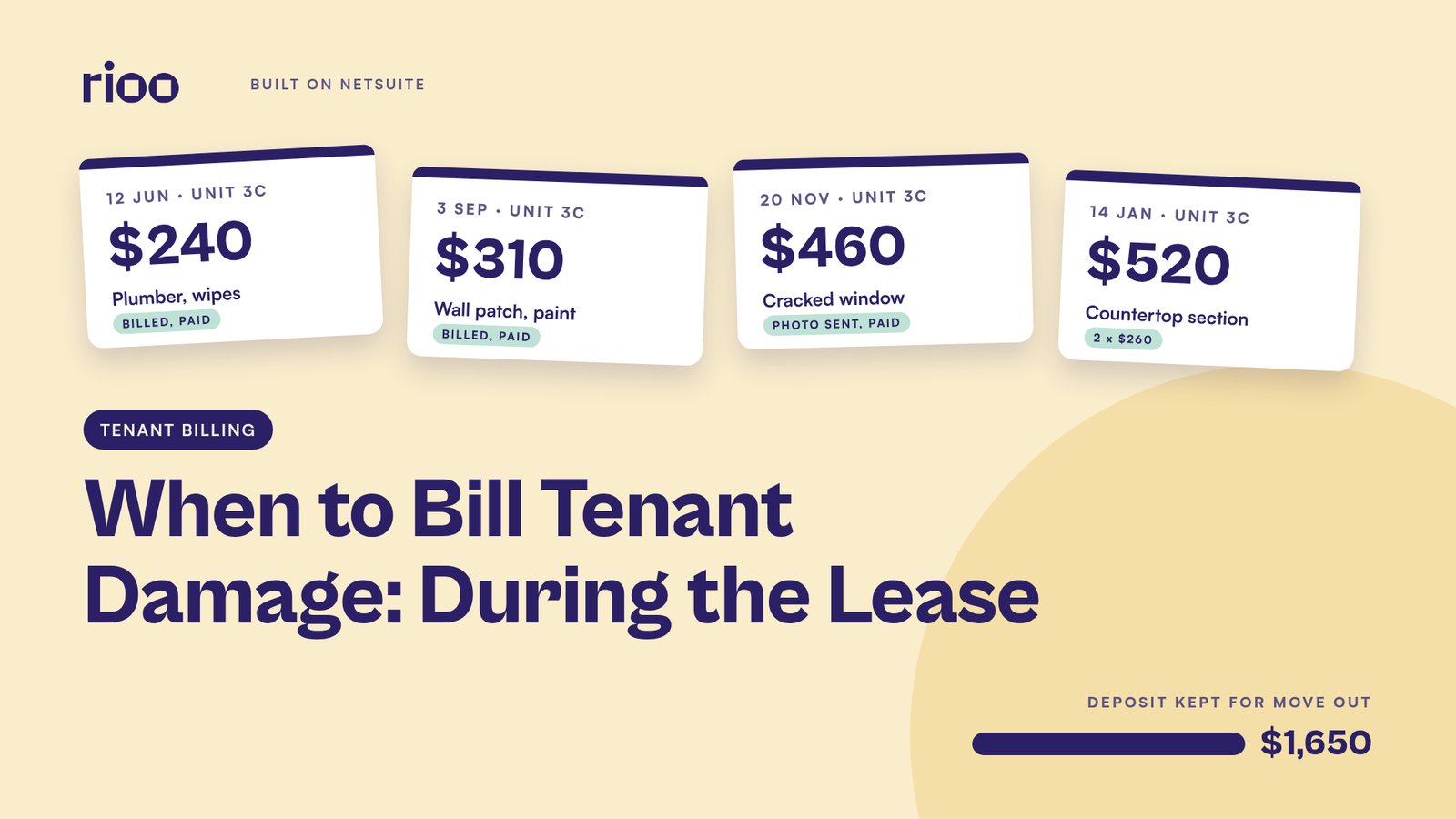
This is a fictional example. Unit 3C sits in a 64 unit building. The lease runs from 1 March 2025 to 28 February 2026, rent is $1,650 a month and the deposit is $1,650. Four incidents caused by the resident are repaired during the year. The move out inspection then finds carpet staining beyond normal wear.
| Date | Incident | Repair cost |
|---|---|---|
| 12 June 2025 | Toilet blocked by wipes, plumber visit | $240 |
| 3 Sept 2025 | Hole in hallway wall from a door handle, patch and paint | $310 |
| 20 Nov 2025 | Cracked bedroom window pane | $460 |
| 14 Jan 2026 | Burn mark through the kitchen countertop laminate, section replaced | $520 |
| 28 Feb 2026 | Move out: carpet staining beyond normal wear, prorated by carpet age | $650 |
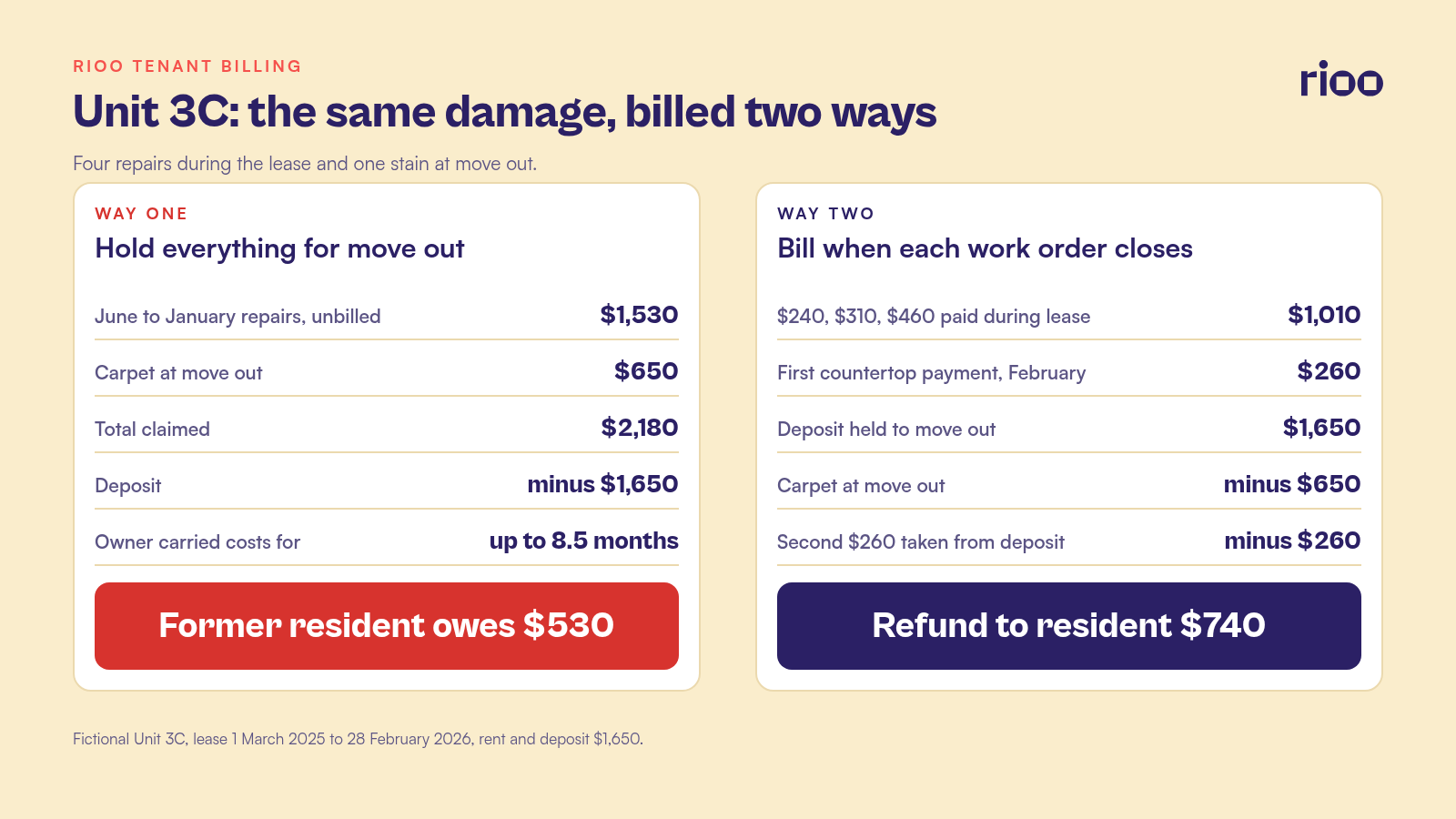
The four incidents during the lease add up to $1,530. With the carpet, the total is $2,180.
Way one: hold it all for move out
Nothing is billed during the year. At move out the team itemizes all five items against the deposit. $2,180 minus $1,650 leaves $530 owed by a resident who has already left. The resident disputes the June plumbing charge because nobody mentioned it at the time. The owner carried the $1,530 for between six weeks and eight and a half months.
Way two: bill each charge when the work order closes
Each repair is billed within a week of the work order closing, with photos and the invoice. The resident pays the $240 and the $310 with the next month's rent. The $460 window charge is questioned, so the manager sends the photo taken on the day and the resident pays it. The $520 countertop charge is split into two payments of $260 for February and March.
At move out, the only new item is the carpet. The second $260 countertop payment fell due in March, after the lease ended, so the resident agreed in writing that it could come from the deposit. $1,650 minus $650 minus $260 leaves a $740 refund. Nobody is chasing a former resident.
Same unit, same damage. Way two ends with a refund going out instead of a balance going to collections.
What billing at work order close changes
The evidence is fresh. The photo, the technician's note and the invoice exist on the day the charge is raised. The resident remembers the incident. A charge that arrives with a photo from last Tuesday is hard to argue with.
The amounts stay small. A resident can absorb $240 next month. A charge sized to one repair is easier to pay than a stack of them, and a payment plan for one larger item is simple to set up.
The resident learns the cost while living there. A second wipes blockage is less likely after the first bill. That is a better outcome for the building than any line in a move out letter.
The owner's books match reality. Repair expense and the tenant recovery land in the same month or close to it. Our guide to work order closeout covers the record each job needs before a charge can be raised from it.
Damage chargebacks in RIOO
RIOO links each vendor bill to its work order and posts the cost to the property's books in NetSuite. In RIOO work order management, chargebacks to tenants land on the tenant ledger. So for Unit 3C, the $460 window shows as a repair cost on the property. A matching charge sits on the resident's ledger, and both trace to the same job.
Because the charge sits on the same ledger as rent, it shows up next to the rent the resident already pays. The repair cost and the recovery point to one job, which is what an owner or auditor will ask to see.
Billing fast does not lower the bar for evidence
A quick charge needs the same file as a slow one. That means the lease clause, proof the damage goes beyond normal wear, dated photos, the real invoice and a written notice. Our guide to recovering billable maintenance costs from tenants sets out that chain and how to price a replaced item by its age. For borderline items, normal wear and tear vs damage gives examples on both sides.
What changes with speed is the notice. Send it within the week, and say plainly that the resident can question the charge and how. Treat two residents with the same damage the same way.
Some states and cities limit the fees a landlord can charge or set notice rules for charges outside rent. Some leases also say unpaid charges count as rent and others say they do not, which changes what a missed payment means. Have counsel check your lease wording for each state you operate in.
Where mid lease billing goes wrong
Billing for wear. Faded paint after three years and worn carpet in a hallway are the owner's cost. Charging for them invites disputes and can break deposit rules.
Billing without notice. A charge that appears on the ledger with no explanation reads like a mistake or worse. Send the notice before or with the charge.
Applying payments in the wrong order. If the resident's next payment goes to the damage charge first, rent can look late. Check how your lease and state law say payments must be applied.
Letting disputed charges sit. If a resident disputes a charge, answer within a set number of days. If you cannot support it, reverse it. An old disputed charge that ends up in a write off helps nobody. Our post on tenant bad debt write off covers what happens when balances are not collected.
Escalating too fast. A damage charge is not a lease violation by default. A formal lease violation letter fits repeated damage or a refusal to pay. A first charge needs a clear bill.
Answers for owners and residents
Can a landlord charge a tenant for damage during the lease?
Generally yes, when the lease makes the tenant responsible for damage they cause beyond normal wear. The charge should match the actual repair cost and come with a written explanation. Local rules on fees and notices apply, so check them.
Can the deposit be used for damage during the lease?
Only if the lease and local law allow it, and many leases then require the tenant to top the deposit back up. Billing the charge separately is usually cleaner, because it keeps the deposit whole for move out.
How soon should a damage charge be billed?
Set a rule and keep it, such as within seven days of the work order closing. The shorter the gap, the easier the charge is to explain and support.
Who keeps the money from a damage charge?
The property that paid for the repair. Post the recovery against the same repair cost, or to a tenant recovery income account the owner has agreed. The owner statement then shows the cost and the recovery side by side. A management company keeps none of it unless the management agreement says otherwise.
What if the tenant refuses to pay a damage charge?
Share the evidence again and offer a short payment plan if cost is the issue. If they still refuse, follow your lease process. Unpaid charges can be claimed against the deposit at move out within the state's itemization rules.
A rule to adopt this month
Write one sentence into your operating policy: tenant caused damage is billed within seven days of the work order closing, with photo and invoice attached. Then review last quarter's repair spend. Count how many jobs had a tenant cause noted and no charge raised. That count is your starting point.