Two units at a fictional building called Ashgrove Terrace share a floor plan, a view and a hallway. Unit 204 still has its 1988 kitchen and rents for $1,495. Unit 206 was renovated last spring and rents for $1,635. The owner's pro forma had promised $1,695. That $60 gap is where renovation plans go wrong.
Apartment renovation ROI is the yearly rent premium a renovation earns, divided by everything the renovation cost, including the rent lost while the unit sat empty. A sound program tests the premium on a small batch of units before committing the whole building. It then cuts any part of the scope residents will not pay for. If the return on cost clears the owner's target, you scale. If it does not, you change the scope before you spend more.
Why the pro forma usually looks better than the building
A renovation budget starts as a spreadsheet. Someone picks a premium from a few listings nearby. Someone else prices a kitchen, floors and lighting. The two numbers meet in a return on cost cell, and that cell drives the decision.
The trouble is that each input is a guess made before a single resident has seen the finished unit. The premium comes from listings, which show asking rents, not signed leases. The cost leaves out the vacant days. The scope reflects what the asset team likes, which may differ from what renters in that submarket value.
In many investment committee decks, the premium is the least questioned number on the page. It deserves the hardest look, because the whole return rests on it. A $60 miss on a $200 premium cuts the return by almost a third.
Assumption one: the premium renters will pay
The premium is the extra monthly rent a renovated unit earns over an unrenovated twin. Measure it from signed leases, not asking rents. Compare like with like: same floor plan, similar floor, signed within the same season.
Two habits keep the number honest. First, keep a few unrenovated units on the market at the same time as the renovated ones. That gives you a live control group. Second, record any concession given on each lease. A renovated unit leased at $1,695 with two weeks free averages about $1,625 a month over twelve months.
Our guide to loss to lease covers how to compare market rent with what each unit actually brings in. The same discipline applies here.
Assumption two: the vacant days
A standard turn might take seven days. A full interior renovation can take three or four weeks on top of that. Every extra day is rent you never collect, and it belongs in the cost of the project.
At Ashgrove Terrace the full scope added 18 days to each turn. At $1,495 a month, that is about $897 of lost rent per unit. On a $14,000 scope it adds over 6 percent to the true cost. Owners often leave it out because it shows up as vacancy in the operating report instead of as a line in the capital budget.
Track renovation days separately from normal turn days. Where the vacant days go explains how to split a turn into stages so the renovation stage is visible.
Assumption three: the scope
Not every item earns rent. Residents in one market may pay for an in unit washer and ignore stone counters. In another, new flooring and better lighting do the heavy lifting. You only find out by testing different scopes on different units.
A practical split is a full scope and a light scope. The full scope at Ashgrove Terrace included quartz counters, new cabinet fronts, plank flooring, stainless appliances, lighting and fixtures. The light scope kept the existing cabinets and laminate counters but did the rest. It cost $10,500 against $14,000 and took about ten extra days instead of eighteen.
Assumption four: what happens at renewal
The premium keeps paying only if residents renew at it. A unit that leases at a high premium and then turns over every year carries extra turn costs that eat the gain.
Watch renewal rates on renovated units for at least one cycle. If they lag the unrenovated units, the premium may be too high for that floor plan. Renewal pricing against turnover cost walks through that trade.
The Ashgrove Terrace pilot in numbers
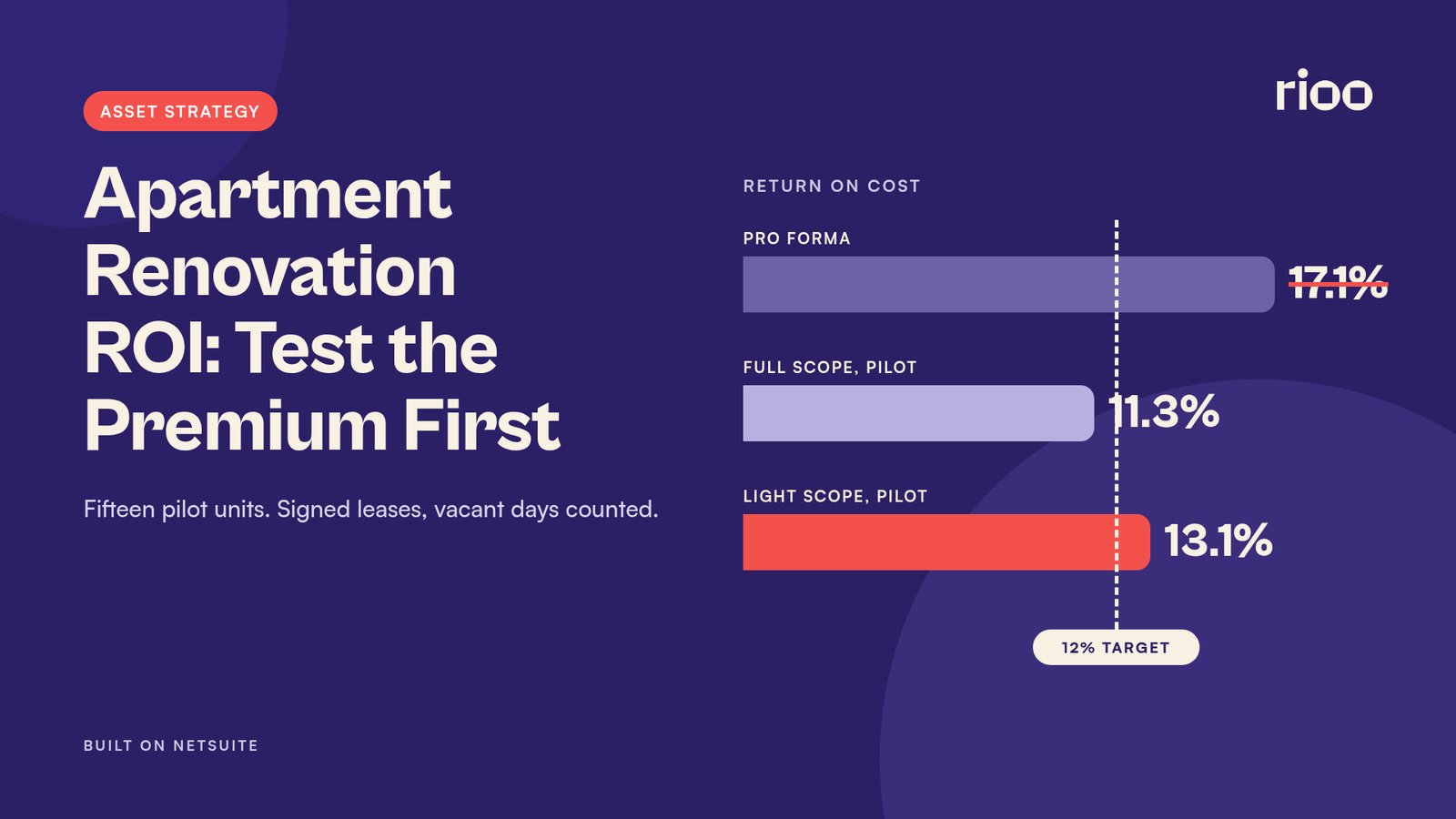
This is a fictional example with rounded figures. Ashgrove Terrace has 84 two bedroom units built in 1988. The owner's target is a 12 percent return on cost. The pro forma assumed a $200 premium on a $14,000 full scope, which would return 17.1 percent and pay back in under six years.
Instead of renovating all 84 units, the asset team ran a pilot. Ten units got the full scope and five got the light scope, all as they came up for turnover between March and July. Four unrenovated twins leased in the same months as a control.
| Measure | Pro forma | Full scope, pilot | Light scope, pilot |
|---|---|---|---|
| Scope cost per unit | $14,000 | $14,000 | $10,500 |
| Extra vacant days | Not counted | 18 | 10 |
| Lost rent per unit | Not counted | $897 | $498 |
| True cost per unit | $14,000 | $14,900 | $11,000 |
| Monthly premium on signed leases | $200 | $140 | $120 |
| Yearly premium | $2,400 | $1,680 | $1,440 |
| Return on cost | 17.1% | 11.3% | 13.1% |
| Payback | 5.8 years | 8.9 years | 7.6 years |
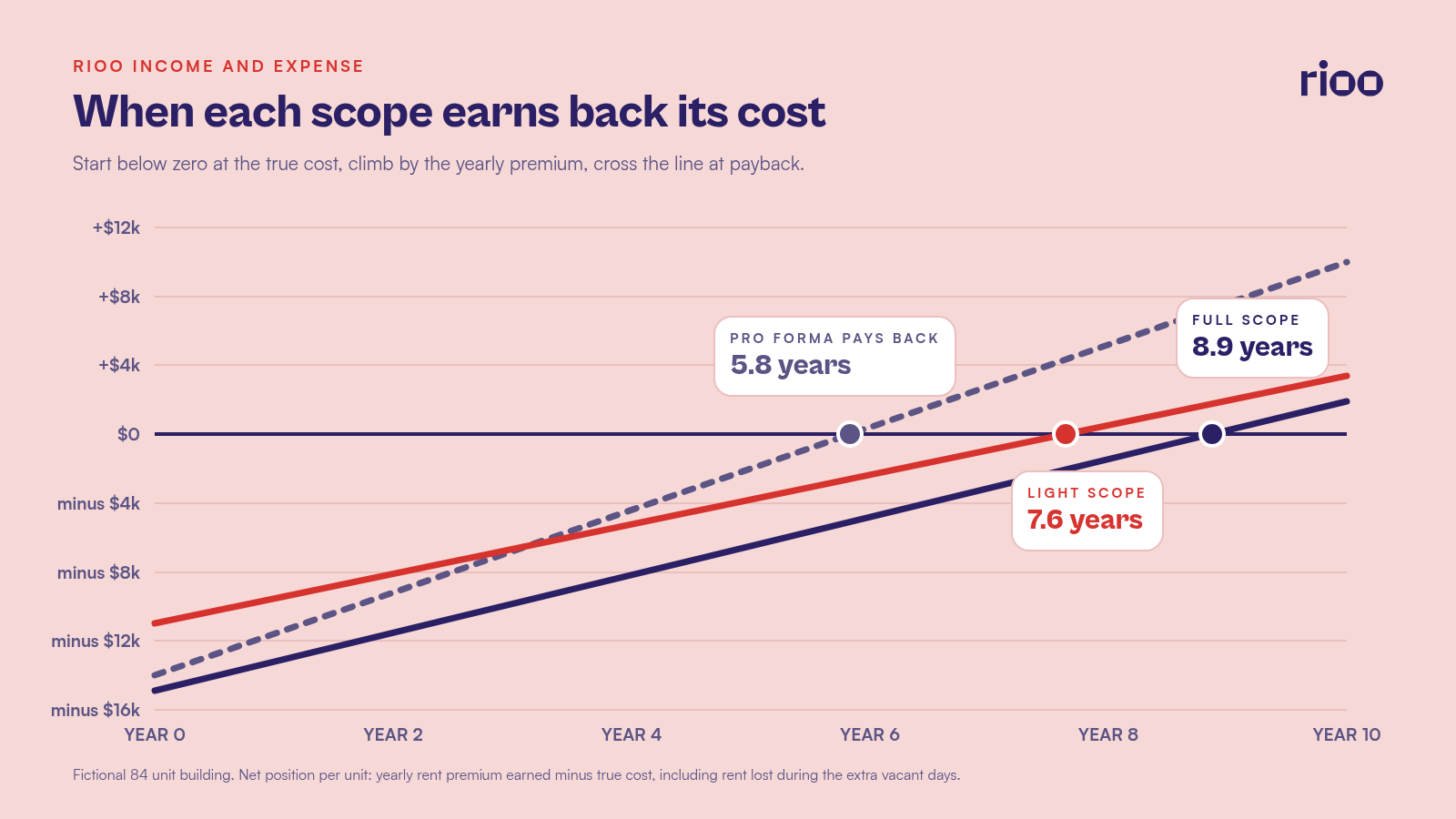
The full scope earned more rent per unit. It still missed the 12 percent target, because the last $3,500 of spending added only $20 a month. The light scope cleared the target with room to spare.
What the owner did next
The team rolled out the light scope across the next 40 turnovers. They kept quartz as an option for the eight corner units, where the pilot showed a stronger premium. They set a check after another 20 leases to confirm the $120 held through the winter leasing season.
How value fits into the decision
Buyers and lenders value a building on its income. At a 6 percent cap rate, $1,440 a year of extra net income adds roughly $24,000 to the value of each unit, if operating costs stay flat. That math is real, but it assumes the premium holds and that vacancy and turnover do not rise. Value creation is a reason to renovate. It is a poor reason to skip the pilot.
When to leave the units alone
Some buildings should not run a value add program at all. If the submarket has a wave of new supply opening in the next year, renovated units will compete with brand new ones on concessions. The premium you measure in spring may not survive the summer.
Look at the gap between your unrenovated rent and the nearest newer buildings. If it is small, there is little room for a premium. Spending the money on deferred maintenance, roofs or energy work may protect income better.
Also check the debt. A loan with a near maturity date may need the cash more than the units need counters. Talk to the lender before you commit capital that the refinance might count on.
A decision rule you can use at the next budget meeting
Write the rule down before the pilot starts, so nobody moves the goalposts afterwards.
- Renovate a pilot batch of 10 to 15 units, with at least two scopes.
- Keep three or four unrenovated twins leasing in the same window.
- Count the premium from signed leases, net of concessions.
- Add the renovation days to the cost at the unit's current rent.
- Scale the scope that clears the target. Drop or redesign the one that does not.
- Review again after the first renewal cycle on the renovated units.
If the renovation is largely a capital replacement of worn items, treat it as such. A 30 year old water heater has to be replaced whatever the premium. Our article on repairs versus improvements explains how that line affects the books.
Renovation questions owners raise
What is a good return on cost for an apartment renovation?
It depends on the owner's cost of capital and the risk in the market. Many owners set a target somewhere around 10 to 15 percent for interior upgrades. Set your own number before the pilot and judge every scope against it.
How many units should a renovation pilot include?
Enough to see a pattern without betting the building. Ten to fifteen units across two scopes is a workable start for a building of 100 or more. Smaller buildings can pilot three to five units and lean harder on the control group.
Should we renovate occupied units or wait for turnover?
Waiting for turnover is simpler and avoids disruption. Renovating at turnover also means the vacant days are already partly there. Renovating occupied units means entry notices, working around the resident and sometimes a temporary move. Some cities regulate that, so check local rules first.
How do we measure the premium if rents are rising anyway?
Use the control group. If unrenovated twins rose by $40 over the same period, only the difference above that belongs to the renovation.
Does the renovation premium change the property tax bill?
It can. Higher income and visible improvements may lead to a higher assessment in some places. Include an estimate in the pilot math and check with your tax adviser.
Tracking renovation returns in RIOO
A pilot is only as good as its records. RIOO keeps units, leases and charges as native records in the owner's NetSuite account. Each unit has its own record, so you can note which scope it received and report signed rent by unit against the unrenovated twins.
Renovation spend can be booked through vendor bills and work orders against the property and unit. NetSuite fixed assets and depreciation sit in the same ledger, so the capital side of the project and the rent it earns are reported together. Income and expense management shows how revenue and cost are classified by property, building and unit, which is what a return on cost report needs.