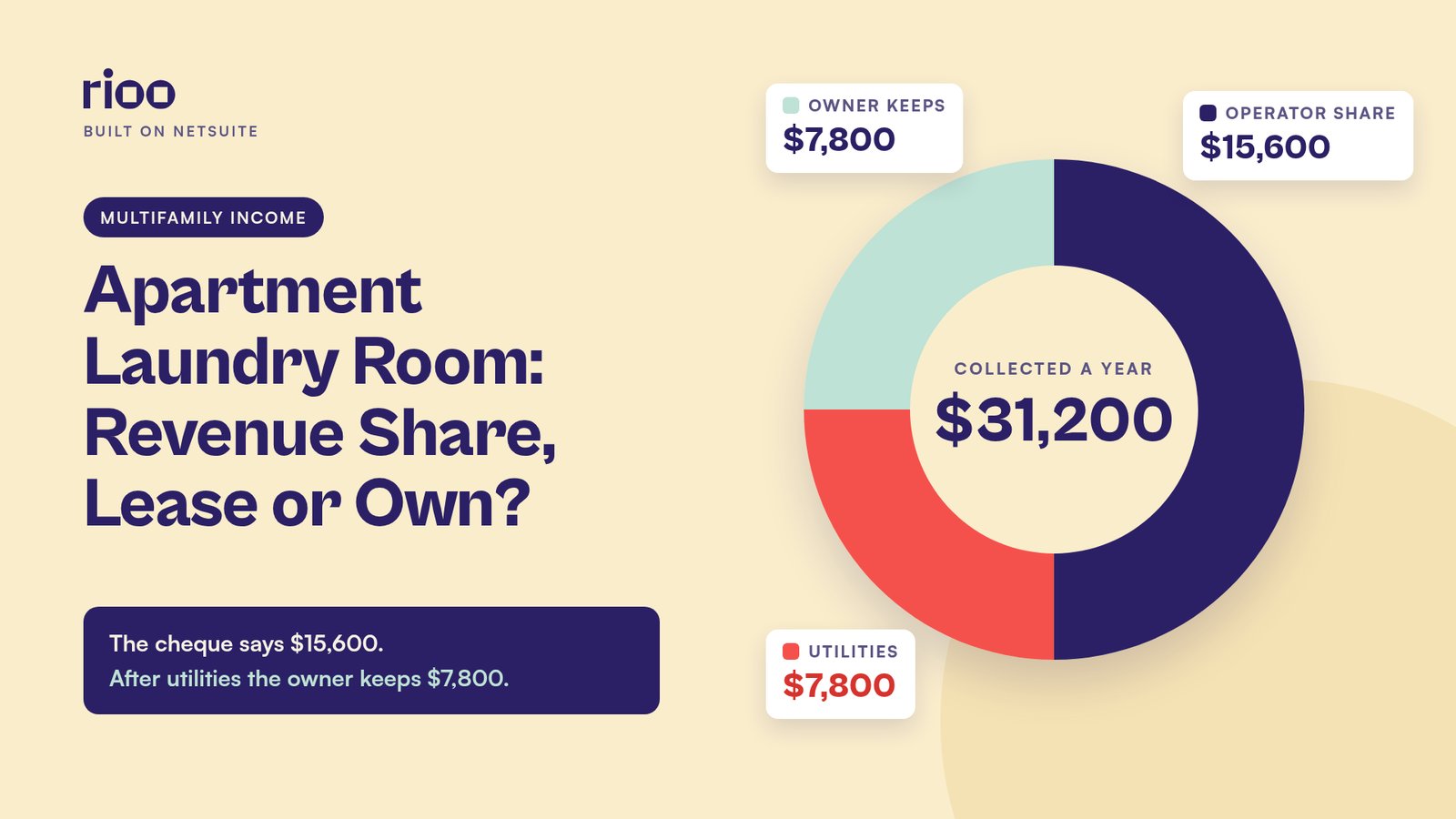
Ask an owner what the laundry room earns and you will usually hear one figure: the commission cheque. It arrives every month, it needs no work, and it looks like pure profit. It is a share of the gross. The water, gas and power the machines burn are still on the owner's utility bills.
For an apartment laundry room there are three ways to run it. A laundry operator can supply the machines and pay you a share of collections. An operator can rent you the machines for a flat monthly fee while you keep the collections. Or you can buy the machines. Compare them on what the owner keeps after utilities, repairs and payment fees. A revenue share suits small or quiet rooms. A busy room usually pays more under a fixed lease or ownership. The contract length and its renewal terms often move more money than the split itself.
What the commission cheque leaves out
A revenue share contract pays the property a percentage of what the machines collect. Offers often open around 50 percent of gross. Small rooms tend to be offered less. Some pay a threshold: the operator keeps everything up to a monthly figure, and the property shares only above it.
The cheque reports gross. It says nothing about the utility cost of each load. A dryer cycle on gas, a hot wash and the sewer charge on every gallon all land in the owner's operating expenses. Nobody tags them to laundry, so the room looks more profitable than it is.
Ask your accounting team one question before any contract decision. What does this room cost us in utilities each month? If nobody can answer, that is the first job. A submeter on the laundry room water line and a separate gas meter for the dryers settle it. Failing that, an engineering estimate from load counts will do. Our guide to RUBS and submetering covers the metering options.
Maple Court, one year of laundry numbers
This is a fictional example with rounded figures. Maple Court has 96 units and one shared laundry room with eight washers and eight dryers. Residents pay $2.25 a wash and $2.00 a dry through an app. The room collects about $2,600 a month, or $31,200 a year. Metered utilities for the room run about $650 a month, or $7,800 a year.
The current contract is a 50 percent revenue share. The owner is weighing a flat lease at $60 per machine per month, and buying sixteen machines for about $28,000 installed. The lease quote bundles the card reader, the payment app and repairs, so those costs only appear in the ownership column.
| Line (per year) | Revenue share | Flat lease | Owner buys |
|---|---|---|---|
| Collections | $31,200 | $31,200 | $31,200 |
| Operator share or machine rent | $15,600 | $11,520 | None |
| Utilities | $7,800 | $7,800 | $7,800 |
| Machine cost spread over 8 years | None | None | $3,500 |
| Service plan and parts | None | None | $2,400 |
| Payment app fees | None | None | $1,400 |
| Staff time | None | None | $720 |
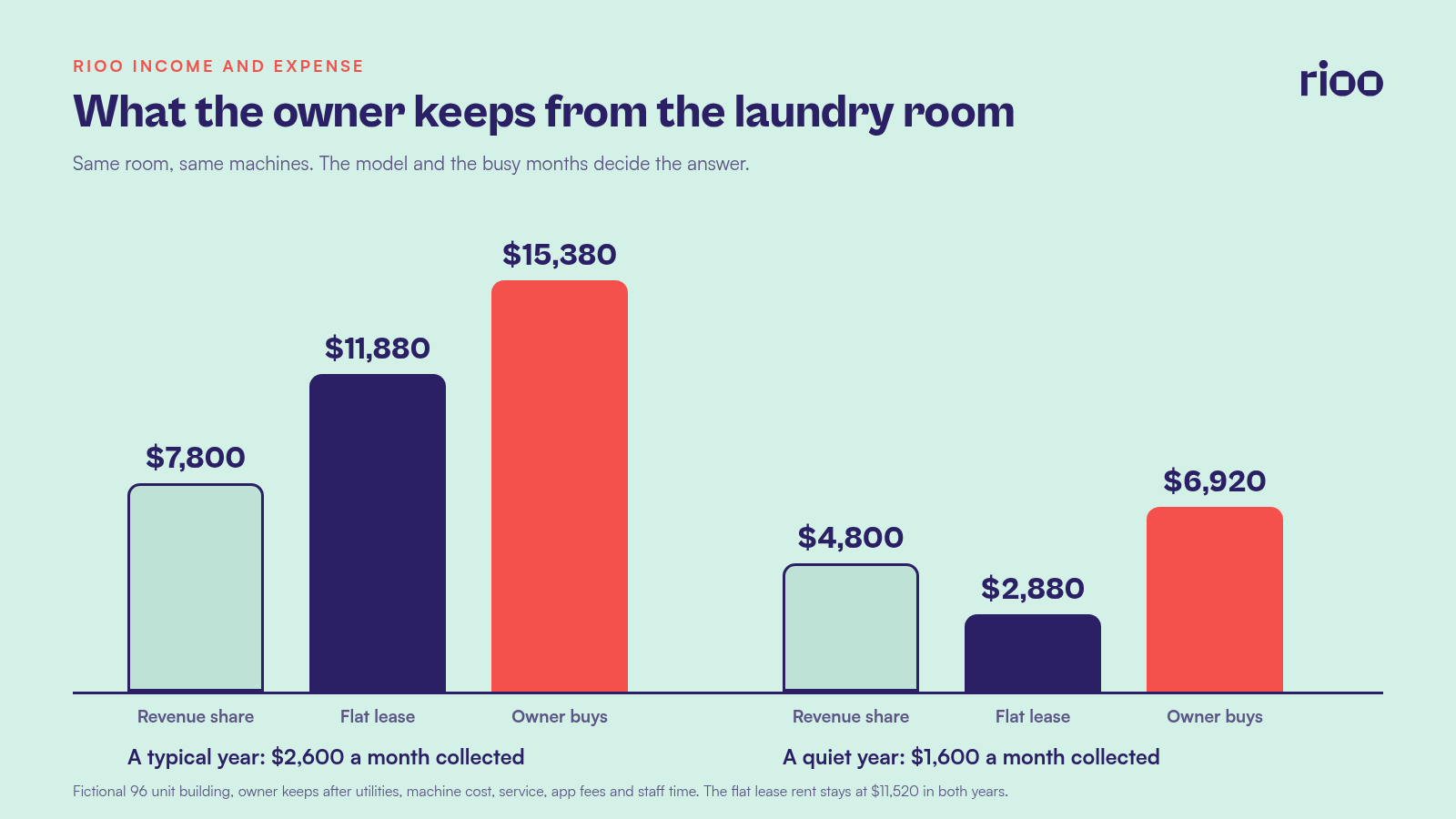
| Owner keeps | $7,800 | $11,880 | $15,380 |
The cheque under the share deal is $15,600. After utilities the owner keeps half of that. The flat lease keeps $4,080 more a year. Ownership keeps $7,580 more, but the owner now carries every breakdown, every app outage and the $28,000 up front.
Run the quiet year too
Collections fall when the building turns over or a few heavy users move out. Say the room drops to $1,600 a month and utilities fall to $400. Under the share, the owner keeps $4,800. Under the flat lease, the rent is still $11,520, so the owner keeps $2,880. Under ownership, with app fees falling to about $860, the owner keeps $6,920.
The flat lease is the model that hurts in a slow year. Ownership still wins on paper, as long as somebody keeps the machines running. Put both years in front of the owner, not just the good one.
Where the contract hides the cost
Two contracts with the same 50 percent split can be worth very different amounts. Read these terms before you compare splits.
Length and automatic renewal
Laundry contracts often run seven to ten years. Many renew on their own unless you send notice inside a short window, sometimes 90 days before expiry. Miss the window and the old split runs for another full term. Put the notice date on a calendar the day you sign, with a reminder six months earlier.
Right of first refusal
Some contracts let the current operator match any rival offer at the end of the term. That weakens your bargaining position. Ask to strike it, or limit it to one renewal.
Who sets the prices
If the operator alone can raise vend prices, residents feel the change and you hear the complaints. Agree prices in writing, with notice to the property before any change.
Service response
A machine that sits broken for a week costs collections and goodwill. Ask for a written response time, such as two business days. Ask for a rent or commission credit when the operator misses it.
Sale of the building
Check whether the contract binds a buyer. A long laundry lease can surprise a purchaser in due diligence. It can also cost you at the closing table. A recorded laundry lease shows up in title searches.
What happens to the room at the end
Ask who pays to remove the machines and repair the floor, vents and wall boxes. If the operator renovated the room at the start, check whether the contract claws back any of that cost if you end early.
When buying the machines pays
Ownership tends to pay when the room is busy, the owner plans to hold the building for years, and someone on site can handle simple faults. Maintenance teams that already service appliances can often take on laundry machines with a parts account and a manufacturer's service guide.
It also gives you control. You choose the payment app, set prices that fit the community and can make laundry free as an amenity if that suits your leasing plan. Treat the machines as capital items and record them in your fixed asset register. Our guide to ancillary income accounting shows how to keep the income and costs in their own lines.
Get quotes from at least two suppliers before you decide. A vendor bid comparison helps when one quote bundles a service plan and another does not.
When sharing the revenue is the sensible choice
A revenue share has no fixed cost. That matters in small buildings, in rooms with uncertain use, and for owners who plan to sell inside a few years. It also suits portfolios with no maintenance staff on site. The operator takes the repair calls, the coin or card hardware and the app support.
If you keep a share deal, negotiate it like any other income contract. Ask for a higher percentage, a shorter term or a capped renewal. A threshold deal can work for a quiet room if the threshold is set low. Ask the operator for twelve months of collections data by machine before you sign anything new.
Residents judge the room, not the contract
Residents never see the split. They see two broken dryers on a Sunday, an app that will not load in the basement and a price that went up without notice. Those complaints follow the community into online reviews and renewal conversations.
Whichever model you pick, set a few house standards. Post a phone number and a QR code for reporting a broken machine. Walk the room on every site inspection. Keep a log of machines out of service and how long each one took to fix. If you run a share deal, that log is your evidence when the operator misses its response time.
Laundry pricing also belongs in your wider amenity plan. Our guide to amenity billing in multifamily covers how fees and amenity charges show up for residents.
Laundry income in RIOO
RIOO classifies income and expense by property, building and unit, on the same records as your NetSuite general ledger. Laundry commission or collections can post to their own income account for each property. The operator's invoices and any service plan go through vendor management and accounts payable. Utility usage and cost tracking lets you hold the laundry room's water and gas next to the income it earns. Machines you own can sit in the asset register with their service history. See how income and expense management works in RIOO.
Laundry room questions owners ask
What is a normal revenue share for an apartment laundry room?
There is no standard figure. Offers often open around 50 percent of gross collections, and small or quiet rooms are usually offered less. Always compare offers after utilities, because the property pays those under almost every share deal.
Can I end a laundry contract early?
Only on the terms in the contract. Read the termination, renewal and buyout clauses. If the operator renovated the room or paid a signing amount, expect to repay part of it.
Should utilities be split with the laundry operator?
Usually the property pays them. Some contracts reduce the operator's share instead. Either way, measure the room's utility cost so you can price the deal properly.
Is buying laundry machines worth it for a small building?
Often not. With a few machines and modest use, repairs and payment fees can eat the gain. Run your own numbers, including a quiet year, before you decide.
Who should residents call when a machine breaks?
Post one number in the room. Under a share or lease deal it should reach the operator's service desk. Your office should still log the report so you can check response times.