









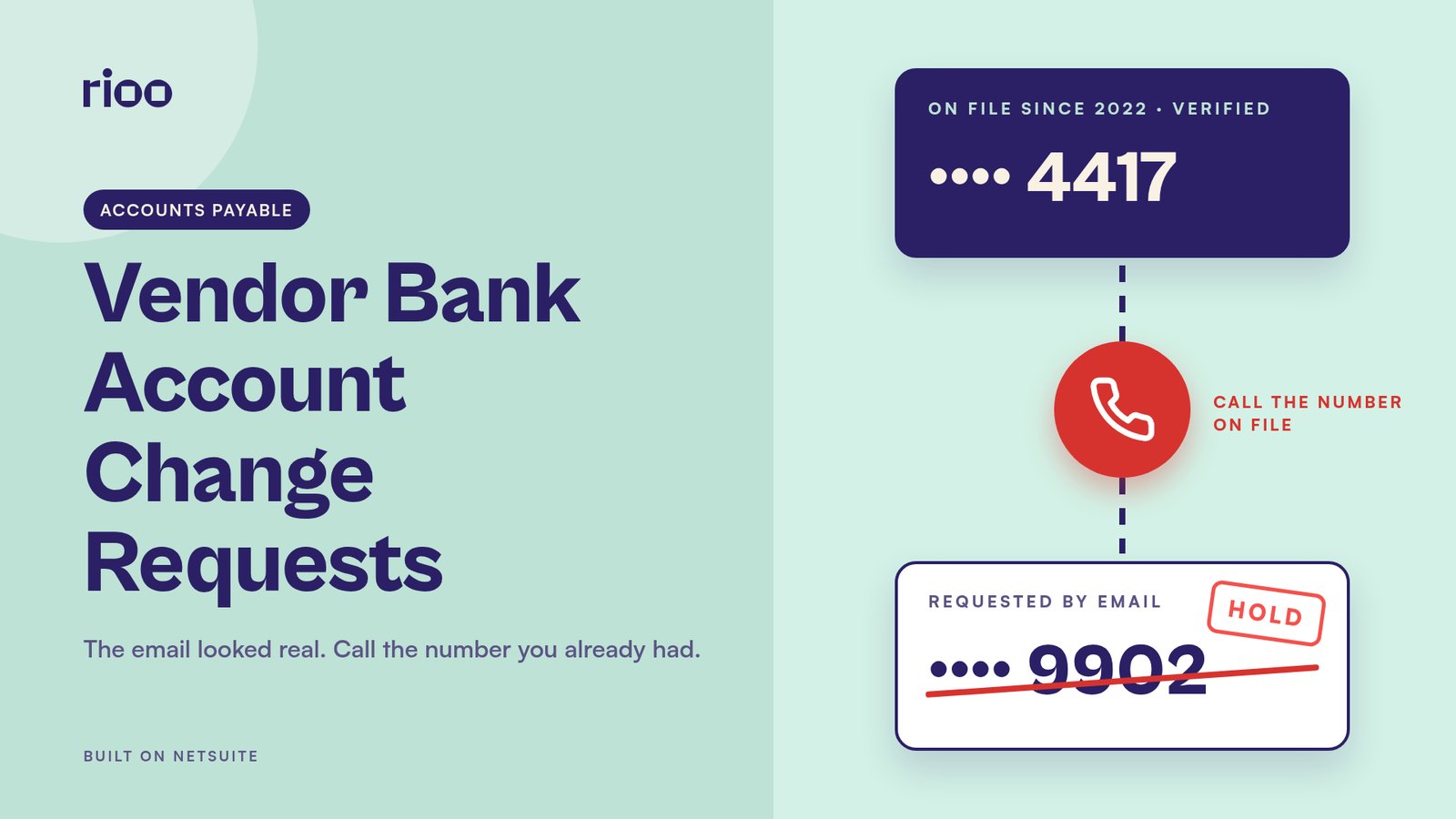
Bank change fraud rarely looks like fraud. The request is polite, short and correctly spelled. It comes from a vendor you have paid for years, often from their real email address. It asks you to update their bank details before Friday's payment run.
Treat every bank account change for a vendor you already pay as a payment, because that is what it becomes. Never accept new bank details on the strength of an email, a letter on letterhead or a call the vendor placed. Confirm by calling a number that was on the vendor record before the request arrived. Have a second person approve the change. Hold or test the first payment to the new account, and tell the vendor's known contact that the change was made. If money has already gone, call your bank's fraud line within hours and report it to the FBI.
Changing the record is the payment decision
Teams guard the payment run. Two people approve it, the bank needs a token, and the controller reviews the batch. Then a clerk edits a vendor record on Wednesday afternoon, and Friday's run sends money exactly where it was told to go.
The run did its job. The decision was made two days earlier, at the vendor record, often by one person with no second check. That is where control belongs.
Property AP is unusually exposed here. A portfolio pays many small contractors. Their invoices arrive by email, often from personal mailboxes, sometimes forwarded by site staff. Plenty of those vendors are too small to have strong email security. An attacker who gets into one plumber's mailbox can see every invoice thread with your team.
Email cannot verify email
The usual fix is to "reply and confirm". It fails in both of the common attacks.
The lookalike address
The request comes from riveraplumbingco.com when the real vendor uses riveraplumbing.com. A reply goes straight to the attacker, who confirms happily. The display name looks right on a phone screen, and nobody reads the full address at 4:50 PM.
The real mailbox, taken over
This one is harder. The attacker has the vendor's actual email password. The request arrives inside a genuine invoice thread, with real invoice numbers and the vendor's usual signature. A reply reaches the real mailbox, and the attacker answers it before the vendor ever sees it.
In both cases the phone number in the email belongs to the attacker as well. So the safe channel is one that existed before the request. Use a number already on your vendor record, taken from the W9 packet, a signed contract or your own onboarding call.
Rivera Plumbing: $18,640 to the wrong account
This is a fictional example. A firm manages 18 properties for several owners. Rivera Plumbing has done its repairs for four years and is paid by ACH every Friday.
| Date (2026) | What happened |
|---|---|
| Tue 13 Oct, 4:52 PM | A reply arrives in a real invoice thread from Rivera's own address. "We've moved banks. New details attached on our letterhead. Please update before Friday's run so nothing bounces." |
| Wed 14 Oct | The AP clerk updates the bank details on the vendor record. Nobody else reviews the change. |
| Fri 16 Oct | The payment run pays four open Rivera invoices to the new account: $6,420, $3,875, $5,180 and $3,165. |
| Wed 28 Oct | Rivera's owner calls about overdue invoices. He never changed banks. His email account was compromised in September. |
The four invoices add up to $18,640. They were for work at four different properties. Each owner's ledger shows the repair as paid. Rivera still has not been paid. The firm now has to decide who covers a second $18,640, and twelve days have passed since the money left.
Some crime and cyber policies pay for this kind of loss only if the change was verified by a callback. Read yours before you need it. Whether the firm or the owners carry the loss depends on the management agreement. That conversation is far easier when the firm can show it followed a written procedure.
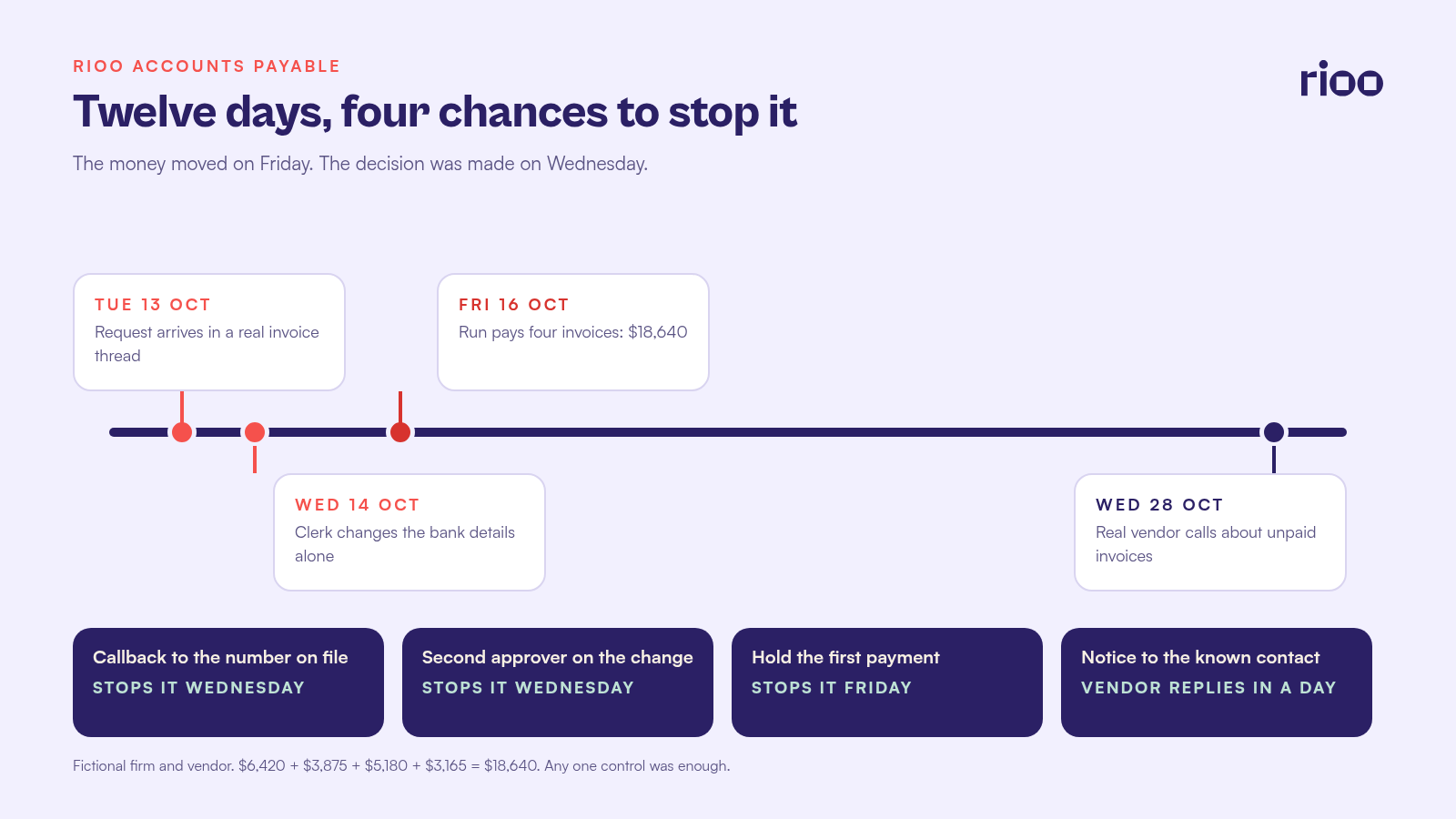
Look at where each control would have acted. A callback to the number on file stops it on Wednesday. A second approver asking "did you call?" stops it on Wednesday. Holding the first payment to a new account stops it on Friday. A notice to Rivera's known contact gets a reply of "we didn't change anything" within a day. Any one of the four was enough.
Write the callback rule so people follow it under pressure
Our vendor onboarding checklist sets a call back rule for new vendors. A change request on a vendor you already pay needs a tighter version, because it arrives inside a thread your team trusts. A rule that says "verify bank changes" gets skipped when the vendor sounds urgent. Make it specific.
- The number. Call only a number that was on the vendor record before the request. Never a number from the request, its signature or its attachment.
- The caller. Someone other than the person who received the request.
- The questions. Ask the vendor to confirm the change and read back the last four digits of the new account. Do not read the digits to them.
- The record. Note who called, the number used, the date, the time and who answered.
- No exceptions. The rule applies to urgent requests, to large vendors, and to requests that seem to come from your own executives.
If the vendor cannot be reached on a known number, the change waits. Pay that cycle by check to the address on file, or hold the payment. A vendor who is waiting for money will answer the phone.
Hold the first payment, and test it the right way
Hold the first payment to any new account for a few business days, or send it only after the vendor confirms receipt of a small test. A zero dollar prenote or a small test deposit shows the account exists. It does not prove who owns it. So the test comes after the callback and never replaces it.
Send a short notice to the vendor's known email and phone as well: "Your bank details on our records were changed on 14 October. If you did not request this, call us at once." That one message catches the case where the attacker has the mailbox but not the phone.
Keep the record editor away from the payment release
The person who edits vendor bank details should not be the person who releases payments. Where your team is too small for that, add a review. Have someone read the vendor change log before every payment run and sign it off.
Your approval matrix should name who may approve a bank change, the same way it names who approves a large invoice. Our guide to designing an AP approval matrix shows where that line sits. A change log check pairs well with the review in our guide to catching duplicate invoices.
The same rules apply to owners. An owner who "changes banks" by email before a distribution is the same attack aimed at a different payee. Our guide to running an owner distribution covers the payment side.
Bank change controls in RIOO
In RIOO, vendor records carry tax details, bank details and insurance documents with expiry dates. The recommended onboarding steps confirm bank details by a call back to a known number, never by email alone. A second person then approves a new vendor before first use. Approvals route by your rules, and approved bills join a scheduled payment run, with the cost posting to the right property. Because RIOO runs inside NetSuite, system notes record who changed a field and when. See how vendor management and accounts payable work in RIOO.
If the money has already gone
Speed matters more than anything else here. Do these in order, on the same day.
- Call your bank's fraud line. Ask them to recall the payment and to contact the receiving bank.
- File a complaint with the FBI's Internet Crime Complaint Center at ic3.gov. Give your bank the complaint details.
- Keep the emails with their full headers. Do not delete the thread.
- Call the vendor on the known number and tell them their mailbox may be compromised.
- Reset the vendor record to the verified details and freeze further changes until reviewed.
- Tell your insurer, then the affected owners, with the facts and the dates.
- Check your own mailboxes too. Sometimes the breach is on your side.
Then reverse the payments in the books against the right properties and record any recovery when it arrives.
Vendor bank change questions
Is a new W9 or a bank letter enough to change bank details?
No. Both are documents the requester controls. An attacker can produce either in minutes. File them once the callback has confirmed the change.
Do we need a callback for every bank change?
Yes, for every change, every vendor and every amount. Small vendors are where attackers find weak email security.
What if the vendor refuses to take a callback?
Then the change waits, and you pay by check to the address on file. A real vendor accepts that once you explain why.
Who should be allowed to edit vendor bank details?
One or two named people, with a second person reviewing each change before the next payment run.
How quickly should we act if we suspect a fraudulent payment?
Within hours. Call the bank first, then file at ic3.gov. Recovery gets harder each day the money sits in the receiving account.