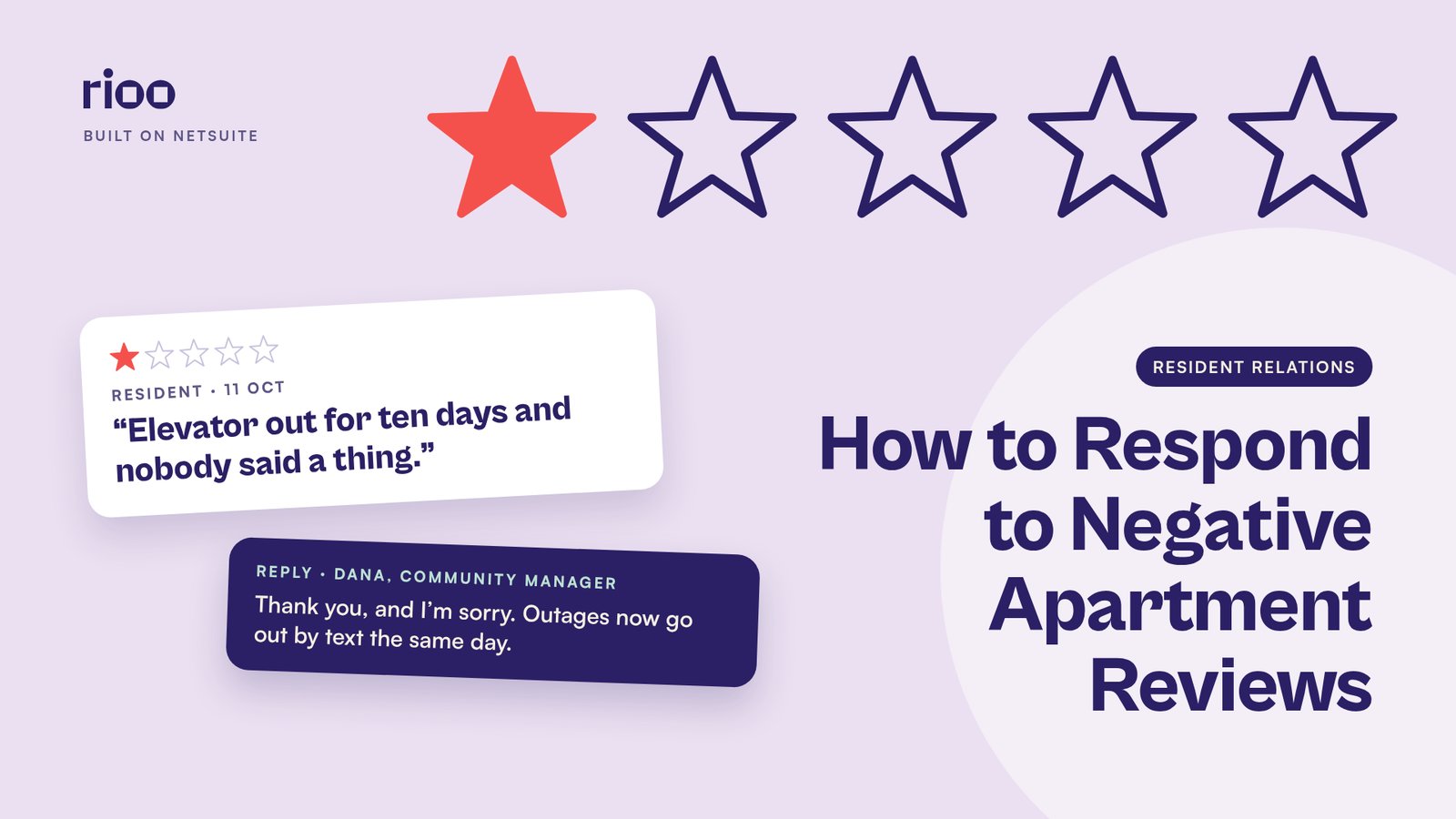
Your reply to a bad review has a bigger audience than the review itself. The resident who wrote it has usually made up their mind. The reader who matters is the applicant who finds your community next March and reads the complaint and your answer side by side.
So here is how to respond to negative apartment reviews. Reply in public within two business days. Thank the reviewer, name the problem in their words, and say what you did or will do, with a date. Give one named person to contact. Keep every detail from the resident's file out of the reply. Then fix the problem offline. Reviews that break the platform's rules can be flagged for removal. Reviews that are simply unkind stay up, and your reply does the work.
Sort the review before anyone types
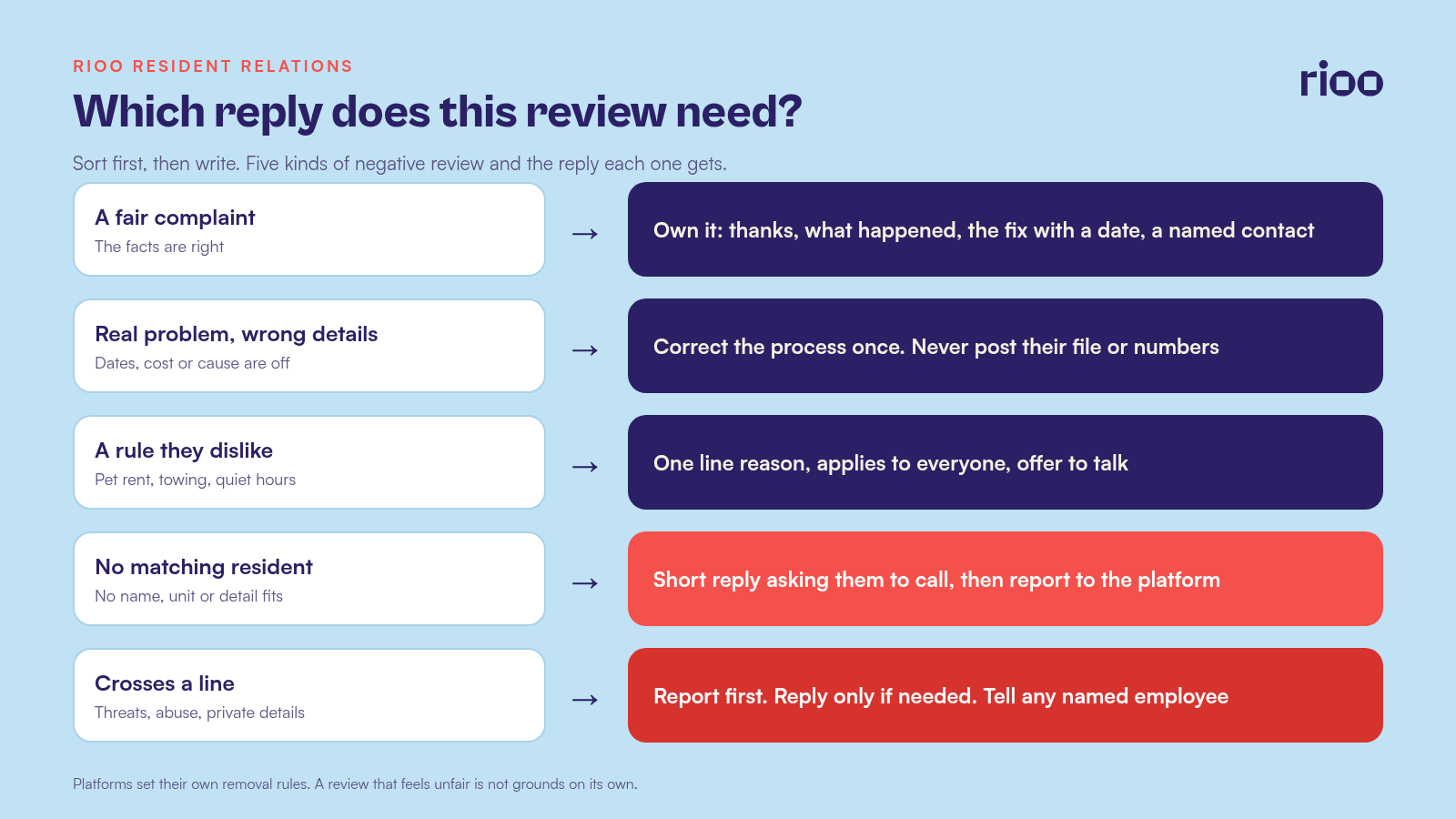
The kind of review decides the kind of reply. Before the leasing office drafts anything, put the review in one of five groups.
- A fair complaint. The facts are right. The elevator was out. The trash room did smell in August.
- A real problem with wrong details. Something went wrong, but the dates, the cost or the cause in the review are off.
- A rule the reviewer dislikes. Pet rent, towing, quiet hours, a denied application.
- A reviewer you cannot find. No name, unit or detail that matches anyone you house.
- A review that crosses a line. Threats, abuse aimed at a named employee, or someone's private details posted in public.
The first three get a careful public reply. The last two may also be reported to the platform. The path below shows each route.
If the complaint is fair, own it in four sentences
The reply has one job. It should show the next reader that problems get fixed here. Four sentences usually do that.
What goes in
- Thanks, using the reviewer's own words for the problem.
- What happened, without excuses or blame on a supplier.
- What changed, with a date.
- A named contact with a direct phone number or email.
What stays out
Leave out the unit number, the lease dates, the balance and anything else from the resident's file. Do not mention a late payment or an old complaint, even if it explains the tone. A reply that reveals private details turns a review into a privacy complaint.
Leave out "we apologize for any inconvenience" as well. Readers recognise a form letter at once.
The Larch Street elevator: two drafts of the same reply
This is a fictional example. Larch Street Apartments has 112 units and one elevator. The elevator failed on Thursday 1 October 2026. The part arrived a week later, and service came back on Saturday 10 October. The next day a resident on the sixth floor posted this:
"One star. Elevator out for ten days and management said nothing. I carried groceries up six floors with a toddler. Nobody cares here."
The leasing office drafted a reply that evening:
"We're sorry for any inconvenience. Elevator repairs depend on parts from the manufacturer and are outside our control. Notices were posted in the lobby. Please contact the office with any concerns."
Every line in it is true, and it will still cost applications. It blames a supplier. It disputes "said nothing" without showing anything. It sends the reader to "the office", which is nobody in particular.
The community manager, Dana, rewrote it and posted it the next morning:
"Thank you for writing this, and I'm sorry. Carrying groceries and a toddler up six floors should never have been your problem to solve. The elevator was out from 1 to 10 October while we waited for a part. We posted lobby notices, but we did not text residents, and we should have. From now on, any outage longer than a day goes out by text and email the same day, with an expected repair date. I'd like to hear more about those nine days. Please call me directly: Dana Ortiz, community manager, 555 0142."
Notice what Dana did with the "ten days". She gave the real dates once and moved on. She did not argue the count.
What happened offline
Dana called the resident on Monday 12 October. Larch Street's written outage policy gives a $75 rent credit when the elevator is out for more than seven days. Dana applied it to the resident's November rent, and to each household on floors three and up. That came to 64 households and $4,800 in credits.
The credit had nothing to do with the review. Dana did not ask for the review to be changed. Offering money or a credit in return for editing or removing a review can run into the federal rules described below.
Two weeks later the resident edited the review to three stars and mentioned the new text alerts. You cannot count on that, and you should never ask for it.
When the details are wrong, correct one thing
Some reviews describe a real problem with the wrong facts. "They kept $900 of my deposit for cleaning" may describe a statement with $180 for cleaning and $720 for a damaged door.
Talk about your process and leave their numbers alone. A good reply reads like this:
"Thank you for the feedback. Move out charges are frustrating, and we want them to be clear. Every deduction on our statements is listed line by line with photos, and residents can question any line with us. I'd be glad to go through yours with you. Please email me at manager@larchstreet.example."
Do not post the amounts, the photos or the statement, even if the resident posted numbers first. Your move out statement can do that job in private. Our guide to normal wear and tear vs damage shows how to build deductions that hold up when questioned.
When the review is about a rule
Residents review rules they dislike. You will not win that argument in public, and you do not need to. Give the reason for the rule in one sentence. Say it applies to everyone. Offer a conversation.
For a towing complaint, that could be: "Our guest parking rules exist because residents asked us to keep spaces near the doors free in the evening. They apply to every vehicle on the property, staff included." A written apartment parking policy makes this reply easy, because the reason is already on paper. The same goes for noise reviews and a clear quiet hours policy.
Reviews from applicants you declined
Say nothing about the application. Do not confirm that the person applied. Say that your screening criteria are written and applied the same way to every applicant, and give the leasing office contact. Saying more in public can expose private screening details and invite a fair housing complaint.
Reviews you cannot match, and reviews that cross a line
Search your resident and applicant records for the name and any detail in the review. If nothing matches, post a short reply: "We can't find a record that matches your experience, and we'd like to understand it. Please contact our community manager at 555 0142." Then use the platform's reporting tool and pick the reason that fits.
Each platform sets its own content rules and makes its own decision. Common grounds for removal include threats, hate speech, private information, conflicts of interest and content about a different business. A one star review that feels unfair does not qualify.
When a review threatens someone or posts a person's private details, report it first and reply second, if at all. If an employee is named with abuse, tell that employee before they find it themselves.
Two federal rules that limit the landlord
Both rules govern what the landlord does. The Consumer Review Fairness Act voids form contract terms that stop customers from posting honest reviews or penalize them for it. A lease or community rules clause that fines residents for negative reviews is that kind of term.
The FTC's rule on consumer reviews and testimonials took effect on 21 October 2024. It bans fake reviews and buying reviews that must say something positive or negative. It also covers reviews by insiders who do not disclose their connection, and review suppression through threats. Staff should never review their own community. No resident should get a gift card for a five star review. State law can add more, so ask counsel before any legal threat over a review.
Asking for reviews without tilting the page
A page full of angry reviews often means only angry residents are writing. The fix is to ask everyone, at fixed moments. Good moments are 30 days after move in, after a closed work order, and at renewal.
Ask every resident at those points, including the ones you expect to complain. Asking selectively skews the picture, and some platforms ban it in their terms. If you offer an incentive, offer it for any honest review, disclose it, and check the platform's rules first. Some platforms do not allow incentives at all.
What RIOO holds behind a review
Reviews live on outside sites. What RIOO holds is the record behind them. Resident messages, service requests and notices sit on the lease and unit record, in threaded conversations, with routing by category. When a review mentions a leak or an outage, the manager can open that unit's work orders and messages before replying. That shows whether the fix and the notice really happened.
Notices can go out by building, unit type or lease status, by portal, email or SMS, and each one is logged on the property record. Response times are visible too, which helps when the same complaint keeps returning. See how tenant communication tools work in RIOO.
Who replies, how fast, and what you count
Write down the standard so it survives staff changes.
| Item | Standard |
|---|---|
| Reply time | Within two business days of the review |
| Who signs | The community manager, with a real name |
| Who checks first | Regional manager, for reviews about safety, legal threats or named staff |
| Length | Under 120 words |
| Which account | The business account on each platform, never a personal one |
| Monthly count | New reviews, days to reply, and repeated topics |
The repeated topics are the useful part. Three reviews about missing parcels in one month tell you to fix the package room. Our guide to apartment package management covers that job.
Review reply questions from site teams
Should you reply to every negative apartment review?
Reply to every review that describes a real experience at your community, good or bad. A page where only some complaints get answers looks selective. For obvious spam, report it to the platform and leave it unanswered.
Can you offer a resident something to remove a review?
No. Tying a credit, a refund or a gift to editing or removing a review can run into the FTC rule. Fix the problem and apply your normal policies. If the resident later changes the review, that is their choice.
How long should a reply be?
Four or five sentences, under 120 words. Long replies read as defensive, and readers stop before the part that matters.
Can a landlord sue over a bad review?
Honest opinions are protected. False statements of fact may be actionable under state law, but a lawsuit is slow, costly and very public. Talk to counsel before sending any letter about a review.
Should the owner reply instead of the manager?
Usually not. Residents deal with the site team, so the reply should come from someone they can call. The owner can approve the standard and see the monthly count.