Short answer: good apartment package management rests on three things. First, a clear model for where deliveries go: the office, a secured package room, smart lockers or the resident's door. Second, a written package policy covering pickup windows, notices, oversized and perishable items, and what happens to unclaimed parcels. Third, a simple daily routine that logs every package, notifies the resident and clears the backlog. Plan for the holiday peak before it arrives, and connect package access to move in and move out so former residents drop off the system.
Packages can take up a real part of the daily work in an apartment office, yet the process is often unplanned. The office fills with boxes in December. A resident says a parcel was delivered but never handed over. A meal kit sits in a hot room over a weekend. Each of these is a policy question that was never answered in writing.
This guide is for community managers and residential operators who want a package process that holds up in peak season.
Choose your delivery model
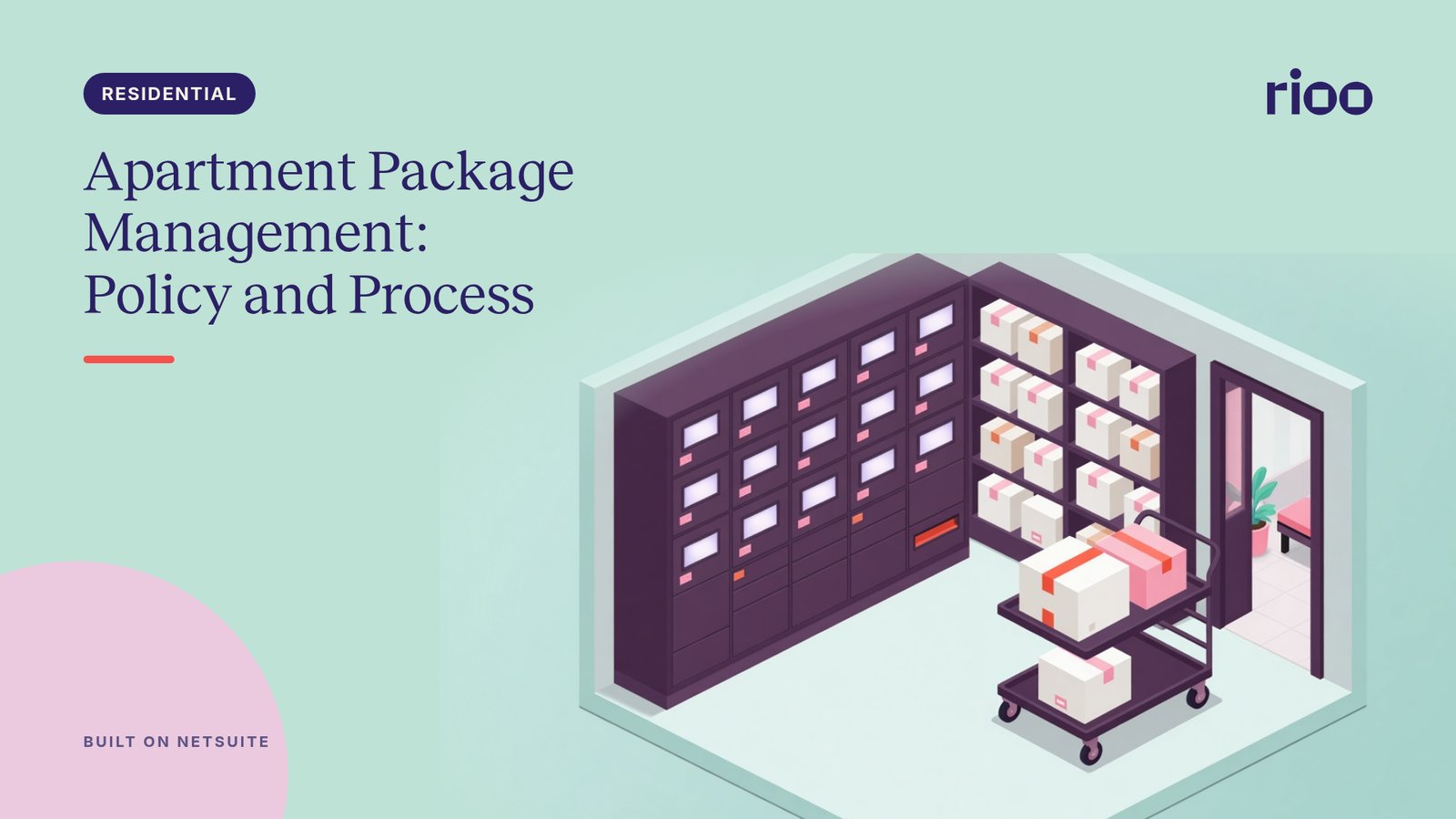
There are five common ways to handle packages. Many communities combine two, such as lockers for standard parcels and the office for oversized items.
| Model | Works well when | Watch out for |
|---|---|---|
| Office acceptance | The community is small and the office is staffed | Staff time, storage space and after hours pickup |
| Secured package room | Volume is high and access control exists | Shared access, theft and untidy shelves |
| Smart lockers | Residents want pickup at any hour | Overflow on busy days and oversized items |
| Carrier or off site lockers | Space on site is limited | Resident convenience |
| Delivery to the door | Carriers can reach the units | Porch theft and building access for drivers |
Whichever model you pick, decide which carriers and couriers can get into the building, and how. Gig delivery drivers may not have the same access as regular carriers.
Write the package policy
A written policy lets staff give the same answer every time. Put it in the lease addendum or community rules, and repeat it in the welcome pack. It should cover:
- What is accepted. Standard parcels, and any size or weight limits for staff handling.
- What is not accepted. Hazardous items, items that need age checks, and perishables unless you have refrigerated storage.
- How residents are told. Email, text or portal notice when a package is logged, with reminders.
- The pickup window. How many days a package can stay before it is returned to the carrier or otherwise handled.
- Oversized items. Where they go and how quickly they must be collected.
- Who can collect. The named resident, other adults on the lease, or someone with written authority.
- Unclaimed parcels. What happens at the end of the window, and the record kept.
- Liability. What the community is and is not responsible for. Have counsel review this wording.
- Large deliveries. Furniture and appliances go to the unit by appointment, not to the office.
Pickup windows vary widely between operators. Pick a number that fits your storage space and say it plainly. Residents accept a short window more easily than a vague one.
The daily package routine
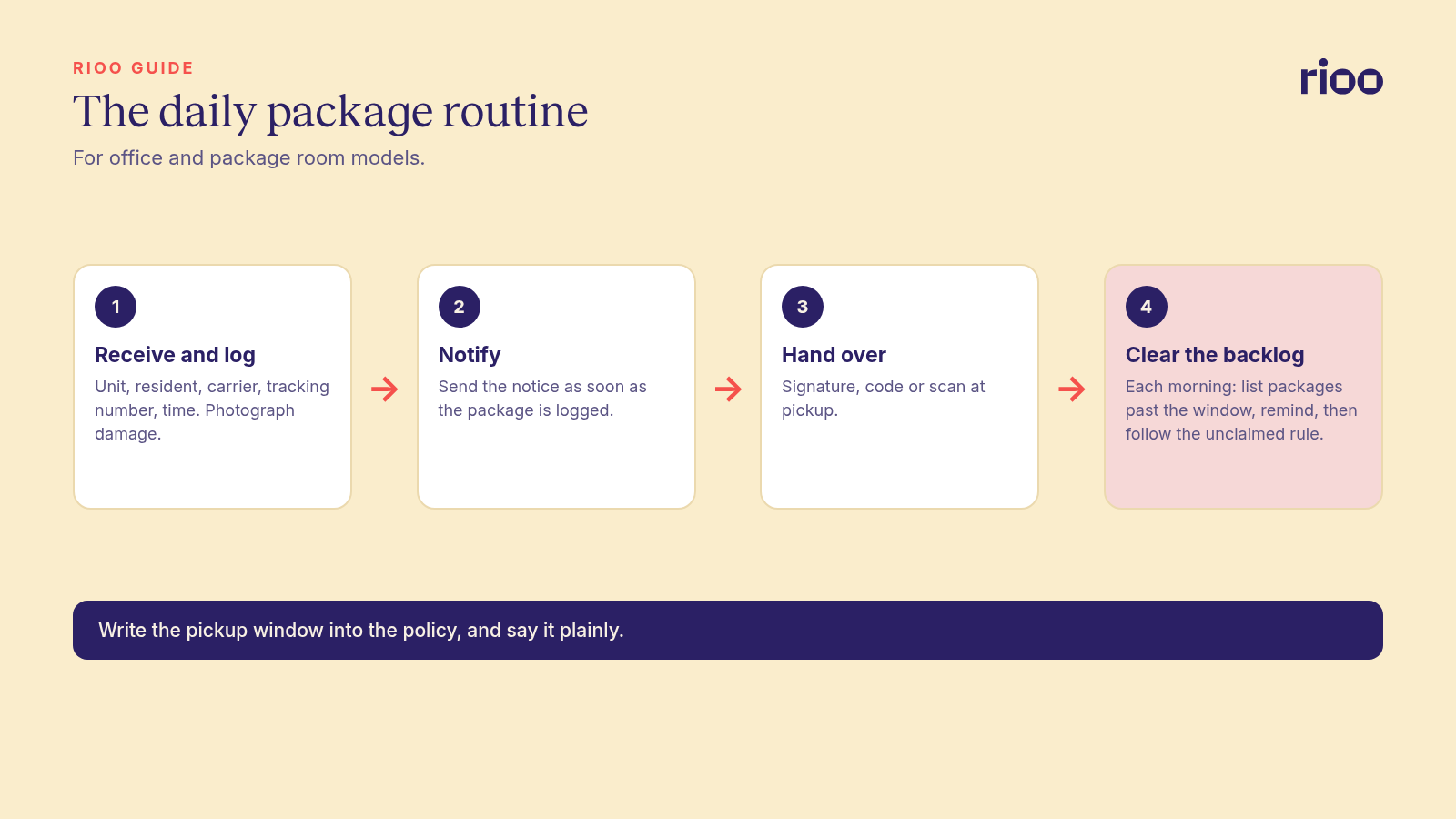
For office and package room models, staff time is the cost. A fixed routine keeps it under control.
Receive and log
Log each package as it arrives: the unit, the resident name, the carrier, the tracking number where visible, and the time. Note any visible damage before you accept it. A package that arrives damaged should be photographed.
Notify
Send the notice as soon as the package is logged. Batch logging in the evening means residents arrive before their notice does.
Hand over
Ask for a signature, a code or a scan at pickup. The handover record is what settles a "never received" claim.
Clear the backlog
Each morning, list packages past the pickup window. Send a final reminder, then follow your unclaimed parcel rule. Record what happened to each one.
Plan for peak season
Volume rises around the end of year holidays, and again at move in season in student housing. Plan ahead:
- Set temporary overflow space before November, with shelving and a lock.
- Shorten the pickup window for the peak if your policy allows it, and announce the change early.
- Add extra pickup hours at the office on busy weeks.
- Remind residents to ship large gifts direct to the recipient, or to collect from a carrier location.
- Check that locker software has every current resident loaded before the rush.
Perishables and special items
Meal kits, groceries and medicine are the hardest packages to handle. Without refrigerated lockers, a perishable left over a weekend becomes a smell, a pest risk and a complaint. Your policy should say whether perishables are accepted at all. If they are, say where they go and how fast they must be collected. If they are not, tell residents to schedule deliveries when they are home.
Medicine deserves a specific line. Residents who depend on delivered prescriptions need to know whether staff will accept them and how quickly they will be told.
Security and lost package claims
Missing parcels are a familiar complaint in apartment offices. A few controls make claims easier to settle:
- Restrict package room access to residents and staff, with a log of entries where the system records them.
- Keep the package log for a period set in the policy.
- Investigate a claim by checking the log, the handover record and the carrier's proof of delivery.
- Tell residents to report missing parcels to the retailer or carrier as well. They can trace the delivery and handle any claim.
Connect packages to move in and move out
A resident's package access should start and end with the lease. Build it into your move in and move out process. Add new residents and every adult on the lease to the locker or package system at move in. Remove them at move out, and forward or return any parcels that arrive afterwards. Otherwise, a former resident's code keeps working and their deliveries keep arriving.
If you charge for locker access or premium package services, treat it like any other ancillary charge. Check local fee disclosure rules first. Start with our overview of rental fee transparency laws by state. Our guide to amenity billing in multifamily covers how to bill these charges cleanly.
A worked example
This is an illustrative case. A 240 unit community uses smart lockers for standard parcels and the office for oversized items. Its policy sets a seven day pickup window for lockers and three days for the office.
- A large box arrives for unit 318 on Monday. Staff log it and the resident gets a notice within minutes.
- No pickup by Wednesday. A reminder goes out that afternoon.
- Thursday morning, the backlog check flags it. The manager calls the resident, who is travelling and asks a roommate on the lease to collect.
- The roommate signs for it that evening. The log shows the handover.
Without a named roommate on the lease, the parcel would have followed the unclaimed rule. The written policy makes that outcome predictable rather than personal.
Who owns each step
| Task | Owner | Record |
|---|---|---|
| Policy and lease addendum | Community manager with counsel | Signed addendum or community rules |
| Daily log and notices | Office staff | Package log |
| Backlog review | Assistant manager | Unclaimed parcel record |
| Locker access at move in and move out | Leasing team | Resident list in the locker system |
| Peak season plan | Community manager | Resident announcement |
Common mistakes
- No written window. Staff end up negotiating with each resident.
- Logging late. Residents arrive before their notice and leave frustrated.
- Accepting everything. Furniture in the leasing office blocks tours and fire exits.
- Former residents still in the system. Remove access on the move out date.
- Silence before the holidays. Announce peak rules early.
Where RIOO fits
Package lockers and package rooms run on their own systems. RIOO supports the resident side around them. Managers can publish notices to residents through the portal and the resident app. In the tenant portal, each adult on the lease can have their own login, so roommates do not share passwords. Rentable spaces such as storage lockers can be modelled as their own records with separate pricing and charges. Tenant ledgers are NetSuite customer records, so those charges sit on the same ledger as rent.
Frequently asked questions
How long should residents have to pick up packages?
Set a window that fits your storage space, and write it into the policy. Office storage usually needs a shorter window than lockers.
Can a community refuse to accept packages?
Generally yes, as a matter of policy, as long as residents know in advance. Some communities stop accepting packages at the office once lockers are installed.
What should happen to unclaimed packages?
Follow your written rule, such as returning them to the carrier, and record the outcome for each one. Have counsel review the rule before you adopt it.
Who is responsible if a package is stolen?
It depends on the policy, the lease and local law. A clear liability clause and a complete handover log make claims much easier to resolve.
Should communities charge a package fee?
Some do, particularly for lockers. Check local fee disclosure rules and include any fee in the advertised costs where required.