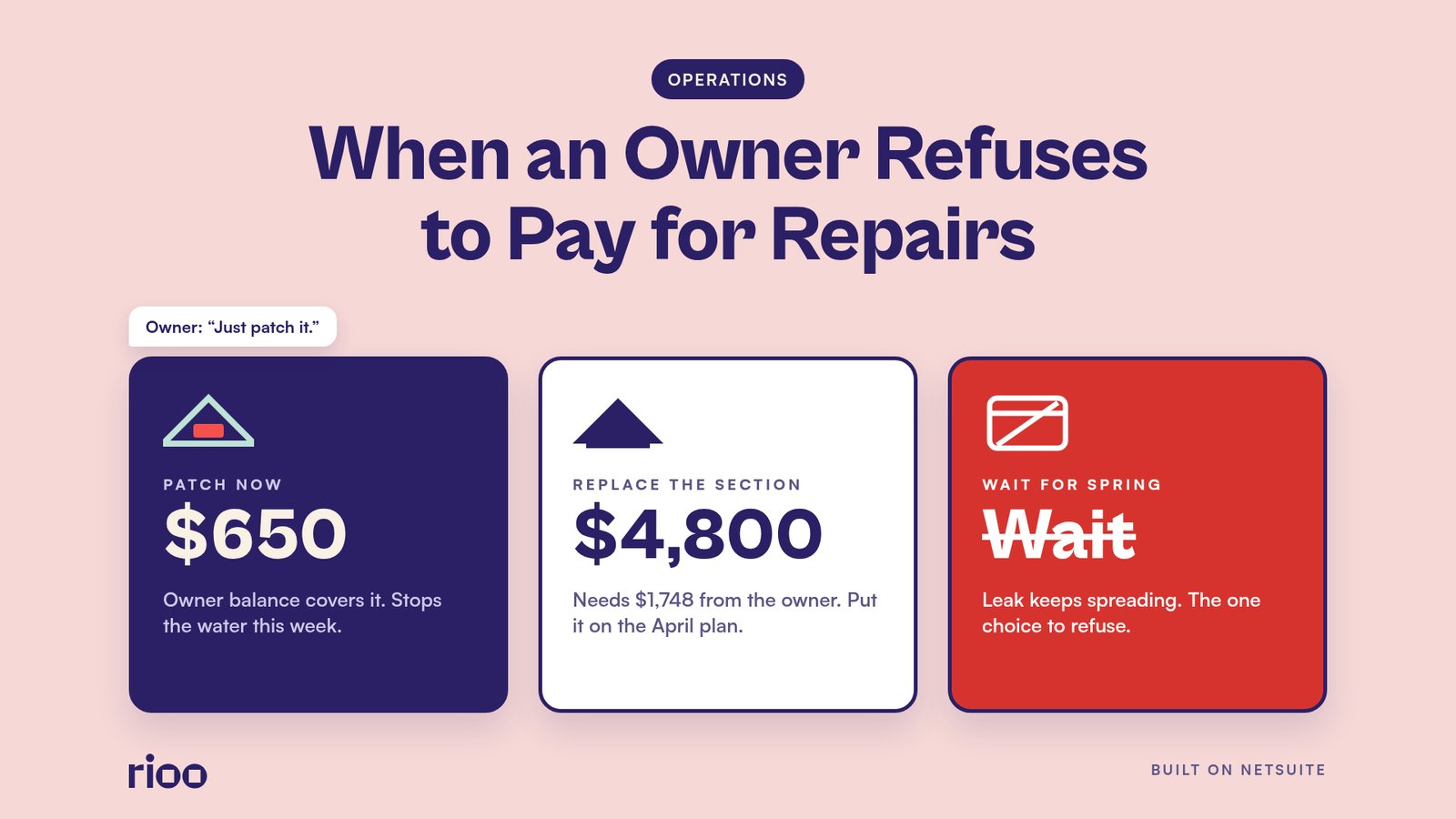
The roofer's two quotes reached the owner on Wednesday 4 November: $650 to patch the flashing, or $4,800 to replace the roof section over the back bedroom. His answer came back by text within the hour. "Just patch it. I'm not putting $4,800 into that roof before spring."
The tenant in the San Antonio duplex had reported water dripping through her bedroom ceiling the day before.
When an owner refuses to pay for repairs, the manager's job is to separate two things. An owner may choose a cheaper fix that still solves the problem. An owner may not choose to leave a safety or habitability problem in place. Your agreement, the state's repair law and a written record decide what happens next. If the owner keeps refusing repairs the law requires, the safest move is often to resign the account.
The agreement already answered this, if you wrote it well
Every owner refusal is easier when the management agreement settled the rules before anything broke. Pull it out before you call the owner back. Four clauses matter.
- Spending limit. The amount you can approve without asking, for example $500 a job.
- Emergency authority. What you may do without approval when life, safety or the building is at risk.
- Reserve. The balance the owner keeps with you for repairs, and how fast they must top it up.
- Termination. How much notice either side gives to end the agreement.
If any of these is missing, fix it at renewal. Our guide to what to include in a property management agreement covers the wording. Our post on setting owner reserves covers how much to hold.
Sort the repair before you sort the owner
Owners push back harder on some repairs than others. Your response should depend on the repair, and the owner's mood should not change it.
Safety and habitability
No heat in winter, no hot water, a gas smell, sewage, live wiring, a door that will not lock, or water coming into a room. State law usually puts these on the landlord. In Texas, Property Code 92.056 presumes seven days is a reasonable time to repair after the landlord receives notice. If the tenant follows the statute's notice steps and is current on rent, remedies can follow, including ending the lease or repair and deduct. Our guide to Texas landlord repair law sets out the steps.
Damage that is still spreading
A roof leak, a slow drain line, a failing water heater. Each week of delay adds cost. Here the owner's choice of fix matters less than the date it happens.
Everything else
Worn carpet, dated cabinets, a sticky closet door. These can wait, and owners are entitled to say so. Log the request, tell the tenant the answer, and add it to the next budget conversation. Our post on deferred maintenance shows how to keep that list honest.
Dennis's roof: patch, replace or wait
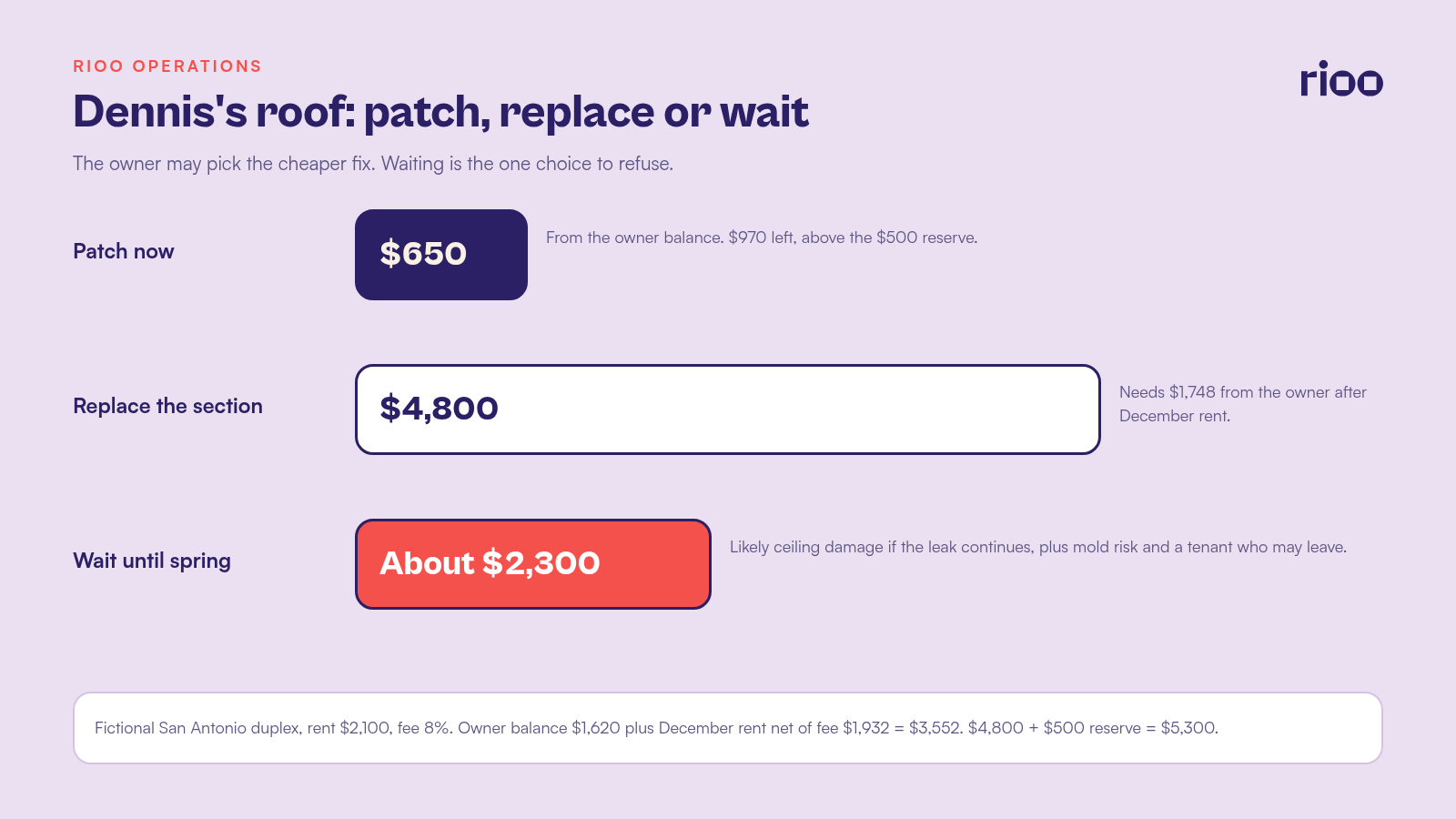
This is a fictional example with made up figures. The owner, Dennis, owns the duplex, and the unit rents for $2,100. The fee is 8%, or $168. The owner's balance with the manager is $1,620, and the agreement says to keep a $500 reserve. The roofer inspected on 4 November and quoted two options.
| Choice | Cost now | Paid from | What it leaves |
|---|---|---|---|
| Patch the flashing and two shingle courses | $650 | Owner balance | $970 left, still above the $500 reserve. Roofer expects it to hold a season. |
| Replace the roof section over the bedroom | $4,800 | Balance, December rent and an owner contribution | $1,748 needed from the owner |
| Wait until spring | $0 | Nothing | Ceiling drywall and insulation, about $2,300 if the leak continues. Possible mold work. A tenant who may end the lease. |
Here is the arithmetic for the second row. December rent less the fee is $2,100 minus $168, or $1,932. Add the $1,620 balance and the manager will hold $3,552 by 1 December. The job costs $4,800, and the reserve needs $500 restored, so $5,300 in total. $5,300 minus $3,552 is $1,748.
The tenant reported the leak on Tuesday 3 November. Seven days runs to 10 November, so a patch on Friday 6 November lands well inside the Texas presumption. The patch is a reasonable owner choice. It stops the water now. The manager can approve it within the owner's instruction and the funds on hand. Waiting is the choice the manager should refuse to carry out.
When the owner says the tenant caused it
Sometimes the refusal comes with a reason: "She broke it, she pays." That can be right. In Texas, Property Code 92.052 removes the landlord's repair duty for a condition the tenant, an occupant or a guest caused. Normal wear and tear is the exception. Other states have similar rules.
Treat it as a question of evidence. Ask the vendor to write down the cause in their report, with photos. If the tenant caused the damage, repair it, then bill the tenant under the lease. Leaving it broken while you argue about who pays still leaves the unit unsafe. A roof leak after a storm is rarely the tenant's doing.
Never fund it with someone else's money
A manager under pressure is sometimes tempted to cover a repair from the trust account and settle up later. If the owner's balance cannot cover the bill, the money would belong to other owners or to tenants' deposits. Paying one owner's bill with another owner's money breaks trust accounting rules, and state licensing boards treat it seriously. Our post on trust and operating accounts explains the line.
When the balance is short, send a written request for funds with the quote attached and a date. If the repair is a true emergency and the owner is unreachable, your agreement's emergency clause decides what you may do. Check what it says about fronting money from your own operating account. If the clause is silent, treat the answer as no.
The phone call with Dennis
Owners who refuse repairs are often worried about cash, or they think the manager is padding the bill. Answer both on the phone, before anything goes in writing.
Manager: "Dennis, I got your text. The patch is fine with me as a first step. I can book it for Friday and pay it from your balance."
Owner: "Good. That's all I wanted."
Manager: "One thing I need from you. The roofer says the patch should hold through the winter, not much longer. Can we put the section replacement on the April plan, so it's in your budget?"
Owner: "Put it down for April. I'll look at it then."
Manager: "I'll send you the roofer's photos and both quotes tonight, with a note of what we agreed."
The manager accepted the cheaper fix and fixed a date for the real one. Then she offered to write it down. Owners rarely object to a record of their own decision.
Put the decision in writing
A short email after the call protects everyone. Keep it factual and send it the same day.
Subject: 2214 Elm Ridge, Unit B: roof leak, decision of 4 November
Dennis, thanks for talking it through tonight. As agreed, we will patch the flashing and two shingle courses on Friday 6 November for $650, paid from your balance. The roofer's report and photos are attached. His view is that the patch will hold for one season. You will decide on replacing the section, quoted at $4,800, in April 2027. We will check the ceiling after the next heavy rain and tell you what we find.
If the owner refuses even the patch, send a different email. State the condition, the date the tenant reported it, the law that applies, and the date you need an answer by. Copy it to the property file.
The work order record in RIOO
In RIOO, the tenant's report becomes a service request and then a work order on the unit. Quotes, photos and the owner's written decision can sit on that work order. Approval thresholds can be set by amount and property, so a job above the agreed limit waits for the right sign off. The vendor bill is recorded against the work order and posts to the property's accounts once approved. Owner statements show income, expenses and distributions for each owner. See how work order management works in RIOO.
When to step away from the account
Some owners will not fund a repair the law requires, whatever you say. Your licence and your name are on the property too. These are the signs it is time to resign:
- A second refusal of a safety or habitability repair within a year.
- A request to delay a repair until the tenant gives up and leaves.
- A request to use deposit money, or another owner's money, to cover a bill.
- A reserve left below the agreed level for more than one statement cycle.
Resign by the book. Give the notice your agreement requires. Tell the tenant in writing where to pay rent from the handover date. Transfer the deposit as your state requires, and send the owner the full file of open work orders, quotes and the tenant's reports.
Short answers on owner refusals
Can the tenant withhold rent while the owner refuses?
In Texas, a tenant must be current on rent when giving repair notice to use the statutory remedies, so withholding rent puts those remedies at risk. Other states differ, and some allow rent escrow or repair and deduct. Check your state's rules before you answer the tenant.
Is the manager liable if the owner refuses a repair?
Possibly, depending on the state and the facts. A written record of the tenant's report, your advice and the owner's decision is your best protection. Ask counsel about your own exposure.
Can I deduct the repair from the owner's next distribution?
If the agreement lets you pay approved repairs from owner funds, yes. Unapproved spending above the limit is harder to defend.
What should I tell the tenant while the owner decides?
Tell them what is happening and when you expect an answer. Do not blame the owner by name in writing. Give them a date for the next update, and keep it.