Here is a fee increase letter that loses owners: "Dear Owner, due to rising costs, our management fee will increase from 8% to 9% from January 1. Thank you for your continued business." It gives no reason the owner can check, and it lands before anyone has picked up the phone.
A property management fee increase works when you can show the owner the work that grew. Raise the fee only where that work grew. Call before you write, and give the notice your agreement requires. Run the numbers first. Often the math shows you can lose a few doors and still come out ahead, and knowing that takes the fear out of the conversation.
Fees drift down even when you never cut them
A percentage fee follows rent. Your costs follow work. For years those two moved together, and then they stopped.
Think about what a single family home needed from a manager in 2019. Rent collection and repairs, with a renewal once a year. Now add twice yearly inspections, more local registration and compliance tasks, an owner portal, resident messages at all hours and longer turns when repair costs rise. Rent went up too, but the hours per door went up faster.
So a fee that stayed at 8% for six years has quietly fallen when you measure it per hour of work. A raise is a correction, and you should be able to prove it.
Price the work first: 140 doors in Tampa
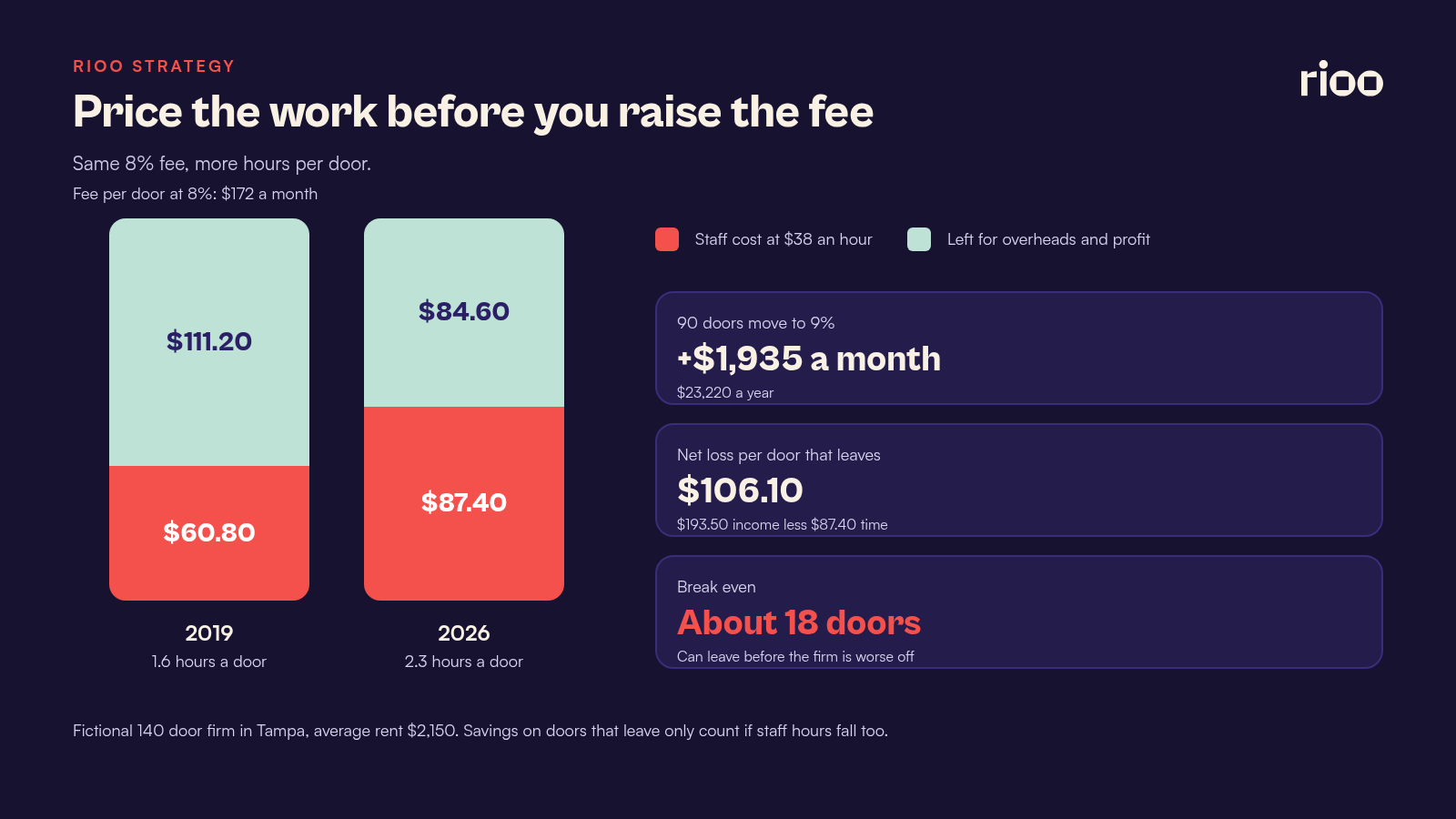
This is a fictional example with made up figures. A small firm in Tampa manages 140 single family and small multifamily doors. Average rent is $2,150 and the fee is 8%, so each door brings in $172 a month. Total fee income is $24,080 a month.
The owner of the firm pulls a year of time records and work orders. In 2019 the team spent about 1.6 hours per door per month. In 2026 it is about 2.3 hours. Staff cost, with taxes and benefits, works out at $38 an hour.
| Per door, per month | 2019 workload | 2026 workload |
|---|---|---|
| Fee at 8% of $2,150 | $172.00 | $172.00 |
| Staff hours | 1.6 | 2.3 |
| Staff cost at $38 an hour | $60.80 | $87.40 |
| Left to cover overheads and profit | $111.20 | $84.60 |
The firm decides to move 90 doors to 9% and leave 50 at 8%. At 9% a door brings in $193.50. Monthly fee income becomes 90 times $193.50 plus 50 times $172, which is $17,415 plus $8,600, or $26,015. That is $1,935 more a month and $23,220 more a year.
Now the question every owner of a firm worries about. What if some owners leave? Each door lost at 9% takes away $193.50 of income but also frees about $87.40 of staff time, so the net loss is $106.10. Divide $1,935 by $106.10 and you get about 18. The firm could lose 18 of the 90 doors before the increase leaves it worse off. That holds only if it trims the hours those doors used to take.
Raise the fee for some owners, not all
An average of 2.3 hours hides a wide spread. When the Tampa firm splits its book by workload, the picture changes.
| Group | Doors | Hours per door | Decision |
|---|---|---|---|
| Older single family homes with frequent repairs | 52 | 3.1 | 8% to 9% |
| Small multifamily, two to four units | 38 | 2.4 | 8% to 9% |
| Newer homes with long tenancies | 34 | 1.4 | Stay at 8% |
| Agreements signed in 2026 | 16 | 1.7 | Stay at 8%, already priced this year |
Owners in the third group would rightly ask why they are paying more for the same quiet service. Leaving them alone protects the relationships that cost you least. In this book, the first group makes the after hours calls and needs the repair coordination. Those owners have watched the work happen, so the increase is less of a surprise.
Other ways to price the same work are worth a look before you settle on a percentage. A monthly minimum fee, a charge per inspection or a coordination fee on large repairs all target the work directly. Our breakdown of residential property management fees walks through each line of a fee schedule.
Owners accept what they can see
A fee increase lands on top of a year of reports. If those reports showed the inspections, the work orders and the late night leak that was handled by 7 a.m., the owner already knows what you do. If they showed only rent in and fees out, the letter feels like a surprise.
Before any conversation, prepare one page per owner with their own numbers for the last twelve months:
- Work orders opened and closed, with the largest two described in a line each.
- Inspections done, with dates.
- Resident messages and calls handled.
- Days vacant at the last turn, and the rent achieved on renewal.
This is the same discipline as a good quarterly owner report. If owners have read reports like that all year, the fee conversation tends to be short.
Call first, write second
An owner should hear about the change from a person. A short call before the letter turns a notice into a conversation. Here is how one might go.
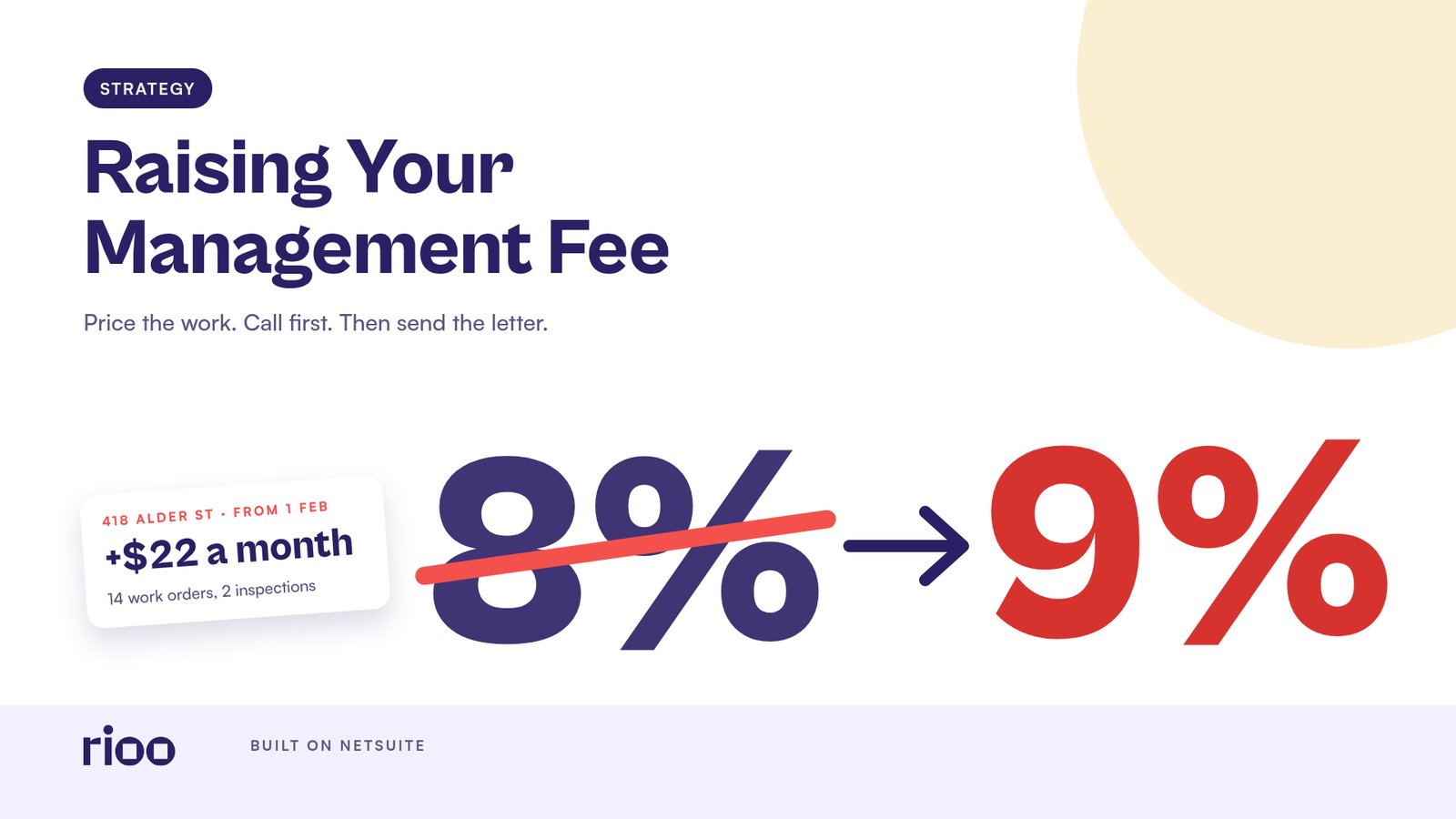
Manager: "Dana, I wanted to talk before anything arrives in writing. From February your fee on Alder Street goes from 8% to 9%. On your rent of $2,200, that is $22 a month."
Owner: "Why now? Rent already went up this year."
Manager: "It did, and that helped. But the house took 14 work orders this year, plus two inspections and the water heater in June. Our time on it has nearly doubled since we started. I can send you the list."
Owner: "Send it. I'm not happy, but I'd rather know."
Manager: "It will be with you today, with the formal notice."
Notice what the manager did. She turned the percentage into $22 and backed it with a list the owner can check. A $22 change is rarely the whole story when an owner leaves. Feeling ignored usually is, which is the pattern in our piece on why property owners leave.
A notice letter that holds up
Check your management agreement first. It should say how fees can change and how much notice you must give. If it does not, the change may need a signed amendment. Our guide to what to include in a property management agreement covers fee change and notice clauses.
A sample letter, using the Tampa example with a 60 day notice clause:
Subject: Your management fee for 418 Alder Street from 1 February 2027
Dear Dana,
Thank you for your time on the phone today. As we discussed, your management fee will change from 8% to 9% of rent collected, starting with February 2027 rent. On your current rent of $2,200 that is $22 more a month.
In the last twelve months your home had 14 work orders, two inspections and one turn. The attached page lists each one. Our time on the property has grown since our agreement began in 2021, and this change reflects that work.
Section 7.2 of our agreement allows a fee change with 60 days of written notice. This letter, dated 1 December 2026, is that notice. Nothing else in the agreement changes.
If you would like to talk it through, call me on my direct line.
Count the days. 1 December plus 60 days is 30 January, so a 1 February start is safe.
When to hold the fee instead
Some years a raise costs more than it earns. Hold the fee, or delay it, when any of these is true for an owner:
- You had a service failure on their property in the last six months that is not fully fixed.
- They are in a dispute with you over a charge or a repair.
- Their unit sat vacant longer than your own target at the last turn.
- They are about to sell, and the change would only reach one or two statements.
Write down why you held the fee for each owner. Next year's review starts from that note.
What RIOO records give you for this conversation
RIOO builds dashboards and reports from the same records your team works in, inside NetSuite. Work orders, inspections, leases, payments and resident messages all sit on the property and tenant records, so the one page per owner comes from data you already keep. Owner reports show income, expenses and distributions for each owner, and can be emailed on a schedule to people without a RIOO login. Management fees can be calculated by rule, such as a percentage of collected rent per property. A new rate is then a change to that rule from the effective date. The owner statement then shows the fee line at the new rate. Read more about RIOO dashboards and reports.
Questions owners ask about a fee increase
How much notice should a property manager give before raising fees?
Whatever the management agreement says. Where it says nothing, give at least 60 days and get a signed amendment.
Is it better to raise the percentage or add a flat fee?
A percentage is simple to explain. A flat fee for inspections or coordination ties the charge to the work. Firms often use both.
Can an owner refuse a fee increase?
Yes. They can end the agreement under its termination clause. That is why you run the break even number before you send anything.
How often should management fees be reviewed?
Once a year, alongside the budget. Small regular reviews feel fairer to owners than a large jump every six years.