The choice between a property management answering service and your own on call team usually gets compared on price. Price matters less than one decision: who sends a technician out at 2 a.m. That decision drives the real cost of after hours coverage. The answering fee is often the smallest line on the bill.
A practical answer for a growing portfolio: let an answering service pick up every call, and keep dispatch authority with someone who knows your buildings. Write the script so the service sorts calls and your on call lead decides on anything borderline. Then measure callouts every week. That split is usually cheaper and calmer than either option on its own.
The answering fee is the small number
An answering service quote is easy to compare. A base fee, a per call or per minute rate, maybe a setup charge. In house on call looks free, because the technicians are already on payroll.
Neither number tells you much. After hours coverage costs money in three places: the people who answer, the callouts that follow, and the damage when a real emergency waits too long. Callouts are the biggest of those in a normal month. A technician paid for a two hour minimum at overtime rates costs more than dozens of answered calls. So the question that matters is how many trucks roll, and whether each one needed to.
Count a month of calls before you compare quotes
Pull every call, text and portal request that came in outside office hours last month. Sort them into a few buckets.
- True emergencies: active water, no heat in freezing weather, gas smell, fire or smoke damage, a door that will not lock.
- Urgent but safe until morning: a slow leak under a sink with the valve off, one burner out, a fridge running warm.
- Routine repairs that should have been a portal request.
- Calls that are not maintenance at all: lockouts, noise, parking, leasing questions.
The mix tells you what you need. A portfolio where half the night calls are lockouts and noise needs good call handling. One where a third are real leaks needs fast, skilled dispatch. Our guide to what counts as an emergency maintenance request has a triage order you can use for the sort.
October at a 340 unit portfolio, priced three ways
Here is a fictional example with made up figures. A manager runs three properties with 340 units in Kansas City. In October 2026 the portfolio logged 112 after hours calls:
- 17 true emergencies
- 38 urgent calls that were safe until morning
- 23 routine repairs
- 34 calls that were not maintenance: 14 lockouts, 11 noise complaints and 9 leasing questions
Every callout costs a two hour minimum at an overtime rate of $48 an hour, so $96. The manager prices three setups for a month like October.
| Setup | Answering | On call pay | Callouts | Month total |
|---|---|---|---|---|
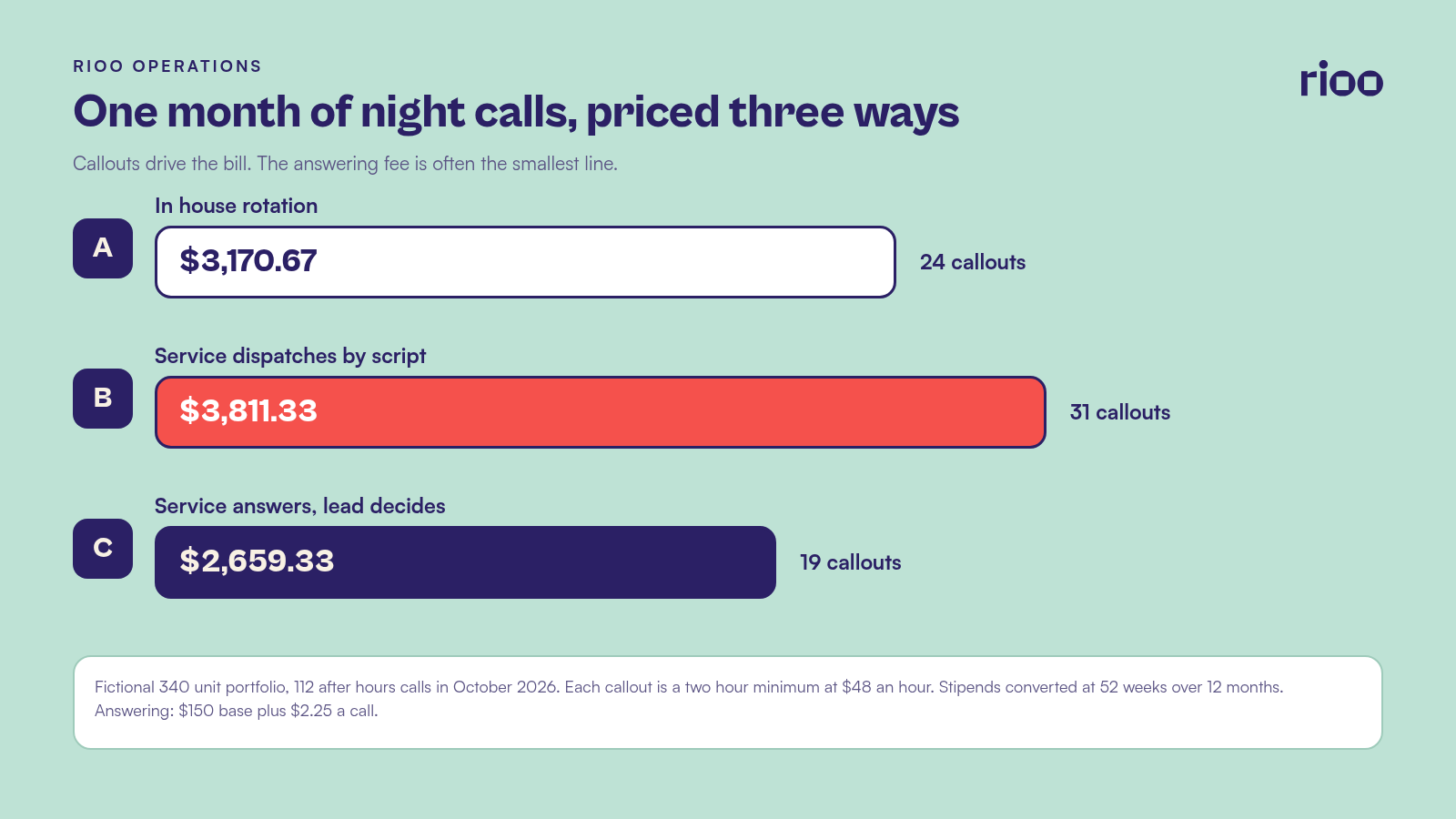
| A. In house rotation of four technicians | $0 | $200 a week stipend: $866.67 | 24 callouts: 17 real, 7 that could have waited. $2,304 | $3,170.67 |
| B. Answering service that dispatches by script | $150 base plus 112 calls at $2.25: $402 | $100 a week for the escalation contact: $433.33 | 31 callouts: the script sends 14 that could have waited. $2,976 | $3,811.33 |
| C. Service answers, on call lead decides | $402 | $433.33 | 19 callouts: 17 real and 2 judgement calls. $1,824 | $2,659.33 |
The weekly stipends are converted at 52 weeks over 12 months. Setup B looks modern and costs more than either of the others, because a script plays it safe and sends a truck when in doubt. Setup A is cheaper on paper but puts 112 calls a month on four technicians' phones. Setup C keeps the screening of B and the judgement of A.
The table leaves out the largest risk. One missed emergency, such as a supply line left running until 7 a.m., can cost more than a year of any setup. Whatever you choose, the 17 real emergencies have to reach a person within minutes.
In house on call wears out your strongest technicians
A rotation of four means each technician carries the phone one week in four. In the October example that is about 25 calls in their week, many between 10 p.m. and 6 a.m. Lockouts and noise complaints wake them as often as leaks do.
The cost shows up later. Tired technicians close fewer jobs the next day. Your strongest people, who are also the easiest to hire away, leave first. On call time can also be paid working time under federal wage rules, depending on how restricted the person is. Our post on on call pay for maintenance technicians covers how the FLSA treats it. Once you count stipends, callout minimums and turnover, an in house rotation is rarely free.
Borderline calls belong with someone who knows the building
An answering service agent does not know that the leak in building B is above the electrical room. Nor that unit 214 had the same "slow drip" twice last month. A script can sort the easy calls well. It struggles with the middle bucket, and that bucket is where wasted callouts and missed emergencies both come from.
So split the work. The service answers within a set number of rings, records the details, and handles everything the script can settle on its own. For anything borderline, it calls your on call lead. The lead decides whether to send someone, wait until morning, or walk the resident through shutting a valve.
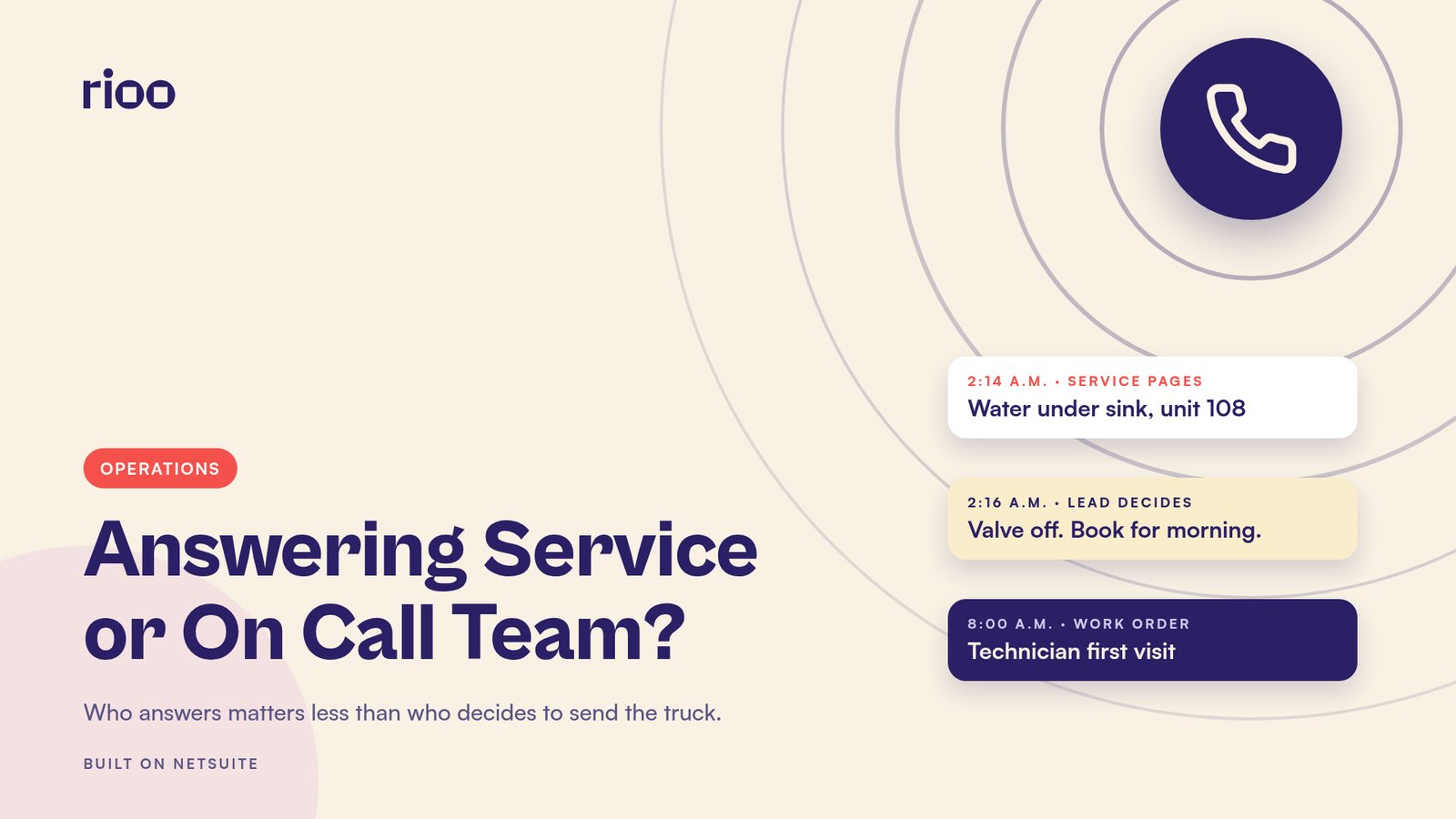
Here is how one of those borderline calls might go. At 2:14 a.m. the service pages the lead about water under a kitchen sink in unit 108.
Lead: "Is it still dripping with the valve under the sink turned off?"
Agent: "She says it stopped once she turned it."
Lead: "Then it can wait. Ask her to leave a towel and a bowl there. Book it for 8 a.m. and tell her a technician will come first thing."
That call took three minutes and saved a $96 callout. Over a month, a dozen like it pay for the service.
Write the escalation script before you sign anything
The script is your policy in writing. Build it with your maintenance supervisor and test it on last month's calls before it goes live.
Send someone now
Active water that will not stop. No heat below the temperature in your local code. Gas smell, after the resident has left and called the gas company. Sewage backup, a broken ground floor entry door or window, or an elevator with someone inside.
Call the on call lead
Water that has stopped but may have reached another unit, a partial heat loss, an electrical smell with no smoke, anything the resident describes as getting worse.
Book for the morning
Leaks that stop with the valve off, appliance faults, single fixtures, pest sightings, and every routine repair.
Never dispatch maintenance
Noise and parking go to the courtesy patrol or the morning team. Lockouts follow your tenant lockout policy, with ID checks. Leasing questions get a callback.
Holiday weeks need the same script with a deeper bench. Our holiday staffing coverage plan shows how to plan backup names.
When a full in house team makes sense
Some portfolios should keep everything in house. Think of a large community with a technician living on site. Or a dense cluster of buildings where one person can reach any unit in ten minutes. Neither gets much from an outside service. The same goes for a portfolio where the on call lead already answers within two rings and wasted callouts are rare. In those cases, spend the money on a second on call name and better tools for the person holding the phone.
The test is simple. If last month's log shows fast answers, few wasted trips and no burnout complaints, your setup works. Change it when the numbers say so.
Four numbers to check every Monday
- Time to answer. How long a resident waited for a person.
- Time to decision on borderline calls. From the service's page to the lead's answer.
- Callouts that could have waited. Review each one with the technician who went.
- Morning handoff. Whether every night call was a work order by 8 a.m.
If wasted callouts climb, tighten the script. If emergencies wait too long, loosen it or add a backup contact. Review the script every quarter and after any bad night.
Where RIOO fits after hours
RIOO does not answer your phones. It gives every request one path once it arrives. Residents can report issues through the resident portal and service requests, and staff can enter a phoned in request the same way. Each request becomes a prioritized work order linked to the property, unit and asset in NetSuite. Technicians see it in the RIOO mobile app, and residents see status changes as they happen. When the morning team arrives, last night's calls are already in the queue with their history. A vendor's callout bill posts to the right property when it comes in.
Answering service questions from owners
Do small portfolios need an answering service?
Not always. If the portfolio gets only a few night calls a week, one experienced person with a named backup may be enough. Count a month of calls before you decide.
Should the answering service dispatch vendors directly?
Only for the calls in your "send someone now" list, and only to vendors you have already approved with agreed rates. Everything borderline should go to your on call lead first.
Who pays for an after hours callout the resident caused?
If the lease allows it, the resident can be charged for damage they caused, such as a clogged toilet from wipes. Keep the work order and photos as evidence.
How fast should an after hours call be answered?
Set a target in your contract, such as a live person within a set number of rings, and check it weekly from the service's call logs.