Cutting the asking rent in December feels like action. It is often the costliest way to fill a winter vacancy. The lower rent stays on the rent roll for a year or longer. It becomes a comparable for the next lease. And the unit comes back empty next December.
Winter leasing works better on three other levers. Keep the price at market and use a small, one time concession only where traffic is thin. Write lease terms that end in spring. Then win on speed, because the few people who move in winter tend to decide fast. Save price changes for unit types where the market has really moved.
Winter renters are fewer and more serious
Traffic drops from November to February in cold markets. Fewer people move during the holidays, school year and bad weather. The people who do search are often moving for a reason that will not wait. A new job starts on 4 January. A lease elsewhere ends on 31 December. A household is splitting up.
That changes what wins the lease. A summer prospect may tour five communities over three weekends. A winter prospect may tour two in one afternoon and sign at the one that answered first and had a ready unit. Price still matters. Speed and certainty matter more than they do in July.
One more difference. Winter prospects remember the walk from the car. A dark parking lot, an icy step or a cold vacant unit sends them to the next property on the list.
A rent cut outlives the season
The trouble with a December rent cut is the calendar. You make the cut to solve a six week problem, and you sign a twelve month lease at the lower number. The cut then runs for a full year. It also shows up as a fresh comparable when you price renewals in the same unit type, which is how a small cut spreads.
A one time concession behaves differently. It costs real money, and it lowers the net effective rent. But the face rent stays at market, renewals start from the right number, and the cost ends when the first month ends. Our piece on why a free month costs more than a month covers the hidden costs of large concessions. The case for a small, targeted one is stronger.
Six December vacancies, three ways
Here is a fictional example with made up figures. Larkspur Commons is a 180 unit community in Indianapolis. On Tuesday 1 December 2026 it has six vacant one bedroom units. Market rent for that plan is $1,450. On Friday 4 December the owner emails the regional manager:
"Six empty units going into Christmas. Can we drop them $100 and get them filled?"
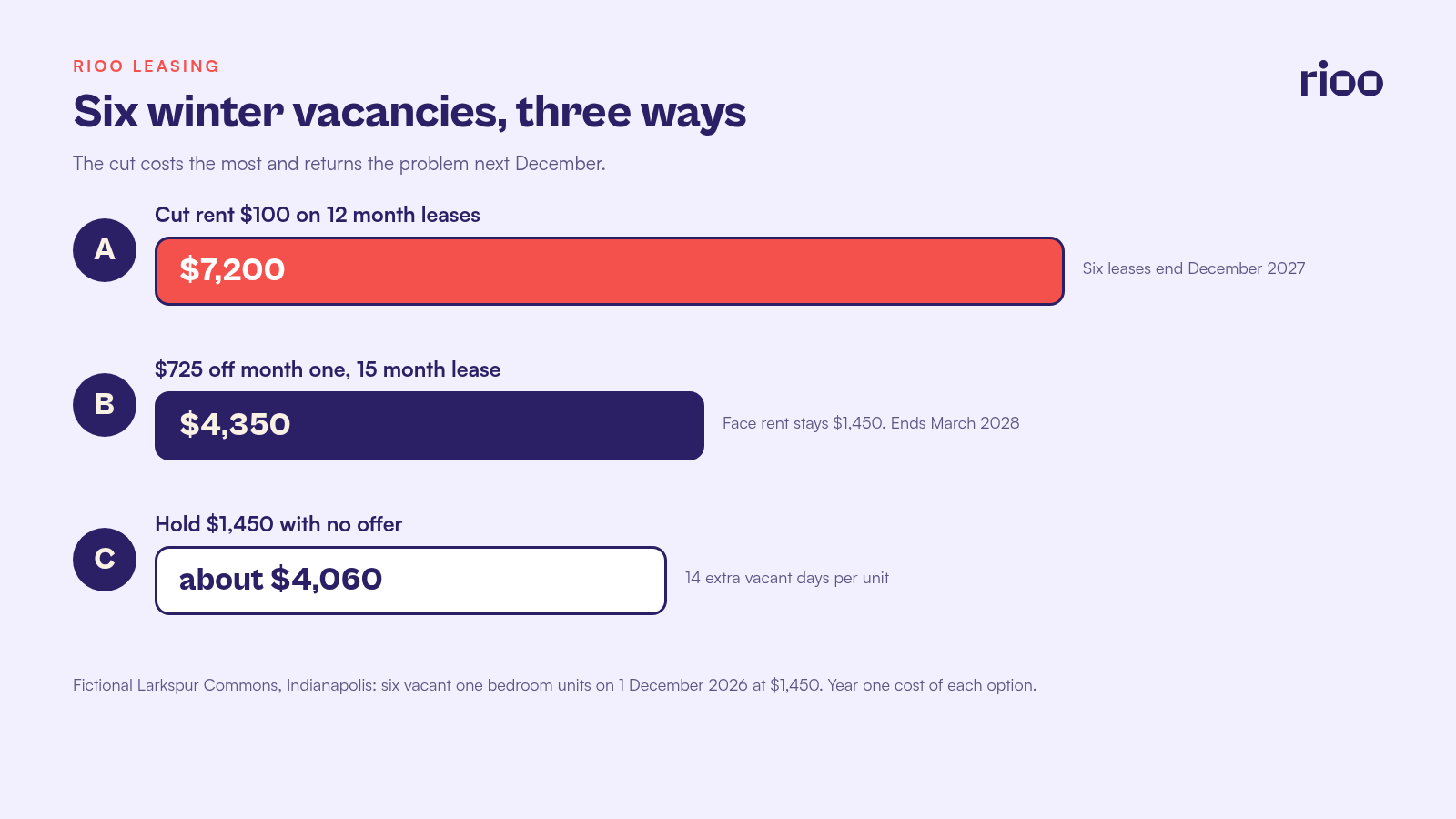
Before replying, the manager prices three options over the first year. The assumption is that a cut or a concession fills each unit about two weeks sooner than holding the price with no offer.
| Option | What it costs in year one | What it leaves behind |
|---|---|---|
| A. Cut asking rent to $1,350 on 12 month leases | 6 units x $100 x 12 months = $7,200 | Six leases at $1,350. All six end in December 2027. |
| B. Hold $1,450, offer $725 off the first month on a 15 month lease | 6 x $725 = $4,350 | Face rent at market. Net effective rent $1,401.67. Leases end in March 2028. |
| C. Hold $1,450 with no offer | 6 units x 14 extra days x $48.33 a day = about $4,060 | Face rent at market. Leases end whenever they are signed. |
The net effective rent in option B is the total rent over 15 months, $21,750, minus the $725 concession, divided by 15. That gives $1,401.67. The daily rent in option C is $1,450 divided by 30.
The cut is the costliest of the three, and it sets up the same problem a year later. B and C are close on paper. C only wins if the units really fill two weeks later and no more, and going into the holidays that is a guess. B costs a known amount and moves the next expirations into spring. The manager replies that afternoon:
"We can drop the rent, but it costs about $7,200 over the year, and all six leases would come back up next December. I would rather hold $1,450 and offer $725 off the first month on a 15 month lease. We will add Saturday and weekday evening tours from next week. If fewer than three are signed by 8 January, I will come back to you with a price change."
By 8 January, four of the six have signed. The last two are both on the ground floor facing the parking lot. That is where a price change finally makes sense, and only for those two.
The lease term decides next winter
A lease signed in mid December for 12 months ends in mid December. That puts the unit back on the market at the slowest time of year. A 15 or 16 month term pushes the expiration into March or April, when traffic returns. Some communities price those longer terms at the same monthly rent, because the payoff is a spring move out instead of a winter one.
This is the cheapest winter fix there is, and it pays off a year later. Our article on using lease term as a pricing lever covers term premiums and how to set them.
Speed beats a discount in a thin market
When there are fewer leads, each lost one costs more. Set response standards and check them weekly.
- Reply fast. Answer calls live where you can. Reply to web and email inquiries within the hour during business hours, and the same day on weekends.
- Offer tours when people are free. In December it is dark before 6 PM in many cities. Weekday evening and Saturday slots catch people who work all day.
- Show a ready unit. If the vacant unit is not finished, show a model or a matching unit and give a firm ready date.
- Decide applications quickly. A winter prospect with a start date will not wait four days for screening. Aim for a same day or next day decision.
Each of these costs staff time more than money. That is why the Larkspur manager adds them on top of option B rather than treating them as a separate choice.
Winter tours start in the parking lot
The first impression in January is the walk in. Clear and treat the route from visitor parking to the leasing office and the tour path before the first appointment. Our snow and ice priority map puts those paths in the first tier.
Inside, keep vacant units heated to a comfortable showing temperature on tour days, and never let them drop low enough to risk frozen pipes. Turn the lights on before the prospect arrives. Put a mat and a boot tray at the door. These are small things. A prospect who walks into a cold, dark unit in January will remember it as a cold, dark unit.
When a price cut is the right call
Holding the price is a choice, and it can be the wrong one. Cut the rent when:
- Comparable units nearby have dropped and stayed down for several weeks.
- One floor plan has far more vacancies than the others.
- A unit has a fixed drawback, such as a parking lot view or a ground floor location, that a concession will not fix.
- The vacancy has already run long enough that each extra week costs more than the cut would over the full term.
The test is simple arithmetic. Multiply the monthly cut by the lease months. Compare that with the vacant days you expect to save, times the daily rent. If the cut costs less, make it, and make it on the units that need it. A cut on the right units is a pricing decision. A cut across every vacancy is a habit.
Track the effect on the rent roll afterwards. Our guide to loss to lease, unit by unit shows how to measure the gap between face rent and market.
Where RIOO fits in winter leasing
RIOO runs leasing and accounting in one system built on NetSuite. Each prospect moves from inquiry to application, screening and signed lease in the leasing module, so a manager can see which leads went quiet. Pricing can be set by term, unit type and season from your pricing strategies. Concessions such as a first month credit are recorded on the lease, apart from the face rent, so the rent roll still shows the market number. Lease end dates sit on each lease record, so you can report on when next year's expirations will land. Learn more on the RIOO leasing management page.
Winter leasing questions
Is it harder to rent an apartment in winter?
Yes, in cold markets there are fewer prospects from November to February. The ones who search are often moving for a fixed reason, so they decide faster. Fast replies and ready units make up for lower traffic.
Should landlords lower rent in winter?
Not by default. A cut runs for the full lease term and becomes a comparable. Use a small one time concession or a longer lease term first. Cut the rent where comparable prices have truly dropped or a unit has a fixed drawback.
What lease length should a winter lease have?
Long enough to end in spring. A lease that starts in December and runs 15 or 16 months ends in March or April, when demand is higher.
Are winter move ins cheaper for renters?
Sometimes. Some communities offer concessions in winter to fill units. Renters should compare the net effective rent across the full term, since a concession lowers the average and leaves the monthly rent unchanged.