A tenant who leaves before the lease ends still owes rent. In many states, though, the landlord cannot simply let the unit sit empty and bill the rest of the term. The law expects a real attempt to rent the unit again, and whatever new rent comes in reduces what the old tenant owes.
That is the landlord duty to mitigate damages. In practice it means four things. List the unit quickly. Price it at market. Treat applicants the way you treat any other applicant. Keep a dated record of every step. Do those, and you can usually recover the rent lost while the unit was empty plus reasonable costs of finding the next tenant. Skip them, and a court may cut the claim down to what you could have avoided.
Five state rules side by side
The duty comes from statute in some states and from court decisions in others. The details differ more than the headline suggests. Here is how five large rental states put it, as of November 2026. Check your own state's code and current case law before you rely on any of this.
| State | Source | What it says | Can the lease waive it? |
|---|---|---|---|
| New York | Real Property Law 227-e | For homes, the landlord must take reasonable and customary steps, in good faith, to rent the unit. The target is fair market value or the old lease rate, whichever is lower. A new lease ends the old tenant's lease. | No. A waiver clause is void. |
| Texas | Property Code 91.006 | A landlord has a duty to mitigate if a tenant abandons the premises in breach of the lease. | No. A clause that waives the duty is void. |
| California | Civil Code 1951.2 | The landlord recovers unpaid rent minus the rental loss the tenant proves could have been reasonably avoided. The tenant carries that burden. | Section 1951.4 allows a different remedy if the lease is written for it. |
| Florida | Statutes 83.595 | The landlord picks one of four remedies. If it retakes the unit for the tenant's account, it must try in good faith to relet and credit the new rent. | The lease can offer a fee of up to 2 months' rent, through a separate signed addendum. |
| Illinois | 735 ILCS 5/9-213.1 | A landlord or its agent shall take reasonable measures to mitigate the damages recoverable against a defaulting tenant. | The statute is short. Courts fill in the details. |
Florida stands out. Its statute also lets a landlord stand by and do nothing, then hold the tenant liable for rent as it comes due. That choice has to be made with care, and a local attorney should be part of it.
What reasonable effort looks like
No statute lists the exact steps. Courts ask a plain question: did the landlord try as hard to rent this unit as it would have tried to rent any other vacant unit? Florida writes that test into its code. It asks for at least the same effort used in the first rental, or for similar units. It does not require you to fill this unit ahead of your other vacancies.
Start the listing fast
Put the unit on the market as soon as you know the tenant is leaving. A notice by email counts. So does a set of keys in the drop box. Waiting until the old lease would have ended is the classic way to lose a mitigation argument.
Price it like any other unit
Ask market rent, backed by two or three comparable listings saved on the day you set the price. Asking well above market looks like an attempt to keep the unit empty. New York caps the target at the lower of market value and the old rent.
Treat applicants the same way
Use your normal screening criteria. If you turn down a qualified applicant, write down the reason. A tenant's lawyer will ask about every applicant you rejected.
Keep a log
Record the listing date, the channels, the asking rent, each inquiry, each showing and each application. Save screenshots of the listings. California puts the burden on the tenant to prove the loss was avoidable. New York puts it on the party seeking damages. Either way, the landlord with a dated log wins the argument about effort.
A broken lease in Austin, worked through
Here is a fictional example. The figures are made up to show the method.
A tenant rents a two bedroom apartment in Austin, Texas. The lease runs from 1 June 2026 to 31 May 2027 at $1,600 a month. The deposit is $1,600. On Wednesday 2 September 2026 she emails the manager:
"I took a job in Denver and start on 5 October. I will be out by 30 September. I know the lease runs to May. What do I owe?"
The manager replies the same afternoon:
"Thank you for the notice. We will start advertising your unit this week at the market rate. Your rent stays due until a new resident moves in, and we will credit you for every day the unit is rented. We will send you a written statement within the deposit deadline."
Eight months remain after September. That is $12,800 of rent. The question is how much of it the manager can fairly claim.
| Date | Step |
|---|---|
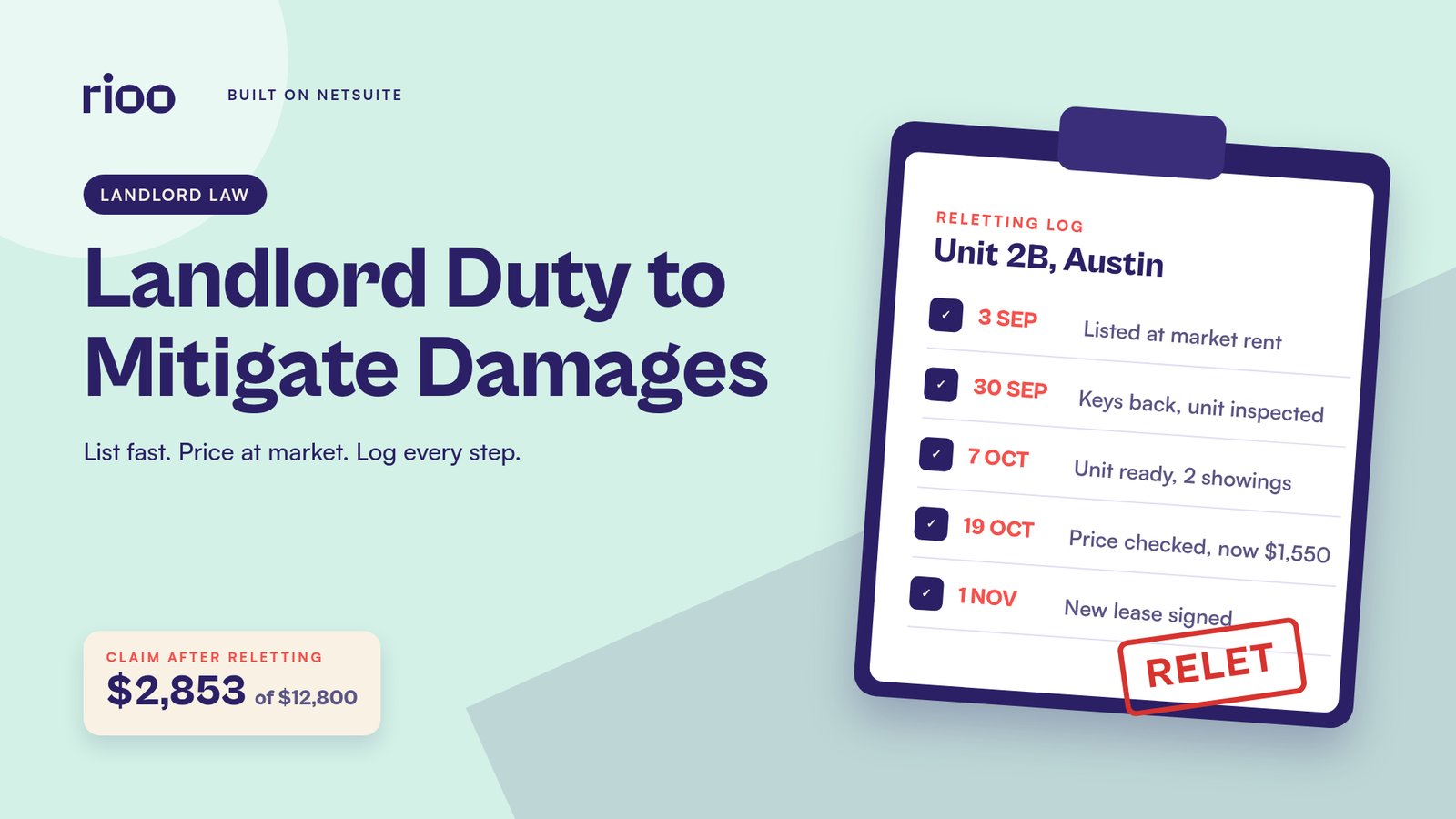
| Thu 3 Sep | Listed at $1,600 on the same sites as other vacancies. Three comparable listings saved. |
| Wed 30 Sep | Keys returned. Move out inspection done. Paint and carpet cleaning booked. |
| Wed 7 Oct | Unit ready. Six inquiries so far, two showings. |
| Mon 19 Oct | Asking rent lowered to $1,550 after two weeks with no application. New comparables saved. |
| Sun 1 Nov | Qualified applicant approved. New lease signed at $1,550, starting Sun 15 Nov. |
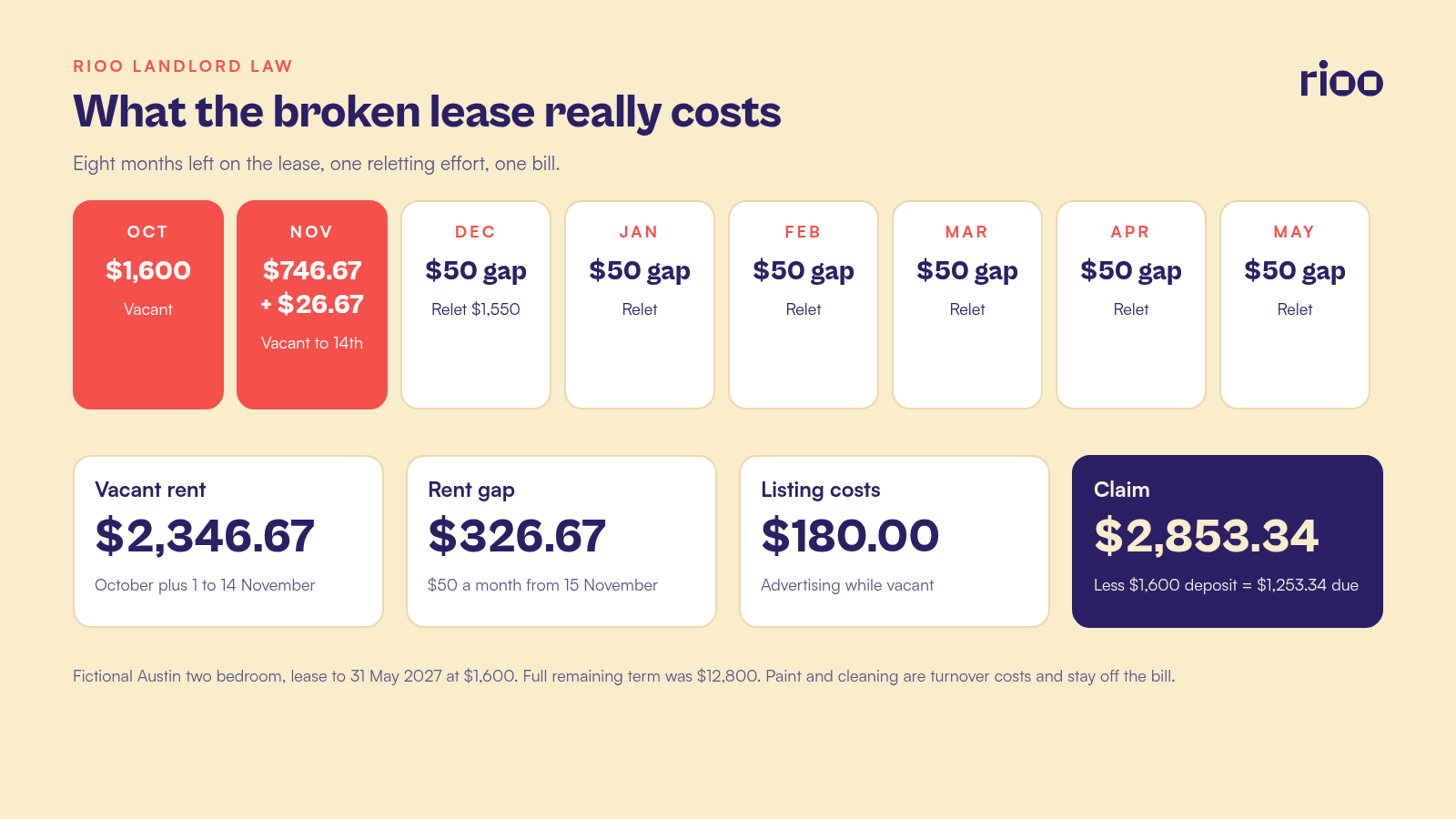
The claim then looks like this.
| Item | Amount |
|---|---|
| October rent, unit vacant | $1,600.00 |
| 1 to 14 November, 14 of 30 days | $746.67 |
| Rent gap, 15 to 30 November, $50 for 16 of 30 days | $26.67 |
| Rent gap, December to May, $50 for 6 months | $300.00 |
| Listing costs | $180.00 |
| Total damages | $2,853.34 |
| Less deposit held | ($1,600.00) |
| Balance due from the former tenant | $1,253.34 |
Paint and cleaning are left out of this bill on purpose. Routine turnover work falls on the landlord. Only damage beyond normal wear would go on the deposit statement, item by item. The $50 gap after November is claimed because the manager can show the lower rent was the market rate.
Timing matters too. Texas gives the landlord 30 days after surrender to account for the deposit, so the deposit statement is due by 30 October, before the unit is even relet. At that point the manager can apply the $1,600 deposit to October rent and say in writing that the rest will follow. The November rent and listing costs are billed once the new lease starts. The $50 gap can be billed month by month, or held for one final statement in May.
Clauses that help and clauses that fail
Lease wording cannot remove the duty in states that make it mandatory. It can still make a broken lease simpler for both sides.
Early termination option
A clause that lets the tenant leave with notice and a set fee gives everyone a known price. Florida allows a fee or liquidated damages of up to 2 months' rent, only with a separate addendum the tenant signs when the lease is made. Other states judge these fees by whether the amount is a fair estimate of the loss. The accounting side of these fees is covered in our guide to early lease termination fees and settlement.
Reletting costs
Say in the lease which reletting costs the tenant pays, such as advertising and a leasing fee. Keep the list to real costs. A flat charge with no link to actual expense invites a dispute.
Waiver and acceleration clauses
A clause saying the landlord need not mitigate is void in New York and Texas. A clause making the full remaining rent due at once can fail too, if it ignores the duty. Courts have reduced such claims to the amount a reasonable reletting effort would have left.
When the lease is commercial
The rules split more sharply for shops, offices and warehouses. The Texas statute sits in a chapter that applies to landlords and tenants generally. New York's 227-e covers homes, so commercial cases there turn on the lease and case law. Other states differ again, and courts do not agree. A commercial landlord should read the default and remedies sections of the lease with counsel before choosing a path.
Early move outs that are not a breach
Some tenants can end a lease early by law. Service members with qualifying orders can do so under the federal Servicemembers Civil Relief Act. Many states also give early termination rights to survivors of domestic violence and to some tenants with serious health needs. In those cases the tenant follows a statutory process, and the damages math above does not apply. Ask for the paperwork the statute requires, then follow its notice period.
Where RIOO fits in a broken lease file
RIOO keeps leasing and accounting in one system built on NetSuite. When a tenant gives early notice, the unit can go straight into the leasing pipeline while the old lease stays open on the tenant ledger. Each prospect is carried from inquiry to application, screening and signed lease, which gives you much of the dated record a mitigation claim needs. When the new lease starts, rent posts to the new resident, and the gap and reletting charges post to the former tenant's ledger. The deposit statement then draws from the same records. You can see how leasing works on the RIOO leasing management page.
The deposit return deadline still applies in a broken lease. Our table of security deposit deadlines by state lists each one. To separate turnover work from chargeable damage, use the normal wear and tear guide. A fast turn also shortens the vacant period you can claim, so a solid make ready checklist pays twice here.
Questions about breaking a lease
Does a landlord have to rent the unit again if a tenant breaks the lease?
In New York, Texas and Illinois the statute says yes, and the landlord must make a reasonable effort. California reduces the claim by any loss the tenant proves was avoidable. Florida lets the landlord choose among four remedies. Check your own state.
How much can a landlord charge a tenant who breaks a lease?
Usually the rent for the vacant period, any rent gap if the unit rents for less, and reasonable reletting costs. Unpaid rent and damage beyond normal wear can come out of the deposit. A valid early termination fee can replace this calculation.
Can a lease say the landlord does not have to mitigate?
Not in New York or Texas, where such clauses are void. In other states courts often refuse to enforce them for homes. Commercial leases vary by state.
What if the landlord has other empty units?
Florida says the landlord need not rent this unit ahead of other vacancies it owns or manages. Equal effort across units is the safer standard everywhere.
Does the old tenant owe rent if the new tenant pays less?
Often yes, for the difference through the end of the original term, if the lower rent was the market rate. New York is different. There, a new lease at market value or the old rate ends the old lease, so ask counsel how that affects a gap claim.