









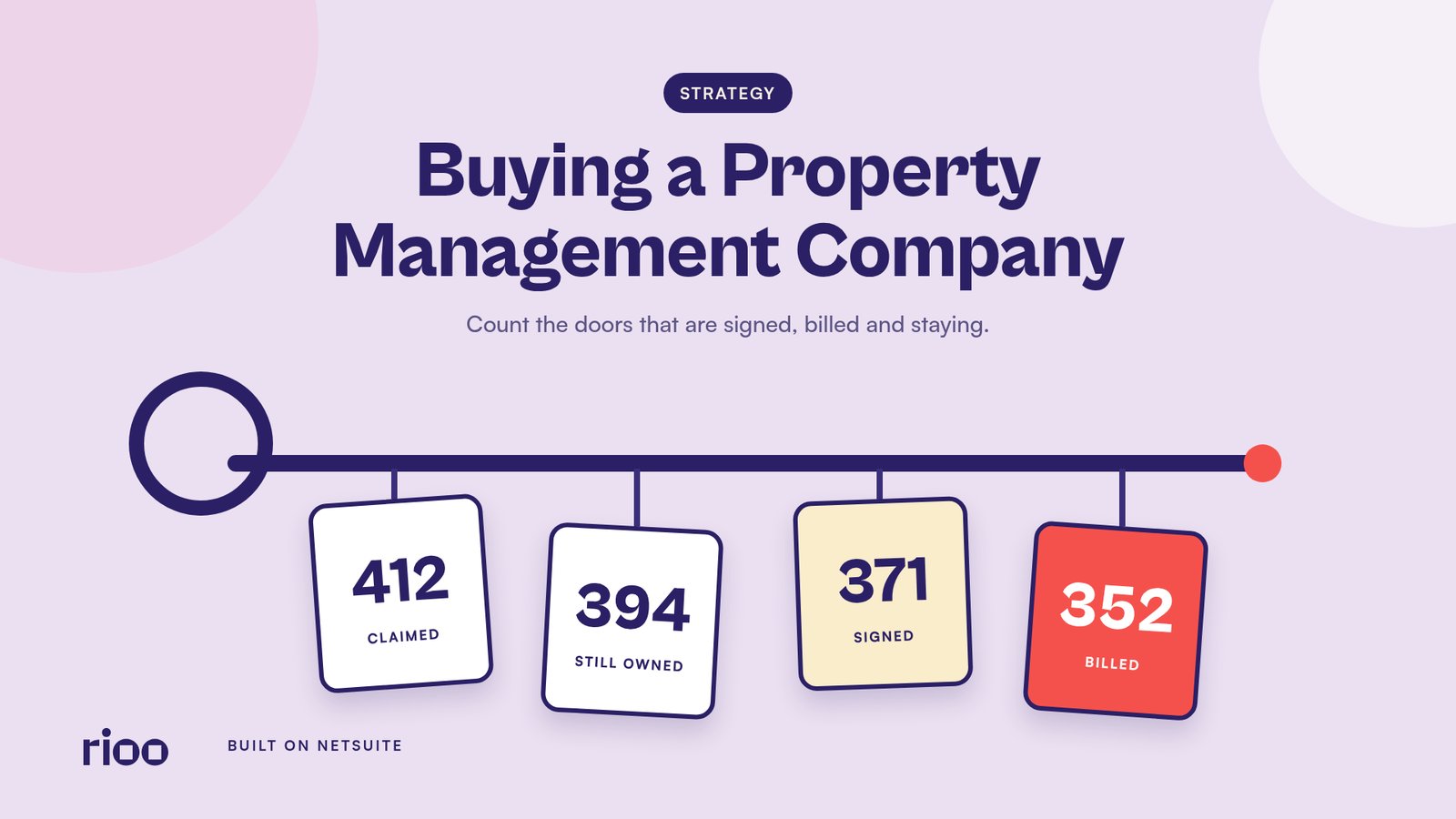
The seller's summary arrives on a Tuesday. One page, a logo, and a big number in the middle: 412 doors. The asking price is built on that number. Six weeks later, after the buyer has read every management agreement and every invoice, the number that matters is 352.
Buying a property management company means buying a set of management agreements and the people who keep those owners happy. Price it on the recurring fees from doors that are signed, billed and likely to stay, not on the door count in the pitch. Check every agreement for term and assignment. Test the trust accounts with a three way reconciliation. Measure owner concentration and churn, and hold back part of the price until the owners have stayed.
Before the letter of intent
A letter of intent sets the price range and the timetable. Once it is signed, every later change to the price feels like a retreat. Do a little homework first.
Ask for four things before you sign anything:
- A door list as of the last billing cycle, with owner, address, monthly fee and start date for each door.
- Twelve months of revenue split into management fees, leasing fees, maintenance markups and other income.
- The last three month end trust reconciliations, with bank statements.
- A copy of the standard management agreement and a list of any owners on different terms.
If the seller will not share a door list at this stage, write the LOI price as a rate per billed door, confirmed in diligence. That keeps the conversation honest without starting a fight.
Also confirm the license position early. In many states, managing property for others requires a real estate broker license, and trust money sits under a licensed broker. Our guide on real estate licenses for property management covers the basics. Check the rule with the state commission where the target operates.
Thirty days of diligence
Diligence on a management company is mostly reading. These are the files that change the price.
The door list against the invoices
Match every door on the list to a fee invoice from the last month. Doors with no invoice fall into a few groups: owners who left, properties that were sold, fees paused during a vacancy, and owners on a handshake deal. Each group gets its own line in your model.
The management agreements
Read the term, the notice period and the assignment clause in each one. An agreement that cannot be assigned without owner consent means a consent letter per owner. Short notice periods mean an owner can leave the month after closing. Our guide to the property management agreement lists the clauses to look for.
Trust accounts
Ask for a three way reconciliation for each trust account at the last month end. Bank balance, book balance and the total of owner and tenant ledgers should all agree. Any gap is the seller's to explain and clear before closing. A shortage gets funded. Money that matches no ledger gets traced to its owner or handled under the state's unclaimed property rules.
Concentration and churn
Work out what share of fees comes from the largest owner and the largest five. Then count how many owners left in each of the last three years, and why. A company whose largest owner holds a fifth of the doors is a different risk from one where nobody holds more than a few percent.
People
Find out who owners actually call. If every relationship runs through the founder, the price should depend on the founder staying for a transition period. Ask which staff will stay, and what it will take to keep them.
A made up deal: 412 doors on paper
A regional firm with 600 doors is buying a made up 412 door company in a nearby city. The seller asks $580,000, about $1,400 a door. The LOI is signed on Wednesday 14 October 2026, with 30 days of diligence and a target close of Tuesday 1 December.
The door list shrinks as the buyer works through it:
| Check | Doors | What dropped out |
|---|---|---|
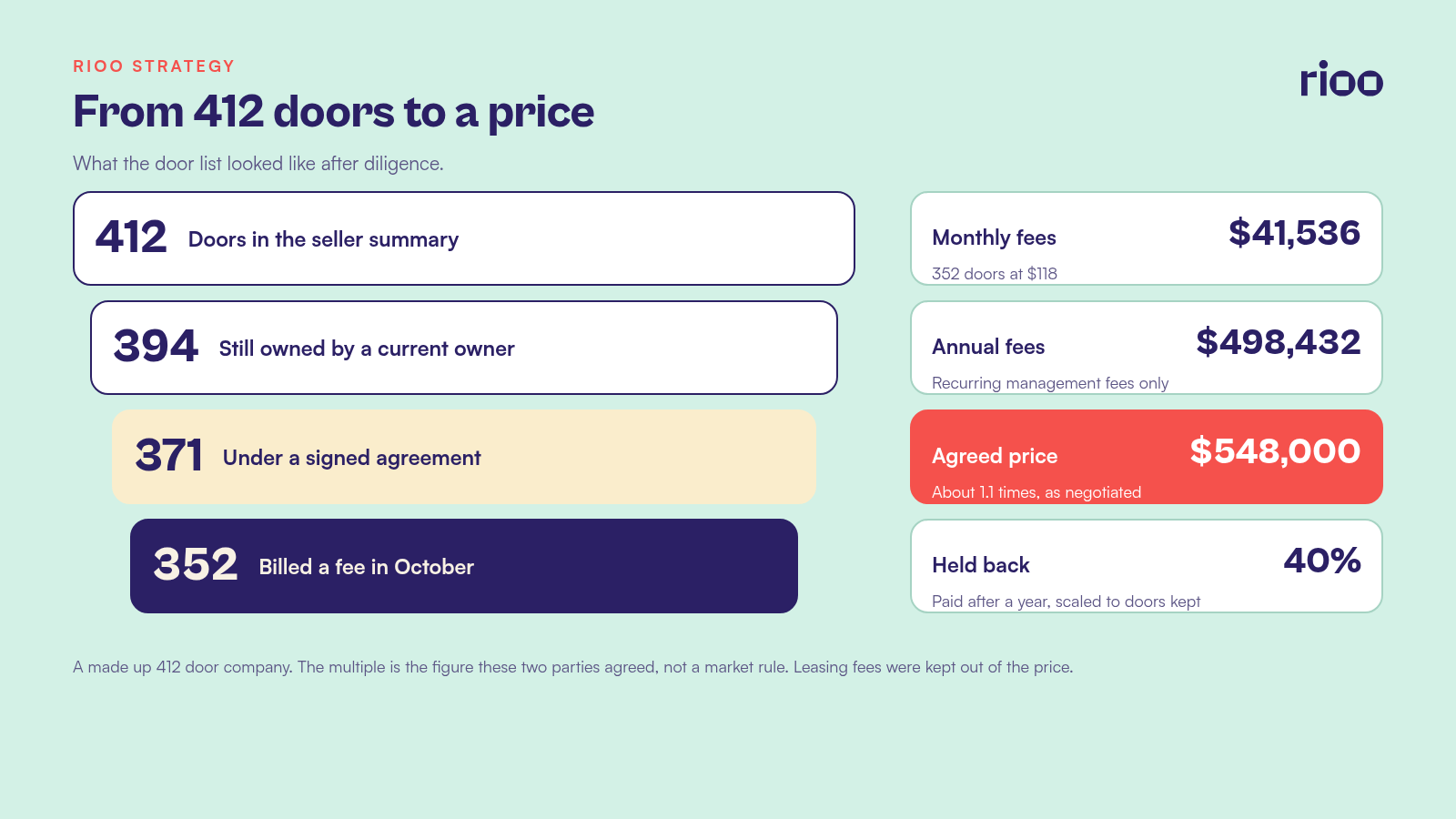
| Doors in the seller's summary | 412 | Starting point |
| Still owned by a current owner | 394 | 18 doors sold or owner left, still in the system |
| Under a signed agreement | 371 | 23 doors on verbal terms only |
| Billed a fee in October | 352 | 19 doors with fees paused or waived |
The 352 billed doors pay an average of $118 a month. That is $41,536 a month, or $498,432 a year in recurring management fees. Leasing fees were another 31% of revenue over the year, but two thirds of that came from one lease up that is now finished. The buyer still counts leasing income in its plan. It just will not pay a multiple on it.
The trust check finds a gap. At 30 September, the bank and the book both show $612,480, but the ledgers total $609,360. The bank holds $3,120 that no ledger accounts for. It traces to old deposits with no matching tenant. The seller agrees to trace those tenants, or report the money under the state's unclaimed property rules, before closing. The buyer will not take on cash it cannot assign.
The largest owner has 48 doors, about 14% of billed doors. That is manageable, but the buyer asks to meet that owner before closing.
The offer
The two sides agree a price of 1.1 times annual recurring fees on billed doors. That multiple is the number this buyer and seller negotiated, not a market rule. It comes to about $548,000.
| Part of the price | Amount | When |
|---|---|---|
| Paid at closing (60%) | $328,800 | 1 December 2026 |
| Held back (40%) | $219,200 | Paid after 12 months, scaled to doors still billed |
| Holdback paid if 320 of 352 doors remain | $199,273 | 1 December 2027 |
| Total paid in that case | $528,073 | Against an ask of $580,000 |
The seller pushed back on the holdback. The buyer's answer on the call was simple: "We'll pay full price for every owner who stays. If they stay because you introduced us properly, you get all of it."
Findings that should move the price
Some diligence findings are normal clean up. Others change what the company is worth. Treat these as price items, not footnotes.
- Owners on verbal terms. They can leave without notice, so price their doors at a discount or after they sign.
- A trust shortage, or money no ledger can claim. The seller clears it before closing, and you widen your review to more months.
- One owner holding a large share of fees. Meet them before you sign, or tie part of the price to their staying.
- Fees well below the local going rate. Raising them after closing is a quick way to lose owners.
- Open legal claims or complaints to the state commission. Ask for the full file.
Write each item into the purchase agreement as a condition, an adjustment or a specific promise from the seller.
Closing week
Three jobs fill the week of closing.
First, trust money. Plan how each trust account moves to the buyer's broker, and on what date. Owner funds and security deposits should be reconciled to the cent on the day they move. Keep both sets of reconciliations in the deal file.
Second, owner letters. Send them the day after closing, signed by both firms. Say who the new manager is, what stays the same, when statements will arrive, and how to reach a person. Owners who hear nothing for two weeks start calling other managers.
Third, data. Agree the export list with the seller before closing: tenant ledgers, deposits held, open work orders, leases, vendor details and owner payment details. Our checklist for a management transition data handover covers the full list.
Two companies, one ledger in RIOO
Bringing a second company into one set of books is a systems job as much as a people job. RIOO runs on NetSuite, and NetSuite OneWorld lets an acquired firm sit as its own subsidiary while reporting rolls up to the group. Its owners, tenants, deposits and fees move into the same records your team already uses. The first owner statements and the next trust reconciliation then come from one place. Pricing is quoted for your portfolio; the pricing page explains how.
The first 90 days decide the holdback
The holdback is won or lost in the first quarter. Call every owner with more than five doors in the first month. Keep the fee unchanged for at least the first year, unless an agreement says otherwise. Send the first owner statements on time, even if the books need cleaning behind the scenes.
Watch for small signals. An owner who asks for a copy of the agreement may be reading the termination clause. A drop in maintenance approvals can mean an owner is testing the new team. A call within a day beats a perfect email in a week.
Integration is where many acquisitions stall. Our piece on the acquisition you can't digest makes the case for planning that capacity before you sign.
Asked by buyers before they sign
How are property management companies valued?
Buyers usually price on recurring management fees or on earnings, then check the result per door. The multiple depends on churn, contract terms, concentration and how much the business relies on the founder. Get advice from an adviser who knows your market.
Can management agreements be transferred to a buyer?
It depends on the assignment clause. Some allow assignment freely, some need owner consent, and some are silent. Read every one before you set the price.
What happens to the trust accounts when a firm is sold?
The funds move to the buyer's trust accounts under the buyer's broker, after a full reconciliation. State rules set how and when. Check with the real estate commission in each state involved.
Should I buy the company or just the contracts?
An asset purchase of the agreements avoids taking on the seller's old liabilities. A share purchase usually keeps contracts in place, though some agreements have change of control clauses that still need consent. Your lawyer and accountant should weigh the trade off for your deal.
How long does the deal take?
The example above ran seven weeks from LOI to close. Larger books, more states or messy trust accounts take longer.