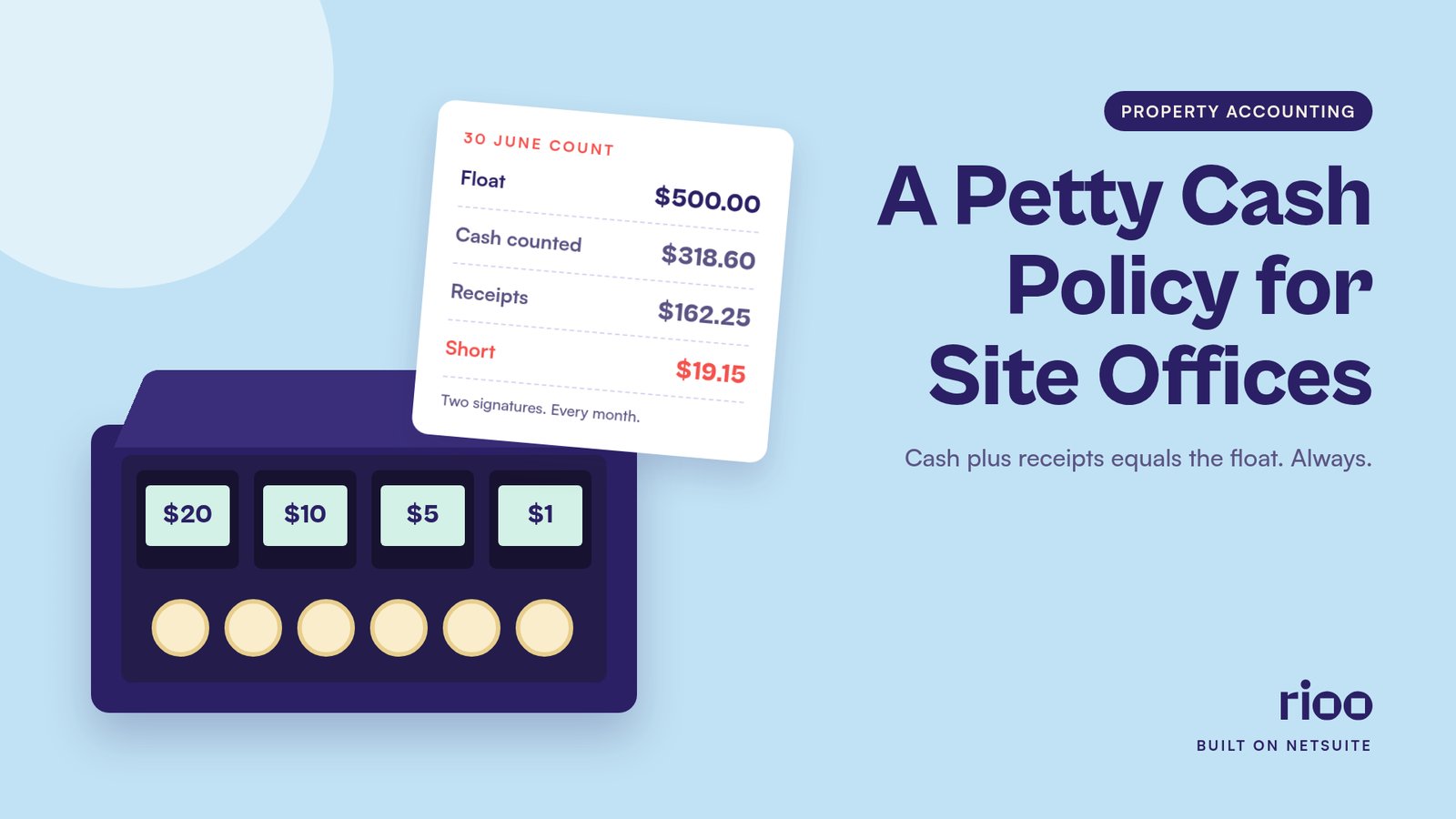
At the 30 June count, the cash box at Maple Court held $318.60 and receipts for $162.25. The float is $500. That leaves $19.15 nobody could explain on the spot. It is a small number, and it is exactly the kind of number an auditor asks about.
A petty cash policy for a property management site office sets a fixed float for each property and names one custodian. It lists what the cash can pay for, caps each purchase and requires a receipt coded to the property. The float is counted at every month end and at every change of custodian. Cash plus unpaid receipts must always equal the float. When the box runs low, it is topped up by exactly the total of the approved receipts, and that top up is where the expense hits the books.
What petty cash is for at a property
Petty cash covers small, urgent purchases where a purchase order would take longer than the job. Think of a $14 bag of ice melt on a Sunday, a $22 replacement lock cylinder, coffee for a resident meeting, or postage for a certified letter.
It is not a second bank account. These uses belong somewhere else:
- Vendor invoices. They go through accounts payable, with the vendor set up properly.
- Payroll, tips or cash advances to staff.
- Refunds to residents, including deposits and overpayments. They go through the tenant ledger.
- Gift cards and resident prizes. They need their own approval and tax handling.
- IOUs of any kind.
A clear list protects the custodian as much as the company. When a resident asks for a $25 fob deposit back in cash, the site manager can point to the policy and send the request through the ledger.
Size the float from real spending
Floats are often set by habit, such as $500 at every site. A better method uses actual spending. Pull three months of small purchases at the property. Divide by three to get a monthly figure. Set the float at about a month and a half of that spend, rounded up to the next $50.
Maple Court, a made up 180 unit community, spent $930 on qualifying small purchases from March to May. That is $310 a month. A month and a half is $465, so the float is $500. A 40 unit building in the same portfolio spent $210 over the same three months. That is $70 a month and $105 for a month and a half, so its float is $150.
Set a per purchase limit too. A limit around $75 suits many site offices. Anything above it goes through purchasing, even if the cash is in the box.
Review the float size once a year, at budget time. Spending patterns change. A new pool, a winter with heavy snow or a switch to a purchase card can all move the number. A float that sits half full for a year is too big, and one that needs a top up every week is too small.
One custodian, one box, one log
Each float has one named custodian, usually the site or community manager, and one backup. The box stays locked. The key or code is held by the custodian and the backup, and nobody else.
Every payout gets a voucher or a log line straight away, with:
- Date, amount, payee and what was bought.
- Property, and unit if the cost relates to one.
- The general ledger account, from a short list.
- The name of the person who took the cash.
- The original receipt, stapled or photographed and attached.
Keep the coding list short. Five to eight accounts covers almost every site purchase: repair supplies, cleaning supplies, office supplies, postage, resident events and small tools. If you have a standard chart of accounts for property management, use those exact accounts.
The custodian should not also approve the top up. Someone else, often the regional manager or the property accountant, reviews the receipts and releases the cash. That is basic segregation of duties, scaled down to a cash box.
The month end count
Count every float on the last business day of the month. A second person watches and signs.
Count the cash
Count notes and coins and write the total on a count sheet. Do not round.
Add up the receipts
Total every voucher and receipt that has not yet been reimbursed.
Compare with the float
Cash plus receipts should equal the float. Any difference is a shortage or overage. Write it down even if it is a few cents.
Book the month's spend
Receipts sitting in the box at month end are expenses of that month. Record them with an accrual or a top up request dated in the month. This keeps the costs in the right period. Our guide to month end accruals shows how to handle the entry if the top up comes later.
Sign and file
Both people sign the count sheet. The sheet, receipts and log go to accounting with the top up request.
Maple Court's $19.15
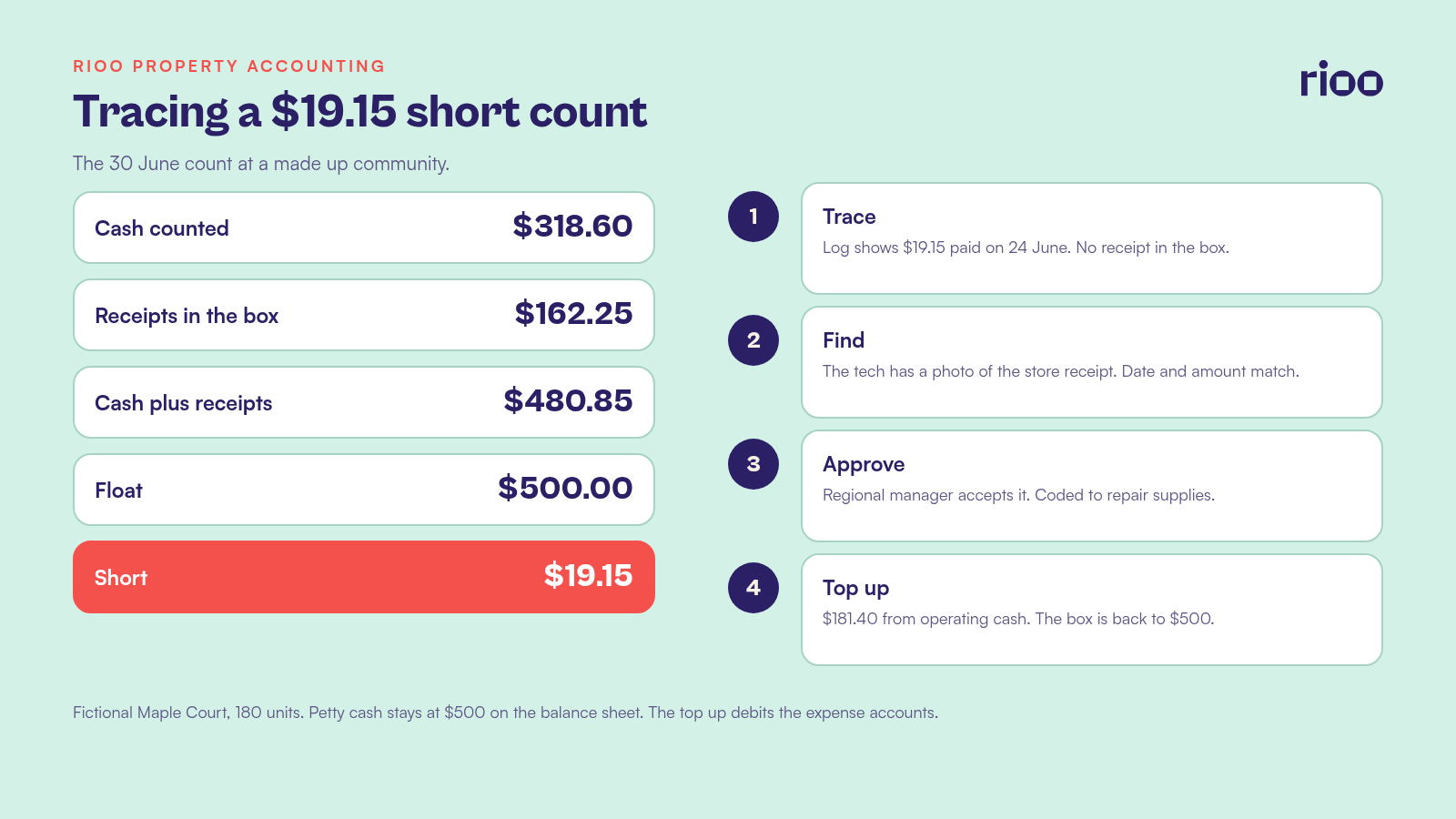
Back to the count. The cash was $318.60. The receipts came to $162.25: repair supplies $96.40, office supplies $41.85 and resident event supplies $24.00. Together that is $480.85. The float is $500, so the box was $19.15 short.
The custodian checked the log first. It showed a payout of $19.15 on 24 June to a maintenance tech for "hose bibb washers and tape." There was no receipt in the box. The tech found a photo of the hardware store receipt on his phone. It matched the date and the amount. The regional manager accepted the photo, the custodian attached it to the voucher, and the $19.15 went to repair supplies.
The top up request was $181.40. Here is how it lands:
| Account | Debit | Credit |
|---|---|---|
| Repair supplies | $115.55 | |
| Office supplies | $41.85 | |
| Resident events | $24.00 | |
| Operating cash, Maple Court | $181.40 |
The petty cash account itself does not move. It stays at $500, because the float was never changed. Cash of $318.60 plus the $181.40 top up brings the box back to $500.
If the photo had not turned up, the $19.15 would have gone to a cash over and short account. One short count is a note in the file. Three in a row at the same property is a conversation with the custodian.
Setting up and changing a float
Setting up a float is a transfer between cash accounts. Debit petty cash for Maple Court $500 and credit the operating bank account $500. No expense is recorded.
The petty cash account changes again only when you change the float itself. If spending drops and you cut the float to $300, the custodian returns $200 to the bank, and you credit petty cash $200. Keep that change separate from any top up so the trail is easy to read.
At a third party managed property, the float is usually the owner's money, funded from the property's operating account. Check the management agreement. Some agreements set a maximum float or ban petty cash. Spending charged to an owner must be coded to their property, never pooled across sites.
Where RIOO fits: petty cash in the NetSuite ledger
RIOO runs property accounting inside NetSuite, so each property's petty cash account sits in the same general ledger as its rent and expenses. Top ups can be entered as expense transactions coded to the property and account, with the scanned receipts attached. NetSuite roles and approvals keep the custodian and the approver separate, and system notes record who entered and approved each top up. See RIOO audit trail controls for how that record is kept.
Handover when the site manager leaves
A custodian change is a full count, done before the departing manager's last day. Both the outgoing and incoming custodians count, sign and date the sheet. Any shortage is settled before the handover is signed. If the box uses a code lock, change the code the same day.
Do not let the outgoing manager take receipts or the log home to "finish later." Everything stays in the box until the count is signed.
A clean handover sheet is the first thing an auditor asks for when a float looks odd. If you are building a PBC list for audit season, add the latest count sheet for every site.
When to close a float
Some sites no longer need cash. Some floats are no longer worth the effort. If spend stays under $50 a month for a quarter, close it. Do the same if staff can use a company purchase card with the same controls. Count it, return the cash to the bank, credit petty cash to zero and file the final sheet. Fewer floats means fewer counts, fewer handovers and less cash sitting in offices.
What auditors and site managers ask
How often should petty cash be reconciled?
At least monthly, at every change of custodian, and any time the box is topped up. Surprise counts once or twice a year help too.
Can the custodian approve their own top up?
No. A second person should review the receipts and release the cash. At very small sites, the property accountant can do the review from scanned receipts.
What if a receipt is lost?
Ask for a photo, a card statement line or a copy from the store. If none exists, record a signed missing receipt note with the date, amount, payee and purpose, and have a manager approve it. Repeat missing receipts are a warning sign.
Should petty cash be kept in the owner's trust account?
Rules for client money vary by state and by agreement. In general, the float is funded from the property's operating account and recorded as a separate cash account for that property. Confirm the setup with your accountant and the management agreement.