Can you evict a tenant in winter? In almost every US state, yes. The court case runs on its normal clock in January the same as in June. What changes in a few places is the day the household is actually removed. Washington, D.C. and Maryland postpone lockouts on freezing days. Seattle gives some households a defense to eviction from December 1 to March 1. Massachusetts limits removals to weekday business hours, which shrinks the calendar around the holidays.
So the practical answer for a property manager is this. Expect the judgment on schedule, but plan the move out date around the forecast and the holiday calendar. Keep billing use and occupancy while you wait, keep talking to the household, and record every postponement in the case file.
This is general information as of November 2026, not legal advice. Local rules change, and a few cities and counties add their own. Check the current text and confirm with your attorney before you schedule anything.
Four places with written winter rules
The table below covers the jurisdictions with clear written weather or winter rules for residential evictions. Each line was checked against the official source in November 2026.
| Where | Source | What triggers it | What happens |
|---|---|---|---|
| Washington, D.C. | D.C. Code 42-3505.01(k) | 8 AM forecast below 32°F at National Airport, precipitation falling at the unit, or a forecast above 95°F | No eviction that day. The U.S. Marshals move it to the next day the weather allows. |
| Maryland | Real Property 8-401(f)(2) | Temperature or next day forecast of 32°F or lower, a winter storm or blizzard warning, hurricane or tropical storm warnings, excessive heat warnings | The district's administrative judge stays the warrant day to day. It gets priority and must be carried out within 5 days after the weather clears. |
| Seattle | SMC 22.205.080 | The tenant would have to leave between December 1 and March 1, the household is moderate income, and the owner has more than four rental units in Seattle | The tenant can raise it as a defense. There are exemptions, such as owner move in, sale of a single family home, and criminal activity or nuisance. |
| Massachusetts | G.L. c. 239, section 3 | Applies all year | Removal only Monday to Friday, 9 AM to 5 PM, never on a legal holiday, after at least 48 hours written notice from the officer. |
Outside these four, check two things locally. First, whether the sheriff, marshal or constable has a holiday or cold weather practice. Second, whether the court publishes a holiday schedule for executions. Neither is written in a statute, but either can move your date.
How each rule works in practice
Washington, D.C.: the 8 AM forecast
The test is the National Weather Service forecast at 8 AM for the National Airport station. If it predicts a low under 32°F, nobody is evicted that day. The same applies while rain or snow is falling at the unit. A 2026 amendment added a third test: a forecast above 95°F.
The U.S. Marshals Service handles evictions in the District. On a weather day, it posts a notice at the property that the eviction will finish on the next permitted date. It also tries to reach the landlord or manager to agree on that date. There are narrow exceptions, each needing a specific court finding. For the wider process, see our D.C. eviction process guide.
Maryland: a stay that has a deadline
Maryland is stricter on paper and kinder to the landlord's calendar. The administrative judge must stay a residential warrant during extreme weather. Once the weather clears, the stayed eviction goes to the front of the queue. The statute says it must be completed within 5 days.
Several district courts publish their own administrative orders listing the same four conditions. Your sheriff's office follows the order for your district. Our Maryland eviction process guide covers the warrant of restitution and its 60 day window.
Seattle: a defense, not a postponement
Seattle works differently. Nothing in the city rule looks at the thermometer. The question is whether the move out would fall in the winter window. If it would, and the household qualifies, the tenant can raise the winter defense in court.
The city's renter pages describe qualifying households as those at or below 80% of area median income. The owner side test in the code is ownership of more than four rental housing units in Seattle. The city's page words that exemption more loosely, so read SMC 22.205.080 itself and the full exemption list before filing a case that would land in winter.
Massachusetts: fewer days to work with
Massachusetts has no temperature rule in chapter 239. The squeeze comes from the calendar. An officer can levy only on weekdays between 9 AM and 5 PM, and never on a legal holiday. With Christmas Day, New Year's Day and Martin Luther King Jr. Day in the window, a late December execution has fewer usable days.
Mass.gov also notes that an execution must be used within 3 months. Judges can also stay an execution for up to 6 months in some no fault cases, or 12 months where the tenant is disabled or over 60. See our Massachusetts eviction process guide for the earlier stages.
A lockout date that slides: one January in Maryland
Here is a worked example. The building, people and figures are made up.
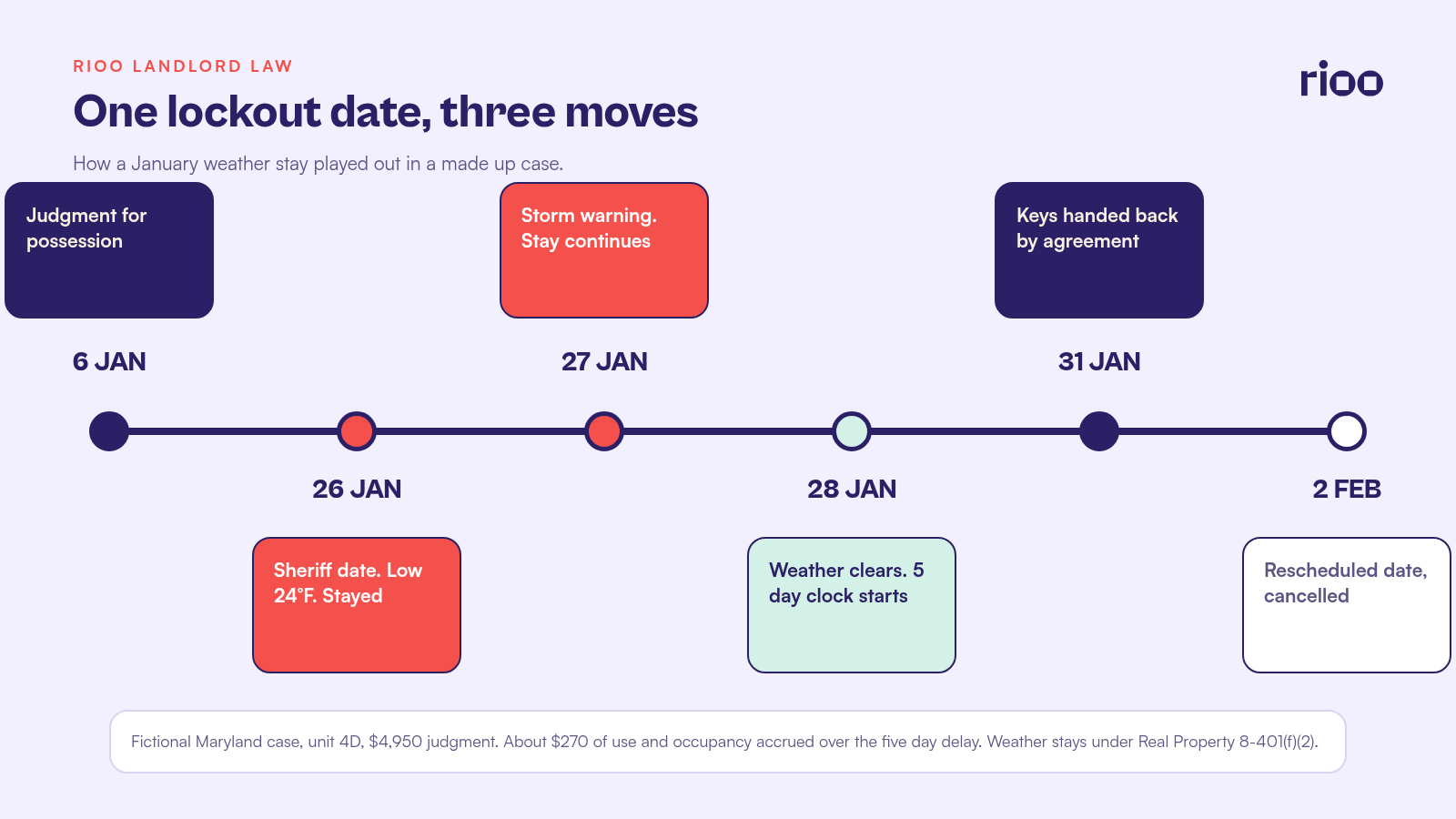
A 120 unit building in Baltimore County. Unit 4D owes $4,950, three months at $1,650. The court enters judgment for possession on Wednesday 6 January 2027. The tenant does not leave within the time allowed. The manager, Priya, requests the warrant and the sheriff schedules the eviction for Tuesday 26 January.
| Date | What happened | What Priya did |
|---|---|---|
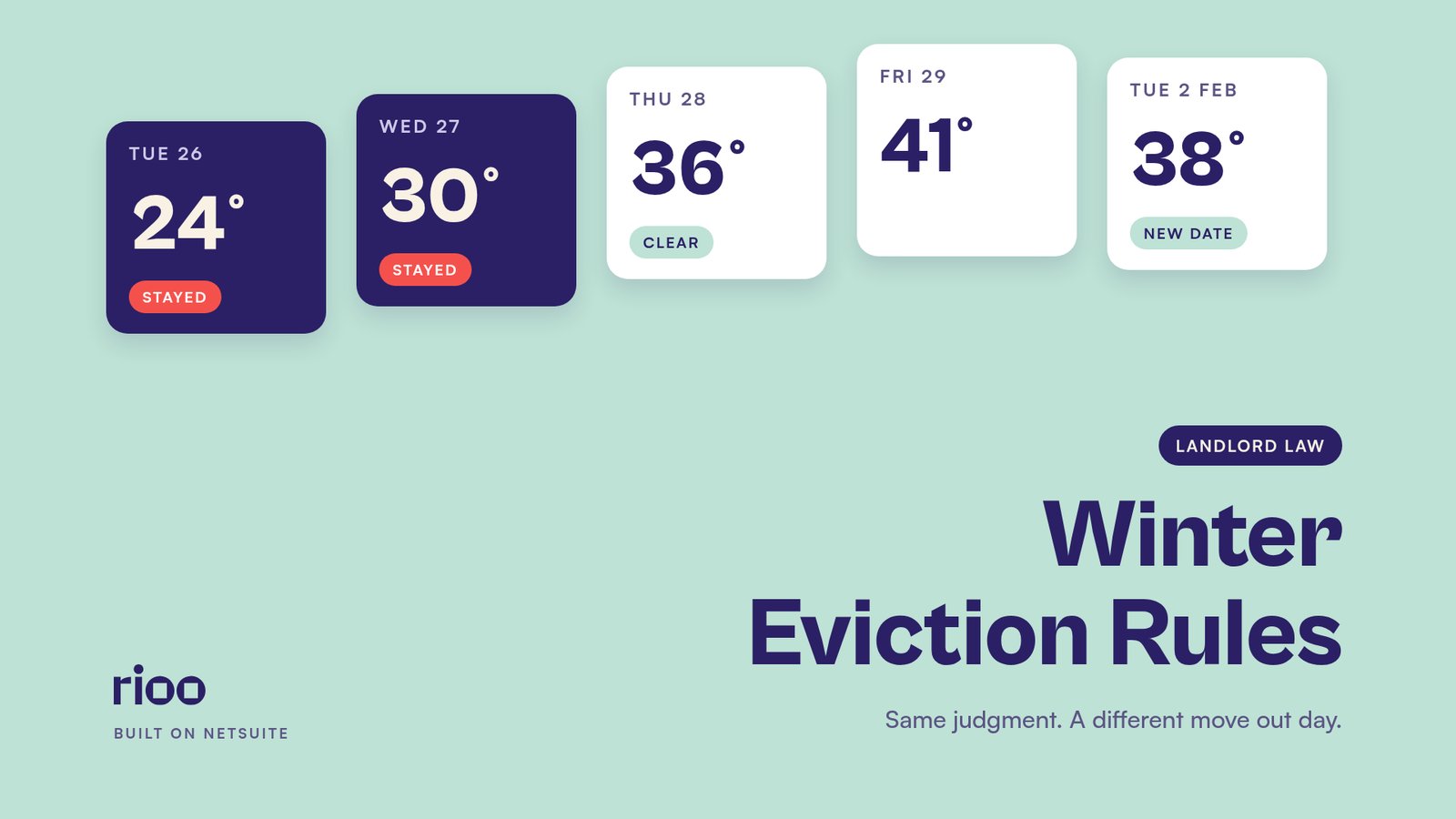
| Mon 25 Jan | Forecast for Tuesday: low of 24°F | Called the sheriff's civil office. Stay confirmed. Told the maintenance lead to hold the locksmith. |
| Tue 26 Jan | Stayed for weather | Logged the stay in the case file with the forecast screenshot. |
| Wed 27 Jan | Forecast still under 32°F, winter storm warning issued | Stay continued. Sent the household a short message offering a meeting about a move out date. |
| Thu 28 Jan | Warning lifted, forecast low 36°F | Asked the sheriff for the new date. The 5 day priority rule applies from here. |
| Tue 2 Feb | Eviction rescheduled | Booked the locksmith and a two person crew for 9 AM. Prepared the move out inspection. |
On 29 January the tenant calls. "My sister can take us on Sunday. Can we just hand you the keys?" Priya agrees in writing. The keys come back on Sunday 31 January and the sheriff date is cancelled through counsel.
What did the delay cost? Five days of use and occupancy, from the first sheriff date to the key handover. At $1,650 a month that is about $270, and it goes on the tenant ledger with the judgment balance. The locksmith's late cancellation fee was $75. A clean handover avoided a crew day and a storage problem. A short, dated record of every call made the owner report easy to write.
Planning the move out date around the forecast
Treat a winter eviction date as a range of days. These are the steps that keep the file tidy.
- When you request the warrant or execution, ask the officer's office how they handle weather days and holidays. Write the answer in the file.
- Check the forecast two days out and again at 8 AM on the day. In D.C. the 8 AM National Airport forecast is the one that counts.
- Hold your locksmith and crew on a "confirm by 8:30 AM" basis. Agree a cancellation fee in advance.
- Keep a dated log of each postponement and the reason given. Owners ask, and so do courts.
- Watch your deadlines. A stayed warrant still sits inside the rules for how long it stays valid. In Maryland a warrant can expire if no action is taken within 60 days. In Massachusetts the execution lasts 3 months.
- Know the holiday list for your court and officer before you choose dates in late December.
What does not change while you wait
A weather stay or winter defense does not cancel a judgment or wipe out a debt. Rent or use and occupancy keeps accruing under your lease and local rules. Your duty to keep the unit habitable continues too. If the heat fails in a unit under an eviction stay, it still needs fixing the same day.
Some tenants can still pay their way out. Maryland gives a right of redemption in many nonpayment cases if the full amount the court found due is paid before the eviction is carried out. Limits apply for repeat judgments, so check section 8-401(h). A week's weather delay can be the week the money arrives.
Do not try to speed things up yourself. Changing locks, removing doors or shutting off utilities to push a tenant out is unlawful self help almost everywhere. In winter it is also dangerous.
Offers that can beat the calendar
A voluntary move out often lands sooner than a weather delayed lockout. Two tools help.
The first is a written move out agreement with a firm date, a key handover time and a ledger outcome both sides understand. Some owners add a relocation payment. Our guide to cash for keys shows how to price that and what to put in writing.
The second is a payment arrangement if the household can catch up. If the arrears came from a short gap, such as a lost seasonal job, a plan may cost less than a turnover in February. Put any plan in writing and run it through your attorney if a case is already filed.
What landlords ask about winter evictions
Is there a national winter eviction ban in the US?
No. There is no federal rule that stops residential evictions in cold weather. The rules are state and local, and many places have none.
Can a landlord file an eviction case in December?
Yes. Filing and court hearings run on the normal schedule in the places above. The winter rules affect the removal date. Seattle's winter defense is raised in the court case itself, so plan for it before you file.
Does the D.C. rule look at the high or the low temperature?
The statute bars eviction on a day the 8 AM forecast says the temperature at National Airport will fall below 32°F. If any part of the day is forecast below freezing, expect a postponement.
Does a weather delay reset Maryland's 60 day warrant clock?
The statute counts from the later of the order for the warrant or a date the court extends. Ask your attorney how your district treats weather stays before the window gets tight.
Do utility shutoff moratoriums stop evictions?
No. Winter utility shutoff protections are separate rules for utility companies. They do not pause an eviction case, though they can affect a tenant's bills in the same months.
Keeping eviction files clean in RIOO
RIOO is property management software built on NetSuite. The tenant ledger is a NetSuite customer record, so judgment balances, use and occupancy charges and any payments sit in one place with the general ledger. Staff can log calls, messages and postponements on the tenant record with dates, which gives you the trail an owner or attorney asks for. Collections and escalation steps can run through RIOO rent collection workflows. Locksmith and crew bookings can be raised as service requests so the cancellation fees land on the right property.