"We'll keep paying rent through the end of the term. We just won't reopen after January."
Every retail landlord gets a version of that call. The tenant is polite, the rent is current and the store is about to go dark. What happens next depends almost entirely on one paragraph signed years earlier: the continuous operation clause.
A continuous operation clause is also called an operating covenant. It requires a retail tenant to keep its store open and trading during set hours for all or part of the lease term. It protects the landlord's percentage rent, the shopping center's foot traffic and the cotenancy promises made to other tenants. My view is that the covenant matters less than the remedy written beside it. A landlord who negotiates the remedy at signing has options in February. A landlord who relies on the bare covenant usually ends up with a lawsuit or a dark box.
What the clause actually promises
A typical clause has four parts. The tenant must open for business on a set date. It must operate in the whole premises, fully stocked and staffed. It must keep the center's standard hours, or its own minimum hours. And it must do this "continuously" for a stated period, which may be the full term or a shorter one.
Look for what the clause leaves out. Closures for remodels, inventory counts, holidays and events beyond the tenant's control are normally carved out. Some leases give the tenant an express right to "go dark" after a number of years. Others are silent, and silence is where disputes start.
The clause also sits next to other terms that depend on it. Percentage rent needs sales. Retail cotenancy clauses in neighboring leases often name a key tenant that must stay open. An exclusive use clause may stop you from putting a similar trade in the empty space quickly.
Why paid rent can still cost the center money
A dark tenant that pays base rent looks harmless on the rent roll. The damage shows up in places the rent roll does not show.
First, percentage rent stops. A closed store reports no sales, so any overage rent disappears. Our guide to breakpoints and overage rent shows how quickly that line adds up for a busy tenant.
Second, cotenancy clauses can trigger. If a neighbor's lease says it may pay reduced rent when a named store closes, one closure cuts income from several units.
Third, traffic falls. Shoppers who came for the closed store stop coming. Smaller tenants see it in their sales first, and you see it at renewal.
Worked example: a junior anchor goes dark
Here is a fictional example with round numbers. The center, tenants and figures are made up.
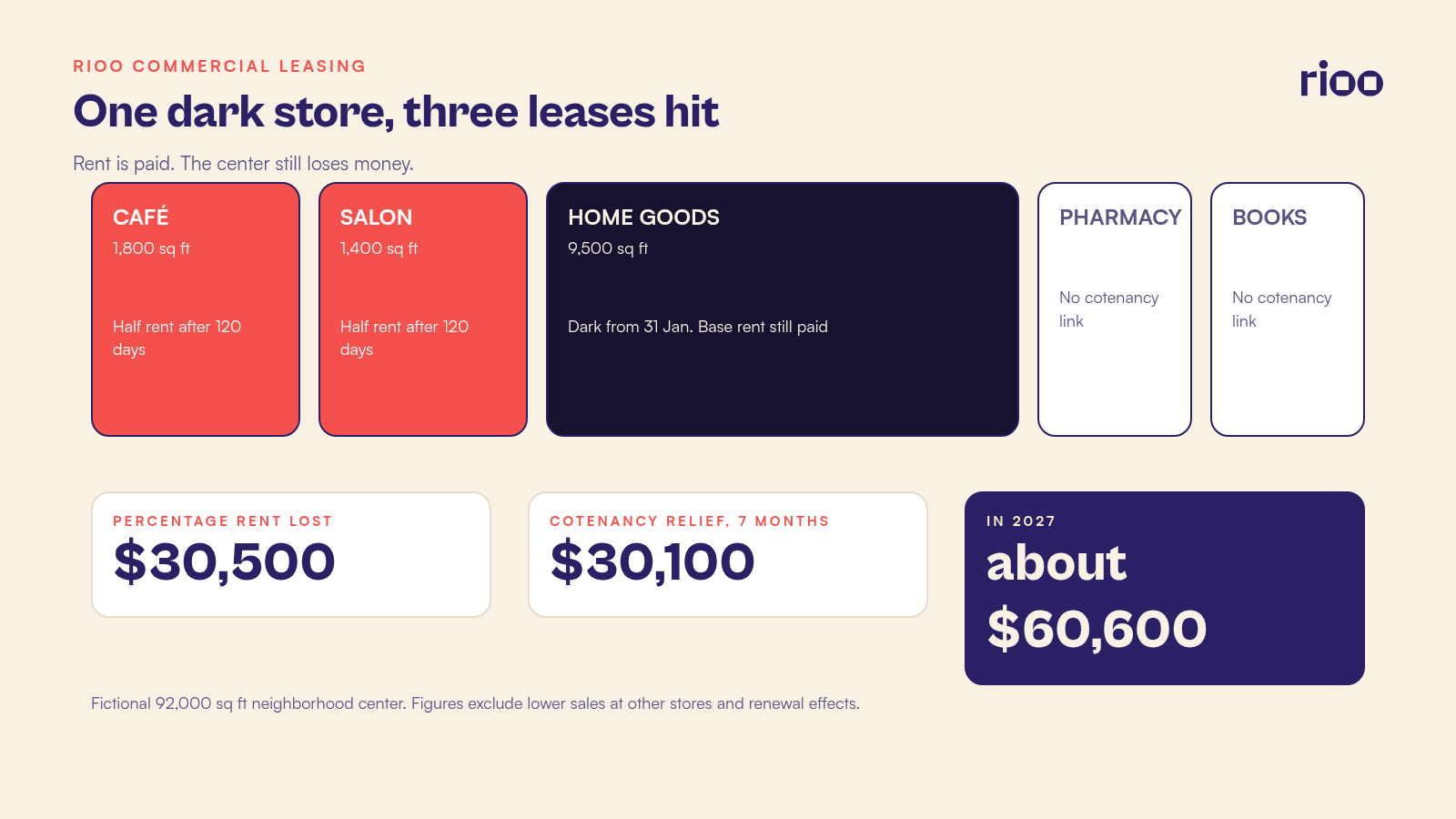
A 92,000 square foot neighborhood center. A 9,500 square foot home goods store pays $21 per square foot, or $199,500 a year. It also pays 5% of sales above a natural breakpoint of $3,990,000. Last year it sold $4,600,000, so percentage rent was $30,500.
Two neighbors have cotenancy clauses tied to the home goods store. A 1,800 square foot café pays $61,200 a year. A 1,400 square foot salon pays $42,000. If the home goods store is dark for more than 120 days, each may pay 50% of base rent until it reopens or is replaced.
The store closes on 31 January 2027 and keeps paying base rent. The 120 days run out at the end of May. Here is what the rest of 2027 looks like.
| Line | Annual amount | Effect in 2027 |
|---|---|---|
| Base rent, home goods | $199,500 | $0, still paid |
| Percentage rent, home goods | $30,500 | About $30,500 lost |
| Café, half rent from early June | $61,200 | About $17,850 lost over 7 months |
| Salon, half rent from early June | $42,000 | About $12,250 lost over 7 months |
| Total | About $60,600 |
That $60,600 is before any fall in other tenants' sales, and before the renewal talks with the café and salon. It is also money the landlord cannot easily recover by suing a tenant that is paying its rent on time.
A court order to reopen is hard to get
Many landlords assume the clause lets them force the store open. In practice that is difficult. Courts in many US states are reluctant to order a business to keep trading, partly because a judge cannot supervise a shop's daily running. They tend to look at money damages instead.
Damages bring their own problem. The landlord has to prove what the closure cost, including lost percentage rent and the knock on effect on other tenants. Those numbers are real, but they are estimates, and estimates get argued over.
Results vary by state and by the exact words in the lease. Some courts do enforce clear covenants. That uncertainty is the whole case for agreeing the remedies up front. Talk to your counsel about how courts in your state treat these clauses before you rely on one.
Remedies to agree at signing
None of these is unusual, and each gives you a choice on the day the call comes.
A recapture right
If the tenant stops operating for a set period, say 90 days, the landlord may end the lease and take back the space. This is the strongest tool, because it lets you lease the space to someone else. Price it honestly. Leasing 9,500 square feet again can mean months of downtime, tenant improvement costs and a broker's commission. In the example above, collecting $199,500 a year from a dark tenant may beat recapture in a soft market.
Go dark rent
The lease can say that if the tenant closes, rent changes to a set figure. One common approach adds the average percentage rent from the last two full years to base rent. That keeps the overage line alive even with the lights off.
A link to cotenancy exposure
Some landlords write in that a dark tenant reimburses rent reductions the closure triggers under other leases. Tenants push back hard on this. Even a cap, such as one year of reductions, changes the conversation.
A defined operating standard
Set minimum hours, staffing and stock levels in plain terms. "Open 10 AM to 8 PM Monday to Saturday" is easier to enforce than "customary hours."
Notice and a short cure period
Give the tenant a written notice and, say, 10 days to reopen before remedies apply. It keeps you fair and gives you a clear record.
What tenants will ask for in return
Retailers know these clauses well. Expect requests for a go dark right after three to five years, carve outs for remodels and inventory days, and a release if the center's own anchor closes. National chains may refuse any continuous operation duty beyond the opening date.
Trade these points rather than refuse them. A go dark right in year four, paired with a recapture right for the landlord, gives both sides an exit. A tenant that agrees to go dark rent usually wants a lower base rent or a longer runway before the covenant bites.
Holiday hours: the small version of the same problem
November and December test the clause in a quieter way. Centers extend hours for the holidays, and some tenants stay on their usual schedule. A store that closes at 6 PM while the rest of the center stays open until 9 PM hurts the whole strip.
Check whether your leases require tenants to follow the center's posted hours or only a fixed minimum. If it is the posted hours, send the holiday schedule in writing by early November. Log which tenants confirm. A short email record now saves an argument in January about whether the clause was breached.
Keeping the clause alive after signing
An operating covenant is only useful if someone is watching. Abstract the clause into your lease records with its exact hours, carve outs, cure period and remedy. Track monthly sales reports, since a sudden drop is often the first sign a closure is coming. Note the date any go dark right opens.
Watch for the softer signs too. Shorter hours, thin shelves and staff cuts tend to come before a closure. Our piece on commercial tenant default warning signs covers what to look for.
Retail lease terms in RIOO
RIOO is property management software built on NetSuite. Lease clauses, critical dates and percentage rent terms can be recorded on the lease, with sales reports collected and percentage rent billed through the same tenant ledger. Alerts can flag the date a go dark right or recapture window opens. Because the ledger lives in NetSuite, rent reductions under cotenancy clauses post to the right property and show up in owner reporting. See RIOO commercial lease administration for how lease records are set up.
Continuous operation clause FAQ
What is a continuous operation clause in a lease?
It is a lease term that requires a retail tenant to stay open and trading during set hours for a stated period. It is also called an operating covenant.
What does it mean when a tenant goes dark?
The tenant closes the store but keeps the lease. It may keep paying base rent while the space sits empty.
Can a landlord force a tenant to stay open?
It depends on the lease and the state. Courts are often reluctant to order a business to keep operating, so landlords usually rely on remedies written into the lease, such as recapture or go dark rent.
What is a recapture clause?
It lets the landlord end the lease and take back the premises if the tenant stops operating. Some leases also allow it when the tenant tries to assign or sublet.
Is percentage rent owed when the store is closed?
Not unless the lease says so. With no sales there is no overage. A go dark rent clause can replace it with a fixed amount.