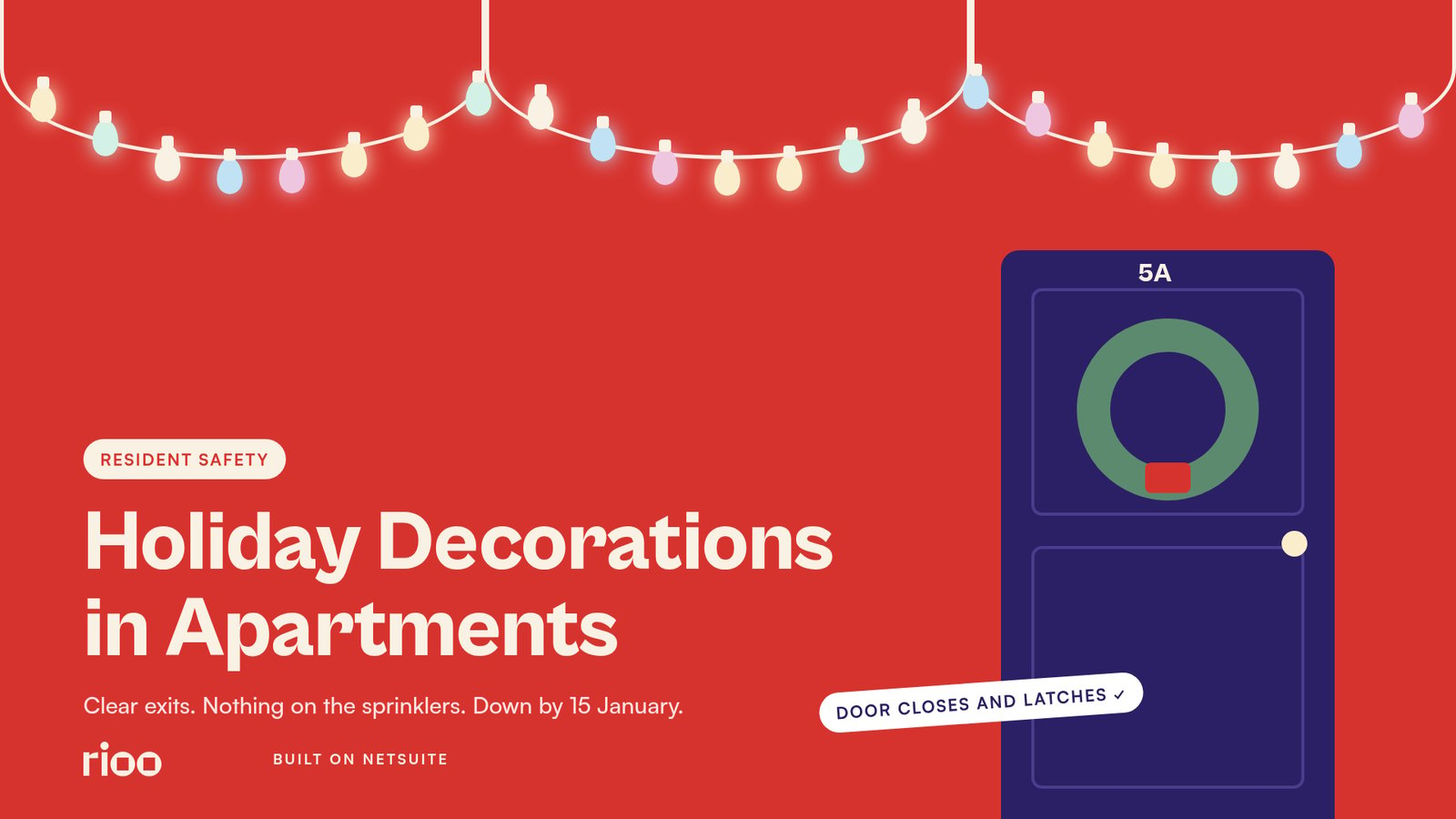
Somewhere in your portfolio this December, a resident will run an extension cord under a closed door to power a balcony light display. Another will prop a real fir tree against a hallway sprinkler pipe. Neither will think of it as a fire risk. A holiday decorations policy exists for those two moments.
A good apartment holiday decorations policy lets residents decorate inside their own units with few limits. It sets firmer rules for shared spaces, doors, balconies and anything with a flame or a plug. It keeps exits, sprinklers, fire alarms and fire doors clear. It names a take down date. It also applies the same rules to every holiday and every resident. Send it to residents in the third week of November, before the first lights go up.
Fire and building codes differ by city and county. The points below follow the model International Fire Code that many places adopt, but your local version and your fire marshal have the final say.
Run every decoration through four questions
When a resident asks "Can I put this up?", you need an answer in under a minute. These four questions get you there. They also make the rule easy to explain, because each one points to a specific risk.
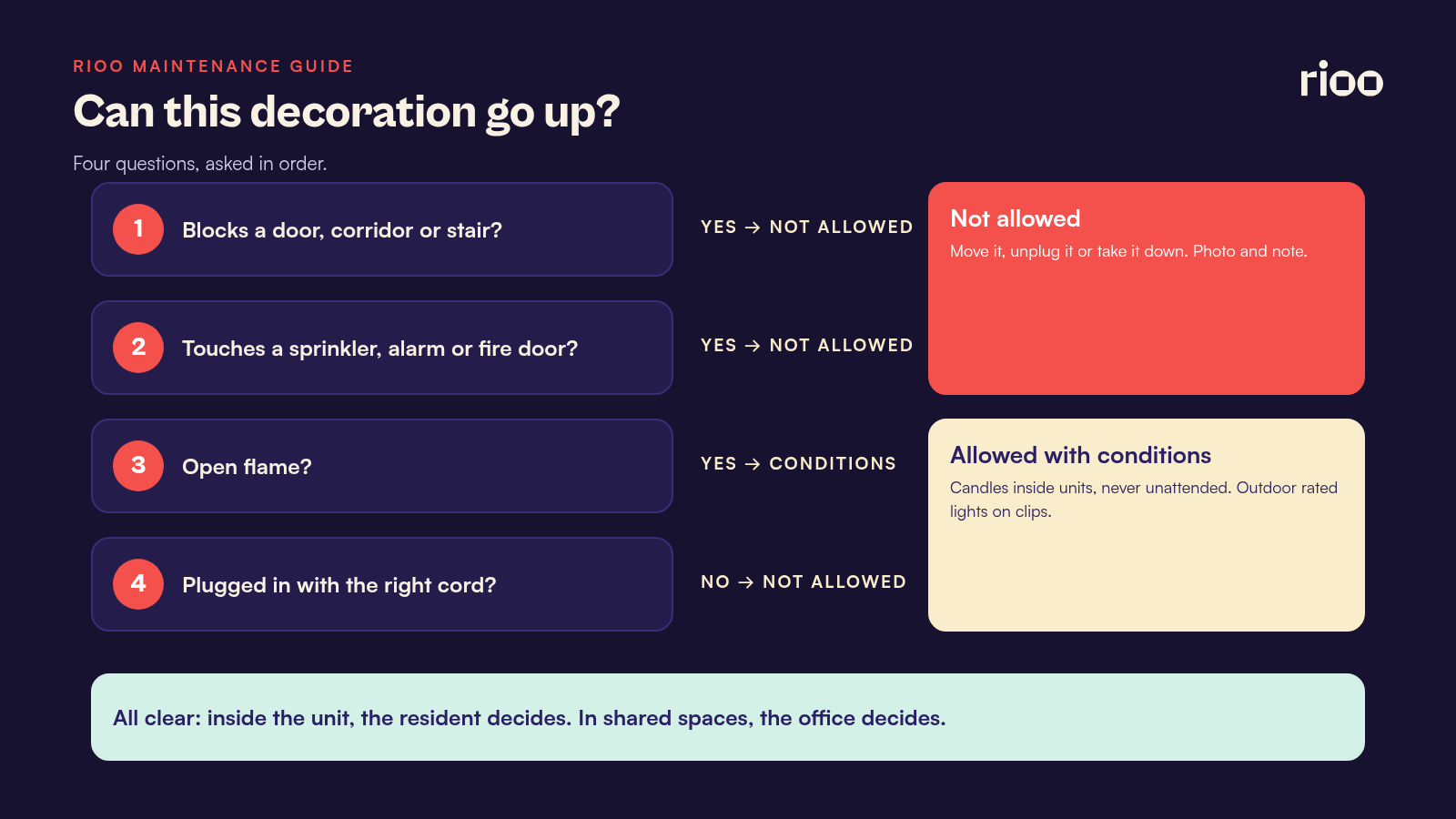
1. Does it block a way out?
Doors, corridors, stairs and balconies used for escape must stay clear. That means no trees, inflatables or furniture moved into hallways. Garland on a corridor wall is fine if it stays flat and does not narrow the path.
2. Does it touch fire equipment?
Nothing hangs from sprinkler heads or sprinkler pipes. Nothing covers smoke detectors, pull stations, extinguishers or exit signs. Fire doors to stairwells must close and latch on their own, so no wreaths that stop them closing and no tape on the latch.
3. Does it have an open flame?
Candles start more December fires than anything else on this list. Decide your open flame rule once and apply it to every resident, whatever they celebrate. A common middle ground is battery candles in shared spaces and real flames only inside units, never left burning in an empty room or near curtains.
4. Is it plugged in, and is the cord rated for the spot?
Outdoor lights need outdoor rated cords and plugs. Cords never run under doors, rugs or through windows that then close on them. Daisy chained power strips are out. If a breaker trips twice, the display comes down until maintenance has looked at it.
If the answer to all four is safe, the last question is location. Inside the unit, residents decide. In shared spaces, the office decides.
Trees: real, artificial and where each can stand
Real trees raise the hardest questions, so it helps to know what the model fire code says. Section 806 of the International Fire Code generally prohibits natural cut trees in apartment buildings. It then makes two exceptions. Trees are allowed inside individual dwelling units. They are also allowed in other areas protected by an approved automatic sprinkler system.
In practice that gives you a simple house rule:
- Inside a unit: real or artificial trees are allowed, kept watered, away from heaters and clear of the door.
- Lobby or clubhouse with sprinklers: a real tree is possible, with a sturdy stand that holds at least two days of water, checked daily.
- Lobby or clubhouse without sprinklers: artificial trees only, labeled flame retardant.
- Hallways and stairwells: no trees of any kind.
Your city may have adopted a different edition or added its own limits. A short call to the local fire prevention office before December settles it.
Balconies, doors and the outside of the building
Exterior decorations draw the strongest opinions. Keep these rules about safety and damage, and leave taste alone where you can.
For balconies and patios, allow lights rated for outdoor use. Ask residents to attach them with removable clips, never nails, screws or staples in railings or siding. Inflatables need to stay inside the balcony line and away from neighbors' windows. Nothing can hang over the railing in a way that drips, blows loose or blocks the unit below.
For front doors, wreaths on over the door hangers are usually fine on unit entry doors. Check that the door still closes and latches, and that the peephole and unit number stay visible. Unit doors that open onto an interior corridor are often fire rated, so ask residents not to drill or screw into them.
Building facades, roofs and landscaping belong to the property. Any lights there go up through the office, using your own vendor and certificate of insurance.
Thursday 10 December: one building walk
Here is a worked example of a mid December walk. The building and residents are made up.
A 64 unit, four storey building with sprinklers in corridors and the lobby, no sprinklers in the separate clubhouse. The maintenance lead, Luis, walks every floor at 10 AM with a phone and a printed copy of the policy. He finds seven items in 40 minutes.
| Where | What he found | Outcome |
|---|---|---|
| Unit 5A door | Extension cord run under the closed door to the corridor outlet | Unplugged on the spot, note left, resident called by noon |
| Floor 2 corridor | Garland tied to a sprinkler pipe | Removed, photo taken, resident reminded by message |
| Clubhouse | 6 foot real fir donated by a resident | Swapped for the office's artificial tree that afternoon |
| Stair B, level 4 | Wreath on the stair door holding it slightly open | Moved to the wall beside the door |
| Unit 1F patio | Inflatable reindeer spilling onto the shared path | Resident moved it back inside the patio line |
| Unit 4A window | Two lit candles on the sill, unit empty | Logged. Luis called the resident, who came home from the gym in 10 minutes |
| Lobby | Office tree stand water low | Refilled, check added to the daily opening list |
The message to the resident in 5A was short and friendly:
"Hi Maya, it's Luis from maintenance. Your door light display looks great. The cord under the door is a fire risk, and the door can't latch with it there, so I've unplugged it. If you'd like a plug near the door, I can check the outlet inside your entry tomorrow. Thanks for understanding."
None of these turned into a lease violation. Two residents got a second reminder later that week. That is what a sensible policy should produce: quick fixes and a short record.
Where RIOO fits
RIOO is property management software built on NetSuite. The policy can go out to residents through the tenant portal. Building walks can run as inspections on a phone, with photos attached to the unit. If a cord or a tripped breaker needs a technician, the finding becomes a service request without retyping. Use RIOO property inspection software to schedule the December walk and the January follow up as recurring tasks.
Shared spaces the office decorates
Lobbies, clubhouses, mail rooms and leasing offices are your responsibility, and residents will copy what they see there. Use flame retardant decorations, LED lights on timers and nothing within reach of fire equipment.
Keep it inclusive without making it a debate. A simple winter theme with lights and greenery works for everyone. Residents may ask to add their own items to a shared space. Set one rule for all requests, such as a sign up board and a size limit, and approve them in order.
Add the decorations to your regular life safety inspection schedule for the season. One extra check of sprinklers, extinguishers and exit lighting after the decorations go up takes an hour and catches the usual problems.
Policy wording you can adapt
Adjust this to your building and have it reviewed before you send it.
- Residents may decorate inside their units. Decorations must not block doors or windows used for escape.
- Nothing may be attached to, hung from or placed over sprinklers, smoke alarms, fire alarm devices, extinguishers, exit signs or fire doors.
- Real trees are allowed inside units only. Keep them watered and at least three feet from heat sources.
- Exterior and balcony lights must be rated for outdoor use and attached without nails, screws or staples.
- No cords under doors or through windows. No connected power strips.
- Corridors, stairs and lobbies are decorated by management only.
- All exterior and balcony decorations must be removed by 15 January.
- Damage from decorations will be repaired and charged as set out in your lease.
The space heater rule belongs next to this one, since both cover heat and cords in winter. See our space heater policy for rentals.
When the decorations come down
A firm take down date matters more than people expect. Real trees dry out fast after New Year. Exterior lights left up into February start to look like neglect to prospects.
Send a reminder on 5 January with the 15 January deadline. Offer a tree drop point and the city's collection dates. After the deadline, a polite notice comes first. A formal lease violation warning letter follows only if the display stays up.
Small nail holes, adhesive marks and scuffs from decorations come up again at move out. Whether they count as damage depends on size and repair cost. Our guide to normal wear and tear vs damage shows how to tell them apart.
Quick answers on holiday decorations
Can a landlord ban holiday decorations?
A landlord can set reasonable rules for safety, damage and shared spaces, especially in a written policy or lease. Rules should apply the same way to every resident and every holiday. A blanket ban inside private units is hard to justify and tends to cause friction.
Can I hang Christmas lights on my apartment balcony?
Usually yes, if the lights and cords are rated for outdoor use, attached without nails or screws, and taken down by the building's deadline. Check your community rules first.
Who pays if decorations damage the unit?
The resident pays for damage beyond normal wear and tear, as the lease sets out. Small, easily filled holes may count as normal wear in some cases.
Can management remove decorations without asking?
In shared spaces, yes, when something creates a hazard. Inside a unit, follow your state's entry rules unless there is an emergency. Leave a note and call the resident.
Are real Christmas trees allowed in apartments?
Under the model International Fire Code, natural cut trees are allowed inside apartment units. They are restricted in other parts of the building unless those areas have sprinklers. Your local fire code may differ.