An outage in an apartment building is one of two problems. Either the utility has lost power to the area, and your job is to keep people safe while you wait. Or something inside your building has failed, and your job is to get it fixed. You need to know which one you have within 15 minutes, because every later decision depends on it.
An apartment power outage plan is a written runbook for that night. It says who checks the cause and who contacts residents who rely on powered medical equipment. It covers elevators, heat, water and doors. It also sets the point where a long outage turns into warming rooms or hotel stays. Write it in the fall, print it, and keep a copy where a flashlight can find it. Below is the version I would hand a new site team, broken into the hours when each job matters.
The first 15 minutes: work out whose outage it is
Residents will call before you have any facts. Give the first caller a short, honest answer: "We know. We are checking the cause now and will update you within 30 minutes." Then find out the size of the problem.
Look outside the building
Are the streetlights and the building across the road dark? Check the utility's outage map and report the outage by phone or app. If the whole block is out, the cause is almost certainly on the utility side. Write down the time you reported it and any reference number.
Look inside the building
If neighbors have power and you do not, the fault is probably yours. Send the maintenance lead to the main electrical room. A tripped main breaker, a failed transformer on your side of the meter or a burnt cable are jobs for a licensed electrician, not the on call tech. If only one unit or one floor is dark, check the unit panel and any external breaker by the meters before you call anyone out. The utility will not touch equipment it does not own.
Smell, sound and smoke
Any smell of burning, any buzzing from an electrical room, or any smoke means you call 911 first and treat it as a fire. Do not reset breakers that trip again straight away.
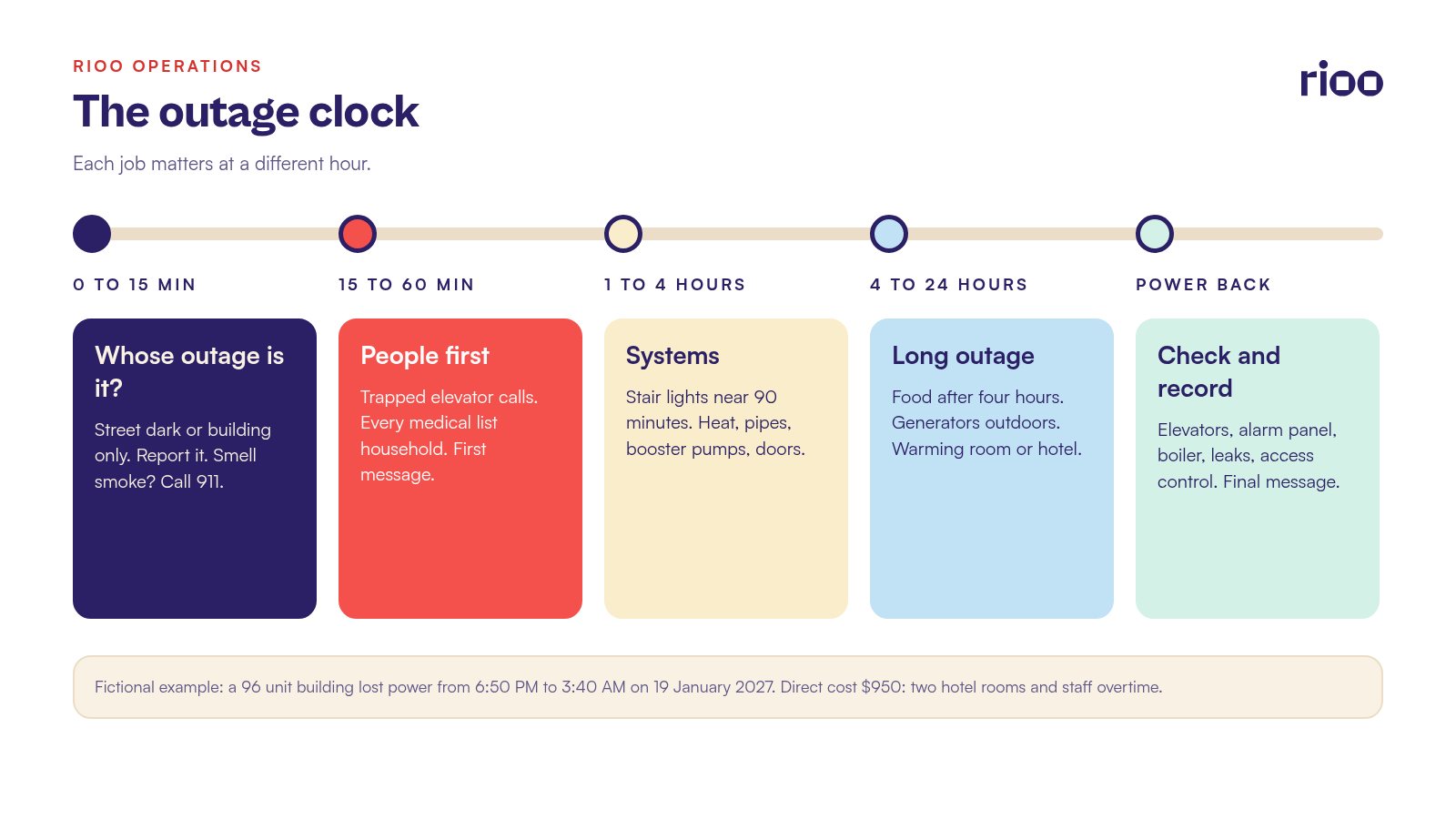
Minutes 15 to 60: people who cannot wait
Once you know the outage is real and not a single breaker, move to the people at risk. This is the hour that decides whether the night goes well.
Elevators
Ask the front desk or the on call phone whether anyone is in an elevator car. If someone is trapped, call the elevator company's emergency line and the fire department. Stay on the phone with the person in the car if the intercom works. Then put signs on every elevator door on every floor so nobody waits for a car that will not come.
The medical list
Keep a short, voluntary list of residents who told you they rely on powered equipment such as oxygen concentrators, home dialysis or powered wheelchairs. Residents choose to be on it, and you keep it private. Call each household in the first hour. Ask how long their backup batteries last and whether they have somewhere to go. If a resident's life depends on power and the outage could run long, tell them to call 911. Your staff are not medical staff, and nobody on the team should promise power they cannot deliver.
The first message to everyone
Send one message to all residents by text and email, and post a printed copy in the lobby. Keep it short:
- What happened and what you know about the cause.
- The utility's estimate, if there is one, labeled as the utility's estimate.
- Elevators are out. Use stairs with a flashlight.
- Do not use gas stoves, ovens or grills to heat a unit.
- When the next update will come.
Hours 1 to 4: heat, water and doors
A building without power loses more than lights. Walk the systems in this order, because each one fails on a different clock.
Emergency lighting
Battery exit signs and stair lights are usually designed to run for about 90 minutes. After that, stairwells can go dark. Have staff walk the stairs with headlamps and place battery lanterns at landings if the outage looks long. Never prop open a fire door to let light through.
Heat and frozen pipes
Boilers, furnaces and heat pumps all need power to run, even gas units. In cold weather, a well sealed apartment might lose a degree or two an hour. Vacant units, stairwells and spaces along outside walls get cold first. Open cabinet doors under sinks in vacant units. If the building has a pipe freeze risk, look at the steps in our guide to frozen pipes in a rental before midnight, not after.
Water pressure
Taller buildings often use electric booster pumps. Upper floors may lose water pressure within an hour. Tell residents on those floors to fill a few containers while some pressure remains.
Doors, gates and access
Electronic locks, garage gates and intercoms behave differently in a power cut. Some fail open, some fail locked, some run on a battery that dies. Know which yours do before the night comes. Put a staff member at the main entrance if doors fail open, and manually close and check the garage gate.
Hours 4 to 24: when the outage runs long
If the utility's estimate passes four hours, start making the bigger calls. Write down each decision and the time you made it.
The refrigerator keeps food cold for about four hours with the door shut, according to Ready.gov guidance on power outages. Tell residents that, and tell them to keep fridges and freezers closed. The same page says generators, camp stoves and charcoal grills must run outdoors, at least 20 feet from windows, doors and attached garages. Say that plainly in your second message. Carbon monoxide poisoning after outages is a real risk, and the building is full of people trying to stay warm.
Next, decide on shelter. Options in order of cost:
- A warming room in a space that still has power, such as a clubhouse on a separate feed or a building nearby.
- Local warming centers run by the city or county. Share the address and hours.
- Hotel rooms for residents on the medical list, or for every household if heat is lost for a long period in freezing weather.
Some cities set written rules here. New York City is one example. Local Law 98 of 2013, as summarized by HPD, requires owners to post a temporary emergency notice in common areas. That applies once they learn a utility outage will last more than 24 hours. Check your own city's rules, your lease, and your owner's insurance before you promise rent credits or hotel costs. Who pays usually turns on whether the cause sat in the building or on the grid, and that is a question for the owner and counsel.
A worked night: 96 units, 8 hours 50 minutes
Here is a made up example of how a plan holds up. The property is a six storey, 96 unit building with two elevators, four households on the medical list and three vacant units. It is Tuesday 19 January 2027 and 18°F outside.
| Time | What happened | Who acted |
|---|---|---|
| 6:50 PM | Power fails. The block is dark. Utility outage reported, reference logged. | On call manager |
| 6:58 PM | One resident trapped in elevator 2 between floors 3 and 4. Elevator company and fire department called. | Front desk |
| 7:10 PM | First message to all residents. Lobby notice posted. Signs on elevator doors. | Leasing agent |
| 7:25 PM | Resident freed from elevator 2 by firefighters. | Fire department |
| 7:40 PM | All four medical list households reached. One has 3 hours of battery left on an oxygen concentrator. | Manager |
| 8:20 PM | Stair lights fade. Lanterns placed on every landing. | Two maintenance techs |
| 9:30 PM | Utility estimate moves to 4 AM. Cabinet doors opened in the three vacant units. | Maintenance lead |
| 10:00 PM | Two hotel rooms booked for medical list households. Second message sent with carbon monoxide warning. | Manager, owner approval by phone |
| 1:00 AM | Unit temperatures checked in three occupied units: 57°F to 59°F, down from 68°F. | Maintenance lead |
| 3:40 AM | Power returns. Elevators tested and returned to service at 4:15 AM. | Elevator company |
The direct cost of that night was small. Two hotel rooms at $139 came to $278. Two staff working eight hours of overtime at $42 an hour came to $672. That is $950 in total. The costly version of the same night is different. Nobody calls the oxygen concentrator household, or a vacant unit's kitchen pipe freezes and floods the unit below. The plan exists to prevent those.
Generators: what they can and cannot do
Many apartment buildings have a generator wired for life safety loads such as fire alarms, some emergency lighting and sometimes one elevator. It usually does not power units. Know exactly which circuits yours covers, how much fuel it holds and how many hours that gives you at full load. Test it under load on a schedule and write the result down.
If you rent a portable generator during a long outage, an electrician connects it, never a staff member. It goes outside, far from air intakes, windows and doors. Residents should hear the same rule in your messages: no portable generators on balconies, in garages or in hallways.
After the lights come back
The work does not stop when power returns. Do these in the first two hours:
- Test each elevator before releasing it, or wait for the elevator company to do it.
- Check that the fire alarm panel is clear of trouble signals.
- Walk the boiler room and confirm the heat restarted.
- Look for leaks in vacant units, stairwells and along outside walls.
- Reset access control, gate and intercom systems and confirm they lock.
- Send a final message: power is back, how to report a problem, and when you will follow up.
Within a week, hold a short review. Which steps ran late? Did the medical list have stale numbers? Did the stair lights last as long as you expected? Change the runbook, then reprint it. If your team handles after hours calls through a triage list, our guide to emergency maintenance requests covers how to sort outage calls from the routine ones. Larger events with damage or injuries follow our major incident response guide.
Short answers for the night of an outage
Is a landlord responsible for a power outage?
A landlord is generally not at fault for a grid outage caused by weather or utility equipment. A landlord is generally responsible for the building's own electrical system, such as wiring, panels and equipment on the owner's side of the meter. Local habitability rules also set duties for heat and safety, so check your state and city.
Do tenants get a rent credit after an outage?
It depends on the cause, the length, the lease and local law. A short grid outage usually does not lead to a credit. A long outage caused by a building fault may. Talk to the owner and counsel before you promise anything in writing.
How often should we update residents?
Every 30 to 60 minutes in the first few hours, and every time the utility's estimate changes. A short "no change yet" message is better than silence.
What about minimum heat rules during an outage?
Many cities set minimum indoor temperatures during the heating season. An outage does not switch those rules off, though a grid failure may be treated differently from a building fault. Our guide to landlord heat requirements lists the common city thresholds.
Should staff go door to door?
Yes for the medical list and for anyone who asked for a check. For everyone else, messages and lobby notices are enough unless the outage runs past the point where units get dangerously cold.
Where RIOO fits on the night
RIOO keeps resident contact details, service requests and work orders together on NetSuite. During an outage, staff can message residents through the tenant communication tools. Each trapped elevator call or leak can be logged as its own service request, with notes and photos added as the night goes on. Hotel stays, overtime and generator rental post as costs against the property, so the owner report the next week shows what the night cost. The medical list itself should stay in a restricted place with access limited to the people who need it.