"We only need it until the first week of January. Can we just sign your normal lease and cross out the dates?" A candle maker asked that about a vacant suite in late October. The manager said no. This guide explains why, and what to sign instead.
A pop up shop lease is usually better written as a short license agreement. The license gives a retailer permission to use a named space for fixed dates, for a fee, without granting a tenancy. It sets separate dates for set up, trading and handback. It covers the fee and any share of sales, utilities, insurance, signage, a condition record and a deposit. A standard lease with crossed out dates carries rights and duties nobody wanted for a six week stay.
License or lease: what actually decides it
The title on the document does not settle the question. If a dispute reaches court, the judge looks at how the deal works in practice. Three facts carry the weight.
Exclusive possession
A tenant can keep everyone out, including the owner, except as the lease allows. A licensee uses the space with the owner's permission. The owner keeps a key, can enter on short notice and can set rules for the space. If your license gives the retailer the sole right to exclude you, it starts to look like a lease.
Length and renewals
A license for six or eight weeks reads as temporary. A license that rolls month to month for a year reads like a tenancy, whatever it is called. Keep the end date firm. If the retailer wants to stay, sign a new document rather than letting the old one run on.
Control of the space
The owner should keep control of hours, fit out, signage and access. The license can still give the retailer a quiet, predictable place to trade. It just should not hand over the building.
Rules on this differ by state and by lease type. If the deal is large, or the retailer wants more than a few months, ask your counsel to review the form before it goes out.
Where a pop up makes sense, and where it does not
A short term retail license fits a unit that will sit empty anyway. Think of a suite between tenants, or a space held for a signed tenant whose fit out starts in February. A corner unit priced above what the market will pay yet is another.
It is a poor fit in a few cases:
- An existing tenant holds an exclusive use right that the pop up would breach. A candle shop next to a home goods tenant with an exclusive on candles is a problem.
- A co tenancy or operating covenant ties another tenant's rent to who is open in the center.
- Your loan documents require lender consent for any occupancy agreement.
- The unit needs real work before anyone can trade safely, such as a failed HVAC unit or a missing fire alarm device.
Check the exclusive use clauses across the center before you quote. It takes twenty minutes and saves an awkward call from your anchor.
The terms a short term retail license needs
Keep the document short. Six to eight pages is plenty. These are the clauses that do the work.
- The space. Suite number, a floor plan and the square footage. Name any shared areas the licensee may use, such as a rear corridor for deliveries.
- Three sets of dates. Set up, trading and handback, each with a start and end. Retailers think in trading days. You need all three.
- Permitted use. One sentence, narrow enough to protect existing exclusives. "Retail sale of candles and home fragrance" works.
- The fee. A flat fee for the period, paid in parts, with an optional share of sales above a threshold.
- Utilities and services. A flat monthly charge is simpler than a submeter for a short stay.
- Hours. Center hours as the minimum, so the pop up does not go dark on a busy Saturday.
- Insurance. General liability with the owner and manager named as additional insured, plus the retailer's own contents cover.
- Signage and fit out. What may go on the glass and walls, and the rule that everything comes down at handback.
- Condition record. Dated photos at the start, signed by both sides.
- Deposit. Held against damage, unpaid fees and removal costs, with a date for its return.
- Ending early. A short notice right for both sides, and the owner's right to end at once for a safety breach.
Collect the insurance certificate before you hand over keys, and read it. A certificate of insurance that names the wrong entity or expires on 31 December is a common miss with seasonal deals.
Pricing six weeks in an empty suite
Start the price from what the unit costs you while it sits dark. Your full lease rate is the wrong anchor for six weeks. The goal is to cover carrying costs and earn a little on top, in weeks that would otherwise earn nothing.
Start with the monthly carrying cost of the vacant unit: its share of CAM, real estate tax and insurance that no tenant is paying. Then set a flat fee that covers that cost for the license period with a margin. A share of sales above a threshold adds upside without scaring a small retailer away. The share works the same way as rent calculated on sales above a breakpoint, just over a shorter period.
Write the fee so it is easy to collect. Half on signing and half at the midpoint is common. A small retailer can manage it, and you are never more than three weeks behind.
Suite 104 at Elm Street Plaza, start to finish
Elm Street Plaza is a made up nine suite strip center. Suite 104 is 1,800 square feet and has been empty since August. Its share of CAM, tax and insurance runs $1,710 a month, and the owner is paying all of it.
A candle maker asks for the space for the holidays. The manager drafts a license with these terms:
| Term | Example figure |
|---|---|
| Set up | Monday 16 November to Thursday 19 November 2026 |
| Trading | Friday 20 November 2026 to Sunday 3 January 2027 (45 days) |
| Handback | Empty and clean by Friday 8 January 2027 |
| Flat license fee | $7,200: $3,600 on signing, $3,600 on 15 December |
| Share of sales | 6% of gross sales above $60,000 |
| Utilities | $300 flat for the period |
| Deposit | $2,500, returned within 14 days of handback, less deductions |
| Insurance | $1,000,000 general liability per occurrence, owner and manager as additional insured |
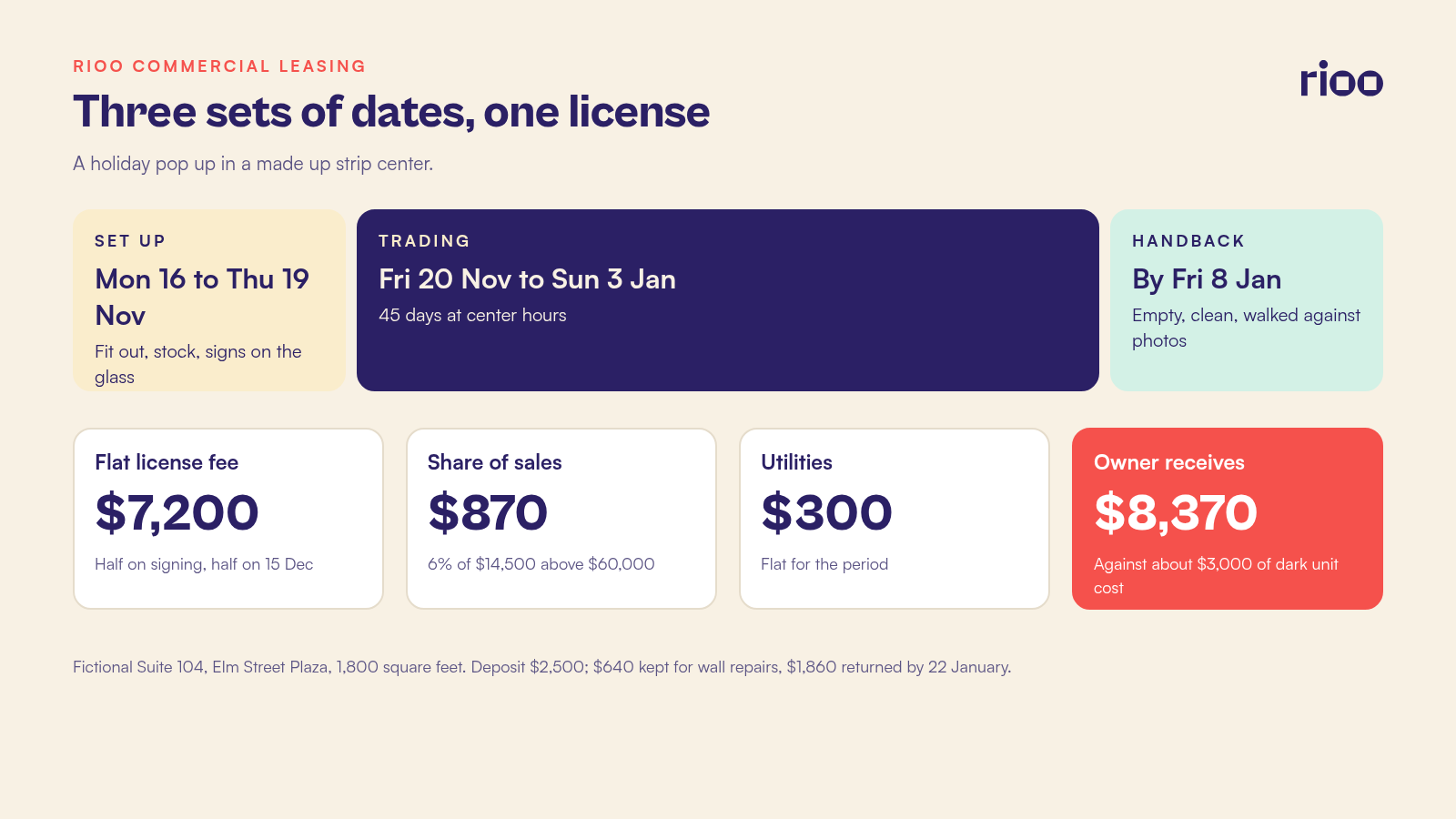
The candle maker reports gross sales of $74,500 for the period. Sales above the threshold are $14,500, and 6% of that is $870. The owner receives $7,200 plus $870 plus $300, a total of $8,370. Over the same weeks the dark unit would have cost about $3,000 in carrying costs with no income at all.
At handback, the walk finds 14 anchor holes from a shelving system and a scuffed back wall. The repair quote is $640. The manager deducts it and returns $1,860 by 22 January, with the photos and the invoice attached.
The email that tests the license
On Monday 28 December, the retailer writes: "Sales are better than we hoped. Can we just stay on through January at the same rate?"
The manager replies the same day: "Glad it went well. We can offer 4 to 31 January on a new license at $1,000 a week, with the same insurance and deposit terms. The current license still ends on 3 January, so please sign the new one by 31 December. If it is not signed, handback stays on 8 January."
That reply keeps the arrangement clean. A retailer who stays past the end date with no new paper can blur the line between licensee and tenant. If that happens, our guide on a holdover tenant covers the options.
Before the keys go out
Run this list the week before set up. None of it takes long, and skipping any one item is how a holiday deal turns into a January dispute.
- Signed license, with all three date ranges filled in.
- First fee payment cleared, not just promised.
- Insurance certificate checked against the license, with the right names and dates.
- Dated photos of every wall, the floor, the glass and the ceiling grid.
- Exclusive use and co tenancy check, recorded in the file.
- Keys or fobs logged, with the number issued.
- Emergency contact for the retailer, and the center's after hours number given to them.
- Trash, deliveries and loading times agreed in writing.
Handback day
Meet the retailer at the suite. Walk it against the opening photos. Collect every key. Read the utility charge, if you used a meter, and note it. Agree any deductions on the spot if you can. If you cannot, send the list within a week with photos, so the deposit return is not a surprise.
Then put the unit straight back on the market. A good season can bring a permanent leasing inquiry. A retailer who sold $74,500 in six weeks may want a real lease for the next holiday. Treat that as a new deal, priced and documented like any other.
Short licenses in RIOO
A license is a short contract, but it still needs a home in the books. In RIOO, a short license can sit on the unit as its own contract, with its own dates, charges and deposit. The fee and utility charges bill on the schedule you set. RIOO also handles percentage rent and tenant sales reporting for retail, so the 6% share can be worked out from the sales figure the retailer reports. Because RIOO is built on NetSuite, those charges post to the same ledger as the rest of the center.
The commercial lease administration tools hold the key dates. Put reminders on the handback date and the deposit return date, so the season does not end with a forgotten refund in March.
Pop up questions from owners and brokers
Can a license agreement be used for a pop up in a mall or strip center?
Yes. Short term retail licenses are common for holiday pop ups, carts and seasonal stores. Keep the term short, keep the owner's access and control, and check other tenants' exclusive use rights first.
How long can a pop up license run?
There is no single legal limit. The longer it runs, and the more it rolls over, the more it can look like a tenancy. For anything beyond a few months, ask counsel whether a short lease is the safer document.
Should a pop up pay CAM?
Usually not as a separate charge. Build the unit's carrying cost into the flat license fee. Running a CAM reconciliation for six weeks of occupancy costs more than it recovers.
Does a pop up need its own insurance?
Yes. Ask for general liability with the owner and manager as additional insured, and a certificate that covers the full set up to handback period.
What if the pop up does well and wants to stay?
Sign a new license, or move to a proper lease. Do not let the old license run past its end date on a handshake.