At 7:10 on a Monday morning the office phone rings. "My sister's car is gone from the guest lot. She was visiting for the weekend. Nobody warned us." Whether that call ends in an apology, a refund or a calm explanation depends on one document written months earlier.
An apartment parking policy is the written set of rules for who may park where. It also covers how residents register cars and guests, and what happens when someone breaks a rule. A good one is signed with the lease, matches the signs in the lot, and follows your state's towing law. It spells out each step from a friendly reminder to a tow, so staff never have to decide on the spot.
What a parking policy has to cover
Use this checklist when you write a new policy or audit an old one. Each line answers a question residents will ask sooner or later.
Spaces and who owns them
- A lot map showing assigned, open resident, guest, accessible, loading and staff spaces.
- How many vehicles each unit may register, and whether a second car costs extra.
- Covered spaces, garages and EV chargers, and whether they are rented separately.
Registration
- What the office records: plate, state, make, model, color and unit.
- Proof of current registration and insurance, if your lease asks for it.
- How a resident updates a plate after buying a new car or getting a rental car after an accident.
- How permits are shown: hang tag, sticker or plate based registration.
Guests
- Where guests park and how they are registered.
- How long one pass lasts and how many guest days a unit gets each month.
- The point where a frequent guest becomes an occupant who must be added to the lease.
Banned uses
- Fire lanes, gates, dumpster access, sidewalks and accessible spaces without a placard.
- Inoperable cars, flat tires, fluid leaks and cars left on jacks.
- Boats, trailers, RVs and commercial trucks, unless the lease allows them.
- Repairs in the lot beyond a jump start or a tire change.
Enforcement
- Which violations get a warning first and which get towed straight away.
- The towing company's name, phone number and storage yard address.
- Who at the property may approve a tow, and when lot checks happen.
- How a resident disputes a warning, a fee or a tow, and how fast you reply.
Write the guest rules with real numbers. "Reasonable guest parking" invites an argument. "Each unit gets 10 guest days a month, and one pass lasts up to 48 hours" does not.
Tow, warn or leave it: a decision path
Staff should never decide a tow on instinct. Give them the same four questions in the same order, every time.
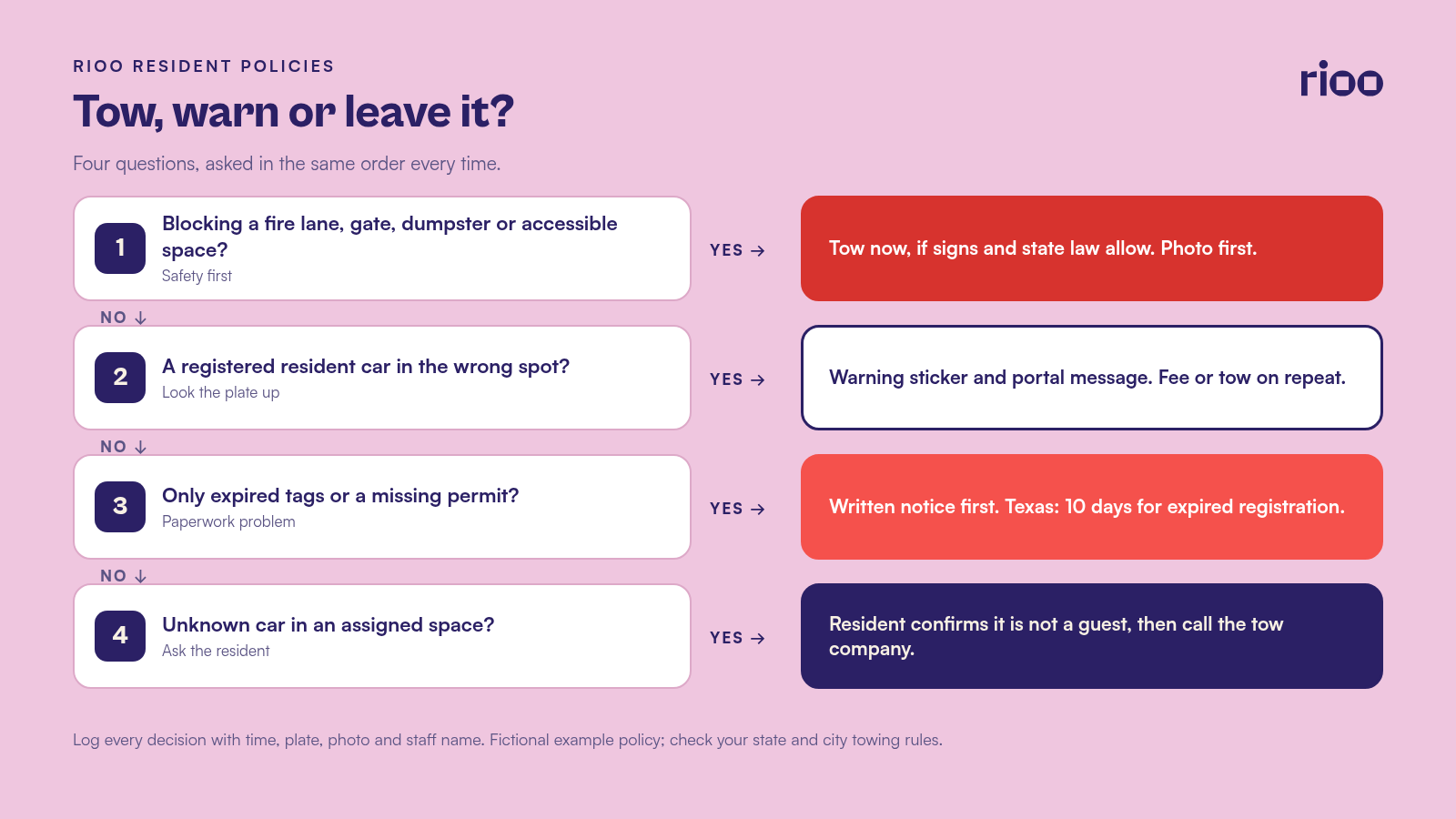
- Is it a safety problem? A car in a fire lane, across a gate, in front of the dumpster or in an accessible space without a placard can usually go straight away. Your signs and state law must allow it.
- Is it a resident's car? Look the plate up first. A registered resident who parked in the wrong row gets a warning sticker and a portal message. Repeat offences move up the ladder in your policy.
- Is the only problem paperwork? Expired tags and missing permits on a known car call for written notice and time to fix it. Some states require this.
- Is a stranger in someone's assigned space? Ask the resident to confirm it is not their guest, ideally with a photo, then call the tow company.
Write down every decision with the time, plate, photo and staff name. A tow you cannot document is a tow you may end up paying for.
State towing rules shape the policy
Towing from private property is regulated by states and often by cities too. The rules on signs, notice and storage vary a lot. Two examples show how specific they get. As of November 2026:
| State | Rule | What it means for the policy |
|---|---|---|
| Texas | Occupations Code 2308.253 lists what can be towed from an apartment lot, such as cars blocking gates or dumpster access, in restricted spaces or leaking hazardous fluid. | A car cannot be towed only for expired plates or registration. The exception: the lease allows it and the owner gets at least 10 days' written notice with a 24 hour phone number. |
| Florida | Statutes 715.07 sets sign rules for towing from private property. | Signs go at each driveway entrance, within 10 feet of the road. They need "tow away zone" in letters at least 4 inches high and the towing firm's name and phone. They must be up at least 24 hours before any tow. |
Other states set fee caps, ban booting, or require a notice on the windshield before certain tows. Read your state and city rules before you copy a policy from another property. Then have local counsel review the towing section, because that is where a mistake costs real money.
Birchwood Flats: one weekend, one tow
Here is a fictional example with made up figures. Birchwood Flats has 120 units and 168 spaces. Each unit has one assigned space. There are 30 open resident spaces that need a permit and 18 guest spaces. Each unit gets 10 guest days a month. Residents register guests in the resident portal, and one pass lasts up to 48 hours.
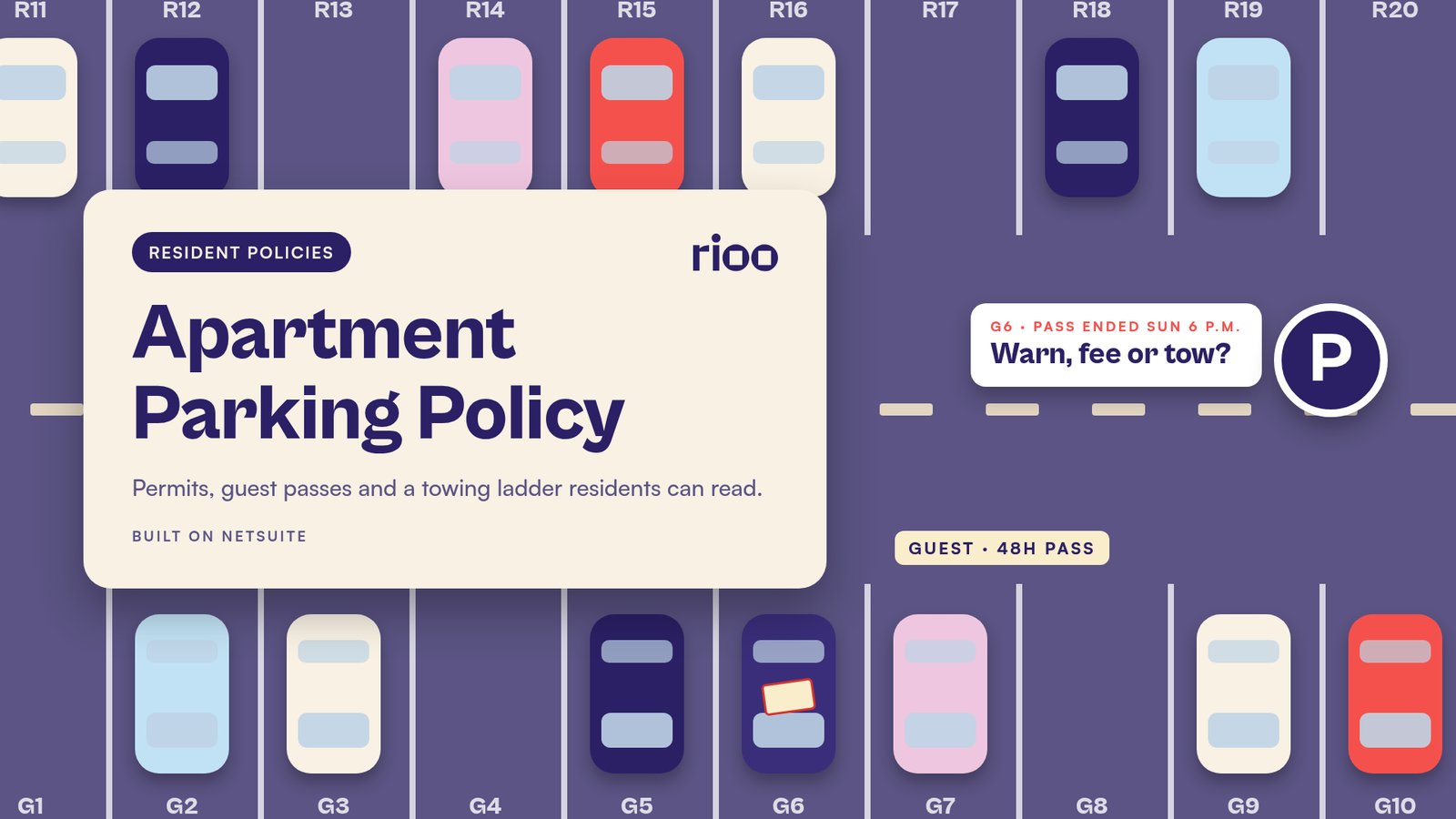
On Friday 13 November at 6 p.m., the resident in 3C registers her sister's car for 48 hours. The pass ends at 6 p.m. on Sunday 15 November. The sister stays an extra night. At 1 a.m. on Monday the night patrol finds the car in a guest space with an expired pass. The signs at the entrance say expired guest passes are towed. The patrol photographs the car and the sign, logs the plate, and calls the tow company.
At 7:10 a.m. the resident calls the office. The assistant manager has the log open.
"Your sister's pass ended at 6 p.m. Sunday. The car was still there at 1 a.m. and the sign at the gate covers expired passes. I can see why it felt sudden. Here is the tow yard's address and phone number. Next time, you can extend the pass from your phone until you hit 10 days."
The resident is not happy, but she can see the rule, the timing and the photo. There is no refund to argue about.
Now look at the whole month. In October, Birchwood logged 61 warning stickers, 7 tows and 2 disputes. One dispute was upheld. A permit printed with the wrong plate got a resident's own car towed. The property paid the $185 tow and storage bill and fixed the permit process. The other dispute was rejected because the photo showed a car parked across a gate.
The weekend tow points to a cheap fix. Of the 7 tows, 4 were expired guest passes, and all 4 ran less than 12 hours over. So in November the manager turns on a portal reminder that goes out 2 hours before a pass ends. If guest pass tows fall to one or none in December, the reminder has done its job, and the office takes fewer 7:10 a.m. calls.
Charging for parking
Many communities charge for covered spaces, garages, second cars or EV charging. That income is fine if the lease or a parking addendum says so and the charge is billed the same way every month. Problems start when a space is promised in a leasing email and never added to the lease. Or a garage gets billed to the wrong unit for six months.
Treat each paid space as its own record, with its own price and its own lease line. Our guide to billing parking, storage and amenities covers the setup. One more check: if you start charging for a space that used to be free, wait for renewal and give proper notice.
Snow nights and lot clearing
In cold climates, the parking policy has to work with the snow plan. Plows cannot clear around parked cars. Pick a clearing order, such as odd rows first and even rows second, and tell residents where to move and by when. Send the notice at least a day ahead if the forecast allows. Keep the tow company on call, but treat towing for snow as a last resort. A resident who misses a 6 a.m. text is not a bad actor. Our snow and ice clearing priority map shows how to sequence the lot with walkways and entrances.
Rolling out a new policy
A new policy on a lot that has had loose rules for years needs a grace period. Announce it 30 days ahead. Spend the first two weeks giving warnings only, with a copy of the policy under the wiper. Put the signs up before enforcement starts. Add the policy to the lease for new residents and to renewals as an addendum. For a resident who keeps breaking the rules after that, use the same written steps as any other lease breach, starting with a lease violation warning letter.
Parking questions residents ask
Can my apartment tow my car without warning?
Often yes, for a car blocking a fire lane, gate or accessible space, if the signs follow state law. For paperwork problems like expired tags, many policies and some states require written notice first. Texas, for example, requires 10 days' notice before a tow for expired registration alone.
How long can a guest park at an apartment?
Whatever the policy says. A common setup is a pass of 24 to 72 hours and a monthly cap per unit. A guest who parks for weeks at a time may really be living there, and the lease rules on occupants apply.
Can a landlord charge for parking?
Yes, if the charge is in the lease or a signed addendum. Adding a new charge in the middle of a lease usually needs the resident's agreement.
Who pays when a car is towed by mistake?
If the property got it wrong, such as a wrong plate on a permit, the property should pay the tow and storage bill and fix the cause. Keep photos and logs so you can tell a mistake from a valid tow.
Can I let a friend use my assigned space while I am away?
Check the policy. Many allow it if you register the friend's car as a guest first.
Parking records in RIOO
In RIOO, a parking space can be its own record in the property structure, under the building, next to units, storage lockers and other units, rooms and amenities. A paid space carries its own charge on the lease, so the garage fee is billed with rent and shows on the resident's ledger in NetSuite. Residents use the resident portal for requests and messages. The property team can send notices by portal, email or SMS, such as a snow night clearing order, and each notice is logged on the resident's profile. When a parking problem turns into a lease breach, the earlier notices are already on that record. To see how this would fit your communities, ask for a demo on your own NetSuite account.