







For US tax purposes, a repair keeps a rental property in its ordinary working condition, and you deduct it in the year you pay it. An improvement makes the property better, restores it after a major failure, or adapts it to a new use. You capitalize an improvement and depreciate it, which for a residential rental building means 27.5 years.
The IRS tangible property rules give you a four step way to sort any invoice. Safe harbors let you expense many small or routine costs without a long analysis. This guide walks through the steps from a property accountant's desk, then sorts one year of invoices at a fictional 16 unit building. It covers federal tax treatment as of November 2026. Your book policy and state tax may differ, so confirm the final treatment with your tax adviser.
Step 1: Find the unit of property
You cannot judge whether a cost improves "the property" until you know what the property is. For a building, the IRS treats the building structure and each key building system as separate units for this test. The IRS guide to the tangible property regulations lists the systems:
- Plumbing
- Electrical
- HVAC
- Elevators and escalators
- Fire protection and alarms
- Gas distribution
- Security
This matters because size is relative. Replacing one compressor is small next to a building's whole HVAC system. Replacing every rooftop unit is not. Judge each job against the system it belongs to.
Step 2: Test for betterment, restoration or a new use
A cost is an improvement if it does one of the following to the unit of property. If it does none of them, it is generally a deductible repair.
Betterment
The work fixes a defect that existed when you bought the property. Or it adds something material, such as an extra room or more capacity. Or it materially raises output, strength or efficiency. Adding a laundry room in a former storage room is a betterment. Patching a hole in drywall is not.
Restoration
The work replaces a major component or a substantial structural part. It can also mean rebuilding to like new condition after the class life ends, or bringing back property that fell into disrepair. A full roof replacement is the classic case. So is rebuilding after a casualty loss where you adjusted the basis.
Adaptation
The work changes the property to a use that does not match how you used it when you placed it in service. Converting a ground floor apartment into a leasing office is an adaptation. Repainting units between residents is not.
The IRS does not define "material" with a percentage. Its own examples tell you to use common sense and reasonable judgement on your facts. That is why the written reason behind each decision matters as much as the decision.
Step 3: Check the safe harbors before you capitalize
Before you put a cost on the fixed asset register, check whether a safe harbor lets you expense it. The first three rows are elections and methods in the same regulations. The last row is the general rule for small parts and supplies.
| Rule | Limit | How you use it |
|---|---|---|
| De minimis | $2,500 per invoice or per item shown on the invoice. $5,000 if you have an applicable financial statement, such as an audited set. Delivery and installation billed for that item count toward the limit. | Annual election statement with a timely filed return. Your books must expense the same items under a policy in place at the start of the year. |
| Routine maintenance | Recurring work you expect to do more than once in the first 10 years a building or building system is in service. | No annual election. It does not cover betterments. |
| Small taxpayers | Average gross receipts of $10 million or less, and a building with an unadjusted basis of $1 million or less. Total repairs and improvements on that building for the year can be no more than the lesser of $10,000 or 2% of its unadjusted basis. | Annual election, building by building. |
| Materials and supplies | Items costing $200 or less, or with a useful life of 12 months or less. | Deduct when used, or under de minimis if you elected it. |
The small taxpayer test on a duplex
Say a landlord owns a duplex with an unadjusted building basis of $310,000. Two percent of that is $6,200, which is lower than $10,000, so the cap is $6,200. During 2026 she spends $5,450 on the duplex: a new exterior door, gutter work and a water softener. The total is under $6,200, so she can elect the safe harbor and deduct the full $5,450. If she had spent $6,300, the safe harbor would be off for that building for the whole year. Each item would then go back through steps 1 and 2.
Step 4: Code it and keep the evidence
A call made at tax time in March is hard to defend if the invoice was coded in a hurry the July before. Make the call when the invoice is approved.
- Use separate GL accounts for repairs and maintenance, capital improvements and de minimis expenses. Our guide to a property management chart of accounts shows where these sit.
- Ask vendors to price each item on the invoice. Four refrigerators at $990 each can qualify for de minimis. One line reading "appliances, $3,960" is harder to support.
- Keep the work order, photos and the vendor's description with the invoice. "Replaced compressor" and "replaced rooftop unit" lead to different answers.
- Write one sentence on why a borderline item was treated the way it was.
A year of invoices at a 16 unit building
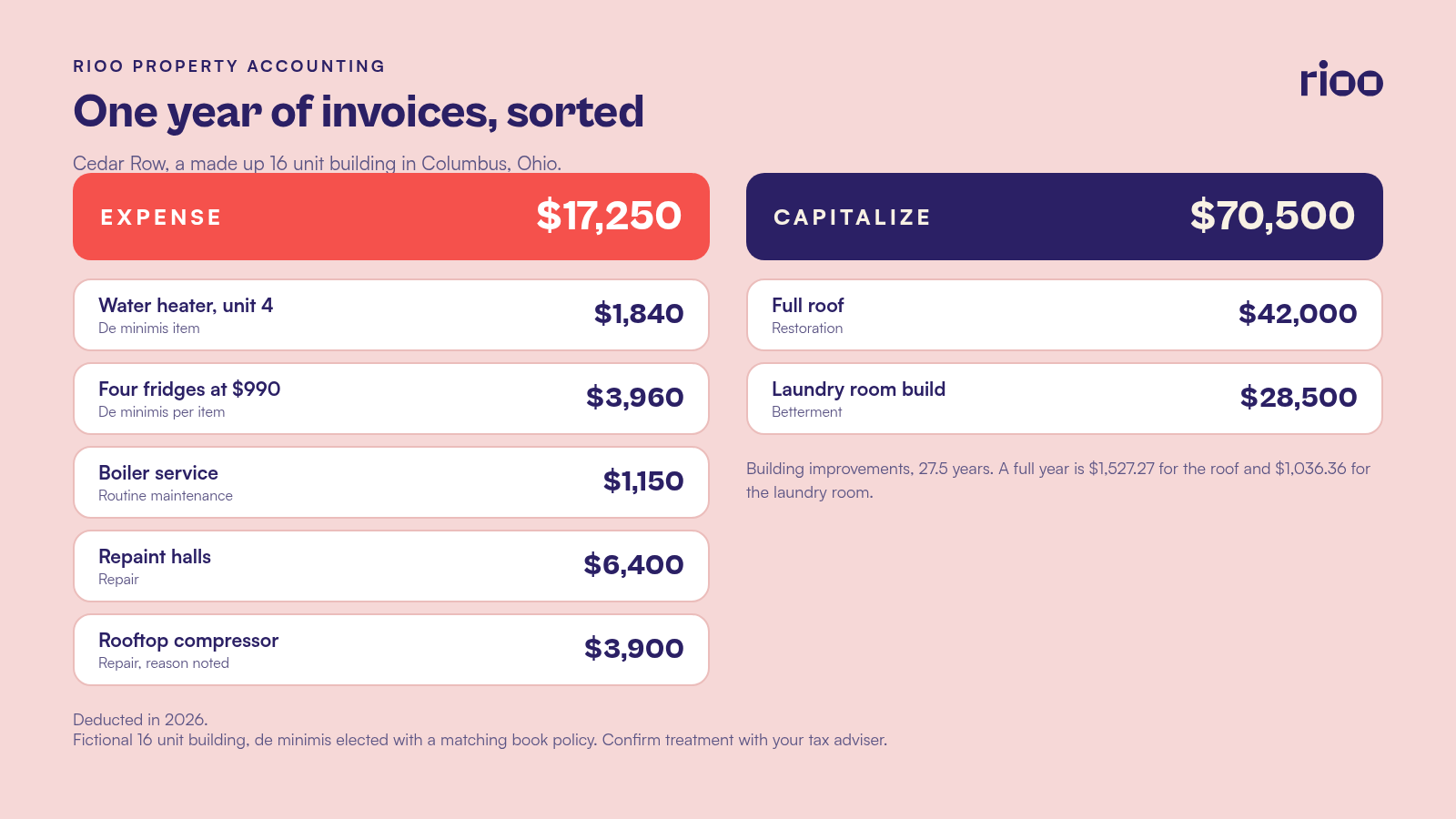
Here is a fictional example with made up figures. Cedar Row is a 16 unit apartment building in Columbus, Ohio, owned by a single LLC. Its unadjusted building basis is $1.4 million, so the small taxpayer safe harbor is not available. The owner's books expense items of $2,500 or less, and that policy was in writing before 1 January 2026. The owner elects de minimis on the 2026 return.
| Invoice | Amount | Treatment | Why |
|---|---|---|---|
| Water heater, unit 4 | $1,840 | Expense | De minimis: one item under $2,500, expensed on the books |
| Four refrigerators, priced per item at $990 | $3,960 | Expense | De minimis applies to each item on the invoice |
| Annual boiler service and gasket set | $1,150 | Expense | Routine maintenance on the HVAC system |
| Repaint stairwells and hallways | $6,400 | Expense | Repair: keeps the building in its usual condition |
| Compressor on the hallway rooftop unit | $3,900 | Expense | Repair: a small part of the HVAC system, with the reason written on the invoice |
| Full roof replacement | $42,000 | Capitalize | Restoration: replaces a major part of the building structure |
| Storage room converted to a laundry room | $28,500 | Capitalize | Betterment: adds a material new feature. The machines are leased, so only the build work is here |
The expensed total is $17,250. The capitalized total is $70,500. Both capital items are building improvements, so each goes on the register as residential rental property over 27.5 years, as IRS Publication 527 explains for a new roof. A full year of depreciation is $1,527.27 for the roof and $1,036.36 for the laundry room. The first year is smaller because of the mid month convention.
Two of these could have gone the other way on different facts. If the stairwell painting had been part of the laundry room build, it would be part of that improvement. If the compressor had been one of several parts swapped in a full rebuild of the unit, the answer could change too. Note the reason on the invoice whichever way you decide.
A water heater is a good example of why the policy matters. The same $1,840 invoice is an expense here because of de minimis. Without the election and a matching book policy, a full water heater replacement would usually need the step 2 analysis. Our guide to rental water heater replacement covers the repair or replace call on site.
Write the book policy before 1 January
The de minimis safe harbor follows your books. If you do not have an applicable financial statement, you need a consistent expensing policy in place at the start of the tax year. If you do, it must be in writing. So a policy written in March 2027 does not help invoices paid in January and February 2027.
A short policy is enough. Name the threshold, say it applies per item as shown on the invoice, and say who can approve exceptions. Keep it with your close binder. Then make the tax side match. A book policy of $5,000 with no audited statements does not give you a $5,000 tax safe harbor. Items above $2,500 go back through the four steps.
Book and tax answers do not always line up. US GAAP has its own capitalization rules, and many portfolios use a higher book threshold for practical reasons. Our post on separating CapEx from OpEx covers the book policy side and its effect on NOI.
How RIOO carries the decision
In RIOO, maintenance work and the money behind it live in the same NetSuite account. A work order is linked to the property, unit and asset. When the vendor bill comes in, costs flow to AP through vendor management and accounts payable, and the bill keeps its link to the work order and photos. Repairs post to the property's expense accounts. A capital job such as a roof replacement can be set up as a project, with its bills collected in construction in progress. When the work is complete, finance creates the asset in NetSuite Fixed Asset Management, where it is enabled in your account. Your tax adviser still makes the final call. The evidence for it is already on the record when they ask.
Questions controllers and owners ask
Is a new roof a repair or an improvement?
A full roof replacement is generally a restoration, so it is capitalized and depreciated over 27.5 years for a residential rental building. Fixing a leak or replacing a few shingles is generally a repair.
Can I expense a new appliance in a rental unit?
If you elect de minimis and the appliance costs $2,500 or less as an item on the invoice, generally yes, as long as your books expense it too. Without the election, appliances in residential rentals are usually depreciated over 5 years.
Is painting a rental unit a repair?
Repainting to keep a unit in its usual condition is generally a repair. Painting done as part of a larger improvement is part of that improvement.
Do I have to file anything to use these safe harbors?
De minimis and the small taxpayer safe harbor each need an annual election statement attached to a timely filed return. The routine maintenance safe harbor is a method of accounting and has no annual statement.
Does the $2,500 limit apply per property?
No. It applies per invoice, or per item where the invoice shows item prices. There is no annual cap, but every qualifying item in the year must be treated the same way.