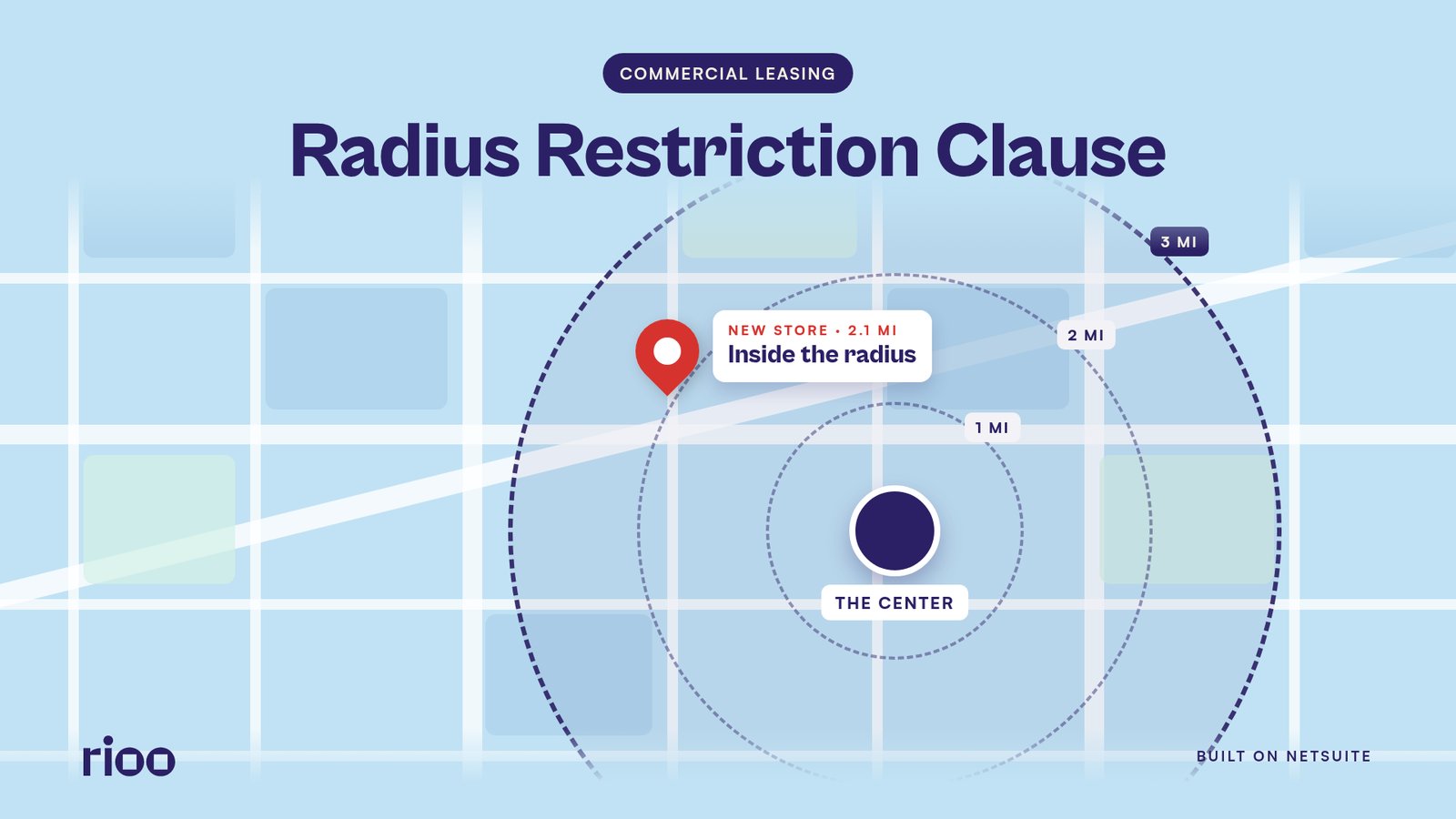
A bakery cafe pays 6% of its sales above $1,600,000 as percentage rent. In 2025 that came to $13,200. In March 2026 the same tenant opens a second cafe 2.1 miles down the road. The original store finishes 2026 with sales of $1,640,000, and percentage rent drops to $2,400. Nobody broke a rule unless the lease had a radius restriction clause.
A radius restriction clause stops a retail tenant from opening or running a similar business within a set distance of your property for a set period. Landlords use it to protect percentage rent and the center's traffic. A clause that holds up names six things. They are the distance, the point you measure from, the businesses covered, the duration, the carve outs and the remedy. Leave one vague and you have a sentence the tenant can argue around.
Why landlords ask for a radius clause
Landlords usually give two reasons. One is money you can count. When a lease carries percentage rent, every sale the tenant moves to a nearby store is a sale you no longer share. The cafe above cost its landlord $10,800 in one year without changing its rent at all.
The other is traffic. A strong tenant brings shoppers who also buy from the stores next door. If the same brand opens closer to those shoppers' homes, fewer of them come to your center. That hurts neighbors who pay no percentage rent, and it can trigger co tenancy rights elsewhere in the lease file.
Traffic also shows up in value. Lenders and buyers read radius clauses during diligence, and a missing one on an anchor tenant gets noticed.
Six decisions that make the clause work
Treat the clause as six separate decisions. Write each one down in plain numbers before counsel drafts the wording.
1. The distance, and where you measure it from
Pick a distance that matches how far customers travel for this kind of store. A grocery shopper might drive three miles. A furniture shopper might drive fifteen. Then say how the distance is measured. "Three miles from the nearest boundary of the shopping center, in a straight line" is clear. "Three miles from the premises" invites a fight about road miles versus map miles and which door counts.
2. Which businesses count
Define the restricted business by what it sells, under what name. A clause that covers "any store operating under the tenant's trade name or a similar concept" catches a rebrand. A clause limited to "the same trade name" does not. Keep the definition close to the permitted use clause so the two read together.
3. How long it lasts
Some clauses run for the whole term, including renewals. Others run for the first five years, while the landlord is still recovering what it spent on the fit out. State the start date and end date in the clause, then put both on your critical dates list.
4. Existing stores and carve outs
Tenants rarely sign a radius clause that closes stores they already run. List every existing location inside the radius by address and exclude it by name. Decide too whether a relocation of an existing store counts as a new store. A carve out for "existing locations" without addresses causes trouble the first time one of them moves.
5. The remedy
Say what happens on breach in numbers. The common remedies are listed in the table further down. Pick one main remedy and one fallback. A clause that only says the tenant "shall not" open nearby leaves you with a lawsuit as the sole remedy.
6. Who it binds
Name affiliates, franchisees, licensees and successors. Suppose the tenant opens the second store through a sister company. A clause that binds only the tenant itself has not technically been breached. Check that the definition survives an assignment, and read it next to your rules on landlord consent to assignment.
Larkfield Commons: a second cafe 2.1 miles away
This is a fictional example with made up figures. Larkfield Commons is a 140,000 square foot center in Indianapolis. A bakery cafe signed a ten year lease in 2023 with these terms:
- Base rent of $96,000 a year.
- Percentage rent of 6% above a natural breakpoint of $1,600,000, so $96,000 divided by 0.06.
- A radius of three miles from the nearest boundary of the center, for the first five lease years.
- Remedy: gross sales of any store in the radius are added to the premises' gross sales for percentage rent.
- Fallback: if the tenant does not report the other store's sales within 30 days of a request, base rent rises 25% while the breach continues.
In March 2026 the tenant opens a second cafe 2.1 miles away. The property manager spots it in a permit notice and checks the distance on a map. She sends a written notice of breach on 14 April 2026 and asks for the new store's monthly sales.
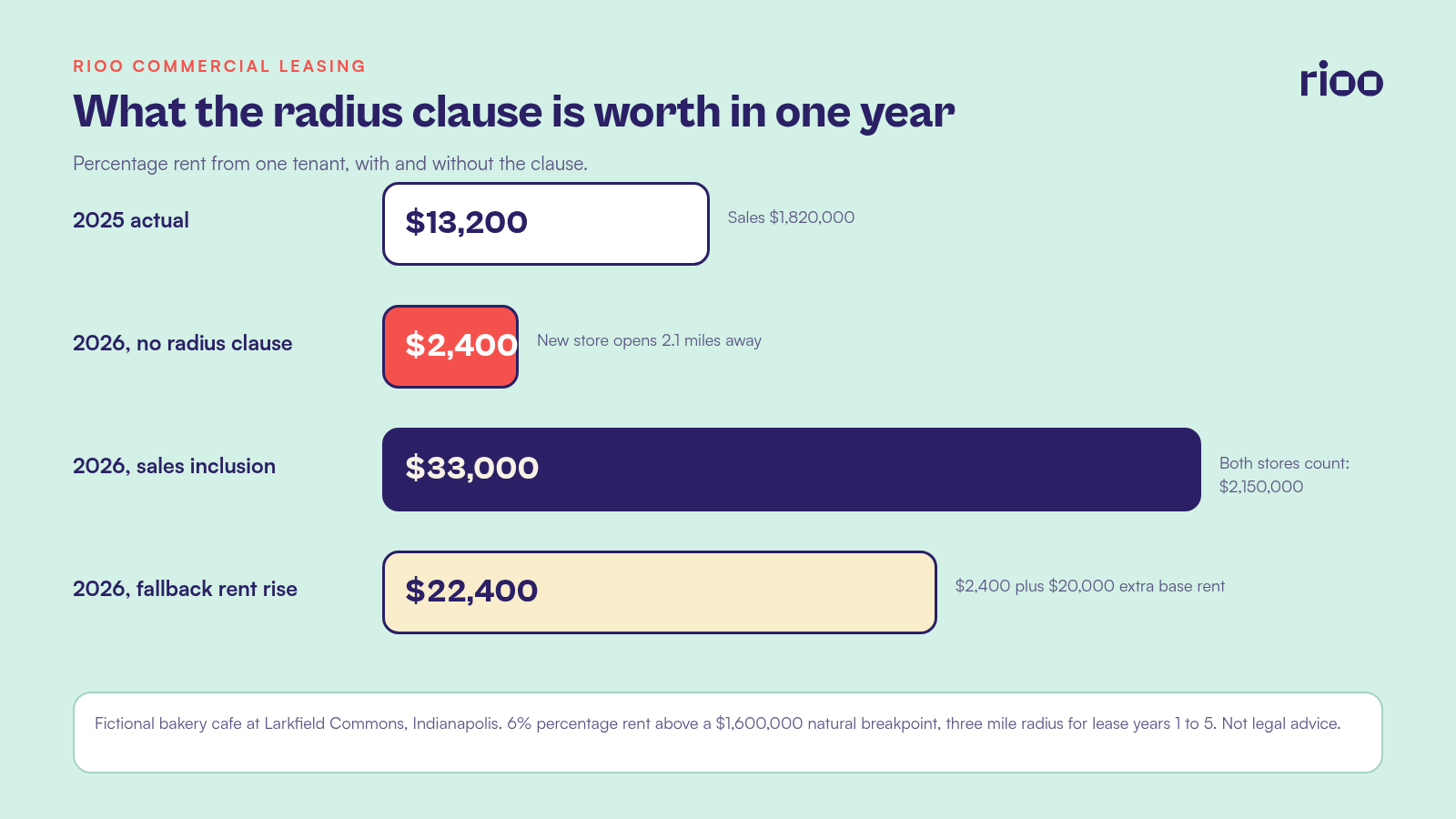
| Case for 2026 | Sales counted | Above breakpoint | Percentage rent |
|---|---|---|---|
| 2025 actual, for comparison | $1,820,000 | $220,000 | $13,200 |
| 2026 with no radius clause | $1,640,000 | $40,000 | $2,400 |
| 2026 with sales inclusion | $1,640,000 + $510,000 = $2,150,000 | $550,000 | $33,000 |
| 2026 with the fallback rent rise, March to December | $1,640,000 | $40,000 | $2,400 plus $20,000 extra base rent |
The fallback is $96,000 times 25%, which is $24,000 a year, or $20,000 for ten months. Under sales inclusion the tenant pays $33,000, far more than the $13,200 it paid before the second store opened. That cost is what makes the clause work. A tenant who reads it carefully either stays outside the radius or negotiates an exception before opening.
The inclusion remedy has one weak point. It depends on sales figures from a store you do not manage. Your lease should give you the same reporting and audit rights over the radius store as over the premises. Our guide to retail sales reporting in a lease covers the certification and audit wording.
Radius clause remedies side by side
| Remedy | How it works | Watch for |
|---|---|---|
| Sales inclusion | Sales at the radius store count toward percentage rent at your premises | Needs audit rights over the other store |
| Base rent increase | Base rent rises by a stated percentage while the breach lasts | Too large an increase may be read as a penalty |
| Loss of tenant rights | The tenant loses exclusives, co tenancy protection or renewal options | Works well alongside another remedy |
| Landlord termination right | The landlord may end the lease on notice | Useful when the space would lease well to someone else |
| Injunction | A court orders the tenant to stop operating the new store | Slow, costly and uncertain |
A sensible pairing is sales inclusion as the main remedy, with a rent increase if the tenant will not report. Losing an exclusive use right also gets a tenant's attention quickly, because it costs them something they value every day.
Four objections from the tenant's broker
These four come up often. Each has a trade you can offer.
- "The radius is too large." Offer a smaller radius in return for a longer duration, or the reverse.
- "We need to grow in this city." Allow one new store after year three if sales at your premises exceed a stated level for the prior twelve months.
- "Online sales should not count." Agree. Restrict the clause to physical stores and leave online sales to the gross sales definition.
- "Our franchisees are independent." Accept franchisee carve outs only where the tenant does not control the site decision, and ask for a list.
Do the trade in the letter of intent. Once the lease draft is on the table, every change to the radius reopens the rent discussion.
How a breach gets noticed
A radius clause that nobody watches is worth very little. The cafe example only worked because someone noticed a permit. Build a small routine around each restricted tenant.
- Record the radius distance, start date, end date and carve outs on the lease abstract.
- Each quarter, check the tenant's store locator and local business license filings for new addresses.
- Ask the leasing team to flag any broker talk about the tenant looking at nearby sites.
- When monthly sales fall by more than 10% against the same month last year, check for a new store before you assume a weak market.
- Send a reminder to the asset manager 90 days before the radius period ends, so its expiry is planned for in renewal talks.
Pair this with the operating covenant check if the lease has one. A tenant that opens nearby sometimes stops trading at your site next, which brings the continuous operation clause into play.
Tracking radius terms in RIOO
RIOO keeps commercial leases as structured records on NetSuite, with abstracted terms, critical dates, options and documents on the same record that drives billing. A radius clause can sit on that abstract with its distance, its end date and a named owner for the review. The expiry becomes a dated reminder instead of a line in a PDF. Because percentage rent is billed from the same lease record, a sales drop at a restricted tenant shows up next to the clause that might explain it. See how commercial lease administration in RIOO handles critical dates.
Is a radius clause enforceable?
Usually, when it is reasonable. Courts tend to look at whether the distance and duration fit the landlord's real interest in the center. A three mile radius for five years on a cafe looks proportionate. A fifty mile radius for the full term on a small shop may not. Rules differ by state, and competition law can apply in some cases. Have counsel in the property's state review the final wording, and keep a short note on file of why you chose the distance.
Radius restriction questions
Does a radius clause apply to online sales?
Only if it says so. Clauses are usually written for physical stores. Whether online orders count toward percentage rent belongs in the gross sales definition, so settle it there.
Can a radius clause cover the landlord too?
Tenants sometimes ask for the mirror image: no competing tenant inside the center. That is an exclusive use clause, and it is negotiated separately.
What if the tenant buys a competitor with a store inside the radius?
Decide this up front. Common wording gives the tenant a period, such as twelve months, to close or rebrand an acquired store before the remedy applies.
Should every retail tenant get a radius clause?
No. Save it for tenants whose sales drive percentage rent or traffic. A small service tenant with flat rent is rarely worth the negotiating time.