Can a renter install an EV charger at an apartment? In some states the answer is already written into law. California and Colorado both give tenants a right to install a charger at their own cost, with limits. Elsewhere it is your policy, your lease and your electrical panel that decide.
The practical answer for an apartment owner: say yes in principle, set the conditions in writing, and make the tenant pay for the install and the electricity. Get a load check before you approve the second or third charger. Bill the power from a meter reading wherever you can. A one page addendum covers all of it.
Two states that set the rules for you
California and Colorado are the clearest examples of renter right to charge laws. They work differently, and the differences decide what you may charge.
| Point | California, Civil Code 1947.6 | Colorado, Title 38, Article 12, Part 6 |
|---|---|---|
| Who it covers | Residential leases signed, extended or renewed on or after 1 July 2015 | Residential and commercial rentals |
| Can the owner refuse? | Yes, in listed cases such as fewer than five parking spaces, parking not part of the lease, or chargers already at 10% or more of spaces | The landlord may not prohibit a Level 1 or Level 2 charger, but may set safety, registration and reasonable appearance rules |
| Install cost | Tenant pays, before work starts | Tenant pays, or reimburses the landlord if the landlord installs |
| Electricity | Tenant pays as part of rent | Landlord may recover actual electricity cost, or charge a reasonable access fee |
| Reserved space | Owner may charge monthly rent for a space the charger reserves | Owner may charge a reasonable fee to reserve a shared space |
| Insurance | Liability cover up to 10 times annual rent, unless the charger is certified and a licensed electrician installs it | For shared areas, the tenant names the landlord as additional insured or pays the extra premium |
| At move out | Per the written agreement on removal | Charger is the tenant's property; they may remove it or sell it |
Read the full texts before you write a policy: the California statute and the Department of Energy summary of the Colorado law. Other states and some cities have their own rules, and the list changes. This table reflects the law as of November 2026. Confirm with local counsel for any other state.
A tenant asks for a charger: the decision path
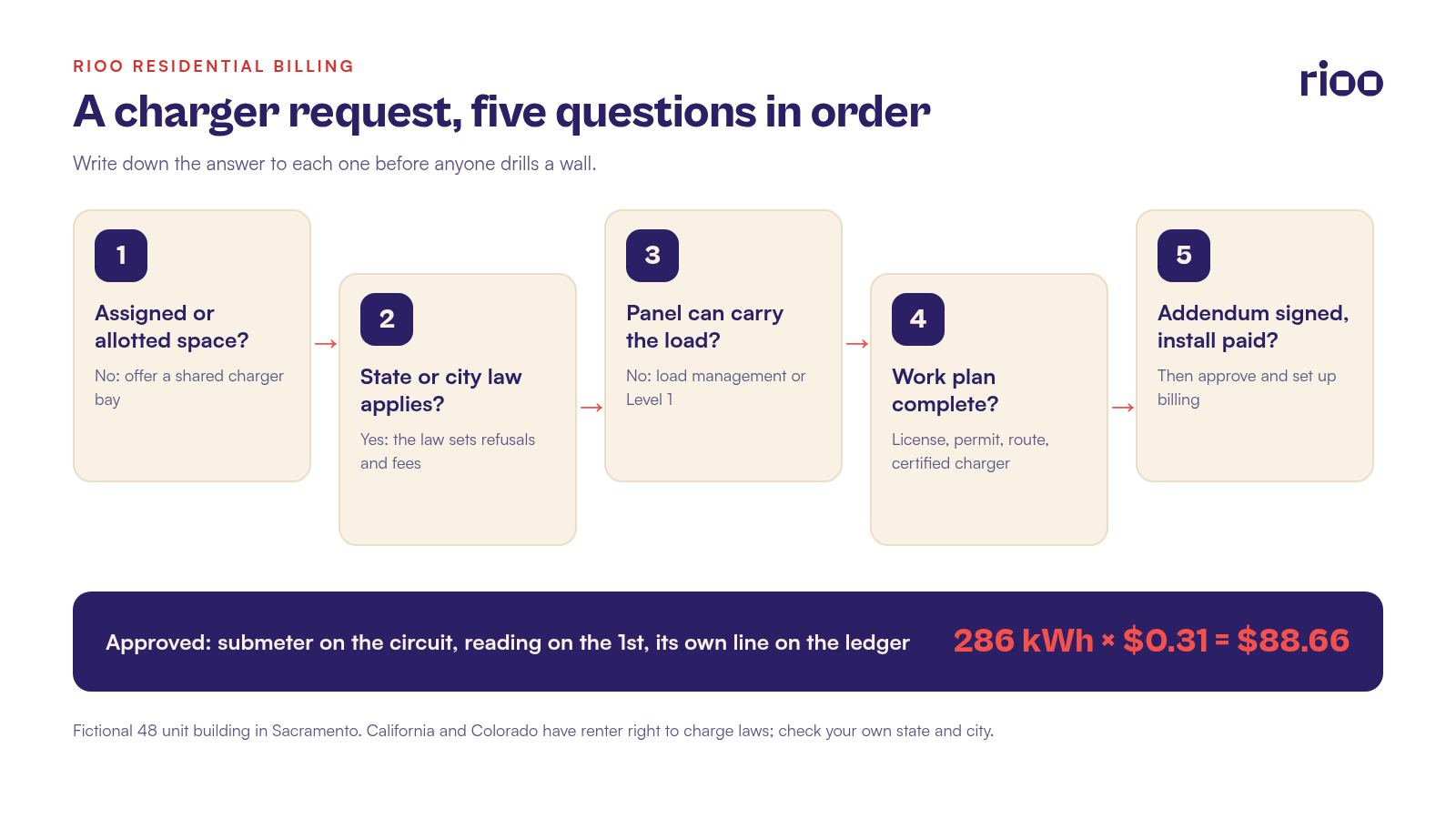
Run every request through the same questions, in the same order. Write down the answer to each one.
- Does the tenant have an assigned or allotted space? If parking is first come, first served, the request becomes a question about a shared charger or a reserved space.
- Does a state or city law apply? If yes, the law sets when you can refuse and what you can charge. If no, your policy sets both.
- Can the panel or service carry the load? An electrician answers this, not the leasing office.
- Is the work plan complete? You want the electrician's license, the permit, the route of the cable, the charger model and its certification.
- Is the paperwork signed? The addendum, the payment for the install and proof of insurance where required, all before work starts.
The panel decides more than the policy
A Level 1 charger plugs into a normal 120 volt outlet and adds range slowly. Many commuters find it enough overnight. A Level 2 charger needs a 240 volt circuit. A common setup is a 40 amp breaker for a charger that draws 32 amps. That is a large new load for an older building panel.
The first charger usually fits. The fifth one may not. Ask your electrician for a load calculation on each meter bank before you approve requests, and keep it on file. If the building is close to its limit, two options keep the door open. Load management lets several chargers share one circuit and slow down when the building is busy. Level 1 outlets cost far less and draw far less. Both give you a fair reason to say "yes, with conditions" instead of "no."
Who pays for what
| Cost | Usual owner policy |
|---|---|
| Charger unit | Tenant |
| Circuit, conduit, permit and inspection | Tenant, paid before work starts |
| Panel or service upgrade | Tenant if it serves only their charger; open to discussion if it serves the building |
| Electricity | Tenant, billed from a meter reading |
| Reserved space | Monthly parking charge where the law and lease allow |
| Repairs and damage | Tenant while the charger is in use |
| Removal and patching at move out | Tenant, unless the owner buys the charger |
Owners who install chargers themselves as an amenity are making a different decision. That is a capital project with its own return, and it sits with the rest of your parking and amenity billing.
Billing the electricity without arguments
The power is the cost that keeps coming back every month, so set it up properly once. There are four workable ways to bill it.
- Tenant's own meter. Wire the circuit from the unit's panel. The utility bills the tenant directly and you bill nothing. Simple, if the route allows it.
- Submeter on the circuit. A small meter on the charger circuit. You read it monthly and bill kilowatt hours at your actual rate.
- Networked charger. The charger records each session and the network bills the tenant. Check the network fee and who receives the money.
- Flat monthly charge. A fixed amount based on an estimate. Easy, but it drifts from real use and residents notice. In Colorado it would need to stay a reasonable access fee.
A submeter is the usual middle ground for a building without a networked charger. It works the same way as submetered utility billing for water or gas, and the charge should appear on the ledger as its own line.
Space 14 at a 48 unit building in Sacramento
This is a fictional example with made up figures. A 48 unit building in Sacramento has 52 assigned spaces and no chargers. On 6 October 2026 the tenant in unit 3C, on a lease renewed in March 2026, asks in writing for a Level 2 charger at space 14.
- California law applies. The lease was renewed after 1 July 2015, the building has more than five spaces, parking is in the lease and no chargers exist. The owner must approve a request that meets the statute and the owner's approval process.
- The electrician's load check shows room on the house panel for two Level 2 chargers.
- Quote: $2,850 for a 40 amp circuit, conduit and a submeter, plus a $180 permit. The tenant pays $3,030 before work starts.
- The charger is certified by a recognized testing lab and a licensed electrician installs it, so no extra insurance is needed.
- Space 14 was already assigned to 3C, so it does not become a reserved space and there is no new parking charge.
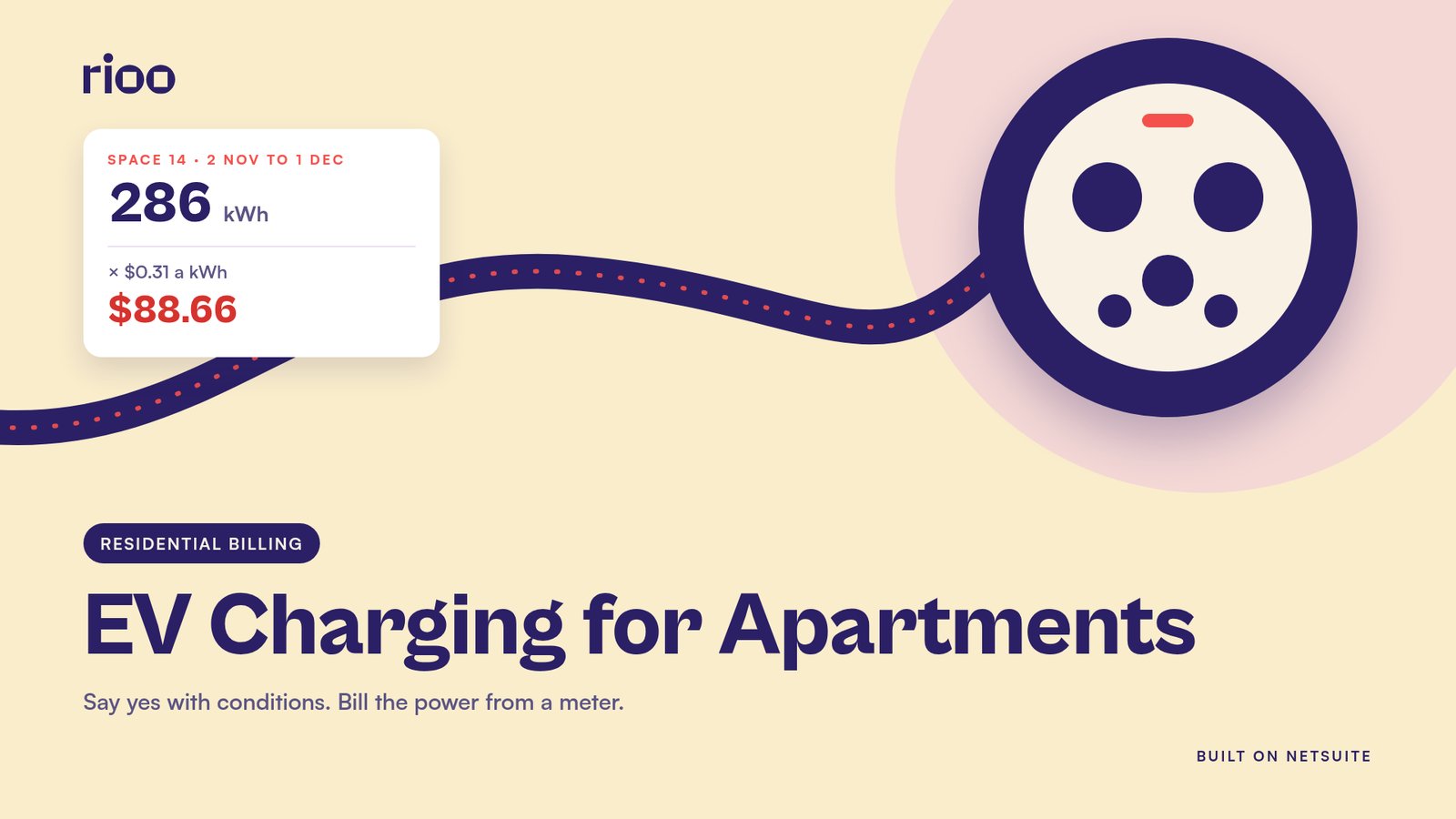
Work finishes on 2 November. The first reading on 1 December shows 286 kilowatt hours. The building pays an average of $0.31 per kilowatt hour on that meter, so the tenant's December charge is 286 times $0.31, which is $88.66. It appears on the rent statement as "EV charging, space 14, 2 Nov to 1 Dec, 286 kWh."
The second request arrives in January. The manager already knows the panel can take one more. A third request would need load management or a service upgrade, and the manager can say so on day one.
When residents share one charger
Some buildings have no assigned spaces. A single shared charger then works better than a run of private ones. Put it in a marked bay, set a session limit such as four hours, and bill each session to the resident who starts it. A car left plugged in after its session ends is a parking problem, so treat it under your apartment parking policy with the same warning and fee steps. Post the rules on the charger itself, where residents will actually read them.
The addendum checklist
Keep the addendum short and specific. It should cover:
- The space number and charger model, with its certification.
- The licensed electrician, the permit and the cable route.
- Payment of all install costs before work starts.
- How electricity is metered, the rate basis and the billing date.
- Insurance where required, with the landlord named on shared areas. See our guide to renters insurance requirements.
- Repair duties while the tenant uses the charger.
- What happens at move out: removal and patching, or a sale to the owner at an agreed price.
- Registration of the charger with the office within a set number of days.
Questions residents ask about EV charging
Can I just run an extension cord from my unit?
Please don't. A cord across a walkway is a trip hazard, and a household cord is not rated for hours of charging. Ask for an outlet or charger through the request process instead.
Can the landlord charge me more than the electricity costs?
It depends on the state. Colorado limits it to actual cost or a reasonable access fee. Elsewhere, the lease and local rules decide.
Will the charger stay if I move?
Only if you and the owner agree a sale. Otherwise you remove it and pay for any patching.
Does a right to charge law cover mobile home parks?
In California, usually not, because a resident leases a lot and owns the home. Colorado's law is less clear. Our post on EV charging in manufactured housing communities explains why.
Billing chargers in RIOO
RIOO handles utility usage and cost data, allocation by submeter, itemized resident charges and the accounting behind them in NetSuite. A charger circuit can be set up like any other submeter. The monthly reading becomes its own line on the tenant's charges, and the electricity cost and the recovery post to the same property. Finance can see how much of the charger power was billed back. Read more about the resident utility billing system.