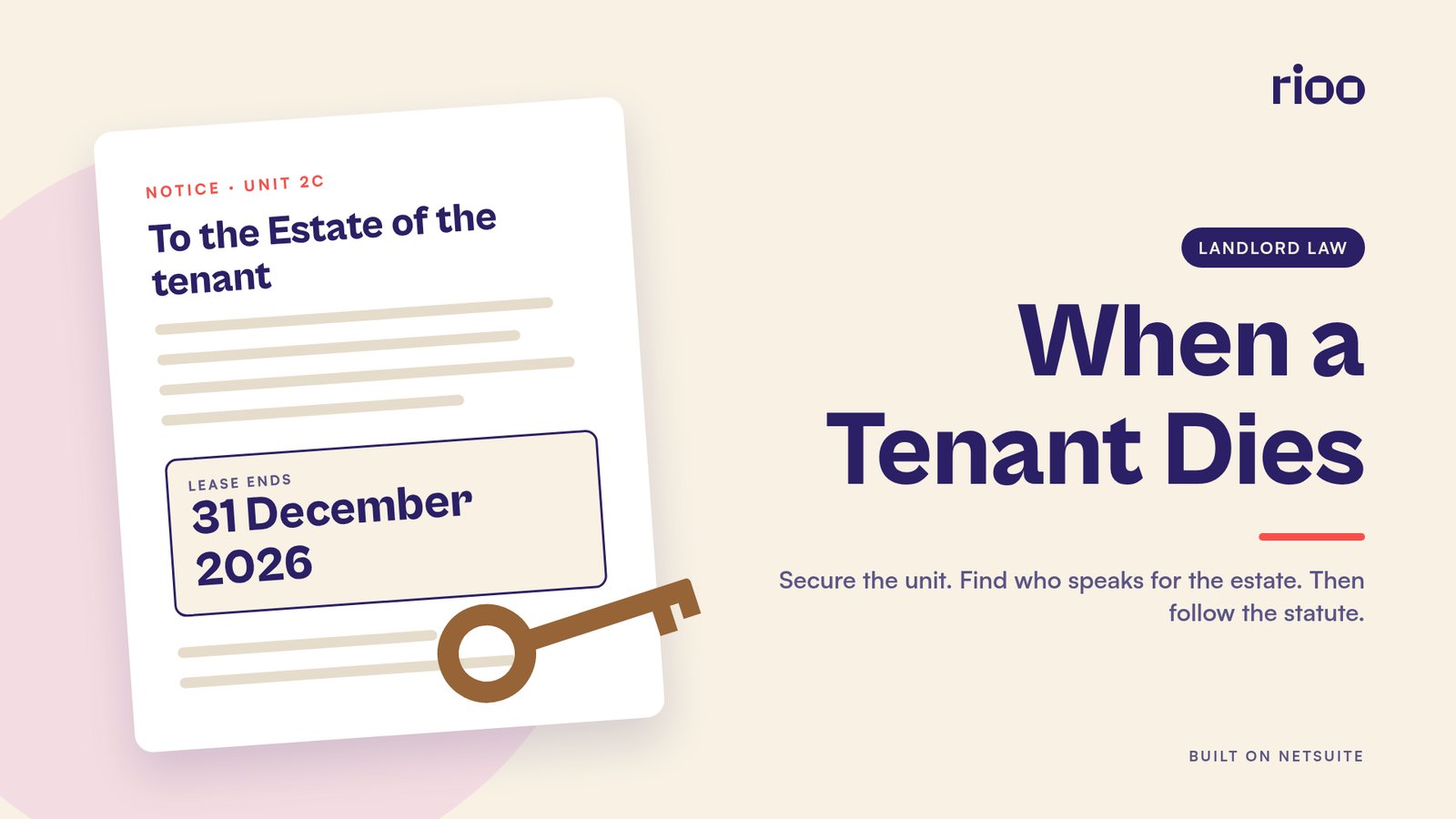
When a tenant dies, the lease does not end that day in many states. It runs on until the estate or the landlord ends it under state law, and the estate stays liable for rent until then. Your first jobs are to secure the unit, find out who has legal authority over the estate, and stop anyone without that authority from removing belongings.
The rules below are general information as of November 2026, with six state statutes linked. Treat it as a working checklist, and confirm the steps with local counsel before you send any notice.
Day one: confirm, secure, write it down
News of a death often reaches the office sideways. A neighbour mentions the mail piling up. A relative calls in tears. A police officer asks for a key after a wellness check. Whatever the route, slow down and record what you were told.
Confirm before you act
Write down who told you, when, and how they know. Do not change the lease status or post anything to the ledger on hearsay. If police or a medical examiner attended, ask for a report or case number. A copy of the death certificate will come later, usually from the family or the estate.
Secure the unit
Lock the door and check windows. If police took a key, log who has it. Some managers rekey at once, which is reasonable when keys are unaccounted for. Keep a new key in the office and note every entry from now on, with date, time and the names of everyone present. Our guide to rekeying locks between tenants covers the key log.
Deal with anything urgent inside
A pet, food in the fridge, a running tap or a thermostat set to 50 in winter all need attention. Enter for these with a witness. Take photos of each room before you touch anything. Then leave everything else where it is.
Week one: find who speaks for the estate
A relative who arrives with a van is not, by that alone, entitled to take anything. Belongings and the deposit belong to the estate. You hand them to the person with legal authority to receive them.
A court appointed representative
An executor named in a will, or an administrator where there is no will, gets authority from the probate court. Ask for the court document that appoints them. Different states call it letters testamentary, letters of administration or letters of authority. Keep a copy on the tenant file.
A small estate process
Many states let a family member collect property from a small estate with a sworn affidavit instead of a full probate case. Each state sets its own value limit and waiting period. Accept the affidavit only if it fits your state's form, and keep a copy.
Someone the tenant named in advance
Texas and Washington let a tenant name a person in writing to act for them after death. In Texas, the landlord can ask every tenant for that contact and a signed authorization under Property Code 92.014. If you manage in either state, collect it at move in. It saves weeks of uncertainty later.
How long the lease lasts after a death, by state
States handle this in quite different ways. Some give the estate a right to end the lease early. Some end the tenancy automatically after a set time. Many have no special rule at all, so the lease simply continues and the estate owes rent until it ends or the unit is surrendered and re rented.
| State | Rule | What it means for you |
|---|---|---|
| New York | Real Property Law, section 236a | The estate representative may end a residential lease by notice. Termination takes effect when the estate notifies you and surrenders possession. Notice goes by registered or certified mail. Any co tenant or guarantor must consent in writing. Applies to leases made or renewed since February 2024. |
| Pennsylvania | Landlord and Tenant Act of 1951, Section 514 | Where the deceased was the sole tenant, the executor or administrator may end the lease on 14 days' written notice. It ends on the later of the last day of the second calendar month after the month of death, or surrender with all belongings removed. Applies to leases signed or extended since 2017. |
| Minnesota | Statutes 504B.265 | When the tenant dies, or all tenants have died, either the landlord or the personal representative may end the lease. It takes at least two months' written notice, effective on the last day of a calendar month. |
| Wisconsin | Statutes 704.165 | A residential tenancy ends 60 days after you learn of the death, or at the end of the lease term if that comes first. You may not ask family members for rent they do not owe. |
| Washington | RCW 59.18.595 | For a sole occupant, you must send written notice to the representative, any named person and the emergency contact. The tenancy ends 15 days after the notice, or when paid rent runs out if that is later. A representative can prepay up to 60 days from the death to clear the unit. |
| Texas | Property Code 92.014 and 92.0162 | For a sole occupant, the estate representative may end the lease by written notice once the belongings are removed. It takes effect 30 days after notice, or when those conditions are met if that is later. To discard unclaimed property, you first send a certified letter to the person the tenant named. Then wait 30 days with no removal or claim. A lease can set a different procedure. |
If your state is not on this list, read the lease first. Some leases include a death clause. Then check your state landlord tenant code for the words "death" or "deceased", and ask counsel.
A Minnesota example, with dates
This is a fictional example. Harold, 78, was the sole tenant of unit 2C in a 24 unit building in St. Cloud. Rent was $1,350, due on the 1st. His lease ran to 31 May 2027, and the deposit was $1,350. He died on 19 October 2026, with October rent already paid.
The manager learned of the death on 21 October after a wellness check. His daughter Karen, listed as his emergency contact, called the next day. No personal representative had been appointed yet.
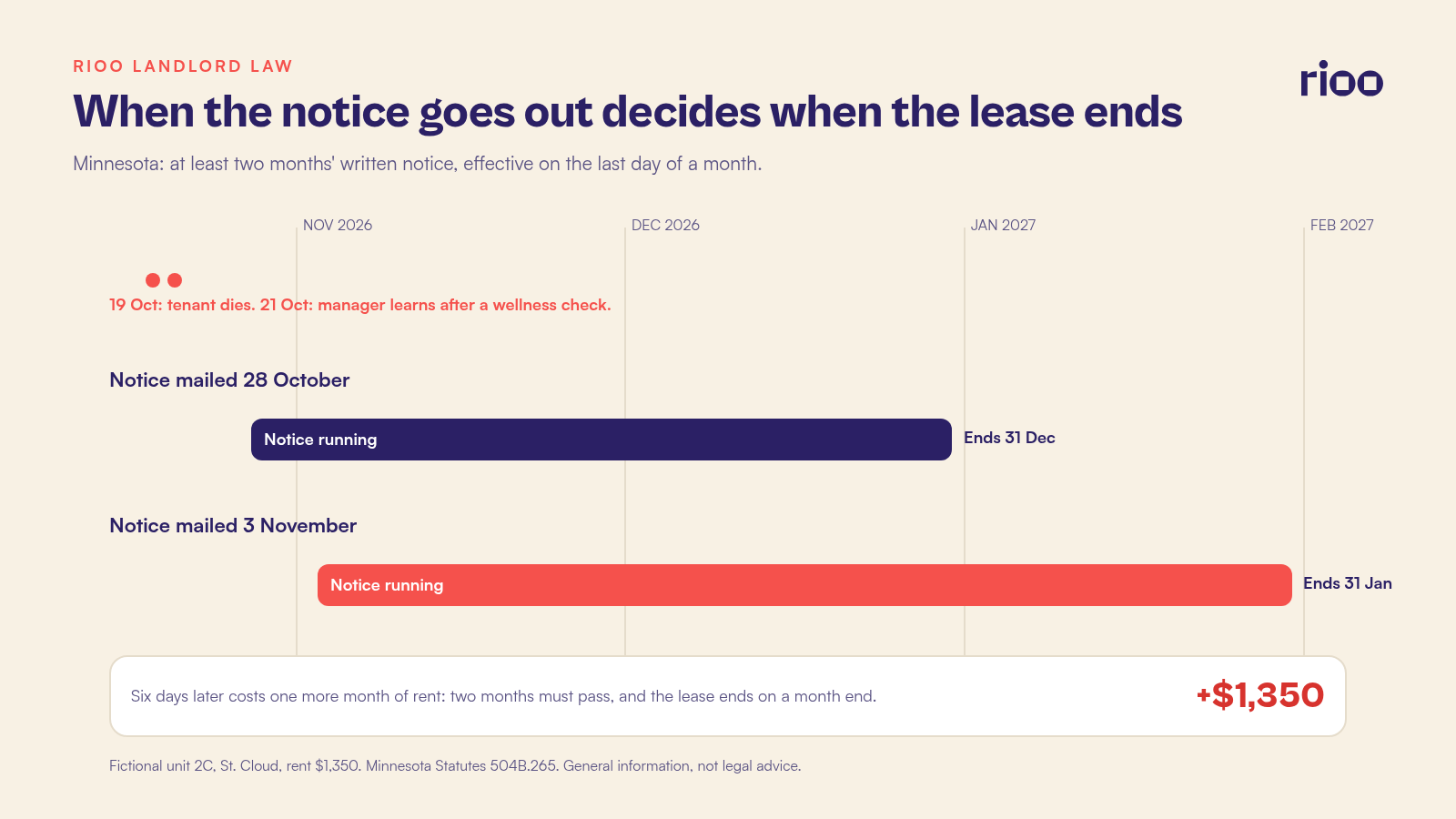
Under 504B.265, the landlord can give the two months' notice too. The manager mailed it on 28 October, to the unit and to Karen. Two months from 28 October is 28 December, so the earliest effective date is the last day of that month, 31 December 2026.
Timing mattered here. Had the notice gone out on 3 November, two months would land on 3 January. The lease would then end on 31 January 2027, and the estate would owe one more month at $1,350.
Rent for November and December came to $2,700. The deposit of $1,350, plus the 1 percent simple interest Minnesota adds to deposits, was applied after the unit was cleared. That left just under $1,350 for the estate to pay, plus any damage beyond normal wear. The manager sent the final statement to the personal representative once one was appointed, and never to Karen personally. She had not signed the lease.
Belongings: who may take what
Family often want to come in quickly, and that is understandable. Let them in under a simple rule. They can look and take photos with you present. Nothing leaves until someone with legal authority signs for it.
- Ask for the court appointment, the small estate affidavit, or the tenant's written designation.
- Walk the unit together and list what is removed. Have the person sign the list, and keep a copy.
- Agree a removal date in writing. If the date passes, follow your state's process for unclaimed property. Never simply bin it.
- Items that look valuable, like jewelry, cash, firearms or papers, go only to the representative. Note them on the list.
Our guide to the notice of entry rules is worth reading here too. While the lease runs, the estate holds the tenant's place, and ordinary entry rules may still apply.
When someone else still lives there
If a co tenant signed the lease, the lease carries on for them. Wisconsin's statute says so directly. Change the ledger name only after the paperwork confirms it, and talk to the survivor about whether they can carry the rent alone.
A partner or adult child who lived there without signing is an occupant. They are not a tenant. Treat them with care, and do not change the locks on them. Decide with counsel whether to offer them a lease of their own. Our post on adding or removing a roommate from a lease walks through the paperwork.
A guarantor may still be liable for rent under the lease. Check the guarantee wording before you contact them, and contact them in writing.
Closing the ledger and returning the deposit
Treat the move out like any other, with one difference. Every statement, refund and notice goes to the representative, and is addressed to the estate.
- Stop late fees from the date you learn of the death. They invite a dispute, and they read badly on a statement sent to a grieving family.
- Prorate the final month if the lease ends mid month. Charge only what the statute or lease allows.
- Do the move out inspection with photos, ideally with the representative present.
- Return the deposit within your state's normal deadline, with an itemized list. In Minnesota that is 21 days after the tenancy ends and you have a mailing address for the estate.
- If the estate still owes money after the deposit, file a claim with the probate estate. Ask counsel about the deadline, because claim periods can be short.
Our guide to security deposit accounting covers how to post the deduction and refund cleanly.
Where RIOO helps
In RIOO, the tenant profile holds the lease, the ledger, deposits, documents and contacts in one place. Household members and contact details sit on the same profile. When a tenant dies, the manager can see at once who else lives in the unit and who to call. The court appointment, the signed property list and every notice can sit on the same record, with their dates. See how the unified tenant profile works.
A letter you can adapt
Here is a short notice for the Minnesota example. Adjust it to your state's statute, and have counsel review your version once so staff can reuse it.
To the Estate of Harold Lind, Unit 2C, 410 Birch Avenue, St. Cloud, and to Karen Lind
We are very sorry for your loss. We are writing to explain what happens with Harold's lease.
Under Minnesota Statutes section 504B.265, this letter is two months' written notice that the lease for Unit 2C will end on 31 December 2026. Rent remains due for November and December. Harold's belongings can be collected by the personal representative of his estate, or by a person with other legal authority. Please call us to arrange a time.
After the unit is cleared, we will send an itemized statement of the security deposit to the estate within the time the law allows.
Questions landlords ask
Does a lease end when the tenant dies?
Often it does not end on its own. Many states keep the lease in force until notice is given or the estate surrenders the unit. Wisconsin is one exception. There the tenancy ends 60 days after you learn of the death, or at the end of the lease term if that comes sooner.
Can family members be made to pay the rent?
Only if they signed the lease or a guarantee. Otherwise the debt belongs to the estate. Wisconsin bars landlords from contacting family to collect rent they do not owe.
Can I enter the unit after a tenant dies?
Yes, for emergencies and to secure the unit. Take a witness and photos. For anything more, follow your state's entry rules and wait for the person with legal authority.
What if nobody claims the belongings?
Follow your state's process for unclaimed property. Texas, for example, lets you discard property only after a certified letter to the person the tenant named, 30 days without removal, and no one else claiming it. Keep the letter and the postmark.