









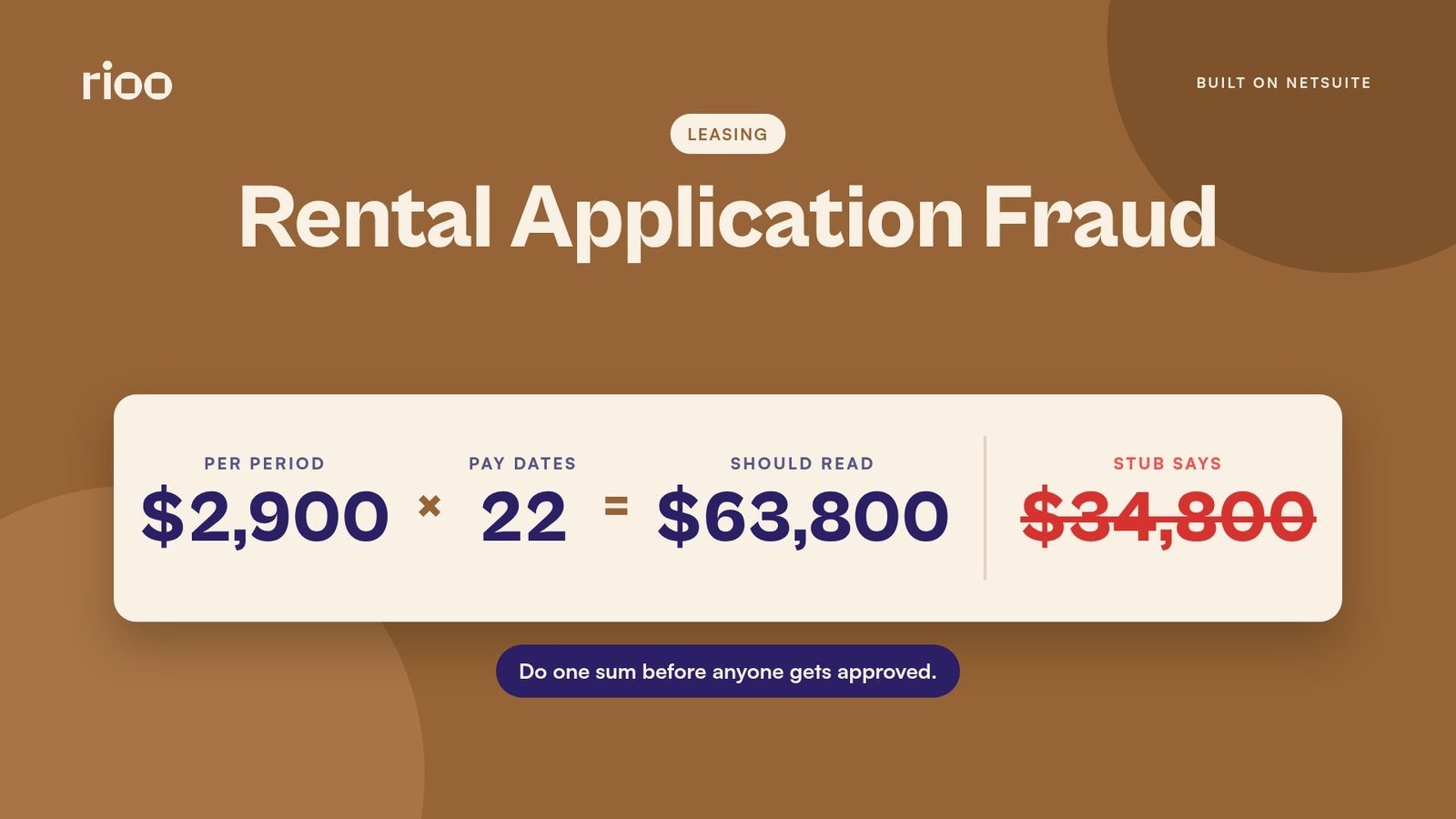
Take the next pay stub that lands in your inbox and do one sum. Multiply the gross pay for the period by the number of pay periods so far this year. Compare the answer with the year to date gross printed on the stub. If the two are far apart, you have a question to ask before anyone gets approved.
Rental application fraud is any false detail or document an applicant uses to get approved. It can be an edited pay stub, an invented employer, a borrowed identity or a friend posing as a past landlord. You catch it with a fixed order of checks, run the same way on every application. Read each document against itself. Verify income at the source. Match the identity to the person. Call references through numbers you found yourself. Then record what you checked and decide on your written criteria.
1. Read every document against itself
Edited documents tend to be wrong in small ways you can check at a desk. Look before you call anyone.
- Year to date totals that do not fit the period pay and the number of pay dates so far.
- Tax withholding that stays the same when gross pay changes, or no withholding on a large salary.
- Pay dates that fall on a weekend or a bank holiday.
- Round numbers everywhere, such as $6,000.00 gross and $1,000.00 tax.
- An employer address that is a home, a mailbox store, or missing.
- Bank statements where the running balance does not add up from one line to the next.
- Fonts, spacing or alignment that change partway down a page.
One oddity is a reason to ask. Payroll systems make mistakes too. Two or three together mean you verify harder before you decide anything.
2. Verify income where it comes from
A document from the applicant proves that the applicant can send a document. Income gets confirmed by the payer or the bank.
Call the employer on a number you found
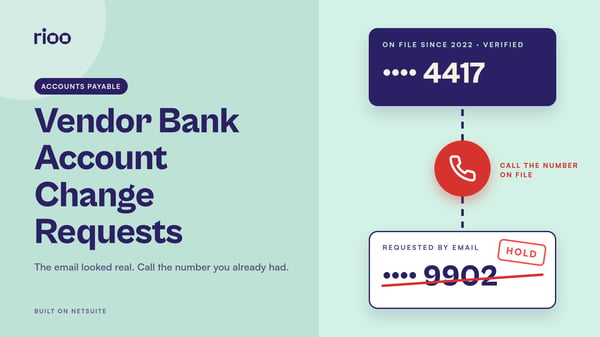
Look up the employer's main number on its own website or a public listing. Do not use the number printed on the stub or the offer letter. Ask payroll or HR to confirm the job, the start date and the pay rate. Some employers confirm dates only. Write down what they would and would not confirm.
Match pay to deposits
Ask for two or three months of statements downloaded from the bank. Payroll deposits should match the net pay on the stubs, on the same dates. A stub showing $2,214 net every two weeks should sit beside deposits of $2,214 every two weeks. If your screening provider offers income or bank verification, the applicant consents and the data comes straight from the source.
Applicants who work for themselves
Ask for the last two tax returns, any 1099 forms, and bank statements that show the deposits. Set this list in your criteria so every self employed applicant gets the same request.
3. Match the identity to the person
Check the photo ID against the person, in person or on a live video call. Then check it against the name and date of birth on the application and the screening report. Look hard at the address history. A history that does not match what the applicant told you, or a credit file far too thin for the applicant's age, needs a second look.
When the applicant may be the victim
Sometimes a report shows accounts or addresses the applicant says are not theirs. That person may be a victim of identity theft. Point them to IdentityTheft.gov, the federal site for reporting and recovery. Give them a fair chance to respond, within the time your written policy allows for holding a unit.
4. Call references you found yourself
A fake landlord reference takes almost no effort. A friend answers the phone and says the right things. So skip the number on the application.
Find the owner of the previous address in the county assessor's records. If a management company runs it, call the company's main line. Then ask questions a real landlord can answer at once. What was the monthly rent? When did the tenant move in? Did they give notice? Would you rent to them again?
Unit 2B at Hollis Court, checked line by line
This is a fictional example. Hollis Court has 64 units. Unit 2B, a two bedroom, rents for $1,950. The written criteria ask for gross monthly income of at least 2.5 times the rent, which is $4,875.
An application arrives on Monday 9 November 2026. The applicant, Ms. Lane, says she has worked at a regional logistics firm since 2023. Her stub for the period ending Friday 30 October shows $2,900 gross every two weeks. That is about $6,283 a month, so on paper she qualifies.
| Check | What the application showed | What the check found |
|---|---|---|
| Year to date gross | $34,800 | Paid every other Friday from 9 January, 30 October is the 22nd pay date. 22 times $2,900 is $63,800. At that rate, $34,800 fits only 12 pay dates. The stub contradicts the claim of work since 2023. |
| Bank deposits | Stub net pay of $2,214 | Statements show payroll deposits of $1,148 on the same Fridays. |
| Employer | Phone number on the stub | The main number from the firm's website reached HR. They confirmed a start date of 8 June 2026, at $22 an hour for about 30 hours a week. |
| Landlord reference | "Landlord" confirmed three years at $1,700, always on time | County records list a management company as owner of that address. Its office had no tenant by that name. |
The confirmed pay works out at $22 times 30 hours times 52 weeks, divided by 12. That is $2,860 a month, well short of $4,875. Sixty hours every two weeks at $22 is $1,320 gross, which fits a deposit of $1,148 after tax.
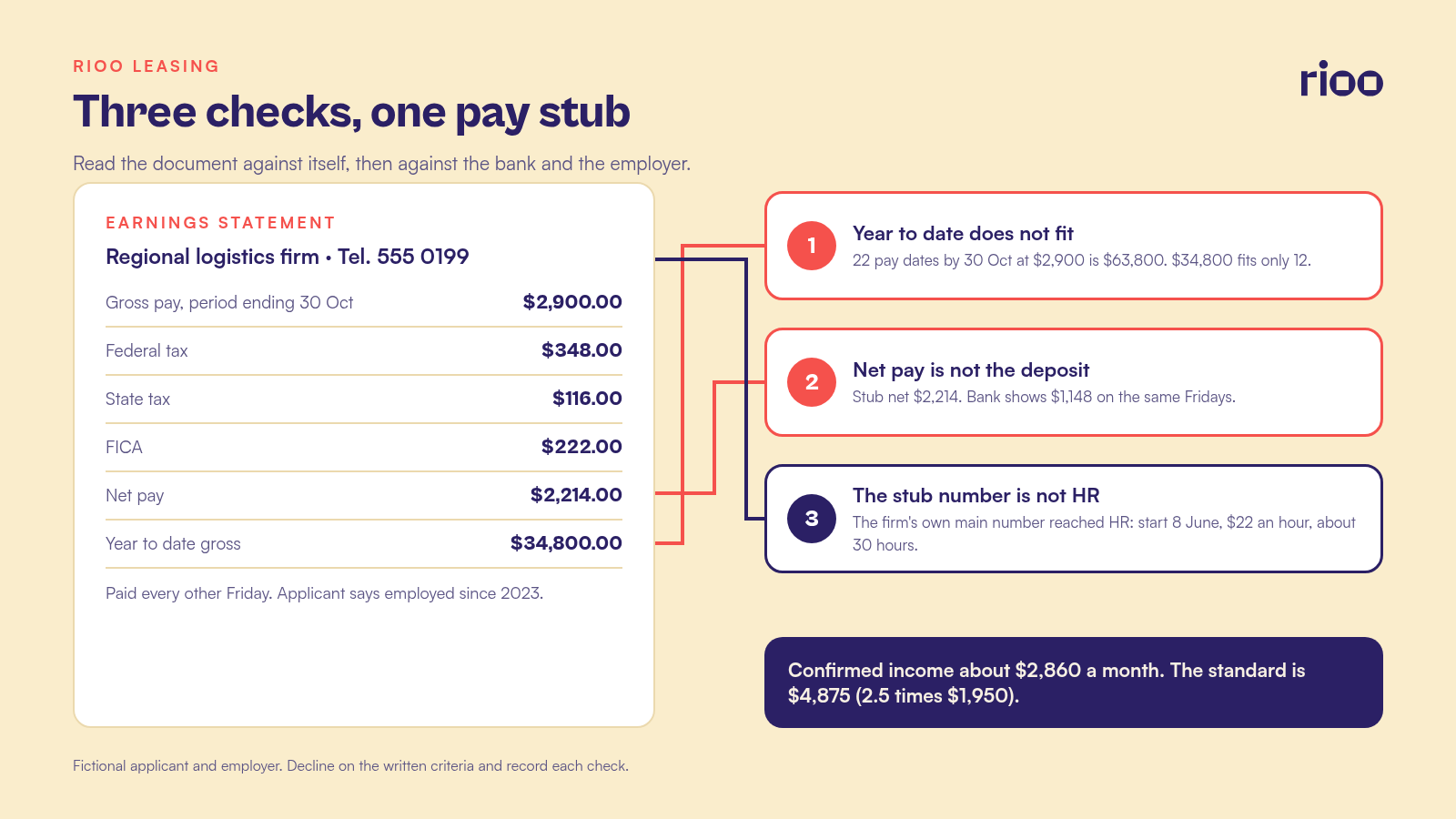
The leasing manager declined the application on the written income standard. The file records each check, the date, and who was spoken to. It does not use the word fraud. The decision rests on income below the standard, which the file can show.
5. Keep the checks identical for every applicant
Fraud checks are part of screening, and fair housing rules apply to them. Run the same checks, in the same order, on every application for the same property. Never verify harder because of a name, an accent, a disability, children in the household or where someone is from.
The same goes for income type. Where state or local law protects source of income, verify a housing voucher through the housing authority the way you verify wages through an employer. Put every check in your written criteria. Our guide to screening criteria that survive a complaint shows how to word them.
6. Decide, record, and tell the applicant
Write down what you checked, when, who you spoke to, and what they said. Decide on the criteria. If you declined, say which criterion the application did not meet.
Do not tell the applicant, a reference or anyone else that you think they committed fraud. You may be wrong, and the accusation adds nothing to the decision.
Under the federal Fair Credit Reporting Act, a denial based on a screening report needs an adverse action notice. If the denial rests on facts from an employer or a past landlord, you may also have to tell the applicant they can ask what that information was. Our guide to the adverse action notice after tenant screening explains which notice applies. If you took money to hold the unit, follow the rules on holding deposits before you keep or return any of it.
Where RIOO fits
In RIOO, the application and the documents the applicant uploads for identity, income and references sit on one application record. Screening runs through connected providers, and the results return to the same record. Your property's criteria apply the same way to each applicant. The decision is recorded with any conditions, and an approved application becomes a lease without retyping. See how tenant screening and applications work in RIOO.
Application fraud questions from leasing teams
Is lying on a rental application illegal?
It can be, depending on the state and the facts. For a landlord, the practical answer matters more. False information is a reason to decline under written criteria. Many leases also let the landlord act if the application turns out to be false. Ask counsel before acting on a signed lease.
What if we find fraud after move in?
Pull the file and confirm what was false. Check what your lease says about false applications and what your state allows. Then talk to counsel before sending any notice. Keep collecting rent and handling repairs as normal in the meantime.
Can we charge extra for the time verification takes?
No. Charge only the application fee your state allows, the same for everyone. Several states cap that fee or tie it to the actual cost of screening.
How long should these checks take?
A clean file with a responsive employer often clears in one or two business days. Set a target in your policy and tell applicants what to expect. Speed matters, because good applicants apply elsewhere when they hear nothing.
Do these checks apply to guarantors?
Yes. A guarantor's income and identity carry the same weight as the applicant's, so they get the same checks in the same order.