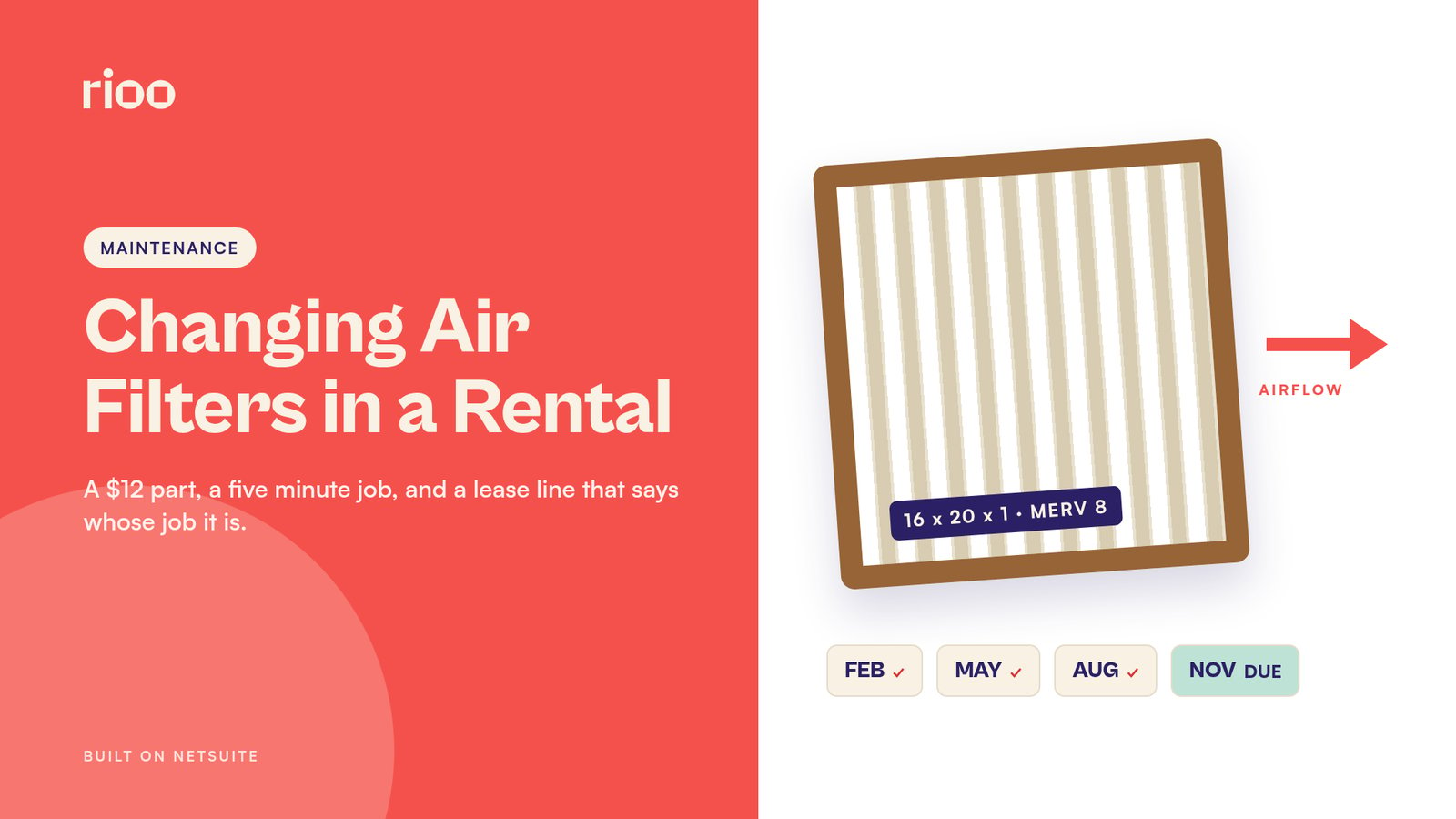
A 1 inch furnace filter costs about $12 and takes five minutes to change. It is also one of the easiest jobs in a rental to lose, because it belongs to nobody until the heat goes weak. Then it belongs to whoever answers the phone at 9 PM.
Who changes air filters in a rental depends on the system and the lease. Take a furnace or air handler inside the unit, with a slot the resident can reach without tools. Many leases make the resident responsible, and the manager still checks at every inspection and at turnover. For a rooftop unit, a closet that needs a key, or a rack above a ceiling tile, the work stays with the owner or the manager. Put the rule in the lease, put a reminder on a calendar, and keep a dated photo of each change. Confirm any habitability rule with counsel, because some states treat heating and cooling as the landlord's duty even when the lease assigns the filter to the resident.
| System | Who changes the filter | How often to start |
|---|---|---|
| In unit furnace or air handler, slot at chest height | Resident, with a manager check at inspection and turnover | Every 90 days, or 30 days with pets or heavy dust |
| In unit system behind a locked closet or ceiling panel | Manager or a vendor | Every 90 days |
| Rooftop or shared plant serving many units | Manager or a vendor | Follow the manufacturer's service plan, often quarterly or with each service visit |
| Window or portable unit the resident owns | Resident | As the maker recommends, often each season |
Use 90 days as a starting interval, not a rule for every building. A unit with two dogs, or a unit on a busy road, may need a change every 30 days. A lightly used one bedroom may be fine at 90. The used filter tells you. If it is grey and packed at 60 days, shorten the interval.
What a clogged filter does to the system
A dirty filter restricts airflow. The system runs longer to reach the thermostat setting. The coil can ice over in cooling season. The heat exchanger can overheat in heating season. Dust bypasses the filter and coats the blower and the ducts. In the unit, the resident feels weak air, uneven rooms and a higher utility bill.
The repair that follows is rarely "just a filter". A frozen coil can leak into the ceiling. A cracked heat exchanger is a safety finding. A clogged filter is one of the common reasons a system short cycles or shuts down on a limit switch. Catching it early is cheaper than any of those calls.
Filters also belong in your wider plant care plan. Our annual preventive maintenance calendar for multifamily sets a quarterly rhythm you can hang the filter route on. When a system has already failed, use our guide on whether to repair or replace an HVAC unit before you approve a large invoice.
Write the lease so both sides know the job
A vague line that says "the tenant shall maintain the premises" does not tell anyone who buys the filter. Be specific.
- Name the system. "The furnace filter in the hall closet" is clearer than "HVAC filters".
- Name the size and the rating you want, for example 16 x 20 x 1, MERV 8. A thicker or tighter filter than the system was built for can starve it of air.
- Name the interval, and say the resident must keep a record, such as a dated photo after each change.
- Say the manager may inspect the filter with proper notice, and may change it and bill the cost if it has been left dirty.
- Say who supplies the first filter at move in, and that a clean filter of the right size will be in place at move out.
If the slot is awkward, do not assign the work to the resident and hope. Either move the work to your team, or walk the resident through the change at move in. Leave a printed card on the closet door with the size, the interval and a photo of the correct orientation. The arrow on the frame points the way the air moves, usually toward the furnace.
Our guide to a space heater policy for rentals is the other half of winter comfort. Residents reach for a heater when the rooms feel uneven, and a clogged filter is a common reason they do.
Seven buildings in Toledo, 43 filters to change
This is a fictional example. A firm manages seven small buildings in Toledo, 112 units in all, each with its own gas furnace in a hall closet. The leases already say the resident changes the filter every 90 days. Nobody on the team had a list of due dates, and nobody had checked a filter since the last turnover.
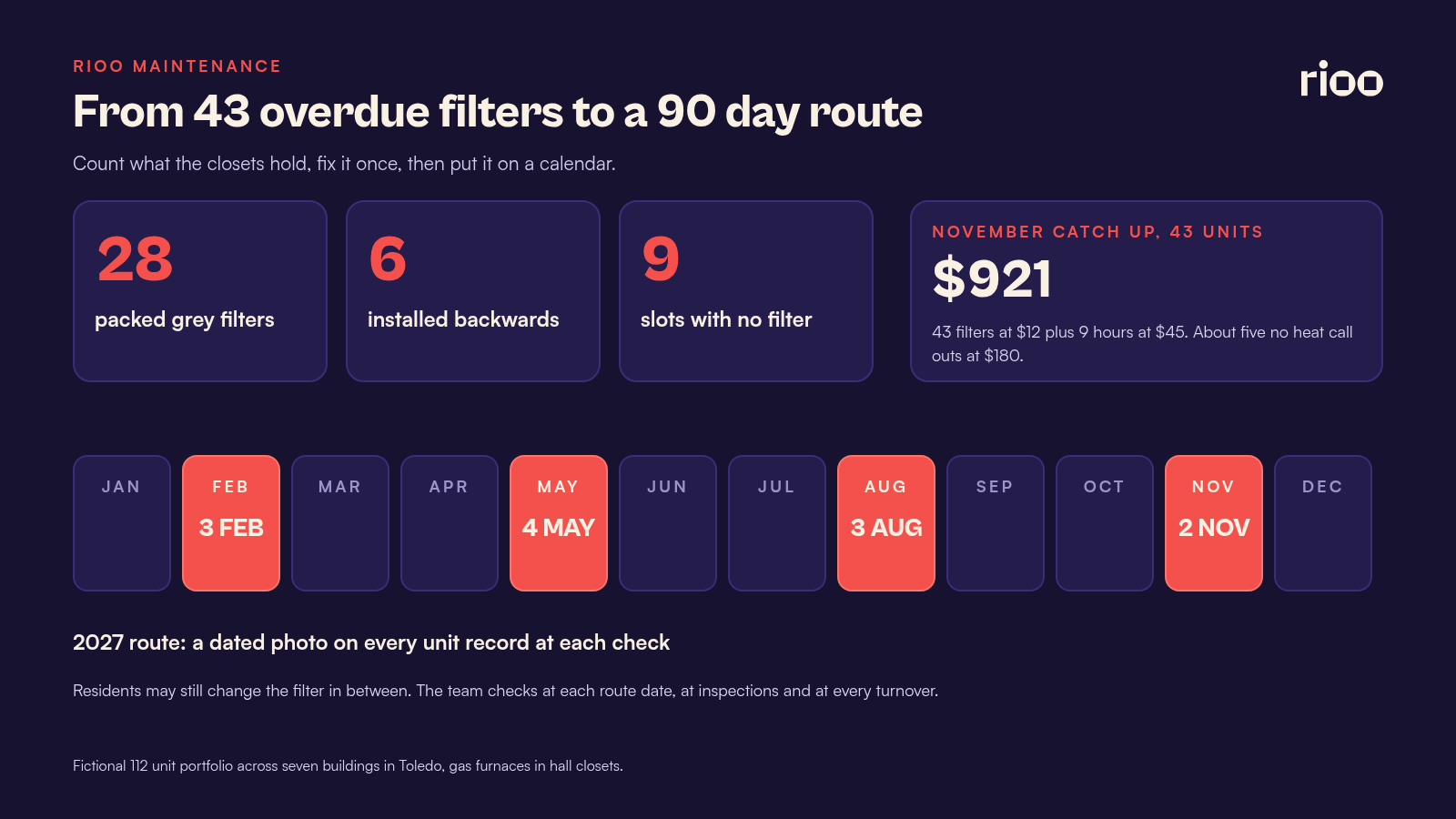
In the week of 3 November 2026 the regional manager, Elena, has every hall closet opened during already booked inspections. In 69 units the filter is fine. She finds 28 filters that are grey and packed, 6 filters installed backwards, and 9 units with no filter in the slot at all. Four of those units had already called about weak heat that month. A same day change in those four units restored airflow. The other 39 units get a new filter over the next four working days, at about 12 minutes a unit including the photo and the note.
Elena then puts every unit on a 90 day route, with checks on 3 February, 4 May, 3 August and 2 November 2027. Residents still change the filter in between if they want to. The team checks at the next inspection and at every turnover. Each visit leaves a dated photo of the installed filter on the unit record, with the size and the MERV rating in the note.
The catch up uses 43 filters at $12, or $516. Technician time is about 9 hours at the firm's internal rate of $45, or $405. The total is $921. That is roughly the price of five after hours no heat calls at the firm's $180 call out rate, before parts. Last winter the portfolio logged eleven of those calls. Two had a packed filter as the only fault.
How to run the route once you have one
- Build a list of every unit with the system type, filter size, rating and who is assigned the change.
- Set the interval from the last photo, not from a generic calendar, and shorten it where the last filter came out dirty early.
- At each visit, photograph the old filter in place, then the new one, with the date in the file name.
- Note any warped frames, gaps at the sides, or a filter that is a different size than the slot. Those are how air bypasses the media.
- If the resident does the change, leave a spare of the right size on top of the unit. Add a card with the next due month.
- At turnover, change the filter as part of make ready, even if the last one looks recent. Our apartment make ready checklist is the place to add that line.
Shared plant is a different job. Rooftop units and mechanical rooms belong on the vendor's service contract. Write filter changes into the visit scope, and keep a copy of each service ticket on the asset record. Do not rely on the vendor to remember if the contract only says "quarterly service".
Putting the route on the RIOO maintenance calendar
RIOO's maintenance planning and scheduling holds recurring work on a calendar, assigned by skill and availability, with a history on the unit and the asset. A quarterly filter route can sit there as planned work, with the size, rating and last photo on the record. Residents can submit a request from the portal if a system is blowing weak air, and the technician closes the visit against the same unit. Utility assets keep the furnace or air handler in a register with its service history. See how maintenance planning and scheduling works in RIOO.
When the resident has not done the work
Send a short notice first. Quote the lease clause, add a photo of a packed filter if you have one, and set a date for the change. Offer to do the change for a stated fee if they would rather not. If the date passes, change it yourself with proper notice of entry, bill the filter and the time, and keep the photos.
Stay even handed. The same interval and the same follow up apply to every unit with the same system. If a resident cannot physically change the filter, treat that as a request for help and assign the work to your team. Do not let the unit go without a filter.
A missing or packed filter can also show up as "damage" at move out. Photograph it, charge the replacement if your lease allows, and be ready to show the move in photo of a clean filter. Our guide to normal wear and tear versus damage helps you draw that line.
Air filter questions from site teams
Who is responsible for changing air filters in a rental?
For an in unit system the resident can reach, the lease can assign the change to the resident, and the manager should still check. For locked closets, ceiling racks and rooftop units, the manager or a vendor should do the work.
How often should rental air filters be changed?
Every 90 days is a sound starting point. Shorten it to 30 or 60 days if the used filter is packed, or if the unit has pets or sits on a dusty road.
Can I charge a resident for a dirty furnace filter?
Yes, if the lease assigns the change to them and you have a move in photo of a clean filter. Change it, photograph it, and bill the filter and the time at the rate in the lease.
What MERV rating should we use?
Use the rating the manufacturer allows, often MERV 8 for a standard residential furnace. A much higher rating can cut airflow and strain the system. Check the model before you standardise.
Should we change the filter at every turnover?
Yes. It is cheap, it protects the next resident, and it gives you a dated photo to start the next interval.