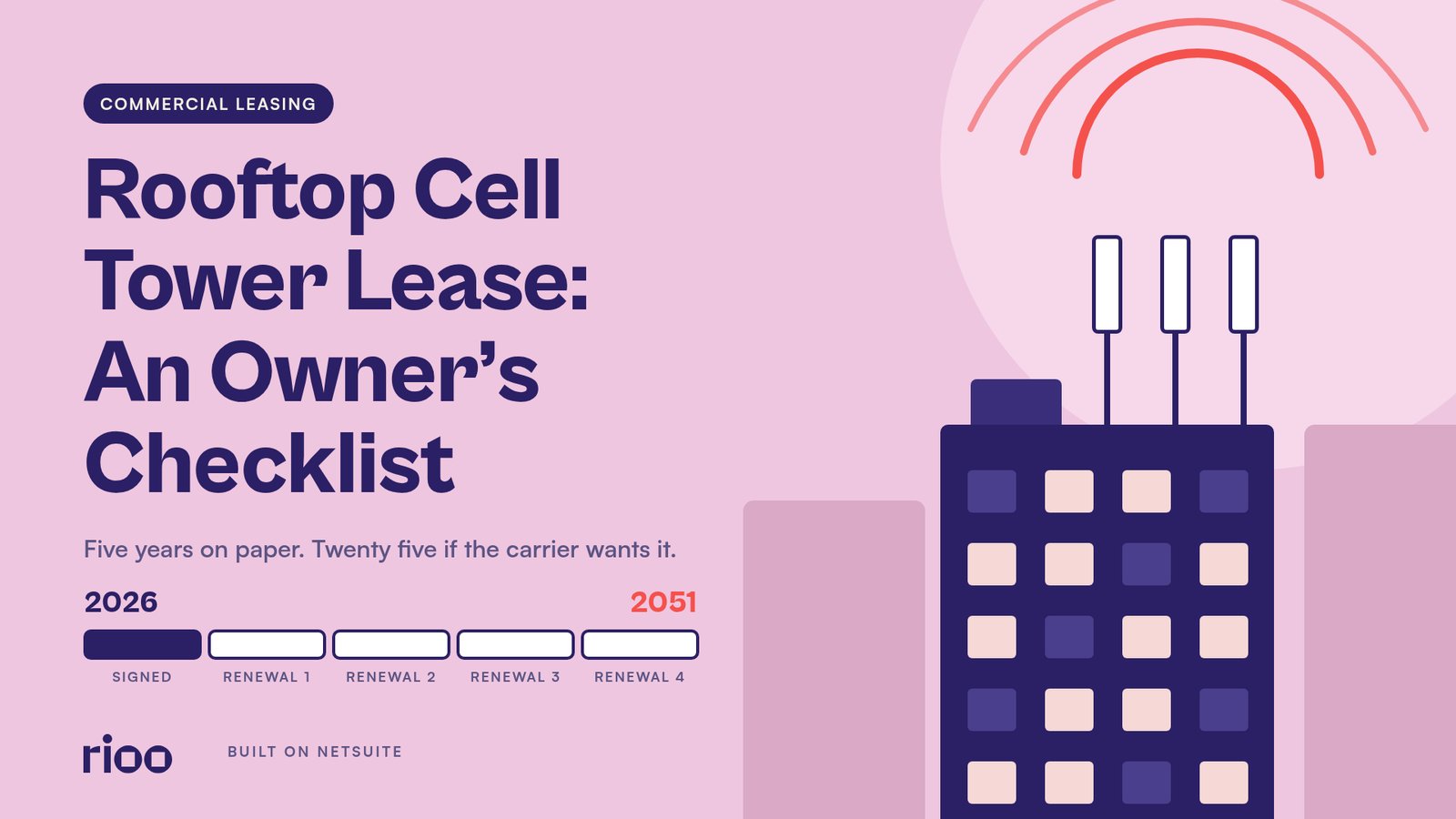
A rooftop lease signed this year can still bind the building in 2051. That is the first thing to understand when a letter arrives offering monthly rent for a few antennas on your roof.
A rooftop cell tower lease rents part of a building's roof to a wireless carrier or a tower company for antennas, cables and equipment cabinets. The usual form has a five year initial term followed by several five year renewals that the carrier alone controls, so 25 years is common. Rent and the yearly escalator matter. So do the clauses that decide whether you can repair the roof, sell or redevelop the building, and get the equipment removed at the end. Have a structural engineer and a lawyer review the deal before anyone signs.
Hargrove House, one offer read two ways
This is a fictional example with rounded figures. Hargrove House is a nine story office building with a flat roof replaced in 2019. A site agent offers $2,000 a month for three antenna panels and an equipment cabinet on the roof.
The draft lease runs five years, with four automatic five year renewals at the carrier's option. Rent rises 2 percent a year. The carrier can end the lease on 90 days' notice. There is no clause letting the owner move the equipment for roof work.
| Term | Draft as offered | After negotiation |
|---|---|---|
| Starting rent | $2,000 a month | $2,000 a month |
| Yearly escalator | 2 percent | 3 percent |
| Rent in year 25 | About $3,217 a month | About $4,066 a month |
| Total rent over 25 years | About $768,700 | About $875,000 |
| Carrier termination notice | 90 days | 12 months, plus one year of rent as a fee |
| Roof work relocation | None | Temporary move at the carrier's cost on 90 days' notice |
| Removal at the end | "Reasonable efforts" | Within 120 days, roof restored, backed by a bond |
The starting rent never changed. One percentage point on the escalator added about $106,000 over the full term. The relocation clause will matter even more in the 2040s, when the roof membrane is due for replacement while the antennas are still up.
Five questions before you answer the letter
Work through these in order. A troubling answer to any of the first three is a reason to slow down or decline.
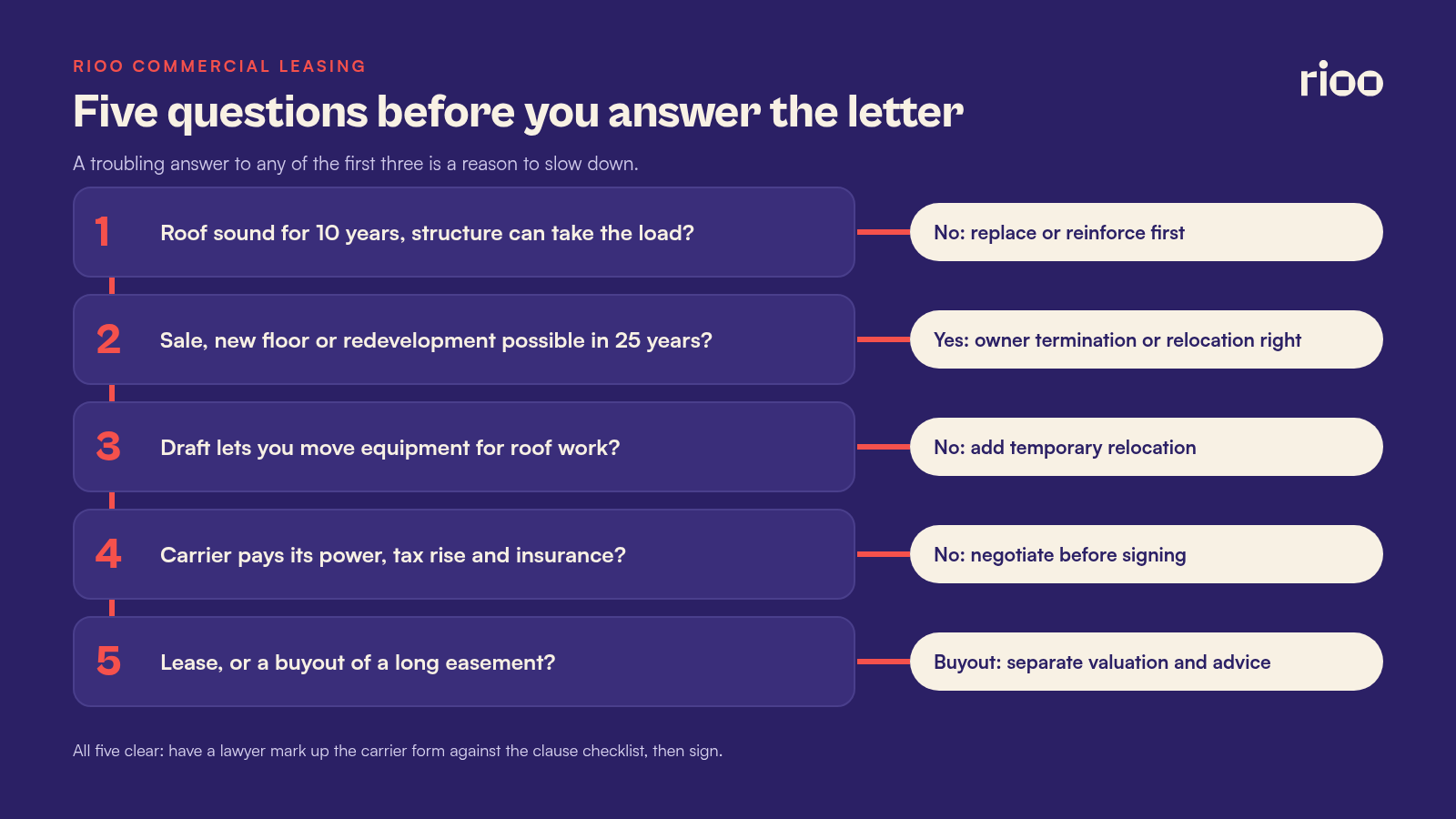
Is the roof ready for 25 years of equipment?
Ask your engineer to check the structure for the added load and the plan for roof penetrations. If the membrane is near the end of its life, replace it first. Pulling up a roof around live antennas is slower and costs more.
Could the building change during the term?
A sale, a new floor, a solar array or a change of use could all collide with the equipment. If any of these is possible, you need an owner termination or relocation right in the lease. Buyers will ask about it too.
Can you move the equipment for roof work?
Look for a temporary relocation clause. It should let you require the carrier to move or power down equipment for repairs, on notice and at the carrier's cost. Without it, every roof job becomes a negotiation.
Who pays for power, taxes and insurance?
The carrier should have its own electric meter. Any rise in property tax caused by the installation should pass through to the carrier. The carrier should carry liability insurance naming the owner and manager as additional insureds.
Is this a lease, or a buyout?
Some offers ask for a lump sum in exchange for a long easement over the roof. That trades decades of rent and control for cash today. Treat it as a separate decision with its own advice.
The clause checklist
Use this list when your lawyer marks up the carrier's form. Each item is a common point of negotiation.
- Rent start. Rent should begin on a fixed date or when construction starts, not when the site goes live.
- Escalator. A fixed yearly increase or an index link. Avoid increases that happen only at each renewal.
- Renewals. Fewer or shorter renewal periods bring the next rent review closer.
- Carrier termination. A long notice period and a termination fee protect you from a sudden exit.
- Added equipment. New antennas, larger cabinets or a second carrier need written consent and extra rent.
- Assignment. Require written notice of any transfer. Keep the original tenant liable where you can.
- Access. Set rules for when and how technicians reach the roof, with escort and keys controlled by your team.
- Removal and restoration. A fixed deadline, a restored roof and a bond or deposit to cover it.
- Holdover. Rent at a premium if the carrier stays after the lease ends.
- Costs. The carrier pays your legal and engineering review fees.
Insurance certificates expire every year. Our guide to COI tracking explains what a certificate proves and what it does not. If the carrier later asks to transfer the lease, the logic in our article on landlord consent to assignment applies here as well.
Keeping staff and roofers safe near antennas
Antennas emit radio frequency energy. The Federal Communications Commission sets exposure limits, and the carrier, as the FCC licensee, must keep its site within them. The FCC radio frequency safety page explains the rules.
The lease should still spell out the practical side. Ask for warning signs and barriers where the carrier's study says they are needed. Ask for a named contact and a process to power down antennas before anyone works close to them. Brief your own roofers, window cleaners and HVAC vendors before they go up.
Fold roof access into your normal inspection cadence. Our guide on how often to inspect the roof and envelope covers the schedule, and the carrier's equipment should be on the walk route.
Apartment and condo roofs need extra steps
Residential buildings raise questions an office building rarely does. On a condo or HOA building the roof is usually common property. The governing documents decide whether the board can sign alone or needs an owner vote. Read them before any letter of intent.
Residents will notice the work. Cabinets with cooling fans can hum, and a backup generator needs testing. Ask where the equipment will sit, how loud it runs and when tests happen. Put quiet hours for testing in the lease.
Access is the other issue. Technicians may need to pass through residential corridors or use a resident elevator. Agree an escort rule, a sign in log and a notice period for routine visits. Emergency access should still be possible at night, with a named contact on both sides.
Some residents will ask about health. Answer plainly that the carrier must meet federal exposure limits, share the FCC page and offer the carrier's compliance study. Keep the conversation factual and give one point of contact.
The roof lease as a record in RIOO
A rooftop agreement is a lease like any other, even though the tenant never occupies a suite. In RIOO Professional it can sit as a commercial lease record on NetSuite. The record holds the abstracted terms, critical dates, escalations, guarantees and documents.
Escalation dates and renewal windows appear on the critical dates list with an owner assigned. The insurance certificate expiry is tracked next to them. Because the same lease drives billing, the yearly increase reaches the ledger without anyone keying it twice. Commercial lease administration shows how that works.
Running the lease once it is signed
The work does not stop at signature. Somebody has to check that rent arrives and rises on the right date each year. A rooftop lease can be underbilled for years if nobody applies the escalator.
Book the rent as other income at the property. Our guide to ancillary revenue streams covers how to classify it alongside parking and storage. Keep a copy of the carrier's site drawings and update them when equipment changes.
Put three dates on the calendar the day the lease is signed. The first is each escalation date. The second is the notice deadline before each renewal. The third is the insurance certificate expiry. Set reminders 90 days ahead of each.
Before you reply to the carrier
How much does a carrier pay for a rooftop cell site?
It varies widely with location, height and how badly the carrier needs coverage there. Treat the first offer as an opening number. Ask a broker or adviser with rooftop experience to benchmark it.
Can I say no to a rooftop antenna offer?
Yes. A private owner has no duty to lease roof space. Check any existing leases first, since an office tenant may hold rights to the roof for its own equipment.
What happens to the lease if I sell the building?
The lease normally runs with the building, so the buyer takes it on. Buyers value the income but will read the relocation and termination clauses closely.
Who maintains the roof under the equipment?
The owner usually keeps the roof. The carrier should repair any damage it causes and pay for added work around its equipment. Write both points into the lease.
Should I accept a buyout of my rooftop lease?
Only after comparing the cash offer with the present value of the rent stream and the control you give up. Get independent valuation and legal advice first.