









The roof bid is $612,000. The reserve fund holds $366,000 for the roof. The board now has to find $246,000. Unless it borrows or delays the work, that gap becomes a special assessment.
An HOA special assessment is a one time charge to owners for a cost the regular budget and reserves cannot cover. To levy one, the board first confirms its power under the governing documents and state law. It gets a member vote if the amount needs one and sets each owner's share by the formula in the declaration. Then it gives written notice inside the legal window, offers a payment plan, and bills the charge separately from regular dues. Rules differ by state, so have the association's counsel confirm each step.
What a special assessment pays for
A special assessment covers one defined cost. A typical cause is a roof, siding or elevator replacement that the reserves did not fully fund. Others are an uninsured loss, a storm deductible or a legal settlement. It is not a way to patch an operating budget that was set too low. That problem belongs in next year's dues, set through the HOA budget adoption process.
Owners take a special assessment better when the purpose is narrow. "Replace the main roof on Buildings A to D" gets a calmer reaction than "building repairs." The narrow purpose also protects the board. Money collected for a stated purpose should be spent on that purpose, and any surplus handled the way the governing documents say.
Before anything else, read the reserve study. If it showed the roof as underfunded for years, say so in the notice. Our guide to HOA reserve study requirements explains how to read that gap.
Seven steps from board vote to collected funds
These steps follow the order a community manager works through them. The legal details sit in step 2 and step 4, and they are the ones that differ from state to state.
Step 1: Price the gap and look at alternatives
Get at least two bids for the work. Take the low qualified bid, add a contingency, and subtract the reserve money already set aside for this component. The result is the amount to raise.
Then write down what else the board considered. A bank loan to the association, a phased project, or a higher reserve contribution next year are the usual options. Owners will ask "why not a loan?" at the first meeting. A one page comparison answers it.
Step 2: Confirm the board's authority
Read the declaration and bylaws for limits on special assessments. Some cap the amount the board can levy alone. Some require a member vote above a threshold or for any special assessment at all.
State law can add its own limits. California sets a 5 percent ceiling. Special assessments that together exceed 5 percent of the year's budgeted gross expenses need approval from a majority of a quorum of members, under Cal. Civ. Code 5605. Assessment votes there are held by secret ballot under Civ. Code 5100. Florida's homeowners association statute puts the weight on meeting notice. Notice of a board meeting that will consider special assessments must say so and describe them. It must go out at least 14 days before the meeting, under Fla. Stat. 720.303. Rules as of November 2026; check the current text.
Step 3: Hold the vote and record it properly
Whoever votes, the minutes should state the total amount, the purpose and the allocation method. Add the due date and whether instalments are allowed. Record the count. If a member vote was required, keep the ballots and the inspector's report as the governing documents and state law require.
Quorum is where member votes fail. Our piece on HOA election quorum covers how to get enough ballots back.
Step 4: Set each owner's share and send notice
Use the allocation formula in the declaration. That may be equal shares, a percentage interest per unit, or square footage. Do not invent a new formula for this one charge.
The notice should open with the dollar amount for that owner. Then give the purpose, the vote that approved it and the due date or instalment schedule. Explain how to pay, how to apply for a plan, and what happens if a payment is missed. California requires individual notice of a special assessment at least 30 and no more than 60 days before it is due, under Civ. Code 5615. Deliver it to each owner by a method state law accepts. First class mail works, and so does email for owners who agreed to it. Keep proof of delivery.
Step 5: Offer a payment plan before anyone asks
A four figure bill due in 45 days will produce delinquencies. Spread over 12 months, the same bill becomes a line in a household budget. Publish the plan terms in the notice and make enrolment a short form with a deadline.
Decide in advance whether instalments carry a fee or interest. Settle what happens to the plan if the unit is sold, and whether a missed instalment makes the whole balance due. Ask counsel whether owners on a plan should sign a payment agreement.
Step 6: Bill it as its own charge
Post the special assessment as a separate charge type on each owner ledger, never folded into regular dues. Owners, auditors and buyers' title companies will all ask for the balance on its own. Deposit the money where the board resolved it should go, often the reserve or a dedicated project account.
Step 7: Follow up and report
Send a reminder 10 days before the first due date. Report collections to the board monthly by unit, with plan enrolments shown apart from unpaid balances. When an owner falls behind, follow the association's adopted collection policy and the state's pre lien steps exactly. Our guide to the HOA collection step you cannot take yourself explains where the manager stops and counsel takes over.
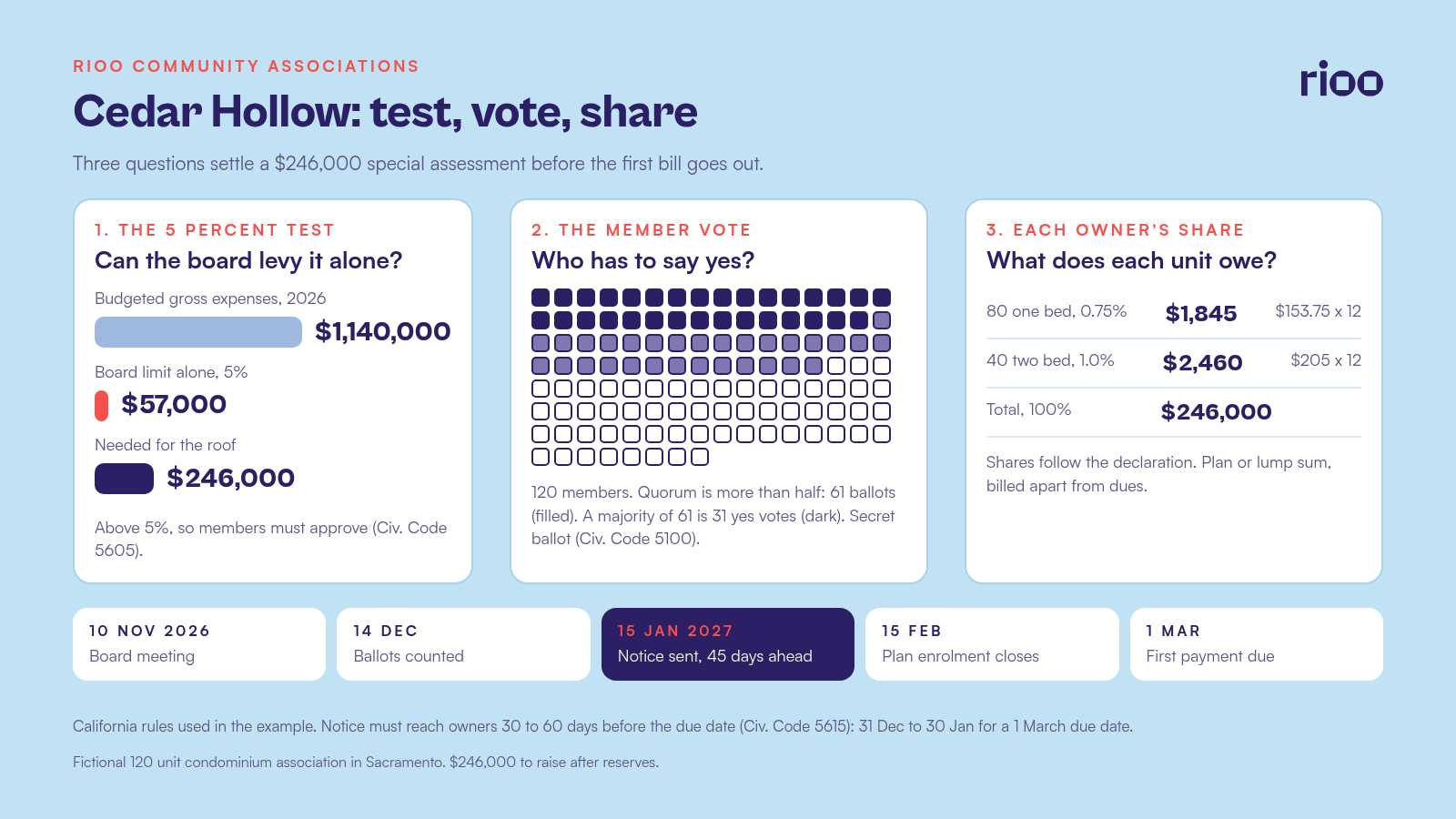
Cedar Hollow: a $246,000 roof gap, worked through
This is a fictional example with round numbers. Cedar Hollow is a 120 unit condominium association in Sacramento, California. Its budgeted gross expenses for 2026 are $1,140,000. The roof bid is $612,000 and the reserve holds $366,000 for the roof, which leaves $246,000 to raise.
The 5 percent limit is $57,000, which is 5 percent of $1,140,000. The $246,000 is far above that, so the board cannot levy it alone. It needs approval from a majority of a quorum of members. A quorum means more than half of the 120 members, so at least 61 ballots. If exactly 61 come back, 31 yes votes carry it.
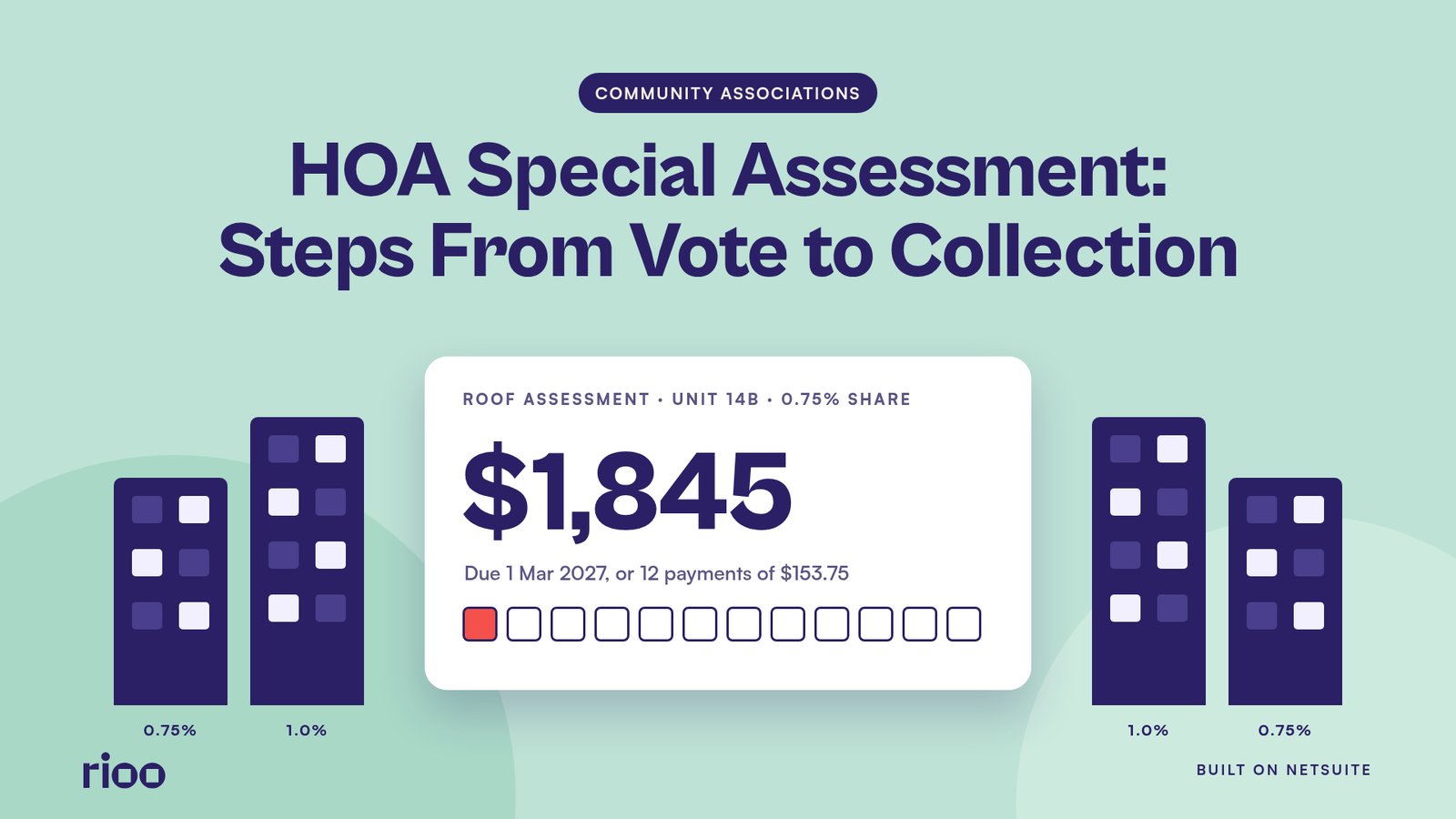
The declaration allocates by percentage interest. Cedar Hollow has 80 one bedroom units at 0.75 percent each and 40 two bedroom units at 1.0 percent each. That adds up to 60 percent plus 40 percent, or 100 percent.
| Unit type | Units | Share each | Assessment each | 12 monthly payments | Total raised |
|---|---|---|---|---|---|
| One bedroom | 80 | 0.75% | $1,845 | $153.75 | $147,600 |
| Two bedroom | 40 | 1.0% | $2,460 | $205.00 | $98,400 |
| All units | 120 | 100% | $246,000 |
The board chooses 1 March 2027 as the due date. The notice window then runs from 31 December 2026 (60 days before) to 30 January 2027 (30 days before). The manager sends notice on 15 January, which is 45 days ahead, by mail and by email to the owners who consented to email.
At the owner meeting in December, one owner asks the obvious question.
"Why can't we just take a loan?"
"We priced one," the board president answers. "Seven years at 7 percent adds about $66,000 in interest. Owners who can pay now would carry that cost for owners who cannot. The 12 month plan costs the association nothing extra."
That figure is a simple amortised loan of $246,000 over 84 months at 7 percent. Use the bank's actual quote when you run this conversation.
Billing the Cedar Hollow assessment in RIOO
RIOO runs association accounting on NetSuite, with each association in its own books. On the HOA, condo and strata management side, a special assessment is billed per unit by ownership share or an agreed formula. It is tracked apart from regular assessments, and instalment plans can be set up where the board approves them.
For Cedar Hollow, that means the 120 charges come from the share table, not from a spreadsheet typed by hand. Each owner's ledger shows the special assessment as its own line, plan or no plan. The board pack can then show collections against the $246,000, unit by unit.
When owners push back
Write your answers down before the notice goes out. The same objections tend to come up each time.
Owners want to know why reserves fell short. Give the honest history, even if a past board underfunded the roof. They question the amount, so show the bids and the contingency, and say what happens to unused contingency money. Some owners simply cannot pay on time. Point them to the payment plan and to any hardship process the association has adopted.
A town hall before the vote helps more than a long letter after it. Bring the bids and the reserve study page for the roof. Let owners see the paper.
The assessment also affects sales. In many states, the disclosure package or resale certificate a buyer receives has to show approved special assessments. Keep the board resolution and the per unit schedule ready, because title companies will ask for them on every sale during the payment period.
Owner and board questions
Can an HOA charge a special assessment without a vote?
Sometimes. The governing documents and state law decide. Some boards can levy up to a set limit alone. In California the limit is 5 percent of budgeted gross expenses in total for the year, and anything above needs member approval. Some states, California included, allow an emergency exception, so check the statute before relying on it.
How much notice do owners get?
It depends on the state and the documents. California requires individual notice 30 to 60 days before the assessment is due. Florida HOAs must notice the board meeting where a special assessment will be considered at least 14 days ahead.
Who pays if a unit sells during the payment plan?
The governing documents and the purchase contract decide. Often the unpaid balance is paid at closing, or the buyer takes over the remaining instalments. Disclose the balance in the resale package either way.
Can the association put a lien on a unit for an unpaid special assessment?
In many states, yes, under the same rules as regular assessments. The pre lien notices and timelines are strict. Follow the collection policy and involve counsel before any lien is recorded.
What happens to money left over after the project?
Check the governing documents and the board resolution. Common choices are a refund or credit to owners in proportion to what they paid, or a transfer to reserves if the documents allow it.