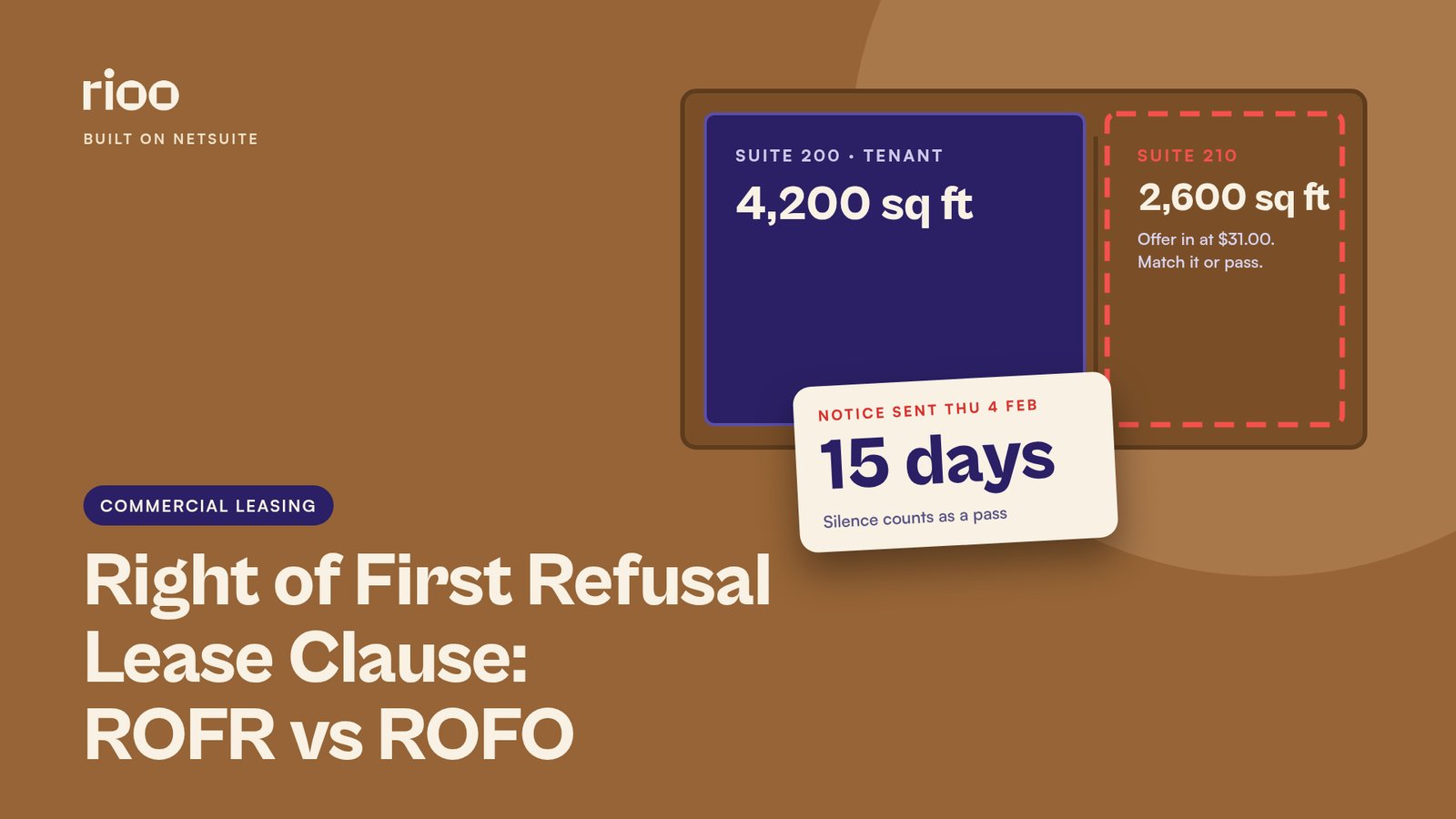
A right of first refusal in a lease gives the tenant the chance to match a deal the landlord has already agreed in principle with someone else. When a genuine third party offer arrives for the covered space or the building, the landlord must show the tenant its terms. The tenant then has a fixed number of days to take the deal on those same terms. If the tenant passes or stays silent, the landlord can close with the third party.
That differs from a right of first offer, where the landlord must go to the tenant before marketing at all. Both clauses look short on the page. Both can slow a leasing deal or a sale if the notice rules, deadlines and exclusions are loose. This guide is written for landlords and property managers who have to live with the clause after signing.
ROFR, ROFO and purchase options side by side
These three rights get mixed up in negotiations. The table shows what each one does on the day something happens.
| Question | Right of first refusal (ROFR) | Right of first offer (ROFO) | Purchase or expansion option |
|---|---|---|---|
| What starts it? | A third party offer the landlord is willing to accept | The landlord deciding to lease or sell | The tenant, any time inside the option window |
| Who sets the terms? | The third party, in its offer | The landlord, in its first offer to the tenant | The lease, by fixed price or formula |
| What does the tenant do? | Match all terms or pass | Accept, negotiate or pass | Exercise by notice or let it lapse |
| Effect on third parties | Strong. Bidders know they can be matched | Moderate. The tenant sees the deal first | Strong while the option is live |
| What the landlord gives up | Speed and some bidder interest | A short wait before marketing | Control of timing and price |
A ROFR can cover adjacent space or a sale of the building. In multi tenant office and retail buildings, the space version is the one leasing teams handle day to day. Sale ROFRs carry bigger consequences, because buyers and lenders price the delay.
Short answers before the details
Is a right of first refusal binding?
Generally yes. Once it is in a signed lease, it is a contract term like any other. A landlord who leases or sells the covered space without giving the required notice risks a claim from the tenant. Courts read these clauses closely, so the exact wording on notice and timing matters.
How long does a tenant usually get to respond?
The lease sets it. For space, leases often allow 10 to 30 days. Sale ROFRs often run longer. A landlord should push for a short, firm period and a rule that silence means the tenant has passed.
Does a ROFR survive if the tenant passes once?
It depends on the clause. Many space ROFRs are continuing, so the right comes back if the space becomes available again. Some end after the first pass. Write the answer into the lease so nobody argues about it later.
Can a ROFR be assigned with the lease?
Landlords usually make it personal to the original tenant, so it falls away on an assignment or sublease. Our guide to landlord consent to assignment of a commercial lease covers how that review works.
One offer, 15 days: a worked timeline
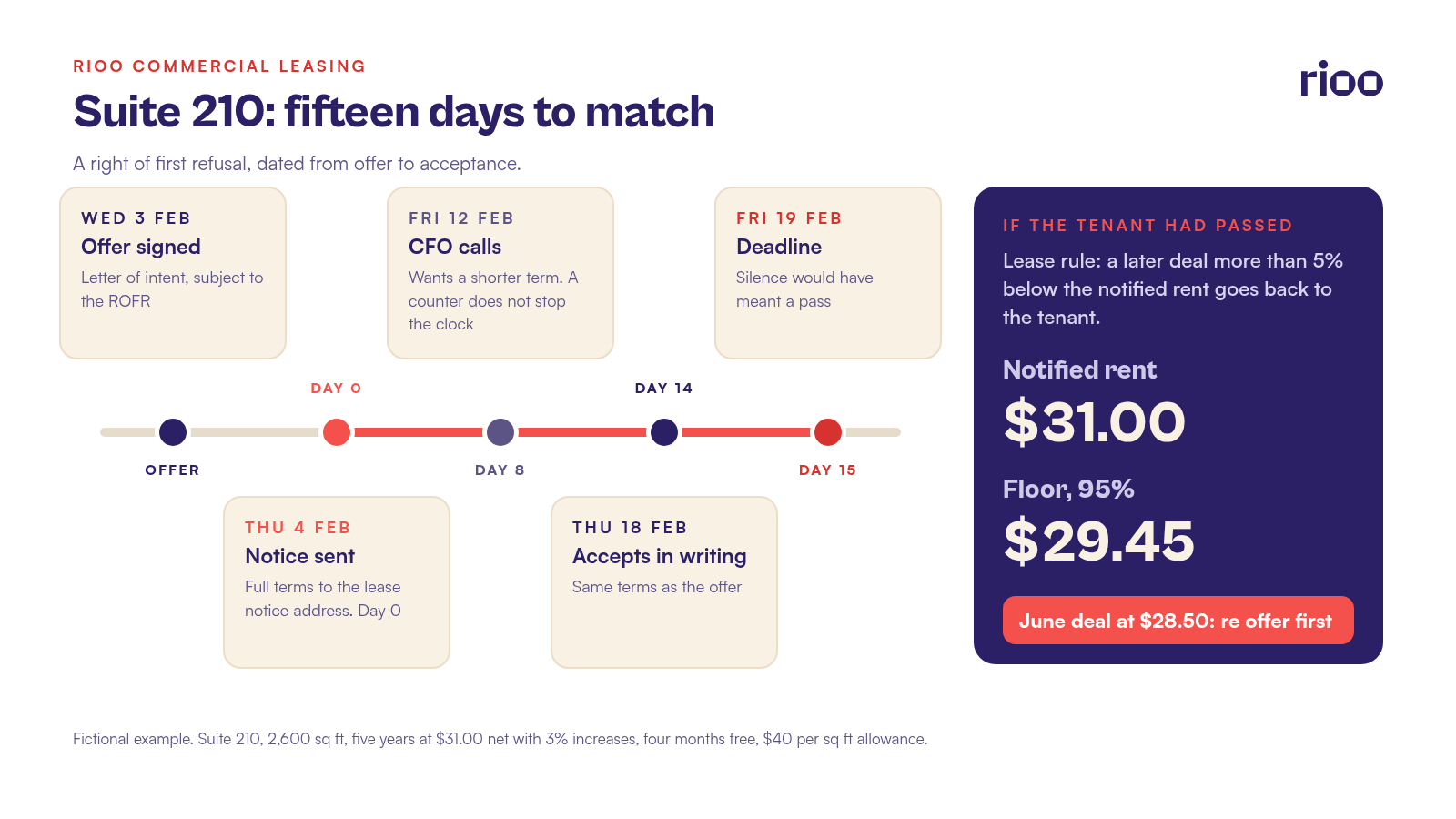
This is a fictional example. Larkspur Dental leases Suite 200, 4,200 square feet, in a two story office building. Its lease runs to 31 January 2031 and gives it a continuing ROFR on Suite 210 next door, 2,600 square feet. The clause gives the tenant 15 days from the landlord's notice to accept "on the same terms" as the third party offer. Silence counts as a pass.
In early February 2027, a physiotherapy group signs a letter of intent for Suite 210 on these terms.
| Term | Third party offer |
|---|---|
| Area | 2,600 sq ft |
| Term | Five years, 1 May 2027 to 30 April 2032 |
| Base rent | $31.00 per sq ft a year, net, so $80,600 in year one ($6,716.67 a month) |
| Increases | 3 percent a year |
| Free rent | Four months, worth $26,866.67 |
| Improvement allowance | $40 per sq ft, so $104,000 |
Over five years the base rent adds up to $427,916.35. Take away the free rent and the allowance and the landlord nets $297,049.68. That works out to about $22.85 per square foot a year before any discounting. The headline rent is $31.00. The number the tenant must match is the whole package.
Here is how the 15 days played out.
| Date | What happened |
|---|---|
| Wed 3 Feb 2027 | Letter of intent signed with the physiotherapy group, expressly subject to the ROFR |
| Thu 4 Feb | Landlord sends the ROFR notice with the full offer terms to the notice address in the lease. The 15 days end on Fri 19 Feb |
| Fri 12 Feb | Tenant's CFO calls the property manager |
| Thu 18 Feb | Tenant accepts in writing, on the same terms |
| Mon 15 Mar | Lease amendment for Suite 210 signed |
| Sat 1 May | Suite 210 term starts |
The phone call on 12 February is where these deals wobble.
"We want the space," the CFO said. "But can the new suite end with our main lease in January 2031? We don't want two expiry dates."
"That's a different deal," the property manager answered. "The offer is five years to April 2032. If you want a shorter term, send a written acceptance of these terms first. We can talk about lining up the dates after that. A counter by itself doesn't stop the clock."
The tenant accepted the offer as written six days later. The parties then agreed a separate amendment that added an option to extend Suite 200 to April 2032, so both suites end together.
Now take a different ending. Suppose the tenant had passed, and the physiotherapy deal then fell apart. In June the landlord finds another prospect willing to pay $28.50 for the same space. Suppose the lease says any later deal at a rent more than 5 percent below the notified offer must be offered to the tenant again. The floor is $29.45, which is 95 percent of $31.00. At $28.50, the landlord has to go back to Larkspur first.
Should a landlord grant one?
Granting a ROFR can win a strong tenant or settle a renewal. It also puts a tenant between you and every future deal for that space. Work through these questions before agreeing.
Is the space likely to be wanted by others?
A ROFR on space that leases slowly costs little. On a corner retail unit, or the floor next to a fast growing tenant, it can cool interest. Some prospects will not negotiate a deal that may simply be matched.
Would a ROFO do the job?
Often, yes. The tenant gets the first look, and the landlord does not have to sign a third party deal before knowing whether it can close. Offer a ROFO first and keep the ROFR for tenants that insist.
Does it touch a future sale or financing?
A sale ROFR can delay or block a building sale and worry lenders. Keep sale rights out of space leases unless ownership has signed off. Exclude transfers to affiliates, foreclosure and portfolio sales.
Will the tenant still be the tenant you wanted?
Make the right personal to the original tenant. End it if the tenant is in default or has sublet a large part of its space. End it too when fewer than a set number of months remain on its term.
Clause points to settle before signing
These are the gaps that produce disputes. Take them to counsel when the lease is drafted.
- Exactly which space or property the right covers, with a floor plan attached.
- What counts as a bona fide offer: a signed letter of intent, or only a signed lease.
- What the notice must include and where it is sent, matching the lease notice clause.
- The response period, and that silence is a pass.
- Whether the tenant must take the whole offer or can take part of the space.
- How term mismatches are handled when the offer runs past the tenant's own expiry.
- The re offer rule: how much better a later deal must be before the tenant sees it again.
- Whether the right continues after a pass or ends.
- Exclusions: existing tenants' renewals, expansion rights already granted, and affiliate transfers.
- Conditions: no default, personal to the tenant, minimum remaining term.
Rights granted earlier to other tenants can collide with a new ROFR. Relocation rights are a common clash, because moving the tenant can change which space its ROFR sits next to. Our guide to the commercial lease relocation clause covers that drafting. Before you sign, list every option and right on the floor. Our lease abstraction checklist covers the fields to capture.
How RIOO tracks the notice window
A ROFR fails in practice when nobody remembers it exists. Then a leasing agent signs a letter of intent and the tenant finds out from the new neighbour's contractor. Commercial lease administration in RIOO turns a lease into a structured record on NetSuite, with options and critical dates abstracted from the document.
For Suite 210, that means the ROFR sits on the Suite 200 lease record as an option, with Suite 210 named in the abstract. A leasing team can check it before any letter of intent goes out. The 15 day response deadline can be logged as a critical date. Because the same record drives billing, the Suite 210 rent, free months and increases come from the amendment rather than being keyed in again.
Space ROFRs during a sale
When the building sells, the buyer inherits every space ROFR in the rent roll. Buyers will check them in due diligence and in tenant estoppels. Our guide to tenant estoppel certificates explains what each tenant certifies about its rights.
Make sure the estoppel form asks the tenant to confirm any ROFR, ROFO or expansion option, and whether it has passed on any notice. A ROFR the seller forgot about is a problem for the buyer on day one.