A resident who smells gas should not be on the phone with you from inside the building. That is the first rule of an apartment gas leak. Every other step in this guide follows from it.
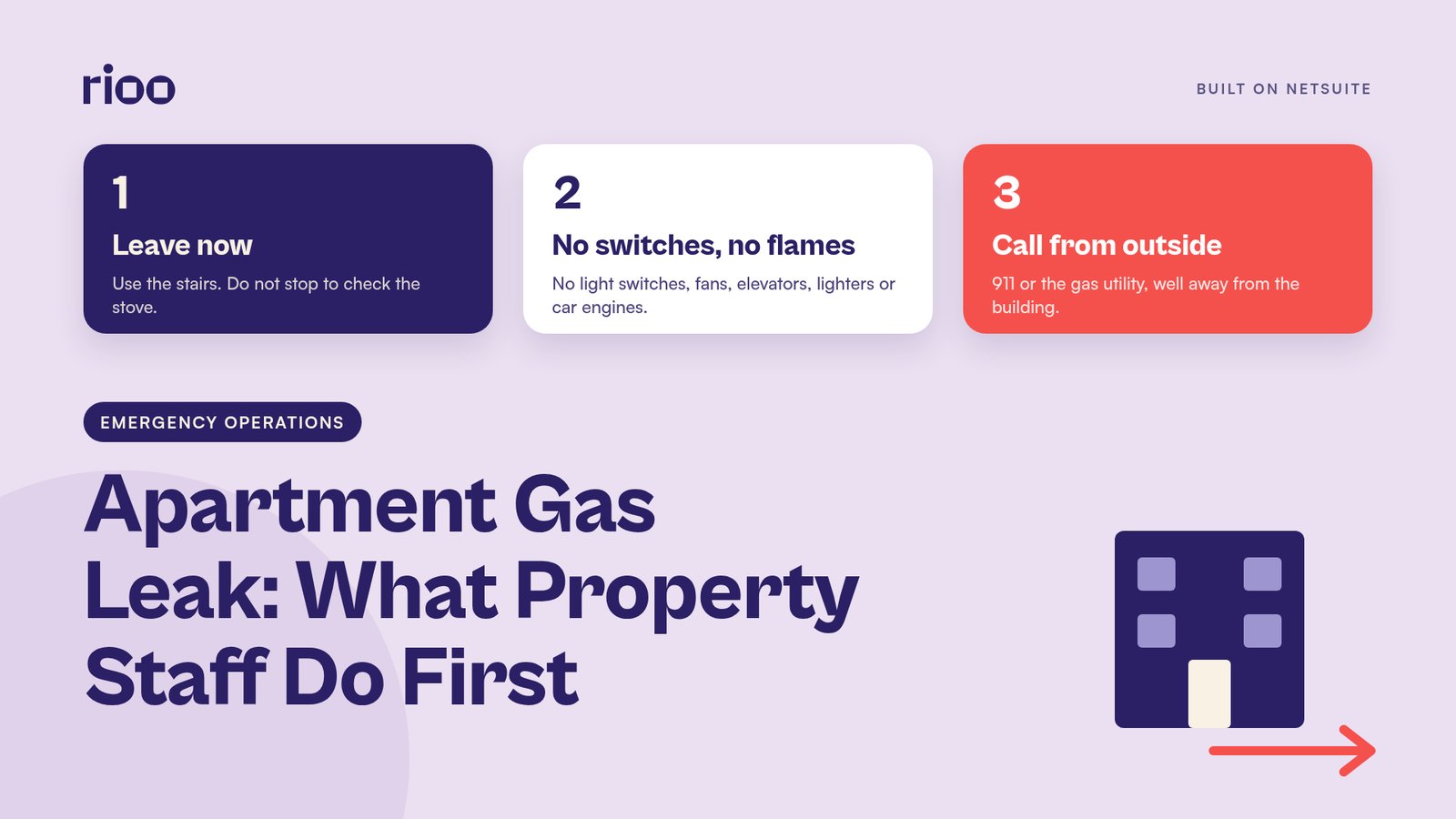
Here is the short answer. When someone reports a gas smell, tell them to leave the building now. They should not touch light switches or appliances, light anything, or start a car nearby. Once they are well away from the building, they call 911 or the gas utility's emergency line. Your staff do not hunt for the leak. They help people out, keep everyone back from the building, meet the fire department and the utility, and write down what happened. Nobody goes back in until the utility or fire officials say it is safe. After that, the work turns to relights, repairs, resident updates and the incident file.
The first two minutes happen on the phone
Gas calls are rare, so few staff have taken one. The person who answers is often a leasing agent, a night concierge or an answering service. What they say in the first two minutes matters more than anything the manager does later.
Give every person who answers resident calls the same short script. Print it. Put it in the answering service instructions. Practice it once a year at a team meeting.
The script, line by line
- "Are you inside the building right now?" If yes: "Please hang up and leave the building now. Do not switch any lights on or off, do not light anything and do not use the elevator. Call me back once you are well away from the building."
- "Have you called 911 or the gas company?" If not, the staff member calls 911 from where they are, away from the building. They give the address, the unit or floor, and what the resident smelled.
- "Is anyone else in the unit or nearby?" Note children, older residents and anyone who may need help with stairs.
- "Where exactly is the smell strongest?" A kitchen, a hallway, a boiler room door or outside near the meters.
- "Please stay well away from the building. Do not start a car parked near it. Wait for the fire department." Then the call ends and the staff member opens an emergency request.
Two things are missing from that script on purpose. Staff do not ask the resident to check the stove, and they do not ask them to open windows on the way out. Both keep a person inside a gas filled space for longer.
What the answering service needs from you
Do your after hours calls go to an outside service? Check its instructions for the word "gas." Some scripts may still say "take a message and page maintenance." That is the wrong order. Gas should go to 911 or the utility first, then to your on call manager. Our guide to emergency maintenance requests covers how to sort other after hours calls.
Who does what once 911 is called
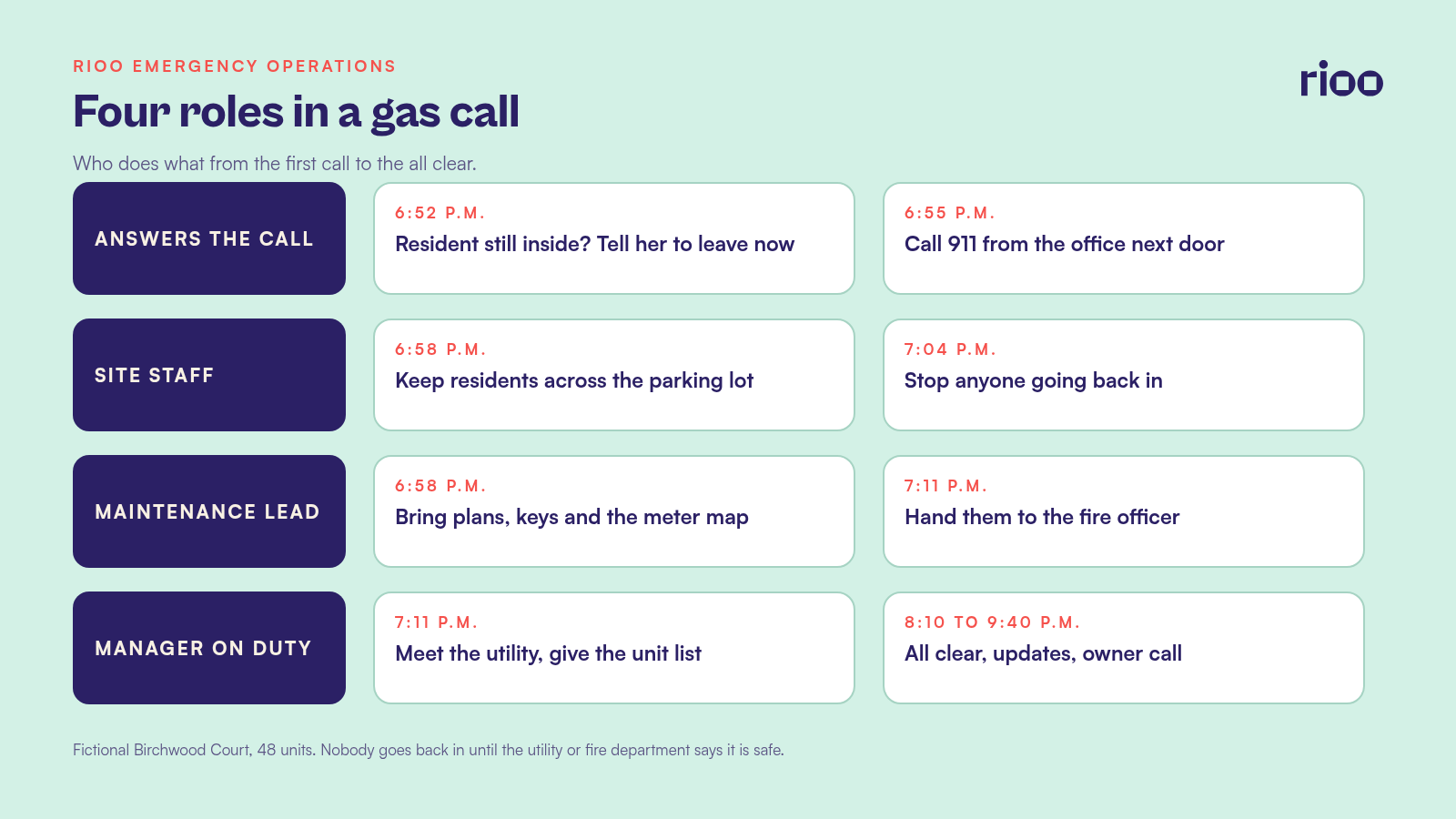
A gas leak needs four roles. In a small building one person may hold two of them. Write the names into your emergency plan before you need them.
The staff member on site
This person looks after people. They move residents away from the building and keep them back. They stop anyone from going in for a pet, a laptop or a car key. They do not go door to door through a hallway that smells of gas.
Evacuation inside the building should follow your fire safety plan. Ask your local fire department ahead of time how they want staff to alert other residents during a gas call. Then write their answer into the plan, so nobody improvises on the night.
The maintenance lead
Maintenance brings the building plans, the location of every gas meter and shutoff, and the master keys. They hand all of it to the fire officer in charge. They leave meters and valves to the utility unless the utility has trained them and told them to act.
The manager on duty
The manager meets responders, answers questions about the building and becomes the single point of contact. They pull three lists: occupied units, vacant units, and residents who told you they need help in an emergency. They also call the owner once the scene is under control.
The office or remote team
Someone away from the scene sends updates. Short, plain and timed. "Gas smell reported on floor 3. Fire department on site. Please stay out of the building. Next update by 8:00 p.m." Residents who are away from home need the same message, so they do not walk into a closed scene.
A worked example: Birchwood Court, one Thursday evening
This is a fictional example. Birchwood Court has 48 units on four floors, with a gas range in every kitchen and a gas boiler in the basement.
| Time | What happened |
|---|---|
| 6:52 p.m. | The resident in 3C calls the office. She smells gas in the hallway outside 3D. |
| 6:53 p.m. | The leasing agent asks if she is inside. She is. The agent tells her to leave by the stairs and call back from across the street. |
| 6:55 p.m. | The agent calls 911 from the leasing office in the next building. She opens an emergency request for floor 3. |
| 6:58 p.m. | The maintenance tech arrives and keeps residents across the parking lot, away from the building. He has the meter map and the master keys. |
| 7:04 p.m. | The fire department arrives and clears floors 3 and 4. |
| 7:11 p.m. | The utility crew arrives. The manager on duty meets them and gives them the unit list. |
| 7:36 p.m. | The utility finds a loose range connector in 3D, where the resident is away. It shuts gas to that unit and tests the floor. |
| 8:10 p.m. | The utility and the fire officer confirm the rest of the building is clear. Gas stays off to 3D until a licensed plumber fixes the connector. |
| 8:15 p.m. | Residents return, except 3D. The office sends the all clear update. |
| 9:40 p.m. | The manager calls the owner and completes the incident note. |
At 8:20 p.m. the resident of 3D called back from a friend's apartment.
"Can I come home tonight?"
"Not tonight. The gas company has shut off gas to your unit. A plumber is booked for 9 a.m. tomorrow. We will call you as soon as it is safe."
"What about my cat?"
"Once the floor was cleared, a firefighter let our maintenance tech in to check. She is fine, and he left her food and water."
The next day the plumber replaced the connector for $185 in labor and a $38 part. The utility restored service and relit the range at 1:30 p.m. The owner covered the repair, because the connector had failed with age and nobody had damaged it. That decision, the photos and the plumber's invoice all went into the request file.
Getting units back in service
The utility or the fire department decides when gas can flow again. Your team decides how quickly residents get their heat and hot water back after that.
- Ask the utility which units it relit and which it left for you. Some utilities relight every appliance. Others restore the meter and leave pilots to a licensed technician.
- Book a licensed plumber or gas technician for any unit with a failed part. Do not let a general handyman reconnect a gas appliance.
- Enter units where nobody was home only under your state's emergency entry rules. Leave a note that says what was done and when. Log the entry on the request.
- Send a final update to every resident who got the first message. Say what was found, which units are still affected and who to call with questions.
- Keep the request open until every unit has gas again and the repair invoice is attached.
If the building loses gas for longer, the work looks a lot like a long outage. Our apartment power outage plan covers temporary heat, welfare checks and resident messages that carry over.
Mistakes that make a gas call worse
Sending maintenance in to find the leak. A tech with a flashlight and a phone in a gas filled hallway is the risk you are trying to avoid. Finding the leak is the utility's job.
Telling a resident it is probably nothing. Utilities add a strong odor to natural gas so people can smell a leak. Treat every report as real until the utility says otherwise.
Turning on fans to clear the smell. Switching anything electrical on or off can create a spark. Leave ventilation to the responders.
Closing the request when the utility leaves. The leak is fixed, but the job is not. Relights, repairs, resident follow up and the owner report still need doing.
Letting the story spread before the facts. Residents talk in the parking lot. A timed update every 30 to 45 minutes stops guesswork.
Prepare before the next call
Much of the work in a gas leak happens before anyone smells anything. Set these up now.
- Every gas meter and main shutoff marked on a building plan, with a copy in the office and one in the on call phone.
- The utility's emergency number saved on every staff phone and printed in the answering service instructions.
- A current list of residents who asked for help in an emergency, reviewed every quarter.
- A message template for the first update, the all clear and the final note.
- Carbon monoxide alarms tested on your inspection schedule where your local code requires them.
- One short drill a year, where a staff member takes a mock gas call and reads the script aloud.
After a real incident, run a short review within a week. Our major incident response guide sets out what to record in the first two days and who needs a report.
Where RIOO fits in a gas emergency
RIOO puts every request in one queue with a priority. On the RIOO service requests and tasks page, a gas leak sits in the emergency group, which is attended first, any day. Staff can log a request taken by phone on a resident's behalf, so the 6:55 p.m. call in the example becomes a record with a time on it.
For updates, RIOO tenant communication tools send targeted notices by building or group through the portal, email and SMS, with read and delivery tracking. The repair becomes a costed work order that posts to the property's books in NetSuite, so the plumber's bill sits against the same request.
Gas leak questions from property teams
Should our maintenance staff turn off the gas at the meter?
Not unless the utility has trained them and told them to. Utilities and fire departments set their own rules on this. Ask your utility what it wants your staff to do, and write the answer into your plan.
Can we enter a unit without notice if we suspect a gas leak?
State entry laws generally allow entry without notice in a real emergency. A gas smell usually counts. Check your state's rule, enter with or behind the responders where you can, and log the time and reason.
Who pays if residents cannot return for the night?
It depends on the lease, the cause and local law. If the building's equipment failed, the owner often covers a short hotel stay as a goodwill cost. If a resident caused the leak, the lease may let you recover costs. Decide the default with the owner before it happens.
What if the utility finds no leak?
Thank the resident anyway, and log the call. A false alarm still tells you something. It may point to a sewer smell, a dry floor drain or a pilot that went out. Ask maintenance to check those during normal hours.
Do we have to tell the owner?
Yes. Call the same evening if residents were evacuated, and send a short written report within a day. Include the timeline, the cause, the repair cost and any resident costs.
Print the script, give it to everyone who answers your phones, and read it aloud together before the heating season.