Arguments about late fees tend to start with a waiver. A resident hears that a neighbor had a fee taken off in March, asks for the same in June, and gets a no. A $75 charge has just turned into a fairness complaint.
A late fee waiver should follow a written rule that every staff member applies the same way. Reverse the fee in full when the late payment was your fault or the fee was charged wrongly. Offer a courtesy waiver no more than once in 12 months, to a resident who is paid up, with a set approver. Never delete the charge. Post a credit with a reason code, so the ledger, the owner statement and any later dispute all show what happened and why.
Five questions that decide a waiver request
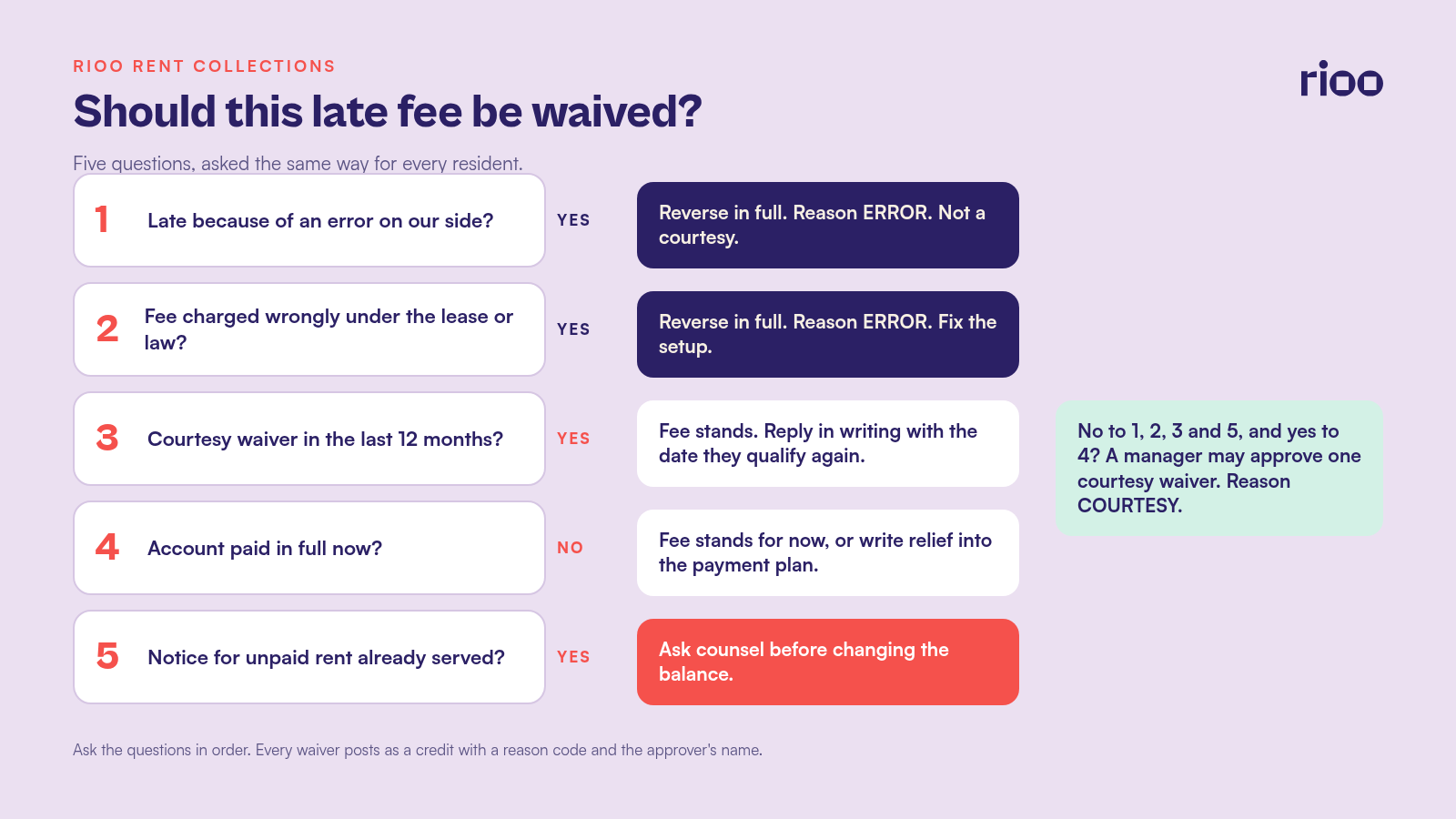
Work through these in order. The first two are about whether the fee should exist at all. The last three are about whether you choose to forgive a fee that was fairly charged.
1. Was the payment late because of something on our side?
Check for a portal outage or a payment that sat in processing. Check for a bank holiday the lease treats as a grace day, or a resident who was told the wrong due date. If the cause was yours, this is an error reversal. It does not count as a courtesy. It needs no special approval, only a note of the cause.
Holiday and weekend due dates trip up a lot of teams. Our post on rent due on a holiday or weekend explains when a payment on the next business day is still on time.
2. Was the fee charged correctly?
Compare the fee with the lease and with local law. Check the grace period, the amount, any cap and whether the lease allows a daily fee. A fee above a state cap should never have been charged, so removing it is a correction rather than a favor. Our guide to rent late fee rules lists the caps and grace periods by state.
3. Has this resident had a courtesy waiver in the last 12 months?
Use a rolling 12 months, not the calendar year. A calendar rule lets a resident get one waiver in December and another in January. The rolling count should come from the ledger, not from someone's memory.
4. Is the account paid in full now?
A courtesy waiver makes sense for a resident who slipped once and caught up. It makes less sense for an account that is still behind. If the resident is on a rent payment plan, write any fee relief into the plan itself, tied to the plan being kept.
5. Could the waiver affect a notice or a court case?
If you have served a notice for unpaid rent, talk to counsel before you change the balance. Changing what is owed after a notice can create problems with that notice. Accepting money on a late account can raise its own issues too, which our post on the partial payment that waives your right to evict explains. Repeated waivers can also make a late fee clause harder to enforce later. Ask your counsel how your state treats this.
Four kinds of waiver and how each one posts
Teams often use one word for four different things. Separate them, because each has a different approver and a different reason code.
| Type | When it applies | Who approves | Counts toward the 12 month limit? |
|---|---|---|---|
| Error reversal | The fee was wrong, or the payment was late because of us | Any staff member, with the cause noted | No |
| Courtesy waiver | A fairly charged fee, first request in 12 months, account paid up | Property manager | Yes |
| Partial waiver | A daily fee has grown large and you remove part of it | Property manager, within the owner's limit | Yes |
| Settlement waiver | Fees forgiven as part of a payment plan or move out agreement | Senior manager or owner, in writing | Recorded separately |
Check who the late fee belongs to
Read the management agreement before you set approval levels. Some agreements give late fees to the owner. Others let the management company keep all or part of them. If the fee is the owner's income, a waiver gives away the owner's money, so the owner should set the limit. If the company keeps it, the company sets the rule but should still tell the owner how it works.
A worked example: December at Larkspur Flats
This is a fictional example. Larkspur Flats has 60 units. Rent is due on the 1st. The lease gives a grace period to the end of the 5th, then a flat $75 late fee posts on the 6th. In December 2026, 15 residents paid after the 5th and got the fee.
Three residents asked for a waiver.
Unit 12. She paid on 7 December. The payment portal was down from 9 p.m. on the 5th to 2 a.m. on the 6th, and the outage is in the support log. Her first attempt shows at 9:40 p.m. on the 5th. This is an error reversal. No limit applies.
Unit 31. He paid on 8 December, explained a payroll delay at his employer, and has paid on time for 14 months. His account is at zero. This is a courtesy waiver, approved by the property manager.
Unit 44. She paid on 9 December and asked for a waiver. She had a courtesy waiver in July. The fee stands. The manager replies the same day.
"I understand the payment was only a few days late. Our policy allows one courtesy waiver in any 12 months, and your account had one in July. The $75 fee stays on this month. You would be eligible again once 12 months have passed since July's waiver. If paying on the 1st is hard with your pay date, I can talk you through our split payment option."
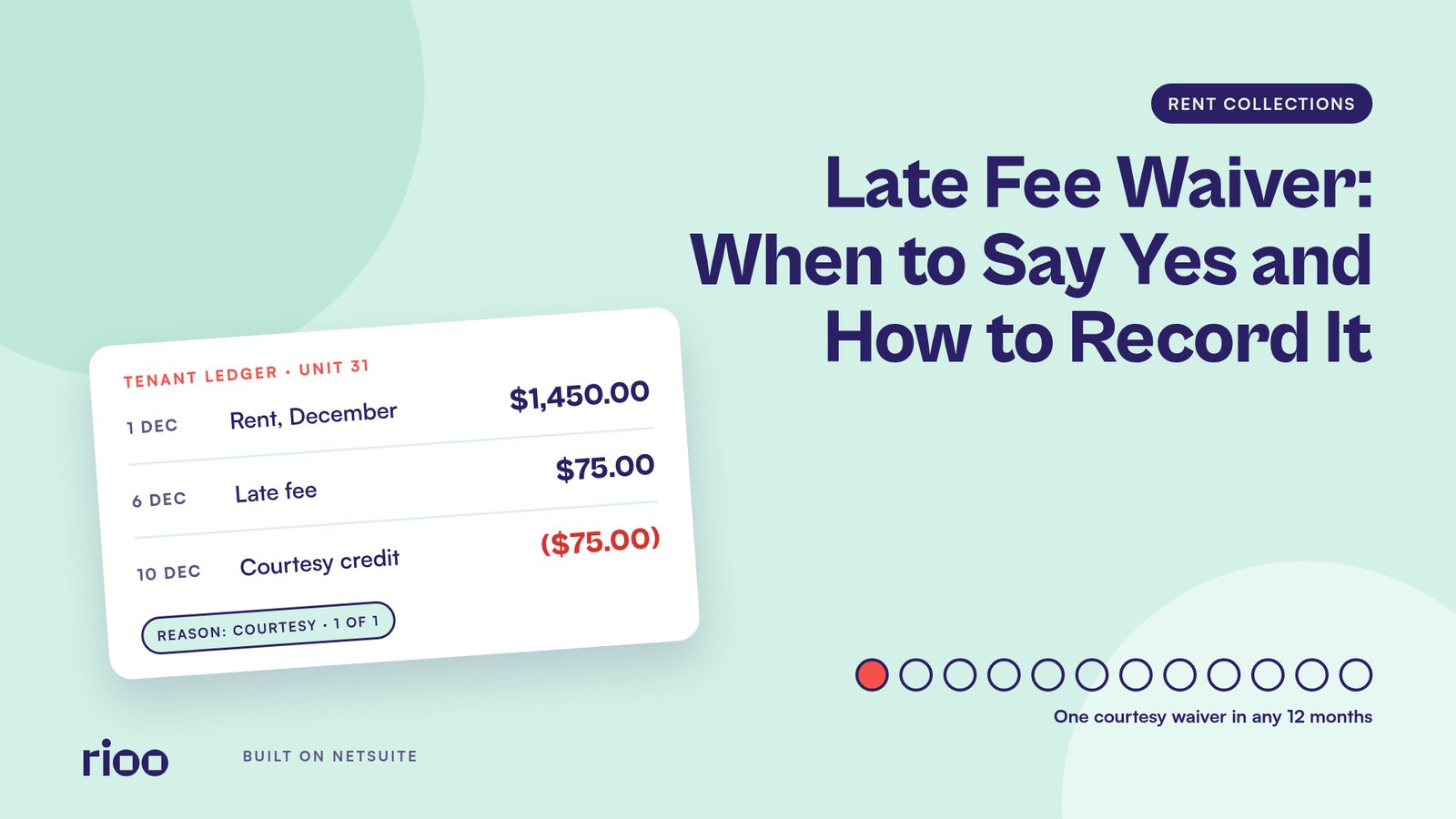
Here is how Unit 31 looks on the ledger.
| Date | Entry | Amount | Balance |
|---|---|---|---|
| 1 Dec | Rent, December | $1,450.00 | $1,450.00 |
| 6 Dec | Late fee | $75.00 | $1,525.00 |
| 8 Dec | Payment received | ($1,525.00) | $0.00 |
| 10 Dec | Late fee credit, reason COURTESY, approved by the property manager | ($75.00) | ($75.00) |
| 1 Jan | Credit applied to January rent | $75.00 | $0.00 |
The month end report shows 15 fees charged, or $1,125. It shows one error reversal and one courtesy waiver, $150 in total. Net late fee income is $975. The owner statement shows the $1,125 charged and the $150 credited as two lines, not one netted figure.
How to record a waiver so anyone can follow it
An auditor, an owner or a housing counselor may read this ledger a year from now. Write it for them.
- Credit, never delete. A deleted fee leaves no trace. A credit shows the fee, the decision and the date.
- Use reason codes. ERROR, COURTESY, PARTIAL and SETTLEMENT are enough. Free text alone is hard to report on.
- Name the approver. Record who approved it, not just who keyed it.
- Keep the evidence. Attach the outage log, the bank trace or the email that supports an error reversal.
- Report waivers by property each month. A sudden rise at one site tells you something about staff, residents or your systems.
The order of entries matters when a payment fails later. Our guide to a returned rent payment covers what to reverse first if a payment that cleared a waived balance bounces.
A waiver policy you can adapt
Keep the written policy short enough that staff will read it. This version fits on half a page.
Late fees are charged as set out in the lease and local law. A late fee will be reversed in full if it was charged in error. It will also be reversed if the payment was late because of our payment systems or information we gave. A resident may request one courtesy waiver of a correctly charged late fee in any rolling 12 month period. Their account must be paid in full when they ask. The property manager approves courtesy waivers. Any other waiver needs written approval from [senior manager or owner]. Every waiver is recorded as a credit with a reason code and the approver's name. This policy is applied the same way to every resident.
Have counsel review it, and attach it to your collections procedure.
Where RIOO fits
RIOO rent collection services apply late fees and grace periods the same way across a property, run reminder cadences and handle payment plans. Every step is recorded on the tenant ledger in NetSuite. That means the late fee, the credit and the payment in the Unit 31 example sit on one record that collections, finance and the property manager all see. If your team adds a reason code to each credit, the month end report can show fees charged and fees credited by property, side by side.
Late fee waiver questions
Do we have to waive a late fee when a resident asks?
No. If the fee was charged correctly under the lease and local law, a waiver is a choice. What matters is making that choice the same way for everyone.
Can we waive a fee for one resident and not another?
Yes, if the reason is your written rule, such as the 12 month limit. Problems start when decisions depend on who asks or who answers. Fair housing complaints often begin with uneven treatment, so record the reason every time.
Should a waived late fee show on the owner statement?
Yes. Show the fee charged and the credit as separate lines. Netting them hides how often waivers happen.
Should we put a waiver in writing to the resident?
Yes. A short message saying what was credited, why, and that it counts as the courtesy waiver for the next 12 months prevents a dispute later.
Can a waiver depend on future payments?
It can, if you write the condition down. A common version credits the fee once the next two months are paid on time. Agree the condition in writing and track it on the account.