









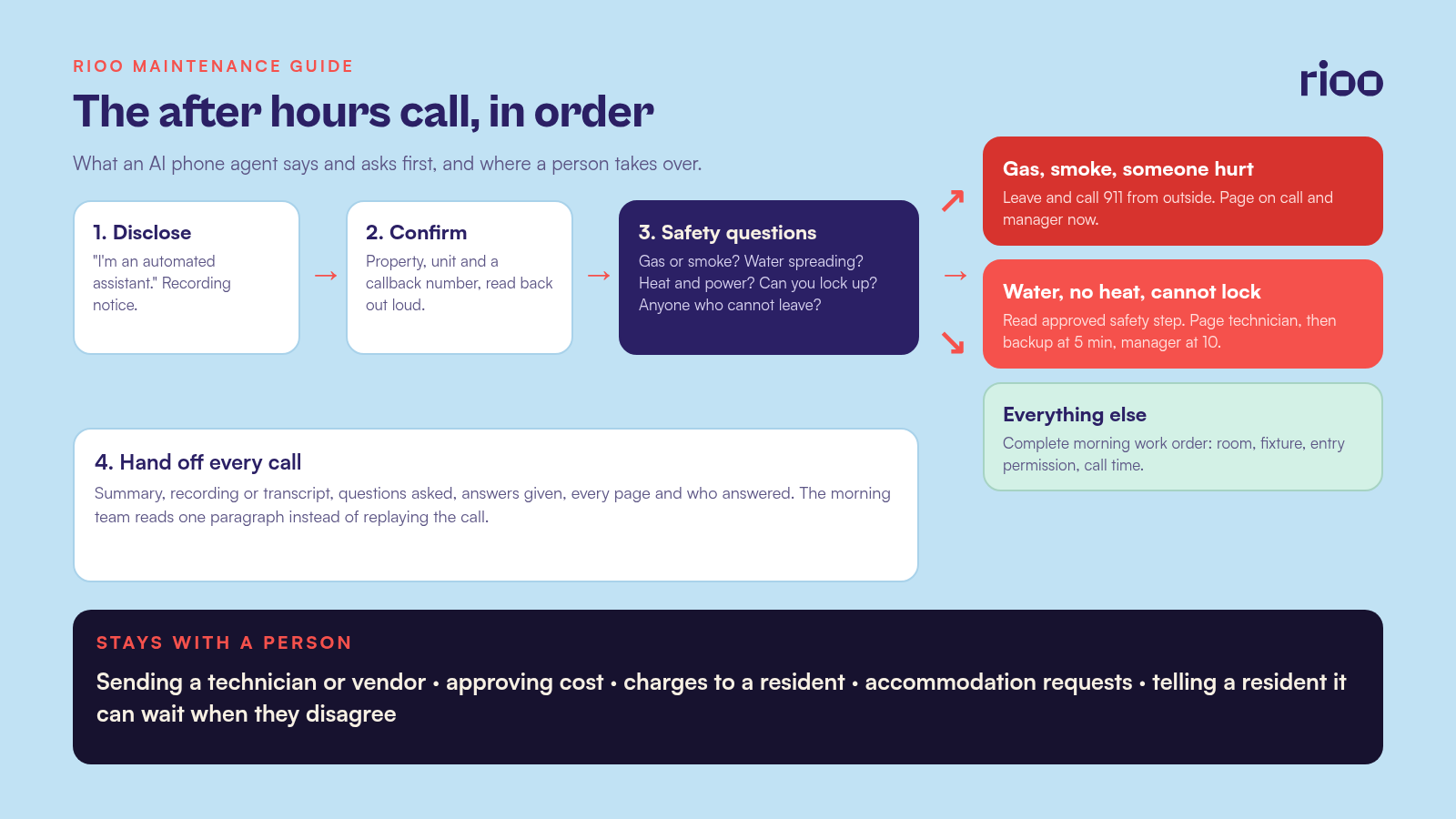
An AI phone agent on your after hours maintenance line should do five things before anything else, in this order. Say it is an automated assistant. Confirm the property, unit and callback number. Ask the safety questions about gas, smoke, water, power and entry. Give only the safety steps your team approved in writing. Then page a person for anything urgent, or log a complete work order for the morning.
The agent answers the phone and gathers the facts. Your on call person still decides who goes out tonight and what it costs. Below is the call script step by step, then one fictional Saturday night that shows where the hard calls fall.
Seven steps on the night line
Seven steps cover the night line. Keep each one short. A resident standing in water does not want a menu.
Step 1: Open with who is answering
Start with a plain line: "You've reached the after hours maintenance line for Maple Row. I'm an automated assistant. If anyone is hurt or you smell gas or smoke, hang up and call 911 now." Residents should know they are talking to software. Some states also require consent before a call is recorded, so add a recording notice and check your state's rule with counsel.
Step 2: Confirm the property, unit and callback number
Match the caller's number to a resident record if you can, then confirm it out loud. "I have you at Maple Row, unit 3B. Is that right?" Always take a callback number. A dropped call with no number is a lost emergency.
Step 3: Ask the safety questions before anything else
Ask the same questions, in the same order, on every call:
- Is anyone hurt, or do you smell gas, smoke or burning?
- Is water coming in right now, and is it spreading?
- Do you have power and heat? What is the temperature inside?
- Can you lock your door and windows tonight?
- Is there anyone in the home who cannot leave easily?
A yes to the first question ends the questions. The agent tells the caller to leave and call 911 or the gas utility from outside, then pages on call at once. Our post on what staff do first in an apartment gas leak has the full routine your people follow next.
Step 4: Read only the steps your team approved
The agent should never improvise repair advice. Give it a short library of approved lines, each tied to a trigger:
- Overflowing toilet: "Turn the valve behind the toilet to the right until the water stops."
- Leaking water heater: "If you can reach the cold water valve on top of the heater safely, turn it to the right."
- Sparks, a burning smell or a wet outlet: "Stay away from it, and leave the room if you can smell burning."
Step 5: Page a person, and keep paging until someone answers
Set the ladder in minutes. One workable ladder pages the on call technician first, then a backup after five minutes, then the maintenance manager after ten. The agent tells the caller what is happening: "I've paged our on call technician. You'll get a call back from a person at this number." Log every page and every answer.
Step 6: Log a complete work order for anything that can wait
Routine calls should end with a ticket a technician can act on at 8 a.m. That means the room, the fixture, what the resident has tried, permission to enter and a good time to call. The agent should also say when the resident will hear back, and that promise must match your morning routine.
Step 7: Hand off the call record
Every call, urgent or not, should leave a short summary, the recording or transcript, the questions asked and the answers given. The morning team reads one paragraph instead of replaying a call.
Saturday night at Maple Row, call by call
Here is a fictional example. Maple Row has 212 apartments across four buildings. On Saturday 12 December 2026 the low is 27°F. Dario is the on call technician. The phone agent takes five calls between 10 p.m. and 6 a.m.
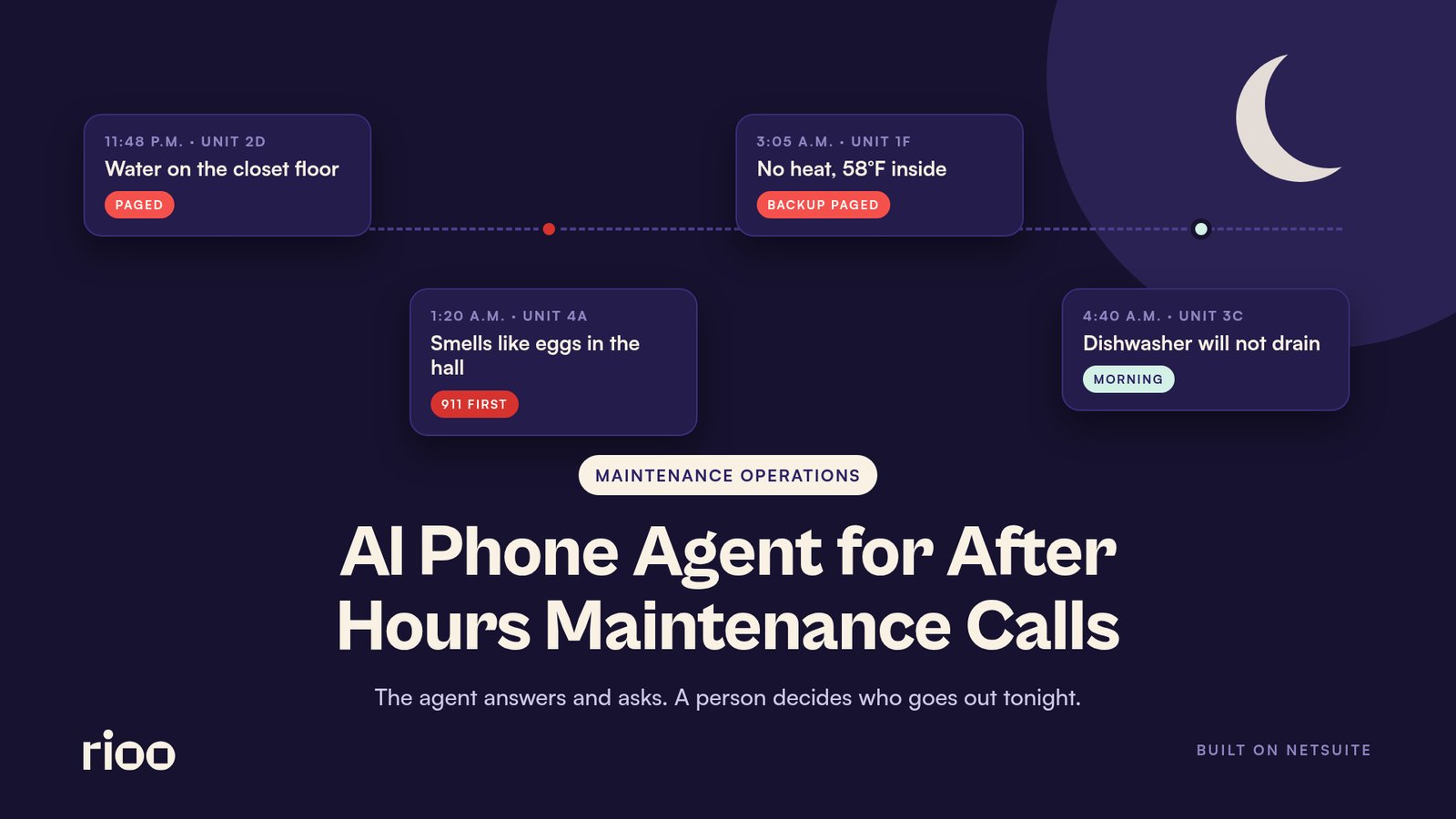
11:48 p.m., unit 2D. "There's water all over the closet floor." The agent asks if it is still coming. It is. The closet holds the water heater. The agent reads the approved line about the cold water valve. The resident turns it and the flow slows. The agent pages Dario at 11:51. He calls the resident at 11:54 and is on site by 12:30.
1:20 a.m., unit 4A. The caller says the hallway "smells kind of like eggs." That is on the gas list. The agent stops asking questions. "Please leave the building now and call 911 or the gas company from outside. Don't use light switches." It pages Dario and the manager together. The fire department finds a leaking connector at a range in 4C and the utility shuts off that line.
3:05 a.m., unit 1F. "The heat isn't working. It's 58 in here and I have a baby." No heat in freezing weather with an infant is on the emergency list. The agent pages Dario at 3:05. He does not answer, so at 3:10 the agent pages the backup, Lena, who picks up straight away. She talks the resident through checking the thermostat batteries. That fails, so she brings two approved space heaters from the shop and books a technician for 8 a.m.
4:40 a.m., unit 3C. "The dishwasher won't drain." No water is spreading. The agent asks for the make and the error code, gets permission to enter and books a morning visit. Nobody is woken.
5:15 a.m., unit 2B. A resident asks whether they can pay rent late this month. That is not maintenance. The agent takes a message for the office and says someone will call during business hours. It does not discuss fees.
By 7 a.m. the office has five call records, three urgent calls with every page timed, one gas incident report, two complete morning tickets and one message for the leasing team. The 3:05 call moved to the backup after five minutes, exactly as the ladder says.
What RIOO does with the call record
RIOO sits behind the phone line, so the night's work has a home once the call ends. Your team logs each call as a service request in RIOO, whether a person took it or the phone agent did. The request becomes a prioritized work order tied to the property, unit, asset and lease in NetSuite. The service request and task management module assigns the work, tracks it to completion and keeps the history on the unit. Residents can follow the status in the tenant portal. Dario's callout invoice for unit 2D then flows to accounts payable against the same property. The night's spend sits beside the work order it paid for.
Where the agent hands off to a person
Dario and Lena made every decision that cost money or sent someone into a home. Write that split down before you switch anything on. It becomes the brief for the tool and the script for testing, and it answers the owner who later asks who decided.
| The phone agent can | A person keeps |
|---|---|
| Answer every call at once, in the languages you set up | Deciding to send a technician or vendor tonight |
| Match the caller to a property and unit, and confirm it out loud | Approving any cost, overtime or callout fee |
| Ask your safety questions and your trade questions | Telling a resident a problem can wait when they disagree |
| Read out safety steps your team wrote and approved | Anything involving an injury, a threat or a person who feels unsafe |
| Page the on call person and move up the list if nobody answers | Accommodation requests and anything about a disability |
| Create the work order with a summary and the recording | Charges to a resident, including callouts they caused |
If your team already sorts requests with a model, the same written rules apply on the phone. Our guide to AI maintenance triage covers how to write those tiers. A phone call adds one thing a portal ticket does not have: a caller who may be in danger right now.
Recordings, consent and equal treatment
A phone line carries risks a web form does not. Settle these before launch.
- Same questions for every caller. The script should not change with the caller's accent, language or way of speaking. Test this directly.
- No guesses about who lives there. The agent asks if anyone cannot leave easily, because that changes the response. It never asks about age, health conditions or family makeup beyond that.
- Accommodation requests go to a person. A caller asking for a ramp, grab bars or help with an assistance animal is making a request your staff must handle. Our post on reasonable modification or accommodation explains the difference.
- Keep recordings where they belong. Store them in your property system or a tool covered by a signed data agreement, with a retention period. Never paste resident names, units or recordings into a public chatbot.
- Outbound calls need consent. If the agent will also call or text residents back, check the rules first. The FCC ruled in February 2024 that AI generated voices count as artificial voices under federal robocall law.
Shadow calls before launch
Run it beside your current line for two to four weeks. Real calls still go to people. Your team then plays recorded and scripted calls into the agent and grades every answer.
Build the test set from your own call history. Include a calm caller with a serious leak and an upset caller with a small problem. Add a caller who speaks a second language your residents use, and one who mentions a disability. Add a few calls with a bad phone line and long pauses.
One failure is enough to stop and fix the rules. A common one is underplaying. A resident says "it's probably nothing, just a bit of water on the ceiling" and the agent books a morning visit. The fix is a rule that the words "ceiling" and "water" together always page a person, however calm the caller sounds.
What to measure after launch
Pull the same numbers for the month before launch so you have a fair baseline. Then review them every Monday.
- Time from an emergency call to a person speaking with the resident.
- Pages that needed the backup, and how long each step of the ladder took.
- Calls the morning team would have handled differently, from a weekly read of ten transcripts.
- Morning tickets completed on the first visit.
- Resident complaints about the line, and how many callers hung up before the safety questions.
If you still use an answering service for some properties, compare the two side by side. Our guide to choosing a property management answering service or on call team lists the numbers worth tracking for either model.
Asked before switching on a phone agent
Can an AI phone agent dispatch a plumber by itself?
It can be set up to, but it should not. Dispatch commits money and sends a stranger into a home at night. Let the agent page a person, and let that person decide.
What if the caller does not want to talk to a bot?
Give them a way out. Saying "person" or pressing zero should page the on call staff for anything urgent, or take a message for anything that can wait.
Should the agent answer leasing or rent questions at night?
Keep the night line for maintenance. Take a message for rent, fees, renewals and complaints about neighbors, and let the office answer during business hours.
How do we keep the safety steps current?
Review the approved lines every quarter and after any incident. Add new triggers when a real call shows a gap, as with the ceiling and water rule above.
Does this replace our on call rotation?
No. Your on call person stops taking routine calls and spends the night on the ones that need a human. For which calls those are, see our list of what counts as an emergency maintenance request.