









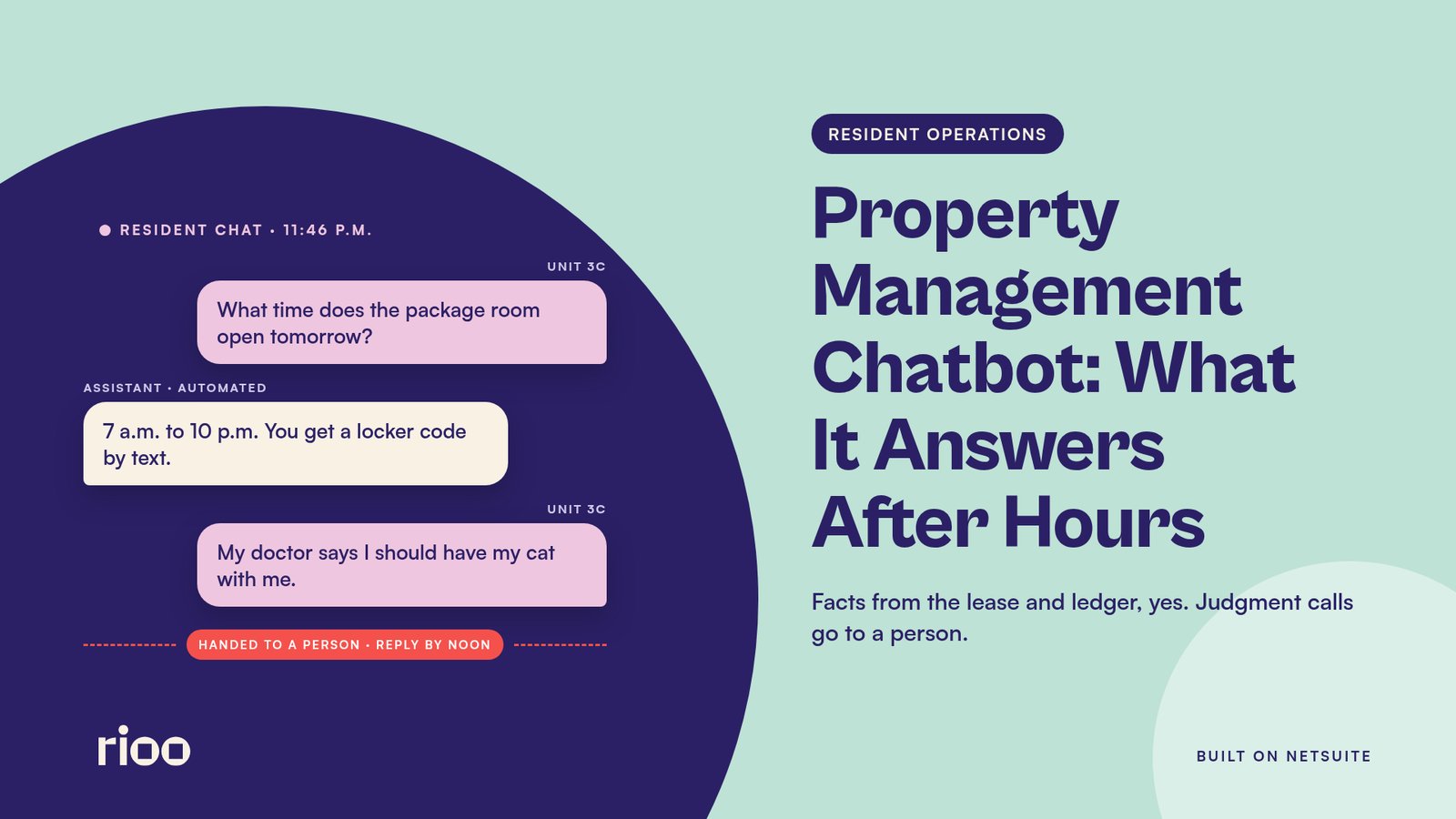
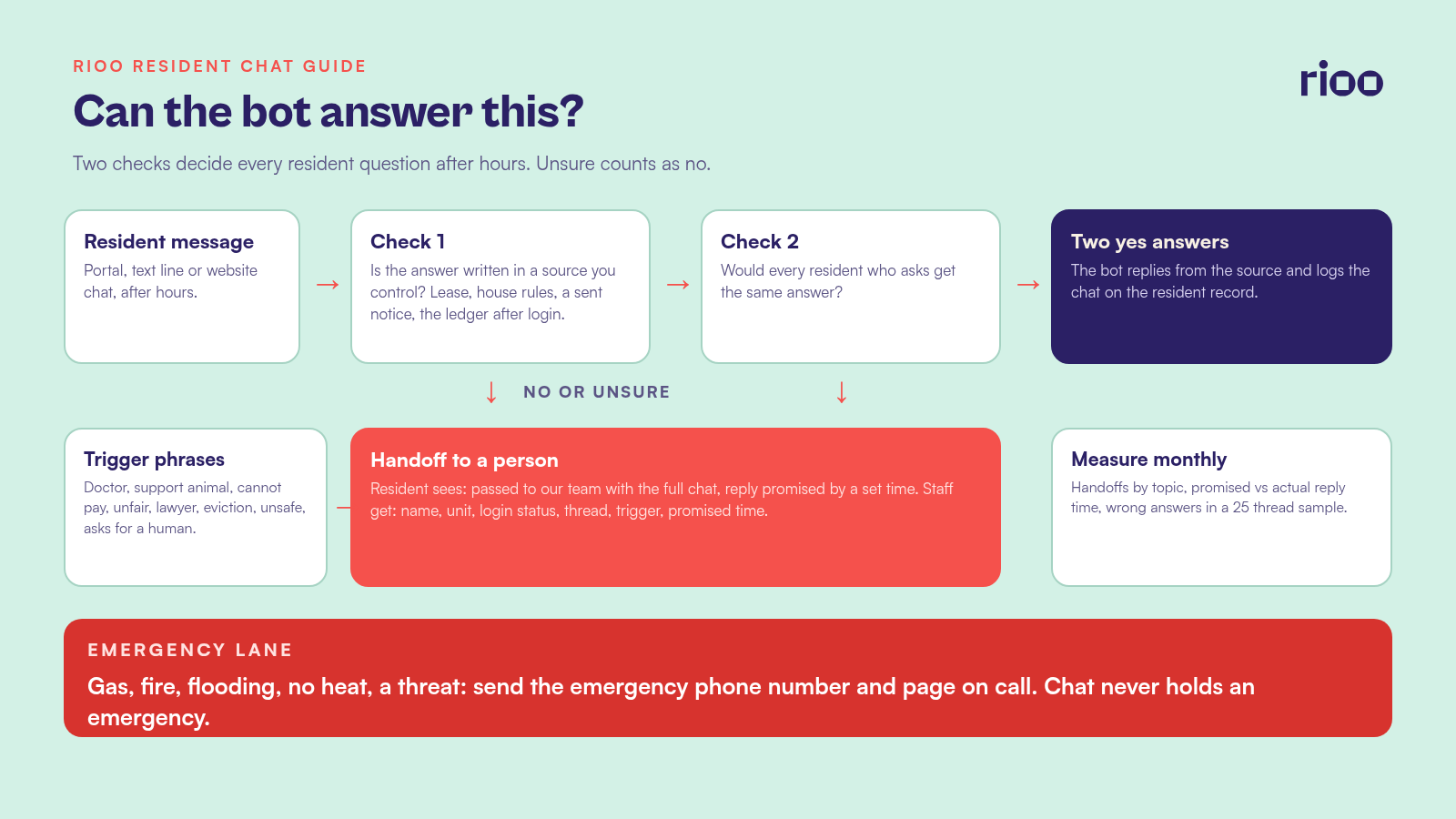
A property management chatbot can answer a resident after hours when two things are true. The answer is already written down in a source you control, such as the lease, the house rules or the resident's own ledger. And every resident who asks the same question would get the same answer. If either test fails, the bot hands the chat to a person and attaches the whole thread.
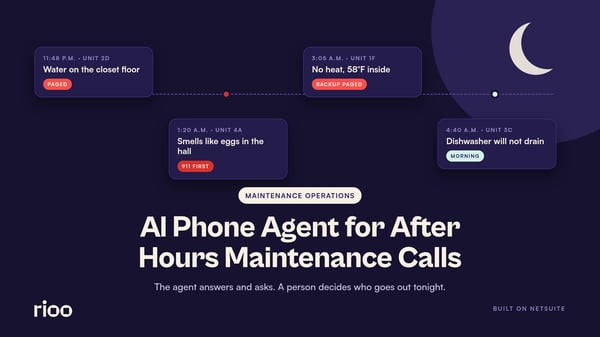
That still leaves the bot plenty to do at night. Package room hours, trash day, the rent due date and the payment link all pass. Accommodation requests, assistance animals, deposit disputes, payment trouble and legal deadlines do not. This guide covers written chat on a portal, a text line or a website. Night maintenance calls follow different rules, set out in our guide to an AI phone agent for after hours maintenance calls.
The two question test
Run every topic you plan to automate through two questions. Write the result down. That list becomes the bot's job description.
Is the answer written down in a source you control?
Good sources are the signed lease, the posted community rules, notices you have already sent and the resident's ledger after they log in. A bot that answers from memory or from the open web will sooner or later make up a policy. If nobody on your team could point to the paragraph behind an answer, the bot should not give it.
Would every resident get the same answer?
"The gym opens at 5 a.m." is the same for everyone. "Can I keep my cat?" depends on the person, the lease and sometimes a disability. Any answer that changes with the resident's situation needs judgment. Judgment belongs to staff.
Both answers yes: the bot replies and logs it. Either answer no or unsure: the bot hands off. Unsure counts as no.
Rules the bot follows before it says a word
Fair housing and privacy set the limits here. Agree them before anyone writes a single reply.
- The bot speaks for you. Under federal rules, a housing provider can be liable for discrimination by its agents and employees. See 24 CFR 100.7. Treat chat replies the way you treat anything your office staff say in writing.
- No steering, no opinions about people. The bot should never describe a building as right for a type of household, or comment on neighbours, schools or who lives where.
- Accommodation requests need a person. A resident does not have to use special words to ask for an accommodation. "My doctor says" or "because of my condition" is enough. The bot must never refuse, question the diagnosis or say the lease rule settles it.
- Check identity before account details. Balances, payment history and lease dates should appear only after the resident logs in through the portal or a verified channel.
- Keep sensitive numbers out of chat. The bot should never ask for a Social Security number, a full card number or bank login. Send residents to the secure payment page instead.
- Do not feed resident files into public tools. Leases, ledgers and chat logs belong in your property system or in a tool covered by a signed data agreement.
- Say it is automated. Open every chat with a line such as "You're chatting with our automated assistant." Some states have bot disclosure laws, so ask counsel which apply to you.
A sorting table for resident questions
Fill this in on paper before anyone sets the bot up. The middle column is the source the bot answers from. The last column is where it has to stop.
| Topic | The bot answers from | Hand to a person when |
|---|---|---|
| Rent due date and how to pay | Lease terms and the payment page link | The resident says they cannot pay, asks for a plan or mentions a hardship |
| Current balance | The resident's own ledger, after login | A charge looks wrong to them, or they ask for a fee to be waived |
| Packages and lockers | Posted hours and locker instructions | A parcel is missing, damaged or delivered to the wrong unit |
| Amenity hours and bookings | Community rules and the booking calendar | A complaint about another resident, or a request for an exception |
| Trash, recycling and bulk items | Posted rules and pickup days | The resident received a fine or a violation notice |
| Parking and guest passes | The parking policy | Towing, a blocked space or a dispute with a neighbour |
| Notices already sent | The exact text of the notice | The resident says the work affects a medical need |
| Lease end and renewal dates | The lease record | Questions about offer terms, rent changes or ending early |
| Routine repairs | Creates a service request | Anything that sounds urgent goes to the emergency line at once |
Keep the table short at launch. Add a topic only after a month of clean logs on the ones you have.
Phrases that mean a person takes over
Write a trigger list and test it. Matching words is a starting point, never the whole rule. The bot should also hand off whenever it is not sure what the resident means.
- Health and disability: doctor, disability, condition, wheelchair, support animal, service dog, medication.
- Rights and disputes: unfair, discrimination, lawyer, my rights, harassment, deposit back, dispute.
- Money trouble: cannot pay, lost my job, payment plan, late fee, hardship.
- Legal steps: notice to quit, eviction, court, break my lease, move out early.
- Safety: unsafe, threat, police, someone is in my unit, domestic violence.
- Frustration: the resident asks for a human, repeats a question twice or writes in capitals.
Review the list every quarter against real chats. Residents rarely phrase things the way a policy manual does.
How a good handoff reads
A handoff should calm the resident and give your staff everything they need. It has two halves.
What the resident sees
Keep it plain and promise a time you will keep. For example: "Thanks for telling us. I've passed this to our community team with our full conversation. A person will reply by 10 a.m. tomorrow. If anyone is in danger, call 911. For a maintenance emergency, call our emergency line."
What your team receives
The morning owner should see the resident's name and unit, whether they logged in, the full thread, the trigger that caused the handoff and the reply time promised. Nobody should have to ask the resident to repeat themselves. Our post on why tenant communication breaks down explains why repeated questions damage trust so quickly.
A Thursday night thread, line by line
Here is a fictional example. Linden Court has 140 units and a resident chat on its portal. At 11:46 p.m. on a Thursday, the resident in unit 3C starts a chat.
Resident: What time does the package room open tomorrow?
Bot: The package room is open 7 a.m. to 10 p.m. You'll get a text with a locker code when a parcel is scanned.
That passes both tests. The hours are posted and the same for everyone.
Resident: Ok. Also why is my balance $1,935? Rent is $1,850.
Bot: You're logged in, so I can see your account. Your balance is October rent of $1,850 plus a water charge of $85. Would you like the bill breakdown?
Still fine. The figures come straight from the ledger, and $1,850 plus $85 is $1,935.
Resident: The water charge is wrong. I was away for three weeks.
Bot: I can't change charges, but I've sent this to our accounts team with our chat. A person will reply by noon tomorrow.
That is a dispute, so the bot stops explaining and hands off.
Resident: One more thing. My doctor says I should have my cat with me, but the lease says no pets.
Bot: Thank you for telling us. A member of our team handles these requests and will contact you by noon tomorrow. You don't need to fill in anything tonight.
The bot did not say yes or no. It did not quote the pet clause or ask about the medical reason. It logged a possible accommodation request and stopped.
At 8 a.m. two items sit in the queue. The accounts lead finds the October water bill used an estimate. She corrects the charge to $41, posts a $44 credit and replies at 9:20 a.m. The community manager takes the second item and follows the written accommodation policy. What the bot got right that night was what it refused to answer.
Where RIOO fits: the records behind the answers
A chatbot is only as accurate as the records behind it. RIOO keeps the lease, the tenant ledger and service requests as native records in NetSuite. The RIOO tenant communication tools keep threaded messages tied to the lease and unit, across portal, email and SMS. Notices and maintenance updates sit on the same tenant record.
That gives any chat assistant a clean source to answer from. When you evaluate one, ask two plain questions. Does it answer only from your records? And does every handoff end up where your team already works, on the tenant's record? If the morning team can see the balance, the lease and the chat in one place, the Linden Court credit takes minutes instead of a phone call.
Two weeks of drafts, then a monthly log review
For the first two weeks, let the bot draft replies that staff read before anything goes out. Use a test script of at least 40 questions, and include the awkward ones. Try a cat that might be an assistance animal, a resident who cannot pay and a complaint about a neighbour.
After launch, review these every month:
- Handoffs by topic. A topic with a high handoff rate may not belong on the bot's list.
- Promised reply time against actual reply time on handoffs.
- Wrong answers found in a weekly sample of 25 threads.
- Requests to speak to a person, and repeat questions in the same chat.
- Every thread that mentioned health, disability or a protected trait. Each one should show a handoff.
Leasing chat with prospects carries different risks, such as tour booking and eligibility questions. Our guide to what AI leasing assistants should automate covers that side.
Resident chatbot questions, answered
Can a property management chatbot take rent payments?
It can send the secure payment link and confirm the balance after login. It should never collect card or bank details inside the chat window.
Should residents be told they are chatting with a bot?
Yes. Say so in the first message. Some states have bot disclosure rules, so confirm with counsel which ones apply to your portfolio.
Does a chatbot replace the after hours emergency line?
No. Chat is for questions that can wait until morning. Emergencies need a phone line answered by a person or a tested call flow. Compare the options in our guide to choosing a property management answering service or on call team.
What should happen to chat logs?
Keep them on the resident's record for a set retention period that counsel approves. Restrict who can read them, and never copy them into public AI tools.
Can the bot tell a resident a rule does not apply to them?
No. Exceptions, waivers and accommodations are decisions about a person. The bot logs the request and hands it to staff.