









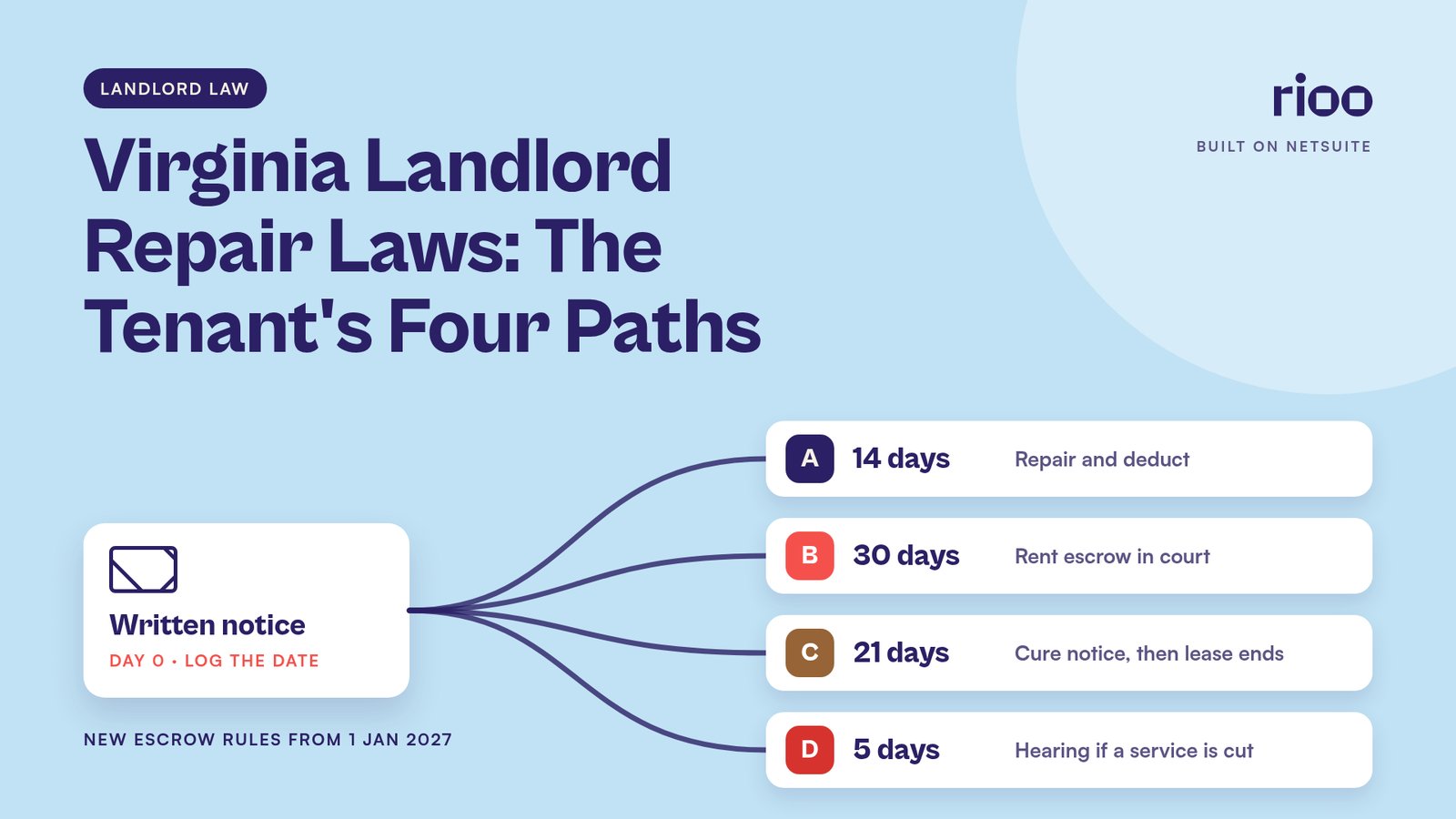
A Virginia tenant whose repair has stalled has four legal paths. They can hire a licensed contractor and deduct the bill after 14 days. They can pay rent into a court escrow account. They can serve a notice that ends the lease unless the problem is fixed in 21 days. Or they can ask for a fast hearing when a landlord cuts off an essential service. The first three share a starting point: the landlord had notice of the problem, usually in writing, and did not fix it in time. The fourth is about deliberate acts.
So the landlord's real job is the clock. Know what Virginia requires you to keep working, log the day each written complaint arrives, and show reasonable steps inside 14 days. Virginia's escrow rules also change on 1 January 2027, and the water heater example further down is set after that date. This is general information as of November 2026. Confirm details with Virginia counsel before you act on a live dispute.
What a Virginia landlord must keep working
The core duty list is Va. Code § 55.1-1220. It has eight parts.
| Duty | What it means day to day |
|---|---|
| 1. Building and housing codes | Meet codes that materially affect health and safety. Where a code asks for more than the rest of the list, the code wins. |
| 2. Fit and habitable | Make all repairs needed to put and keep the home fit to live in. |
| 3. Common areas | Keep shared halls, stairs and grounds clean and structurally safe. |
| 4. Systems and appliances | Keep electrical, plumbing, heating, air conditioning, elevators and supplied appliances in good and safe working order. |
| 5. Moisture and mold | Prevent moisture build up, respond promptly to mold notices and remediate visible mold to professional standards. |
| 6. Trash | Provide bins and arrange removal. |
| 7. Water, heat and cooling | Running water and reasonable hot water at all times, heat in season, and reasonable air conditioning if provided. |
| 8. Smoke alarms | Give the tenant a certificate that the smoke alarms are present, inspected and working, no more than once every 12 months. |
Two details in the same section matter in disputes. Under subsection B, a landlord is only liable for a tenant's actual damages that were caused by a failure to use ordinary care. Under subsection D, landlord and tenant can agree in writing that the tenant handles trash, common area cleaning, water and heat supply, and specified repairs. That agreement must be made in good faith and cannot be a way to dodge the landlord's duties.
Written notice starts the repair clocks
The first three remedies below depend on the landlord having notice. For repair and deduct, the statute asks for written notice. For escrow, written notice from the tenant or a violation notice from a state or local agency both count. The date the notice arrives is the date to record.
Treat every written complaint as the start
Portal messages, emails and letters all land in different places. Pick one place where staff log the arrival date of any written repair complaint. If you are unsure whether a message counts as notice, assume the clock may have started and act on that basis.
The tenant has duties too
Under § 55.1-1227, tenants must keep their unit clean and safe, report pests and moisture or visible mold promptly, and not damage the property. A tenant who delays reporting pests can owe the added cost of treatment. These duties shape who pays, so ask early how the problem started.
Entry for the repair
Under § 55.1-1229, routine maintenance the tenant did not request needs at least 72 hours' notice, unless that is impractical. When the tenant asked for the maintenance, that notice is not required. Entry still has to be at reasonable times. A tenant who refuses entry without good reason weakens their own case later.
Four paths when a repair stalls
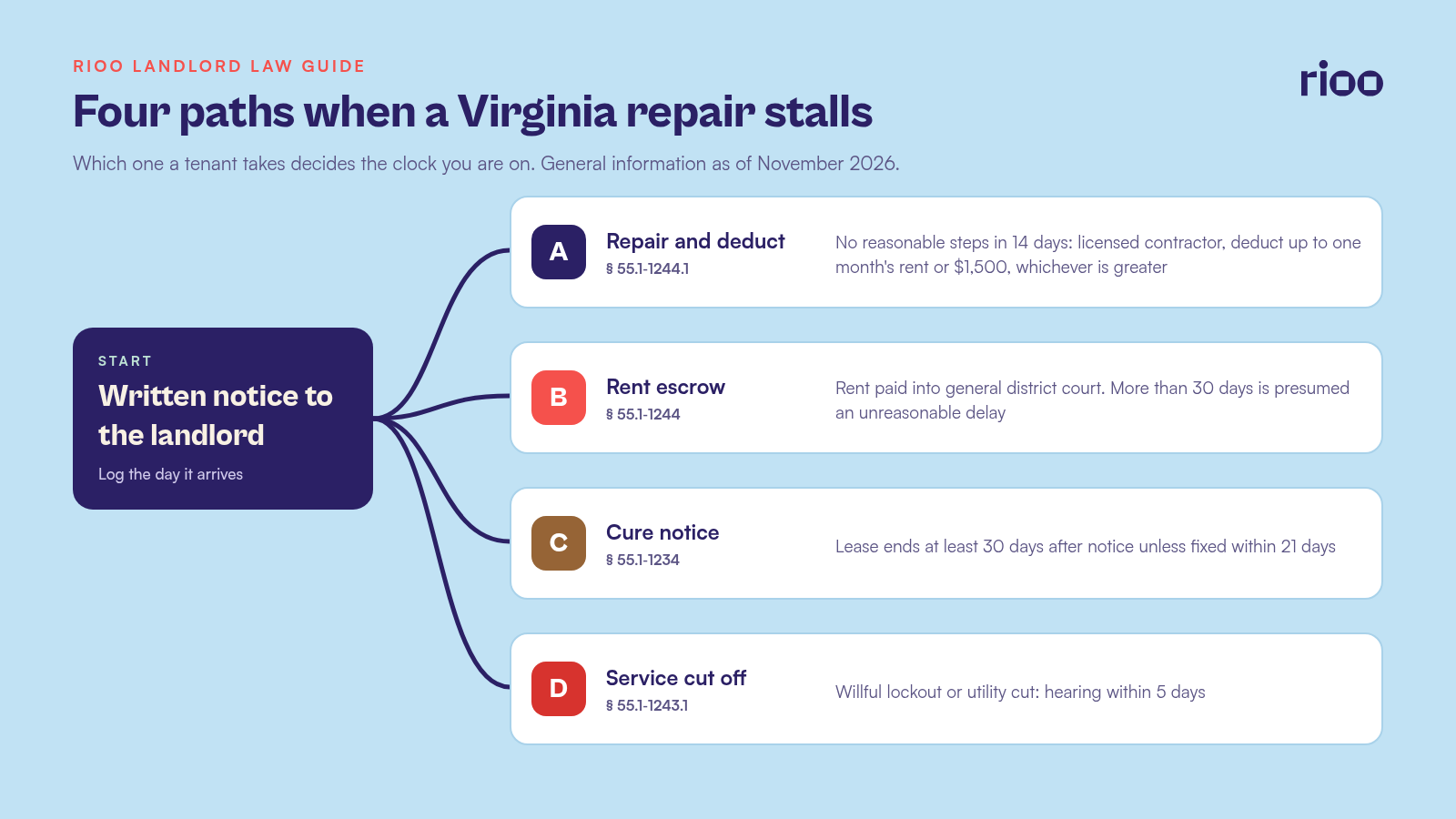
Each path has its own trigger and its own clock. Staff who know all four can tell from a tenant's letter which one is coming.
Path A: repair and deduct after 14 days
§ 55.1-1244.1 applies to a material breach or a condition that threatens life, health or safety. The statute lists examples: rodents, and no heat, hot or cold water, light, electricity or working sewage. Say the landlord takes no reasonable steps within 14 days of the tenant's written notice. The tenant can then hire a contractor licensed by the Virginia Board for Contractors. For rodents, a licensed pest control business is required.
The tenant can recover actual costs up to the greater of one month's rent or $1,500. They deduct it from rent after giving the landlord an itemized statement with receipts. The tenant cannot use this path if they caused the problem, if the landlord was denied access, or if the landlord had already fixed it.
Path B: rent escrow in court
Under § 55.1-1244, the tenant files a tenant's assertion in the general district court where the property sits. They must show the landlord had notice and failed to fix the condition in a reasonable time. A delay of more than 30 days from the landlord's receipt of notice is presumed unreasonable. The first hearing must happen within 15 calendar days of service on the landlord, and sooner for emergencies such as no heat in winter.
The court can hold the rent, cut it, release money for repairs, or end the lease. If an escrow account runs six months without a fix and the landlord made no reasonable attempt, the court must award the escrowed money to the tenant. The court may also order the landlord to pay the tenant's costs and attorney fees.
Path C: a 21 day cure notice
§ 55.1-1234 lets a tenant serve written notice of a material breach of the lease, or a breach of the Act that materially affects health and safety. The notice says the lease ends on a date at least 30 days after receipt unless the breach is fixed within 21 days. Fixing it in time keeps the lease alive. The tenant can also seek damages, and recovers reasonable attorney fees unless the landlord proves it acted reasonably.
Path D: a five day hearing for cut off services
§ 55.1-1243.1 covers a landlord who willfully locks a tenant out, interrupts an essential service, or makes the home unsafe. The first hearing is within five calendar days of filing. At a full hearing, the tenant recovers actual damages, plus statutory damages of $5,000 or four months' rent, whichever is greater, and attorney fees. Path D needs a deliberate act, so a slow repair alone does not trigger it. Even so, never shut off a utility to pressure a tenant.
What changes on 1 January 2027
The Virginia Code site already shows new versions of two sections that take effect on 1 January 2027. The history notes on those pages cite the 2026 Acts of Assembly, chapter 1118 for escrow and chapter 1111 for retaliation.
- Escrow, § 55.1-1244. Today a tenant must have paid the rent due into court, within five days of its due date, before the court grants relief. From 1 January 2027, the tenant pays rent that comes due into the court escrow account while the case runs. They do not have to pay old rent, late fees or other charges in order to file. A late escrow payment is no longer grounds for dismissal, though the court can weigh it. The landlord can still seek possession if an escrow payment is late, and can still get a money judgment for amounts owed.
- Retaliation, § 55.1-1258. The new version lists more protected acts, including a written complaint to the landlord, a complaint to the news media and a fair housing complaint. It also lists more banned responses, such as raising fees, selective enforcement of rules and threats. Read the full section before you raise rent or decline a renewal after any complaint.
The practical effect: from January, an escrow case is harder to end early on a payment technicality. A clean repair file matters more.
Unit 3C and a dead water heater
Here is a fictional example, told through the messages, of how a manager can stay ahead of all four paths. Unit 3C is in a 48 unit building in Henrico County. Rent is $1,640 a month.
Saturday 6 February 2027, 7:40 a.m., portal message from the tenant: "No hot water since last night. The water heater is leaking at the bottom. Photo attached."
Saturday, 9:15 a.m., on call reply: "Thanks for the photo. Please turn the cold supply valve on top of the tank clockwise until it stops. A plumber is booked for Monday between 8 and 10 a.m. Reply here if that window does not work for you."
The manager logs 6 February as the notice date. Day 14 is Saturday 20 February. The escrow presumption date, 30 days out, is Monday 8 March.
Monday 8 February, plumber's note: "Tank failed. Replacement 50 gallon unit quoted at $1,380 installed. Supplier has it on Thursday 18 February."
Thursday 11 February, tenant: "A week without hot water is a lot. If it isn't fixed by the 20th I'll hire my own plumber and take it off the rent."
Thursday, manager: "That's fair to ask. The new heater is ordered and installation is booked for Thursday 18 February. Until then we will credit $15 a day for the days without hot water and provide access to the gym showers. I'll confirm the install time on Tuesday."
The heater goes in on 18 February, inside the 14 days. The file shows notice, a same day reply, a plumber visit, an order date and a fixed date. Had the landlord done nothing, the tenant could have hired a licensed plumber and deducted, say, a $1,450 invoice in full. The cap is the greater of $1,640 or $1,500. The credit was a choice made to keep goodwill. Virginia's repair statutes do not require it.
Keeping Virginia's repair dates in RIOO
Virginia's repair clocks run on dates, so the dates need one home. In RIOO, residents submit requests in the tenant portal, and each request becomes a work order linked to the property, unit, asset and lease in NetSuite. Status changes are visible to the resident. Completed work is recorded against the unit and asset, and costs flow to accounts payable. Add the notice date and the day 14 deadline to the work order, and the evidence for the defenses below sits on one record. See service requests and tasks in RIOO, and our guide to the full work order flow from request to resolution.
What a landlord can raise in an escrow case
Section 55.1-1244 lists four answers to a tenant's assertion. Each one depends on records made at the time.
- The condition does not exist. Inspection notes and dated photos prove this.
- The condition has been fixed. A closed work order with a completion date and the vendor invoice prove this.
- The tenant, a household member or a guest caused it. The technician's written cause notes matter here.
- The tenant unreasonably refused entry. Entry notices and the tenant's replies prove this.
For the rest of the Act, from deposits to entry, see the Virginia landlord tenant law compliance guide. Repair disputes often surface during a possession case, so read the Virginia eviction process guide as well.
Virginia repair questions from owners
How long does a Virginia landlord have to make repairs?
For repair and deduct, 14 days from the tenant's written notice to take reasonable steps. For escrow, a reasonable time, with a presumption that more than 30 days is too long. A cure notice under § 55.1-1234 gives 21 days.
Can a Virginia tenant just stop paying rent?
No. Withholding outside the statutes is not a listed remedy. Escrow means paying rent into court. Repair and deduct means paying a licensed contractor and deducting with receipts.
Can the tenant's cousin do the repair and deduct it?
Not under § 55.1-1244.1. The work must be done by a contractor licensed by the Board for Contractors, or a licensed pest control business for rodents.
Does a lease clause making the tenant handle all repairs hold up?
Only within § 55.1-1220 D. The parties can agree in writing on specific tasks and repairs, in good faith. A clause meant to evade the landlord's duties fails that test.
Does Virginia require heat?
Yes. Heat in season and reasonable hot water at all times. The exceptions are equipment under the tenant's exclusive control and supply through a direct public utility connection. Local codes may set temperatures. Our guide to landlord heat requirements covers the numbers.