









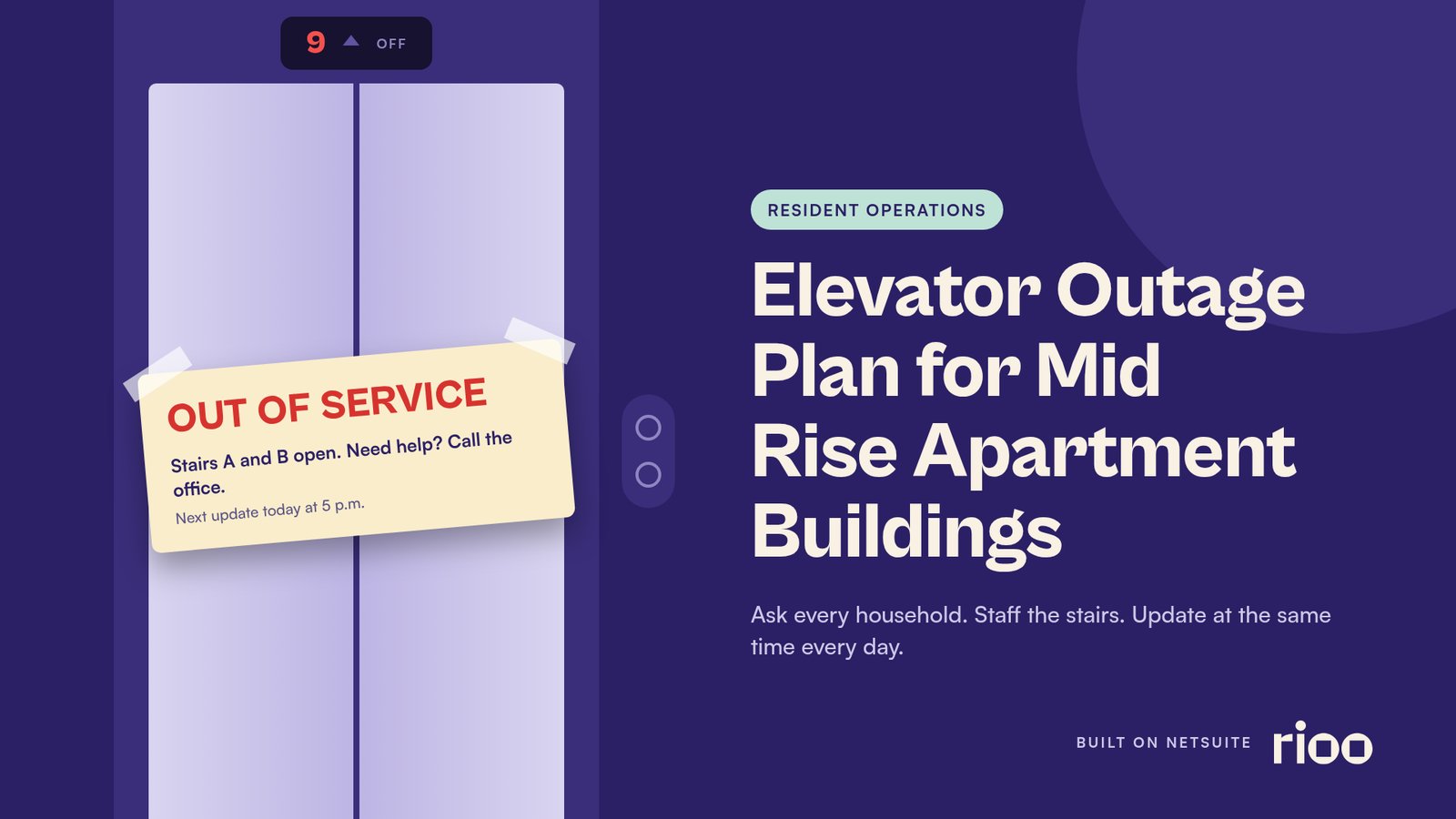
Who in your building cannot manage eight flights of stairs today? If you cannot answer that within an hour of an elevator going down, the outage will be run by phone calls and complaints instead of a plan.
An elevator outage plan starts with the residents, then the repair. Tell every resident fast, in more than one format. Ask everyone, not only people you know about, whether they need help. Put staff on deliveries, trash and errands for upper floors. Handle requests for accommodation one by one, because fair housing law requires it. Then push the contractor for a firm repair date and update residents every day until the car runs again.
Size up the outage on the first call
The plan scales with two facts: how many cars still work, and how long the repair will take. Get both from the contractor on the first call, even as rough estimates.
| Situation | What the plan needs |
|---|---|
| One car of two is down, back within a day | Notice in the lobby and by text. Watch the working car for crowding. |
| The only car is down, back within a day | Notice to all units. Front desk checks on residents who asked for help before. |
| The only car is down for several days or more | The full plan below: help list, runners, accommodation requests, daily updates, fire department told. |
| Planned modernization | The full plan, started weeks or months ahead, with work phased if the building has two cars. |
If someone is trapped in a car, that comes first. Call the contractor's emergency line and the fire department, and stay in contact with the person through the intercom until help arrives.
The help list
The help list is a short, voluntary record of households that need help while the elevator is out. Build it by asking every household. Many limits are not visible. A resident recovering from surgery, a parent with twins in a stroller and a tenant on oxygen may never have told the office anything.
Collect only what you need to help:
- Unit number and a phone number that works during the outage.
- The kind of help wanted, such as groceries, trash, laundry, mail or help with a regular appointment.
- Whether the resident would need help getting out in an emergency.
- Whether they agree to share that last point with the fire department.
Do not ask for a diagnosis. Keep the list with the outage file, away from the lease file, and give it only to staff who are doing the work. Delete or archive it under your records policy when the outage ends.
One owner for each job
Name one person for each job before the first notice goes out. Residents will ask the same questions of whoever they see in the hall, and every answer should match.
Front desk or leasing office
Sends the notices, takes help requests, keeps the help list and logs every call. Runs a daily check on each household on the list, by phone or a knock on the door.
Maintenance lead
Schedules runners for deliveries, trash and laundry. Keeps stairwells lit, clear and unlocked where the fire code requires. Checks the stair lighting each evening.
Property manager
Owns the repair date and the budget. Decides accommodation requests, with counsel where needed. Tells the fire department the elevator is out for several days, and shares the evacuation needs residents agreed to share.
Elevator contractor
Diagnoses the fault, names the part, gives a lead time in writing and updates it. Tells the manager at once if the date slips.
A notice residents can act on
A good notice answers what residents will ask anyway. Post it in the lobby and on every floor, and send it by text and email. Offer it in other formats or languages for residents who need them, and read it aloud to anyone who cannot read a posted sheet.
"The elevator is out of service as of Tuesday 2 February at 6:50 p.m. The contractor expects a new drive part in about 10 business days. We will update you every day at 5 p.m., even if nothing changes. If you need help with groceries, trash, laundry, mail or getting to appointments, call the office at 555 0142 or reply to this text. If you may need help leaving the building in an emergency, tell us. If the elevator being out affects you because of a disability, you can ask us for an accommodation, such as a temporary move. Stairs A and B are lit and open."
Send the 5 p.m. update even on days with no news. Silence is when residents start calling the city.
Accommodation requests while the car is down
Under the Fair Housing Act, a housing provider must make reasonable accommodations in rules, policies, practices and services. The duty applies when a person with a disability needs the change to use and enjoy their home. The rule is 24 CFR 100.204. A resident who cannot use stairs loses the use of their home when the only elevator stops.
State guidance such as the Massachusetts Office on Disability's page on elevator outages in housing lists the kinds of requests that come up. Examples are deliveries of groceries, medication and mail, a move to an available ground floor unit, or substitute housing while the outage lasts. That guidance also makes three points every manager should follow:
- Decide each request on its own facts. There is no standard package that fits everyone.
- A request can be refused if it would be an undue financial and administrative burden or would fundamentally change your operations. If you refuse, discuss other options that would meet the need.
- Respond in a timely way. For an outage nobody planned, the guidance suggests that can mean within 24 hours of telling residents about it.
Write down each request, the date, what was offered and what was agreed. The site's guide to reasonable accommodation requests covers the full process. State and local law may add duties, so check with counsel for your location.
Halden House: ten days on the stairs
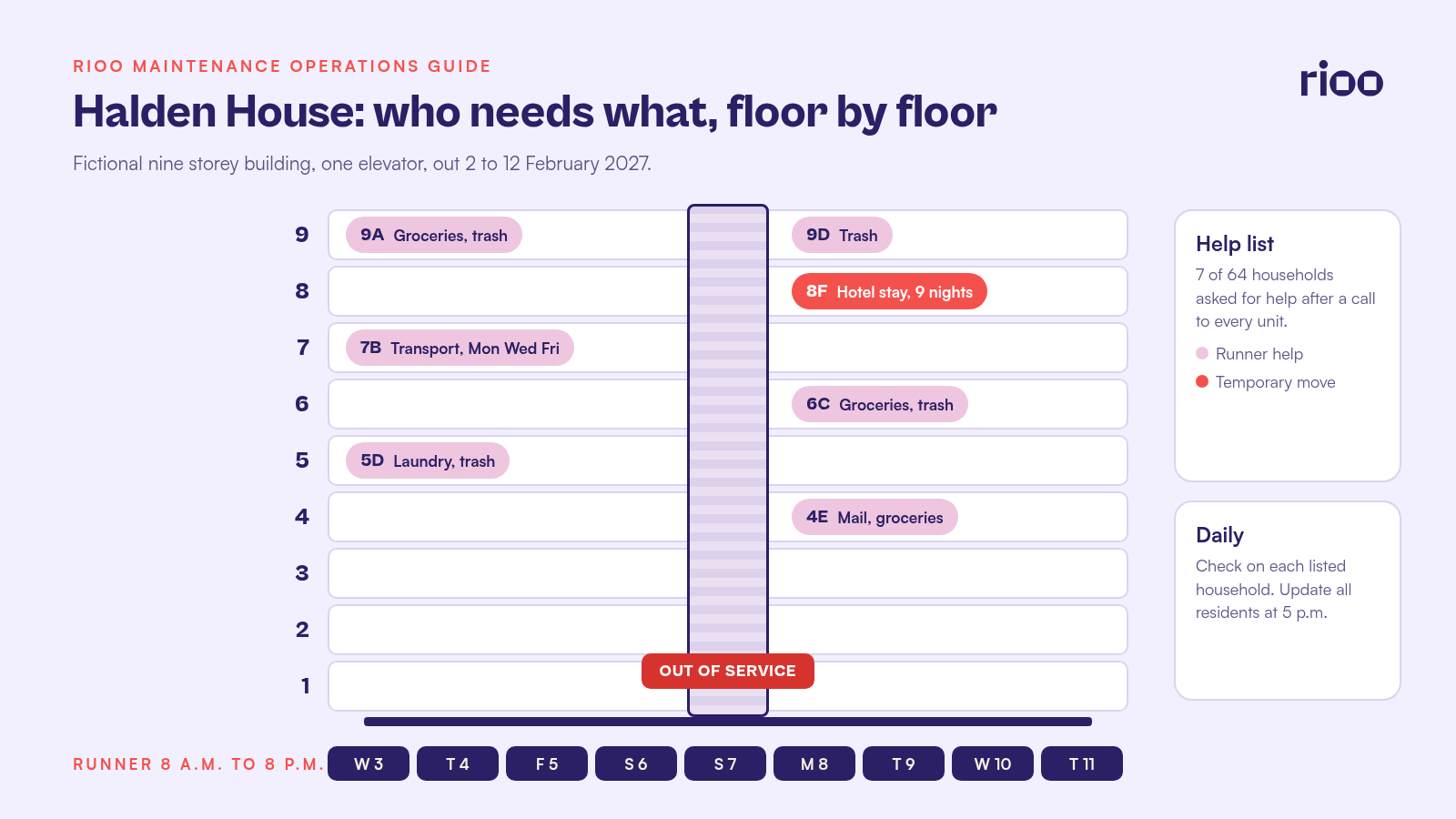
Here is a worked example. Halden House is a fictional nine storey building with 64 units and one elevator. The car stopped at the lobby on Tuesday 2 February 2027 at 6:50 p.m. Nobody was inside.
| Date | What happened |
|---|---|
| Tue 2 Feb, 9:30 p.m. | Contractor diagnoses a failed drive. Part lead time is about 10 business days. First notice goes out at 10 p.m. |
| Wed 3 Feb | Front desk calls every unit. Six households ask for help. One porter starts runner shifts, 8 a.m. to 8 p.m. |
| Wed 3 Feb | The wheelchair user in 8F asks for a temporary move. No lower floor unit is vacant. The manager books an accessible hotel room nearby at $159 a night. |
| Wed 3 Feb | The resident in 7B has dialysis on Monday, Wednesday and Friday. The manager agrees to pay a transport company with a stair chair for each trip. |
| Thu 4 Feb | Fire department told the elevator is out for several days, with the units that agreed to share evacuation needs. |
| Mon 8 Feb | Contractor confirms the part shipped. Expected install Friday. |
| Fri 12 Feb, 3 p.m. | Car passes its test and returns to service. Final notice goes out. 8F checks out of the hotel. |
The costs, all illustrative: nine hotel nights at $159 came to $1,431. Five dialysis trips at $185 each came to $925. The porter worked twelve hour shifts from 3 to 11 February, 108 hours at $26, which is $2,808. On the last morning the maintenance lead covered runs until the car came back. The total was $5,164, on top of the repair itself. The manager logged each cost against the outage so the owner could see it in one place.
Two things went wrong. The 6C resident, recovering from knee surgery, was missed on the first call round because her phone number was out of date. A neighbor told the porter on Thursday, and she became the seventh household on the list. And one update was sent at 7 p.m. instead of 5 p.m., which produced eleven calls in an hour. Both went into the review notes for next time.
Pushing the repair date
Residents judge the outage by how long it lasts. You cannot speed up a factory, but you can stop days slipping for no reason. Ask the contractor these questions in writing:
- What exactly failed, and what is the part number?
- Is the part in stock anywhere, including a rebuilt unit?
- Can the car run safely at reduced service with a temporary fix?
- When will the part ship, and when will a technician be booked to install it?
- Who do I call if that date moves?
Then read your service contract. Response times, parts coverage and overtime terms decide what you can insist on. If the contract is silent, fix that at renewal. Inspection history matters here as well, because a car that keeps failing its checks is a planning problem. The guide to elevator inspection compliance covers that side.
Planned work: modernization
A modernization can take a car out for weeks. Start the resident plan early. Send the first notice as soon as dates are set, build the help list a month ahead and line up any temporary moves before work begins. In a building with two cars, ask for the work to be phased so one car always runs.
Check state and local rules before you schedule it. Some jurisdictions require approvals before an elevator can be taken out of service for modernization. The Massachusetts guidance, for example, says a variance from the state access board is needed before taking an elevator offline to modernize it.
Where RIOO fits
An outage is a communication job with a repair attached. In RIOO, targeted notices can go to one building or group by portal, email and SMS. Read and delivery tracking shows who has not opened the notice yet. Messages sit on the tenant and lease record, so the help list calls and the daily updates leave a full history. Runner jobs and the contractor visit can be tracked as tasks and work orders against the building. See tenant communication tools in RIOO.
When the cause is a power cut and not a mechanical fault, use the apartment power outage plan instead. It covers the first hour, including anyone stuck in a car.
Short answers for the front desk
Does a landlord have to fix a broken elevator?
Where the elevator is part of the building's services, the owner is expected to keep it working and repair it in a reasonable time. State and local codes also require maintenance and inspections. The details vary by jurisdiction.
Does a landlord have to put residents in a hotel during an elevator outage?
Not automatically. A resident with a disability can ask for an accommodation, and a hotel stay is one option. The landlord must consider the request on its facts and may offer a different option that meets the need.
Can residents get a rent reduction while the elevator is out?
In some places, a long loss of a building service can support a rent reduction claim. It depends on state and local law and the lease. Ask counsel before you promise or refuse one.
Should we only contact residents we know have disabilities?
No. Contact every household. Many needs are not visible, and some residents have never told the office. A notice that reaches only known residents will miss people.
How often should we update residents?
Once a day at a set time, plus right away if the repair date changes. A fixed time cuts the calls, because residents know when news will come.