









At 7:40 a.m. on a Saturday in January, the tenant in unit 3 of a four unit building in Paterson texts the super. The radiators are cold and the thermostat reads 58°F. What the owner does in the next few hours, and what goes in the file, decides how the rest of the month plays out.
New Jersey landlords must keep a rental fit to live in for the whole lease. They must repair defects in what the courts call vital facilities, such as heat, water, plumbing, electricity and broken windows. This is the implied warranty of habitability from Marini v. Ireland. Suppose the landlord does not fix a vital defect after notice and a reasonable time. The tenant may then repair and deduct, withhold rent or seek a rent reduction. The tenant may also leave under constructive eviction or ask a court for rent receivership. Buildings with three or more units must also meet the state housing code. This guide follows that Paterson building, a fictional example, through each step. It is general information as of November 2026, not legal advice.
Case law first, then the housing code
New Jersey has no single repair statute for tenants. The duty sits on two layers, and an owner needs both in view.
The warranty of habitability
The New Jersey Supreme Court read a warranty of habitability into residential leases in Marini v. Ireland, 56 N.J. 130 (1970). In Berzito v. Gambino, 63 N.J. 460 (1973), it held that the tenant's promise to pay rent and the landlord's promise to keep the home livable depend on each other. Do not count on a lease clause to shift this duty. The housing code keeps the heating duty on the owner whatever a contract says (N.J.A.C. 5:10‑14.4(c)), and a tenant can ask the court to strike a lease term that breaks state law (N.J.S.A. 46:8‑48). The state's Habitability Bulletin from the Department of Community Affairs (DCA) sums up both cases.
The Hotel and Multiple Dwelling rules
Buildings with three or more rental units must meet the Regulations for Maintenance of Hotels and Multiple Dwellings, N.J.A.C. 5:10. They must register with the DCA Bureau of Housing Inspection, which inspects them on a cycle and takes complaints. One and two unit rentals that the owner does not live in fall under local ordinances and register with the municipal clerk. The Paterson building has four units, so the state code applies.
Tenants have duties too
A tenant must return the unit in the condition received, apart from normal wear and tear. A tenant who causes damage through abuse or neglect pays for that repair, and a tenant who caused the defect cannot use the remedies below. The code also requires occupants to report defects promptly.
Saturday morning: is this a vital facility?
Not every defect gives a tenant a remedy. The DCA guidance limits the remedies to defects in vital facilities, the things needed to make a home livable. A sticking cabinet door is a repair request. No heat in January is a habitability problem.
| Item | Standard in multiple dwellings | Source |
|---|---|---|
| Heat | At least 68°F from 6 a.m. to 11 p.m. and 65°F overnight, 1 October to 15 May | N.J.A.C. 5:10‑14.4 |
| Hot water | At least 120°F and no more than 140°F at the outlets, at all times | N.J.A.C. 5:10‑15.3 |
| General upkeep | Good repair, clean, free of infestation and hazards; working heat, security, smoke alarms, plumbing and wiring | N.J.A.C. 5:10‑5.1, as summarized in the DCA Truth in Renting guide |
| Examples of vital facilities | Toilets, hot and cold water, heat, electricity, windows | DCA Habitability Bulletin |
At 58°F on a January morning, unit 3 is below the daytime minimum. The clock for a reasonable repair has started, even before any letter arrives.
Saturday afternoon: temporary heat
The super finds a failed ignition control on the boiler. The supply house can have the part on Tuesday. That leaves three cold days.
The code expects the owner to do something in between. Under N.J.A.C. 5:10‑4.2, when a required service is out, repairs must be made quickly and temporary or alternate service must be provided where possible. By 4 p.m. the owner has delivered two electric space heaters to each of the four units and posted a note in the hall with the expected repair date.
Heat is also the one item where local health officers can step in fast. If the landlord does not act after proper notice, the local board of health may order the repair as the landlord's agent, under N.J.S.A. 26:3‑31(p) as described in the DCA guide. Tenants are told to call the local health agency for loss of heat or hot water.
Monday: the certified letter
On Monday the owner receives a letter from unit 3, sent certified mail and dated Saturday. It lists the outage start time, the thermostat readings and photos of the radiators.
This is the notice the remedies depend on. DCA guidance says a tenant should give notice in writing by certified mail, return receipt requested, and allow adequate time to fix the defect. New Jersey sets no fixed number of days. What is reasonable depends on the defect, and a no heat call in January allows far less time than a dripping tap.
The owner does three things that day:
- Logs the letter with its receipt date, next to the Saturday text.
- Gives one day notice to enter all four units on Tuesday to check radiators once the boiler is back. The code allows entry on one day's notice in a multiple dwelling, and right away in an emergency.
- Replies in writing with the repair plan and the part's delivery date.
If the repair had stalled: the five remedies
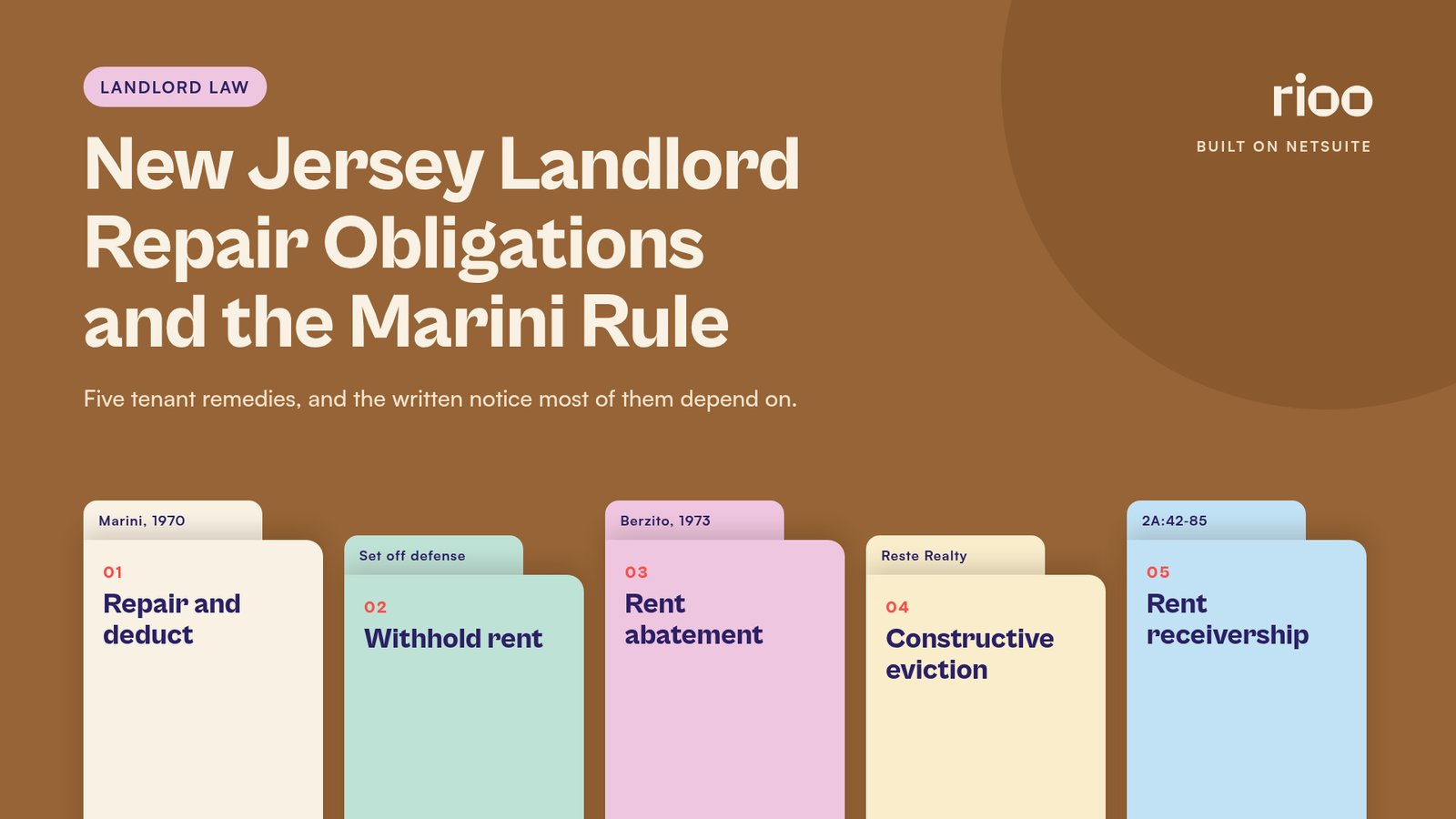
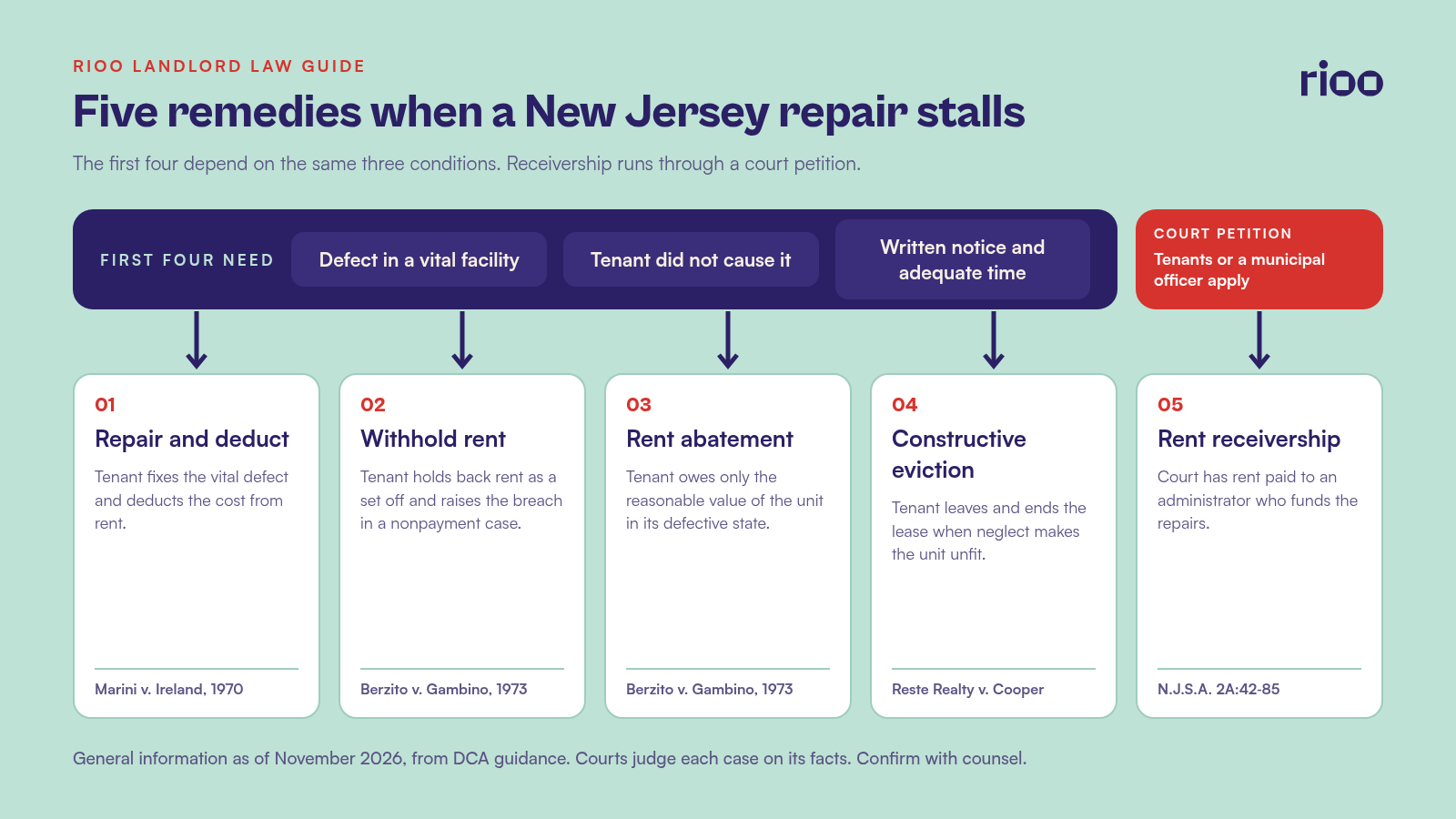
The Paterson boiler was fixed on Thursday 14 January, after a second visit. Had it dragged on, the tenant had five paths, all described by the DCA. The first four depend on the three conditions above: a vital facility, a defect the tenant did not cause, and notice with adequate time. Receivership is different. It runs through a court petition.
Repair and deduct
The tenant pays for the repair of the vital facility and deducts the cost from rent. Marini is the source of this remedy.
Withholding all or part of the rent
The tenant holds back rent as a set off for the defective condition. If the landlord then files for nonpayment, the tenant can raise the landlord's breach as a defense. DCA guidance warns that a tenant should save withheld rent, because the court may order it paid.
Rent abatement
Under Berzito, a tenant can sue to recover rent already paid. If the court finds the unit was not habitable, the tenant owes only the reasonable rental value of the unit in its defective condition.
Constructive eviction
Where neglect makes the unit unfit to live in, the tenant may move out and end the lease without further rent, based on Reste Realty v. Cooper, 53 N.J. 446. If a court agrees, the landlord also returns the deposit.
Rent receivership
Under N.J.S.A. 2A:42‑85 and the sections after it, tenants or a municipal officer can ask a court to have rents paid to a court appointed administrator. The administrator uses the money to fix the conditions. The DCA Truth in Renting guide covers this, along with a related remedy when a tenant's utility service is wrongly diverted.
1 February: $500 short
On Monday 1 February, unit 3 pays $1,450 of the $1,950 rent. A note says the tenant is withholding $500 for the January outage.
The owner has choices, and none of them is a lockout or a shutoff. One is to agree a credit. Here is one way to price it, as an example only. Daily rent is $1,950 times 12, divided by 365, which is about $64.11. The outage ran from Saturday morning to Thursday afternoon, about five days. Five days of full rent is about $321. The owner offers a $321 credit for January, noting that space heaters were supplied, and asks for the remaining $179. The tenant agrees by email on 3 February.
The other choice is to file a nonpayment case and let the court decide. The tenant may raise habitability as a defense. The New Jersey Courts self help guide says the tenant must then deposit all rent due with the court. The tenant must also show evidence of the condition, the notice and the chance to repair. That hearing is often called a Marini hearing. The owner's file, with the Saturday text, the space heater delivery, the letter and the repair invoices, is the landlord's side of that hearing.
A withholding note does not settle who is right. If it goes that far, a court decides on the facts. Treat the note as a dispute to resolve and document, and talk to counsel before filing.
Keeping the Paterson file in RIOO
The Paterson owner could answer every question because each step had a time on it. That is easier when the file builds itself as the work happens. In RIOO, a resident submits a request in the portal and it becomes a work order linked to the unit and asset. The resident sees each status update. Messages, notices and documents sit on the tenant and lease record, with read and delivery tracking. If the first report arrives by a text to the super, log it on the work order with the time it came in. The hall notice, the vendor visits, the invoices and the agreed credit then sit in one history on the unit and lease. See service requests and tasks in RIOO.
For the disclosures that come before any lease is signed, see the New Jersey registration and disclosure checklist. For lease clauses that try to shift these repair duties, see the Truth in Renting Act guide. And for heat policy across states, read landlord heat requirements.
What not to do after a complaint
New Jersey's reprisal law, N.J.S.A. 2A:42‑10.10, bars certain reprisals. A landlord may not evict, substantially change the lease or refuse to renew because a tenant used a protected right. Those rights include trying to enforce the lease or the law, and joining a tenant organization. They also include a good faith complaint to a government agency. The tenant must first notify the landlord in writing and allow a reasonable time to fix the problem. A tenant can sue for damages.
In practice that means the unit 3 renewal in the spring should follow the same rent and terms policy as the other three units. If you do treat unit 3 differently, write down a reason unrelated to the complaint first. The Anti Eviction Act also limits the grounds for removing a tenant at all, so nonrenewal is rarely a simple option.
At turnover: the lead safe check
One more condition duty comes due when a unit turns over. Under N.J.S.A. 52:27D‑437.16, rental units built before 1978 must be inspected for lead based paint hazards. The inspection is due at tenant turnover or every three years, whichever comes first. Exemptions apply, and a unit with a valid lead safe certification does not need a turnover inspection. The statute text on nj.gov lists the exemptions. Owners give new tenants the certification and attach it to the lease. Put the inspection on the move out checklist so it never holds up a move in.
Five things New Jersey owners ask
How long does a New Jersey landlord have to make repairs?
No statute sets a single deadline. The tenant must give notice and allow adequate time, and what is adequate depends on the defect. Loss of heat or water calls for a same day response. Local codes may set their own timelines.
Can a New Jersey tenant withhold rent for repairs?
Yes, for defects in vital facilities that the tenant did not cause, after notice and a reasonable time to fix. If the landlord files for nonpayment, the court may require the tenant to deposit the rent due before a habitability hearing.
Does a lease clause making the tenant responsible for all repairs hold up?
Not for habitability. Courts read the warranty into every residential lease, and a tenant can ask the court to strike a lease term that breaks state law. Tenants can still be made responsible for damage they cause.
Who enforces the housing code in a two family house?
The municipality. The DCA Bureau of Housing Inspection covers buildings with three or more units. One and two unit rentals answer to local code and health officials.
What records should a landlord keep for a repair dispute?
The first report and its time, the written notice and receipt date, every message, entry notices, vendor visits and invoices, any temporary measures, and any credit agreed. Keep them together on the unit file.