Property management accounting tracks rent, deposits, expenses and owner money by property so reports and tax filings match reality. Beginners need four building blocks: separate bank accounts, a simple chart of accounts, a monthly close habit, and clear rules for deposits versus income.
This guide is for an owner operator or new manager who still closes the books in a spreadsheet. The goal is a clean first month before software becomes the bottleneck.
Set the accounts up first
Open at least two bank accounts before you take the first rent payment.
- Operating account: rent deposits and operating bills.
- Trust or deposit account: security deposits where your state requires separation.
Never mix personal spending with property cash. If you manage for others, follow your state trust rules and keep a ledger per owner. Label every transfer in the memo field so a six month bank review still makes sense. See how a full property management company accounting setup expands this when you add staff.
If your bank offers sub accounts under one login, use them. Separate account numbers beat mental bookkeeping when two owners ask for cash on the same Friday.
Chart of accounts in plain terms
Group income and expense lines so every property uses the same names.
| Group | Examples |
|---|---|
| Income | Rent, laundry, parking, late fees |
| Operating expense | Repairs, utilities you pay, insurance, management fee |
| Liability | Security deposits held |
| Capital | Roof, HVAC, major renovations (booked as assets, not one month expense) |
A short chart beats a long one you never use. Add lines only when a report needs them. Pair this with your chart of accounts guide.
Write a one page coding cheat sheet for yourself or your bookkeeper. Example: "Paint and patch after move out = repairs. Full unit remodel with new cabinets = capital." The cheat sheet stops January from looking different from June for the same work.
A worked first month on a duplex
Take a fictional duplex. Unit A rent $1,800. Unit B rent $1,650. Both pay on 1 November. You collect a $1,800 deposit on Unit A for a 1 November move in. November bills: $420 water, $310 insurance installment, $275 for a water heater part on Unit B.
Cash in: $1,800 + $1,650 + $1,800 deposit = $5,250. Deposit $1,800 goes to the trust account and a deposit liability, not to income. Operating income is $3,450. Operating expenses are $420 + $310 + $275 = $1,005. Operating cash left from November activity is $3,450 minus $1,005, or $2,445, before owner draws.
If the deposit had been booked as rent, November income would look $1,800 too high and the trust account would be wrong on day one. Beginners make this mistake often, and it shows up again when the resident moves out and the deposit refund has nowhere clean to post.
Owner draw in this example: leave a $500 operating reserve, then transfer $1,945 to the owner. Record the draw on the owner ledger the same day the bank transfer leaves.
Month end habit
- Reconcile both bank accounts to the statements.
- Match every rent payment to a unit ledger.
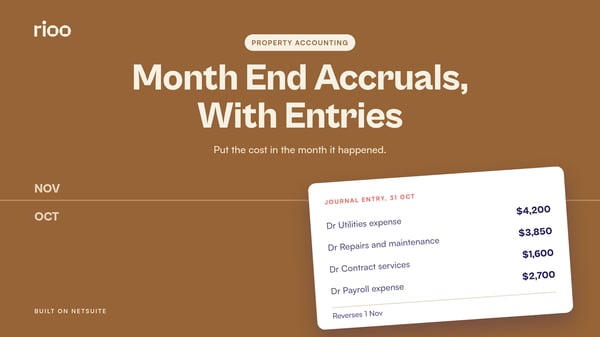
- Record unpaid bills you already received (accruals) if you use accrual books. See month end accruals.
- Review deposits held versus the trust balance.
- Send the owner a one page income and expense summary.
Keep a simple monthly checklist on one page. Tick bank reconcile, deposit tie out, rent roll vs cash, and open bills. That checklist is the habit. Software only helps if the habit exists.
Income, expenses and capital
Rent is income when it is earned under your method (cash or accrual). Repairs that keep a unit working are expenses. Replacing a roof is usually capital. When unsure, ask your accountant once and write the rule down. Mixing capital into repairs makes NOI look better for a month and worse for taxes later.
Late fees and pet rent are income. Security deposit interest, where your state requires it, follows local trust rules. Do not invent a policy that conflicts with the statute your counsel already reviewed.
Common beginner mistakes
- Booking deposits as rent income.
- Paying personal bills from the property account.
- Skipping bank reconcile for quiet months.
- Expensing a full roof replacement in one month without advice.
- One spreadsheet tab for three owners with no property tags.
- Waiting until tax season to invent the chart of accounts.
Fix mistakes in the month you find them and note the correction on the owner statement so trust stays intact.
When to leave the spreadsheet
A clean spreadsheet can work for a few units. Move to a system when you miss reconciliations, cannot answer an owner from one report, or start managing for other people. Process pain is a better trigger than a round unit count.
Where RIOO fits
Beginners outgrow spreadsheets when units and owners multiply. RIOO posts rent, deposits and bills into NetSuite so the property ledger and the GL stay aligned. Owner reports and deposit balances come from the same records. See NetSuite property accounting and income and expense management.
Questions beginners ask
Cash or accrual?
Cash is simpler for a tiny portfolio. Accrual matches income and costs to the month, and lenders and larger owners often ask for it. Pick one method and stay with it.
Are security deposits income?
No. They are liabilities while you hold them. They become income only if you lawfully keep them after move out under your state rules.
How soon should I close each month?
Aim to finish within ten business days. Faster is better for owners who watch cash weekly.
Do I need software on day one?
Not always. Start with clean accounts and a close habit. Add software when the habit starts breaking under volume.