









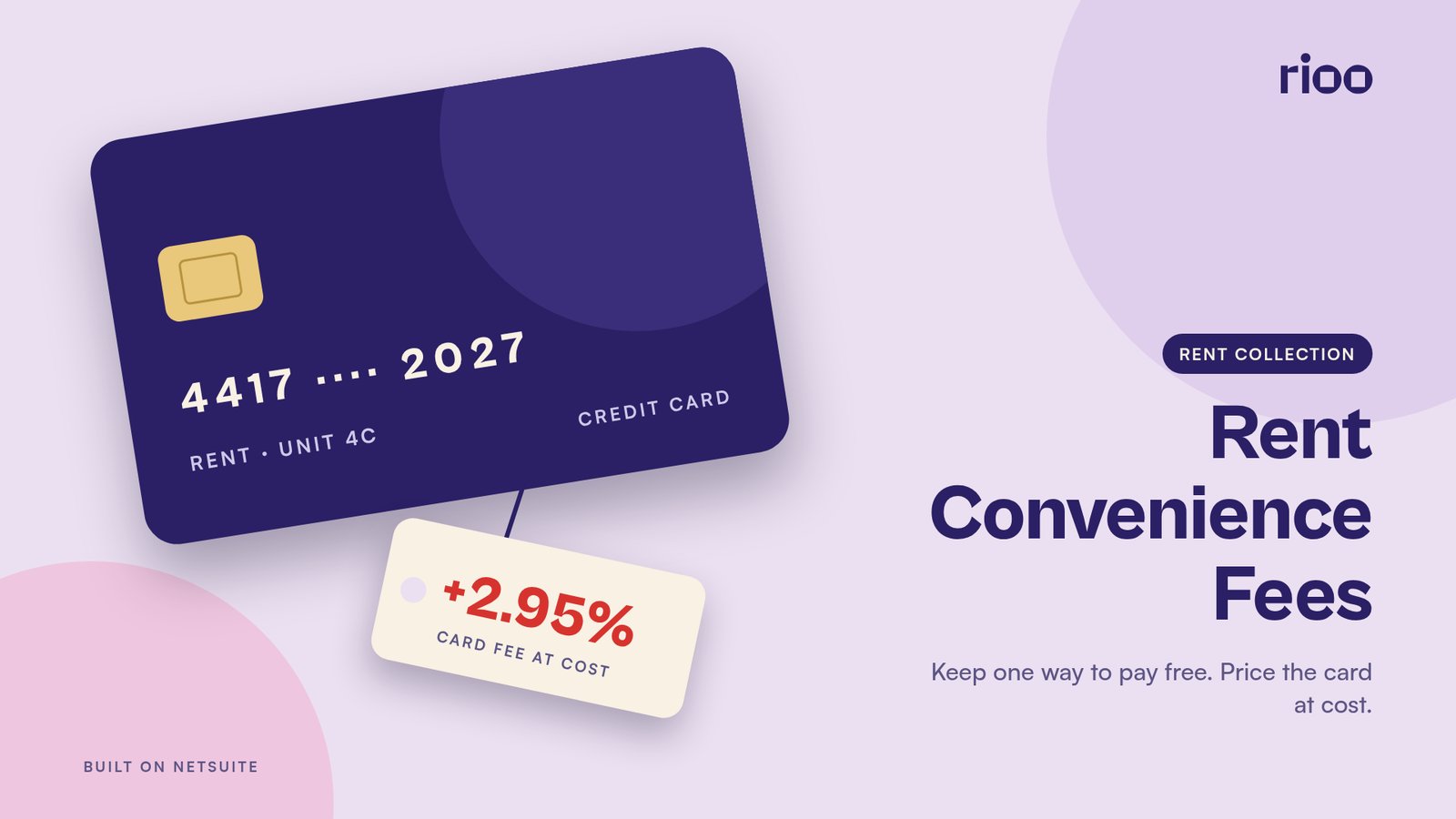
A resident who pays $1,850 rent by credit card costs the owner about $54 in processing every month. Multiply that across a building and it becomes a real budget line. Adding a fee to rent, though, is the kind of charge residents complain about and regulators look at closely.
A rent convenience fee is a charge added when a tenant chooses a costlier way to pay, usually a credit card. Landlords can often charge one, but not everywhere and not on every method. Our view: keep at least one way to pay rent free. Pass on card costs at cost where the law and your processor allow it. Put the rule in the lease before anyone pays. Check your state and local rules first, and confirm with counsel where the answer is unclear.
What card rent costs, worked through
The example below is fictional. It uses rounded processor quotes so the math is easy to follow. Your own merchant agreement sets the real numbers.
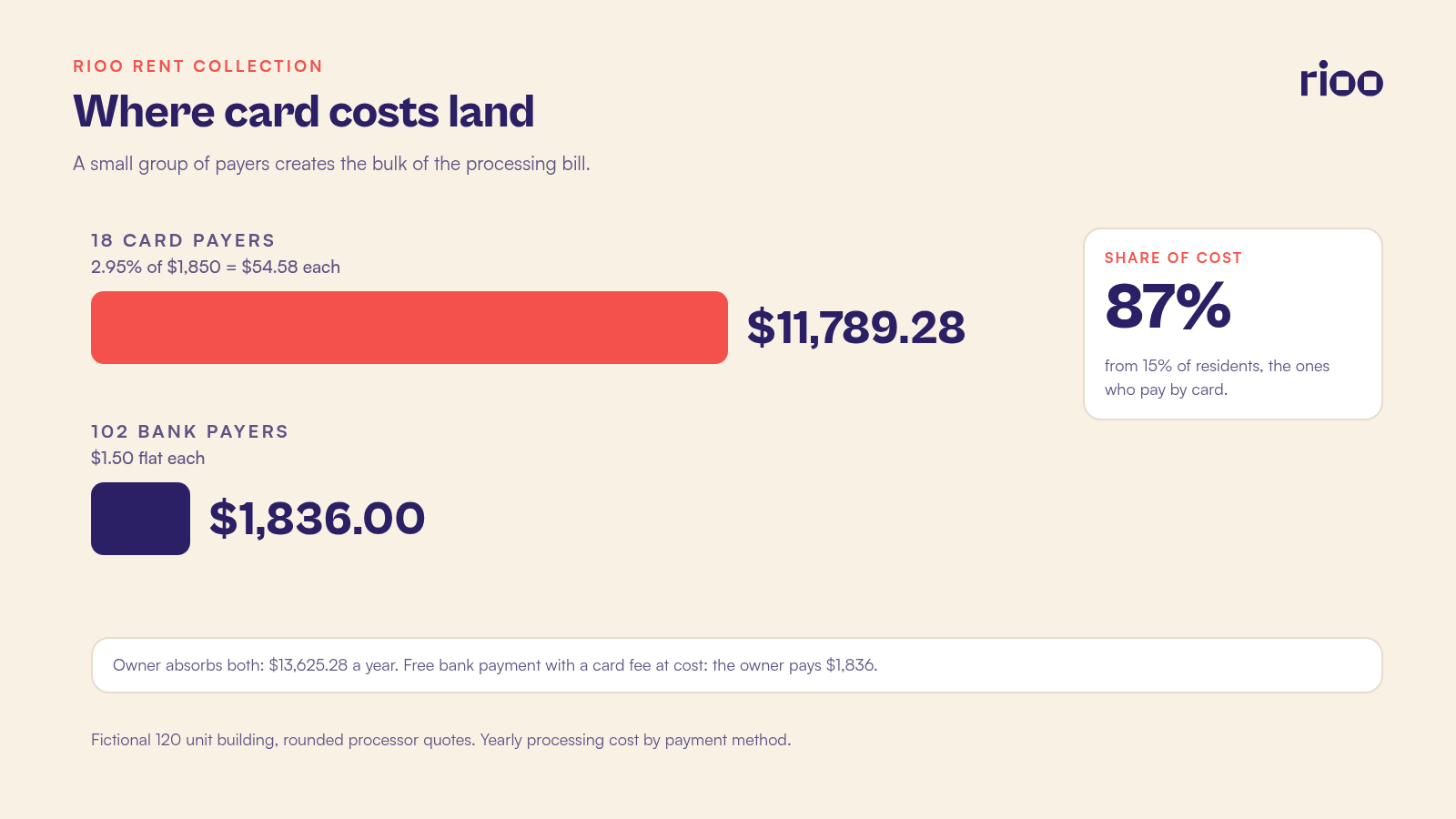
A 120 unit building charges an average rent of $1,850. Its processor quotes $1.50 for each bank transfer (ACH) and 2.95% for each credit card payment. In a typical month, 18 residents pay by credit card and 102 pay by bank transfer.
| Line | Per payment | Payments a month | Per year |
|---|---|---|---|
| Credit card at 2.95% of $1,850 | $54.58 | 18 | $11,789.28 |
| Bank transfer at a flat $1.50 | $1.50 | 102 | $1,836.00 |
| Total if the owner absorbs both | 120 | $13,625.28 |
Against $2,664,000 of yearly rent, $13,625.28 is about half a percent. The split is what matters. Card payers are 15% of the residents and create about 87% of the processing cost. The other 102 households pay their rent by bank and still carry part of that cost through the owner's budget.
Now look at it from one card payer's side. A fee at cost adds $54.58 a month, or $654.96 a year. If their card pays 1.5% back, they earn about $28.57 on a $1,904.58 charge. The reward does not cover the fee, so many residents switch to bank transfer once they see the cost. That switch saves the owner more than the fee itself.
The policies owners choose between
Payment policies tend to take one of four shapes. Each puts the cost somewhere different.
| Policy | Who pays the card cost | Risk |
|---|---|---|
| Absorb everything | The owner, out of rent | Cost grows as more residents pay by card |
| Free bank payment, card fee at cost | The resident who chooses a card | Must fit state law and card network rules |
| Flat fee on every online payment | Every resident who pays online | Looks like a charge on rent itself, with no free option |
| No cards accepted | Nobody | Residents who rely on cards pay late or by money order |
The second row is the one this post recommends. It charges the person who made the choice, it leaves a free route open, and the fee matches a real cost you can show.
The case for passing card costs on
Rent is a fixed debt, and the lease sets the amount. When a resident picks a payment method that costs more to process, that choice creates the extra cost. Shifting it to that resident matches how owners treat other optional services.
There is also a pricing point. If the owner absorbs card fees, that cost ends up in next year's rent for everyone. A resident who pays by bank transfer would then subsidise a neighbour's card rewards. A fee at cost keeps the base rent honest.
Visible fees also change behaviour. Once card costs show on the payment screen, residents move to bank transfer or autopay. That cuts the processing bill and makes rent arrive on a steadier day. Our online rent collection guide covers how to move residents toward autopay.
Where a convenience fee goes wrong
The same fee that looks fair on paper can turn into a complaint, a dispute or a legal problem. These are the patterns to avoid.
There is no free way to pay
If every method carries a fee, the fee is part of the price of renting. Some fee disclosure laws treat a charge with no way around it as mandatory, so it may need to appear in the advertised rent. Our guide to mandatory vs optional rental fees shows how to sort each charge.
The fee is bigger than the cost
A $9.95 charge on a payment that costs you $1.50 is a profit line. Residents notice, and so do consumer protection regulators. Set the fee to match what the processor charges, and keep the quote on file.
The fee was never agreed
Adding a fee mid lease, with no clause and no notice, invites disputes. Put the fee in the lease or a signed addendum, show it before the resident confirms payment, and print it on the receipt.
Debit cards get the same fee as credit cards
Card networks treat debit and credit differently. Surcharges on debit cards are generally not allowed under network rules. Ask your processor exactly which card types a fee can apply to before you switch it on.
Subsidised units follow program rules
Units under a housing assistance program may have their own limits on what can be charged. Check the program rules before adding any fee to those leases.
What the law says before you add a fee
There is no single national rule for rent payment fees in the US. State law, card network rules and your processor agreement all apply. Two state examples show how far apart the rules can be, as of November 2026.
California sets a floor for payment choice. Under Civil Code section 1947.3, a landlord must offer tenants at least one way to pay rent and the deposit that is neither cash nor electronic funds transfer. That usually means a check. The same section says a landlord cannot charge a fee for paying rent by check. A card fee does not change either duty.
Massachusetts takes a stricter line on cards. General Laws chapter 140D, section 28A bars a seller in a sales transaction from adding a surcharge for paying by credit card instead of cash or check. Whether that reaches residential rent is a question for counsel. The cautious path there is to absorb card costs or offer a discount for bank payment instead.
Other states have their own surcharge rules, and some cities regulate rental fees directly. These two are examples, so check the rules where your properties are. Our guide to rental fee transparency laws by state covers the disclosure side.
A fee policy you can defend
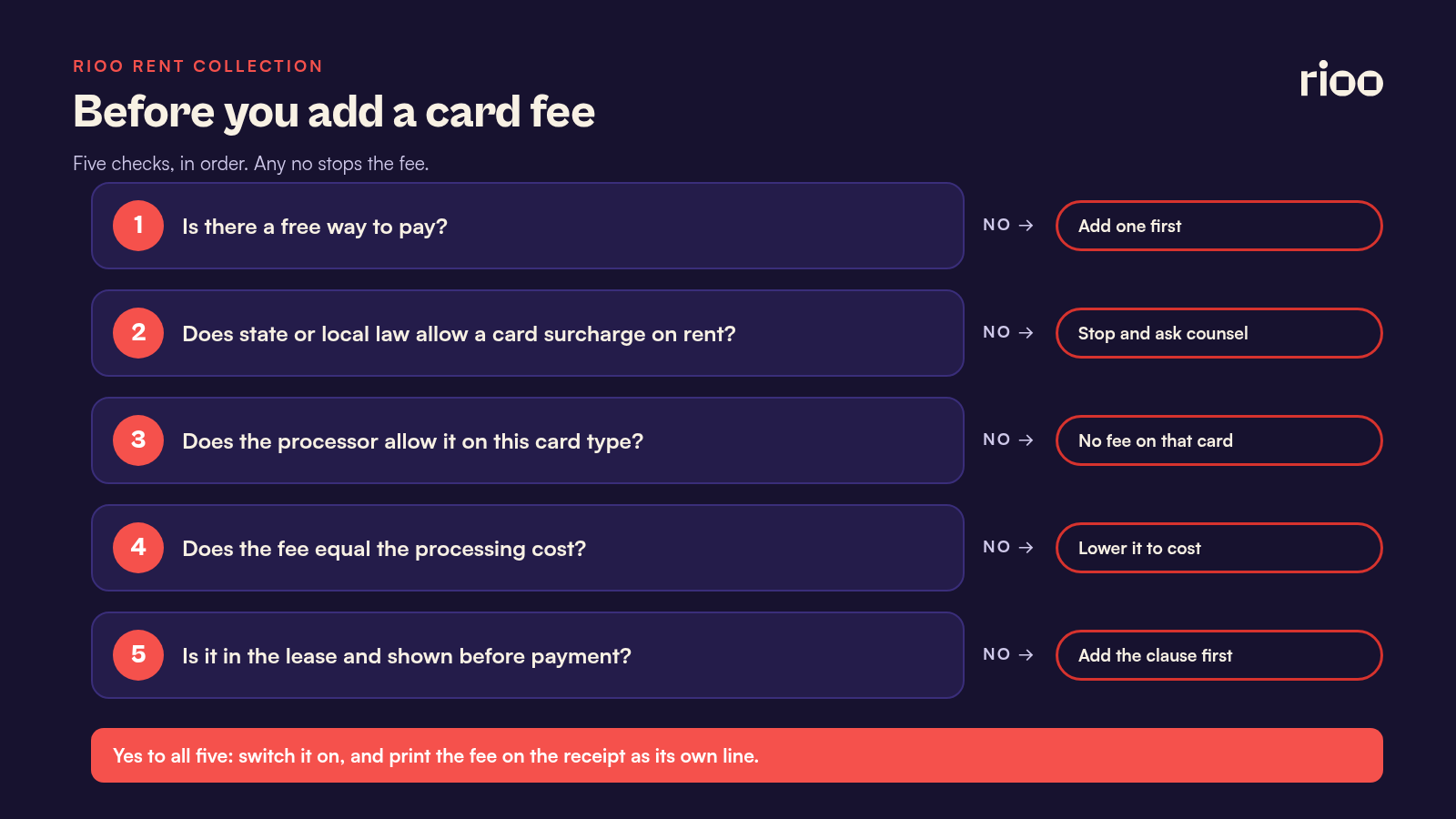
If you decide to pass card costs on, write the policy before you configure anything. Work through these questions in order.
- Is there a free way to pay? Bank transfer, autopay or check should cost the resident nothing.
- Does state or local law allow a card surcharge on rent? If the answer is no or unclear, stop and ask counsel.
- Does the processor allow it, and on which card types? Get the answer in writing.
- Does the fee equal the cost? Use the processor's exact percentage, with no rounding up.
- Is it in the lease, and shown before payment? The resident should see the fee and the total before confirming.
- Is it on the receipt and the ledger? Record the fee as its own line, separate from rent.
Here is how that looks in one fictional case. On 4 January 2027, a resident at the 120 unit building emails: "Why did my rent go up by $54.58?" The manager replies the same day. "Your rent is still $1,850. The $54.58 is the card processor's 2.95% charge, set out in section 14 of your lease. Bank transfer and autopay are free. I can send you the autopay link now." The resident switches to autopay for February. That reply works because the fee was agreed, disclosed and equal to the cost.
Card costs are one reason a payment can arrive short or bounce back later. Our guide to a returned rent payment covers what happens when a bank or card payment reverses.
Rent payment fees: common questions
Can a landlord charge a fee to pay rent by credit card?
In many places, yes, if the lease allows it, a free payment option exists, and the fee fits card network rules and state law. Some states restrict card surcharges, and California bars fees for paying rent by check. Check your state before charging.
What is the difference between a convenience fee and a surcharge?
The terms are used loosely. A surcharge usually means an extra charge for using a credit card. A convenience fee usually means a charge for using an optional channel, such as paying online. Card networks and some states define them differently, so use your processor's terms.
Can I charge a fee for ACH rent payments?
It is possible in some places, but it undercuts the policy. If bank transfer is your free option, keep it free. A fee on every method makes the fee part of the rent.
How much should a rent convenience fee be?
No more than the cost you pay the processor for that payment. If the card rate is 2.95%, the fee should be 2.95% of the payment, shown before the resident confirms.
Should the fee be on the receipt?
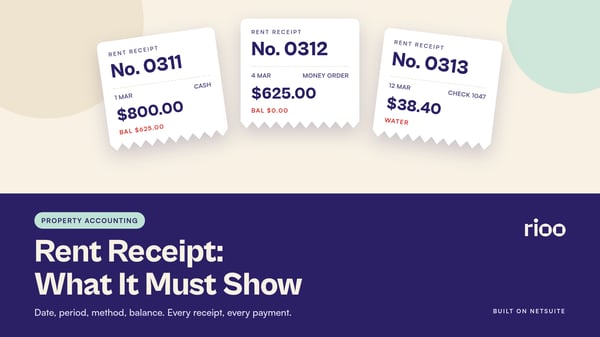
Yes. Show rent and the fee as separate lines. That makes the ledger clean and answers the resident's question before they ask it.
Is a convenience fee taxable income for the owner?
Fee income and processing costs both need to be recorded. How they are treated for tax depends on your structure, so confirm with your accountant.
Processing fees on payments through RIOO
In RIOO, residents pay through the tenant portal, the mobile app, pay by link or autopay, using bank and card payments through integrated gateways. By default, your organisation pays the gateway's processing fees under its merchant agreement, and RIOO records them as an expense in NetSuite. Some operators pass card fees to tenants as a convenience fee. Whether that is allowed depends on card scheme rules and local law in each market, so check both before passing any fee on. Each payment is applied to the tenant ledger and posted to NetSuite like any other receipt. The payment gateway integrations page lists the supported gateways and how settlement works.