









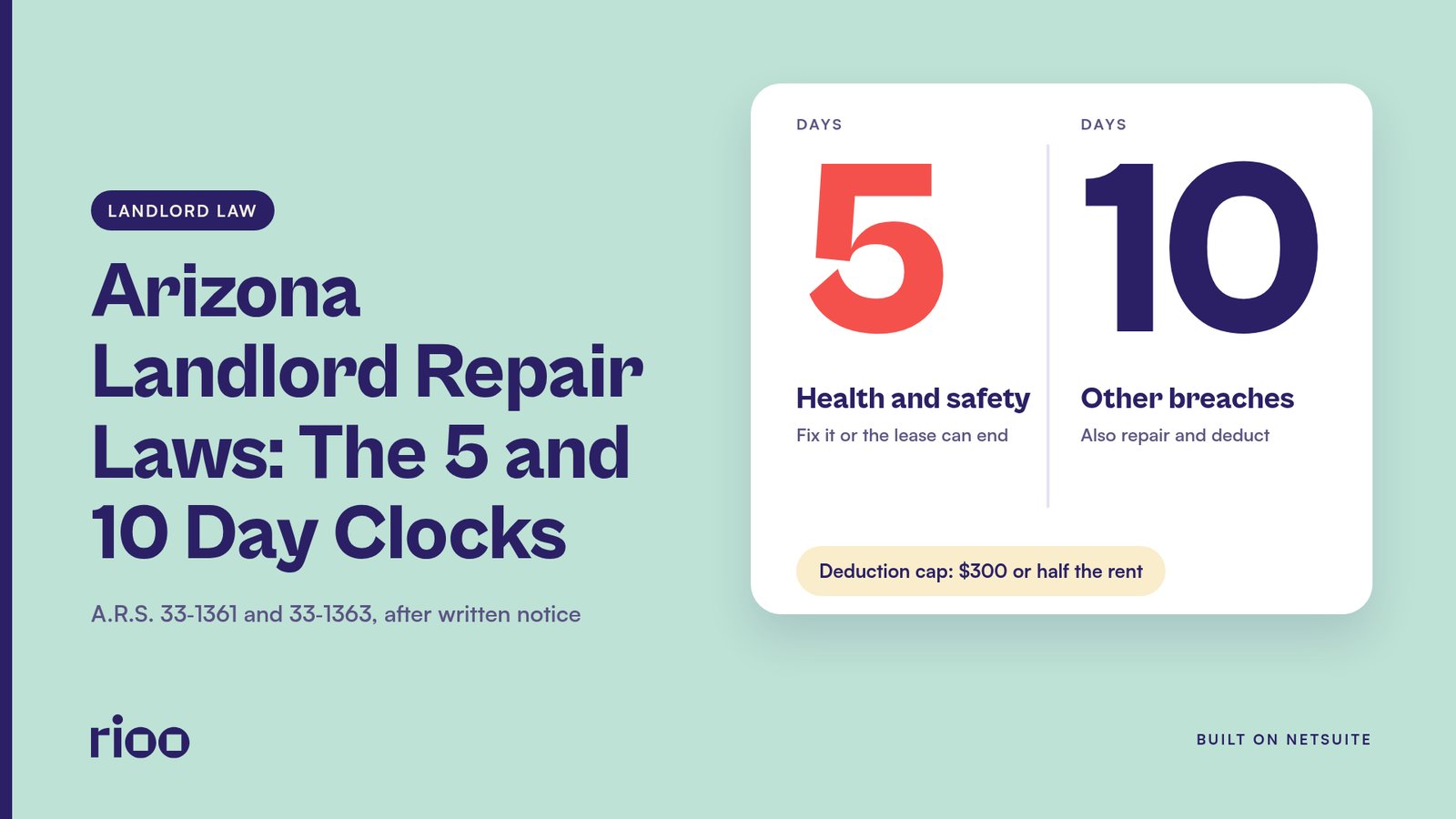
Five days. Under Arizona landlord repair laws, that is how long a landlord has to fix a health and safety problem once the tenant's written notice arrives. Miss it, and the tenant may end the lease. Other material breaches get ten days. For small defects, a tenant may hire a licensed contractor after ten days and deduct up to $300 or half a month's rent, whichever is greater. If heat, cooling, water or another essential service fails, the tenant can buy the service, claim reduced rent, or move to substitute housing.
All of this sits in the Arizona Residential Landlord and Tenant Act, Title 33, Chapter 10 of the Arizona Revised Statutes. A lease cannot waive it. This guide is current as of November 2026. It explains the rules for property managers and is general information. Confirm specific cases with Arizona counsel. Rules for other states are in the RIOO state landlord tenant law library.
What section 33‑1324 requires
A.R.S. 33‑1324 lists the landlord's duties. They apply to every residential unit the Act covers.
| Duty in the statute | What it looks like on site |
|---|---|
| Follow building codes that materially affect health and safety | Smoke alarms, wiring, egress and anything a city inspector would write up |
| Make all repairs needed to keep the unit fit and habitable | Roof leaks, broken locks, failed water heaters, pests that make a unit unlivable |
| Keep common areas clean and safe | Stair lighting, pool gates, walkways, laundry rooms |
| Keep supplied systems in good working order | Electrical, plumbing, sanitary, heating, ventilating, air conditioning, appliances and elevators you supply |
| Provide trash receptacles and removal | Bins and a pickup schedule |
| Supply running water, reasonable hot water, and reasonable heat and cooling when the season calls for it | Heat in a cold snap and cooling in summer, where the units are installed and offered |
The statute lets a landlord and tenant shift some work by a separate signed agreement, with real consideration and in good faith. That work can never include curing a code violation or a habitability failure. In a single family home, a written agreement can also hand the tenant the trash and the water, heat and cooling duties. Read the section before you rely on a lease clause.
Match the problem to its deadline
The deadline depends on the kind of problem. Your team should know which one applies before anyone replies to the tenant.
Five days: health and safety
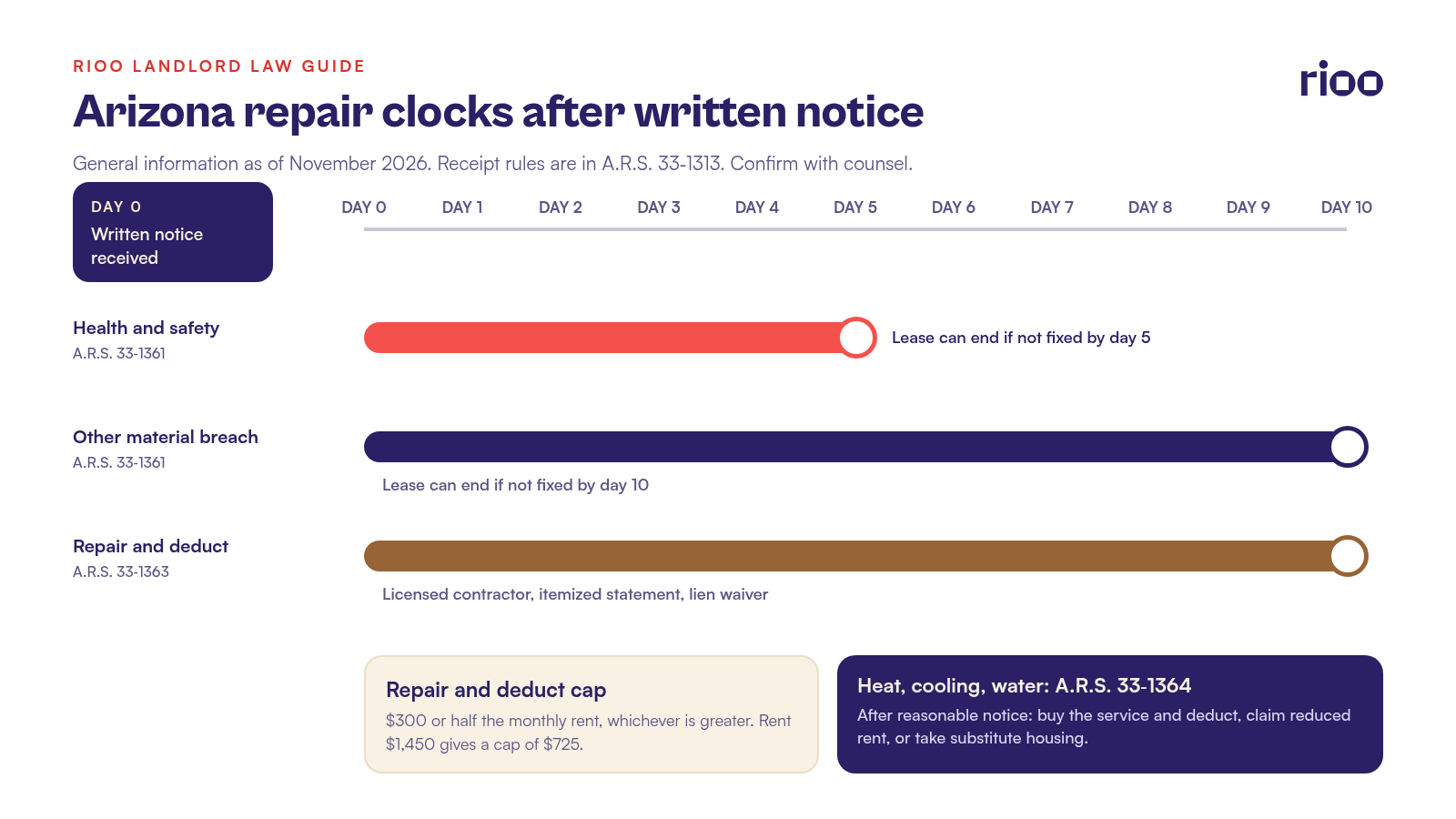
Under A.R.S. 33‑1361, a tenant can deliver written notice naming a breach of 33‑1324 that materially affects health and safety. The notice says the lease ends on a date at least five days after receipt unless the breach is fixed. If you fix it before that date, the lease does not end.
Ten days: other material breaches
For other material breaches of the lease, the same section gives ten days. That includes a material falsification in the written information given to the tenant, such as the condition of the unit or who pays utilities.
Essential services: reasonable notice
Heat, cooling, running water, hot water, gas and electricity follow a separate section, covered below. The tenant must give reasonable notice first. The statute names no fixed number of days.
When notice counts as received
A.R.S. 33‑1313 controls receipt. Hand delivery counts that day. Registered or certified mail counts on the day it actually arrives or five days after mailing, whichever comes first. Log the delivery method and date on every notice you get.
Two more points apply to every clock. The tenant cannot use these remedies for damage the tenant, family or guests caused. And the tenant may still sue for damages under 33‑1361 even when the lease continues.
Repair and deduct, with the cap worked out
A.R.S. 33‑1363 covers self help for minor defects. The steps are strict.
- The defect breaches 33‑1324, and the reasonable cost is under the cap.
- The tenant notifies the landlord in writing of the plan to fix it at the landlord's expense.
- The landlord does not fix it within ten days, or sooner in an emergency.
- The tenant has the work done by a licensed contractor.
- The tenant gives the landlord an itemized statement and a waiver of lien, then deducts the actual cost.
The cap is $300 or half the monthly rent, whichever is greater. Here is how it plays out.
| Monthly rent | Half the rent | Cap on the deduction |
|---|---|---|
| $550 | $275 | $300 |
| $1,200 | $600 | $600 |
| $1,450 | $725 | $725 |
| $2,100 | $1,050 | $1,050 |
So on a $1,450 lease, a licensed plumber's $410 invoice for a cracked toilet tank can come off the next rent. A $900 invoice cannot. Watch for a waiver of lien with each statement. Without one, the tenant has skipped a step.
Heat, cooling and water: three options for the tenant
A.R.S. 33‑1364 applies when the landlord deliberately or negligently fails to supply heat, cooling, water, hot water, gas, electricity or other essential services. After reasonable notice, the tenant may pick one path.
- Buy the service and deduct it. The tenant procures reasonable amounts of heat, water or the missing service and deducts the actual reasonable cost from rent. If service stopped because the landlord did not pay a shared utility bill, tenants may pay the utility directly and deduct it.
- Claim reduced rent. The tenant recovers damages based on the drop in the unit's fair rental value.
- Move out for the duration. The tenant takes reasonable substitute housing and owes no rent for that period. If the housing costs more than the rent, the tenant can recover the excess up to 25% of the rent excused. If the failure was deliberate, the tenant may recover more.
Once a tenant uses this section for a breach, the five day and repair and deduct routes are closed for that same breach, apart from earlier damages. The section gives no right to repair. A landlord also may not cut off utilities that come with the lease, except for repairs, and cannot shift the bill to the tenant without written consent.
Phoenix adds temperature numbers
State law says "reasonable" heat and cooling. Phoenix City Code section 39‑5(B)(1) puts numbers on it, in the version current through June 2026. Where heating is installed, it must be able to heat habitable rooms and bathrooms to at least 70°F. Where cooling is installed, air conditioning must cool to 82°F or below, and an evaporative cooler to 86°F or below. Readings are taken three feet above the floor in the center of the room. The city's cooling ordinance flyer sets out the cooling rule. Other Arizona cities may set their own standards, so check the local code for each property. For heat rules in other cities, see landlord heat requirements by city.
A December heat pump failure, day by day
Palo Verde Flats, a fictional 16 unit building in Phoenix, shows how the dates fall. The tenant in unit 9 pays $1,450 a month. The heat pump is 11 years old.
| Date | What happened | Why it matters |
|---|---|---|
| Tue 8 Dec 2026, 7:40 p.m. | The tenant reports no heat in the portal. The manager's thermometer reads 61°F at 9 p.m. | The system cannot reach the 70°F Phoenix standard. Treat it as urgent. |
| Wed 9 Dec | The HVAC tech finds a failed compressor. The replacement quote is $6,800 with six days for parts. Two space heaters go to the unit that afternoon. | A stopgap shows good faith. It does not end the breach. |
| Thu 10 Dec | The tenant hand delivers a written five day notice under 33‑1361. | Hand delivery counts that day. The deadline is Tue 15 Dec. |
| Thu 10 Dec | The owner approves the $6,800 replacement. The manager replies in writing with the install date. | The reply goes in the file next to the notice. |
| Mon 14 Dec | The new unit arrives. | One day to spare. |
| Tue 15 Dec, 4:10 p.m. | The install is finished. The bedroom reads 71°F at 6 p.m. | Fixed before the deadline, so the lease continues. |
The tenant still asked about the cold week. The manager offered a credit for seven days at a quarter of the daily rent. The daily rent is $1,450 × 12 ÷ 365, or $47.67. A quarter of that over seven days is $83.42. The tenant accepted in writing. A court could value the loss differently. A prompt written offer keeps the conversation calm and on the record.
Had the tenant mailed the notice by certified mail on Thursday, receipt would be the day it arrived, or Tue 15 Dec at the latest. The five days would run from then. Do not plan around those extra days. Fix the problem as fast as parts allow.
Retaliation and the six month window
A.R.S. 33‑1381 bars a landlord from raising rent, cutting services or bringing a possession action because a tenant complained about a 33‑1324 problem. The same applies after a complaint to a code agency, or after joining a tenants' union. A complaint within six months before the landlord's action creates a presumption of retaliation. The presumption does not arise if the complaint came after notice of termination. A landlord can still file for possession when the tenant is behind on rent or caused the code problem.
In practice, check the repair log before any rent increase or non renewal. If a repair complaint sits inside the last six months, write down the real reason for the decision and the evidence behind it.
The repair file to keep
- The request, with the date, time and channel.
- Any written notice, with how it was delivered and the receipt date under 33‑1313.
- Temperature readings for heat or cooling calls, with where and when you took them.
- Vendor visits, quotes, owner approvals and parts dates.
- Every message to the tenant, including stopgaps offered.
- The completion date and a final reading or photo.
- Any credit, deduction or itemized statement and lien waiver received.
You will need entry for many of these repairs. Arizona's two day notice rule is covered in the Arizona landlord entry notice guide. For the whole Act in one place, see the Arizona Residential Landlord and Tenant Act guide.
Where the file lives in RIOO
Arizona's deadlines are short, so the record has to be complete from the first message. In RIOO, a tenant submits a request through the portal, and it becomes a work order linked to the property, unit, asset and lease in NetSuite. Requests are prioritized by urgency and assigned to a technician or vendor. Status changes are visible to the resident. When the work is done, it is recorded against the unit and asset, and the cost flows to accounts payable. That gives your team one timeline to compare against a five or ten day notice. See maintenance request and work order software.
Arizona repair law FAQ
How long does a landlord have to make repairs in Arizona?
Five days after receiving written notice of a problem that materially affects health and safety, and ten days for other material breaches. Repair and deduct also runs on ten days, or faster in an emergency.
Can an Arizona tenant withhold rent for repairs?
The Act does not give a general right to withhold rent. It gives specific remedies: ending the lease after notice, repair and deduct within the cap, damages, and the essential services options in 33‑1364.
Is air conditioning required in Arizona rentals?
State law requires reasonable cooling where cooling is installed and offered. Phoenix sets 82°F for air conditioning and 86°F for evaporative coolers. Check the city code for each property.
Can a tenant pay a landlord's unpaid utility bill?
Yes, in some cases. Say service stops because the landlord did not pay, and tenants cannot move the account into their own names. With the utility's approval, they may then pay it after written notice to the landlord and deduct the payment from rent.
Does the cap mean a tenant can never spend more?
Repair and deduct stops at the cap. Larger problems go through the five or ten day notice, a damages claim, or the essential services section.