









Every utility shutoff notice I have traced back started in accounts payable. A bill went to an old address, an autopay card expired, or a meter never made it onto anyone's list. So when a notice arrives on an account the owner pays, treat it as same day AP work. Call the utility, confirm the amount and the shutoff date, and pay the past due balance with the right approval. Get a confirmation number and ask the utility to cancel the shutoff order. Then tell residents in writing that service will continue, and close the gap that let the bill slip.
Residents may also have a legal right to step in and pay the bill themselves. That turns a missed bill into a tenant relations problem fast. The state rules are further down.
Read the notice before you pay anything
The notice tells you what kind of problem you have. Four details decide what happens next.
Whose name is on the account
Check the customer of record. It might be the owner's entity, your management company, a former manager or a seller from an acquisition. Payment should come from the operating account of the entity that owns the property.
Which meter it covers
A master meter serves several units, so residents cannot move it into their own names. A house meter covers common areas such as hallway lights, a pool pump or a boiler room. An individual meter in the owner's name usually means a vacant unit or a lease where the owner pays. Each one affects a different group of people.
Amount past due and the shutoff date
Write down the exact balance, the date of the oldest unpaid bill and the scheduled shutoff date. Ask the utility whether the full balance stops the order, or only a minimum amount.
Who else received a notice
In some states the utility must notify the residents too. If notices went on every door, residents already know. Your message to them needs to go out the same day.
Pay it the same day, with a clean approval
Urgency is no reason to skip controls. Use an emergency payment path that is written into your AP policy.
- The AP lead confirms the balance and account number directly with the utility, using the phone number on the utility's website. Do not rely on a number from a forwarded notice.
- The approver named for that amount signs off. If the management agreement sets an owner approval limit, get the owner's written OK.
- Pay from the property's operating account. Record the confirmation number and the name of the utility rep.
- Ask the utility to cancel the shutoff order and confirm it in writing.
- Update the billing address and add a second notice contact before you hang up.
- Post the bill to the property with the late charges on their own line.
Keeping late charges separate matters. The owner and the manager may need to agree who absorbs them, and that conversation is easier with the figure isolated.
Tell residents in plain words
Residents who see a shutoff notice will worry about heat, hot water and whether they need to act. Answer all three. A short notice works well.
Notice to residents of Birchwood Terrace, 11 January 2027
You may have seen a notice from the gas company about a shutoff on 26 January. The building's gas account has been paid in full today. Heat and hot water will continue. You do not need to do anything or pay anyone. If you receive a call asking you to pay this bill, please do not pay and let us know. Questions: call the office at the number on your lease.
Post it where the utility posted, and send it through the resident portal or email too. If service has already stopped, follow your outage steps first. The apartment power outage plan covers people who cannot wait.
What tenants may do when a landlord's bill goes unpaid
Several states give residents a way to keep service on when the landlord has not paid. The rules differ, so check each state where you operate. A few examples, current as of November 2026:
| State | Rule | Source |
|---|---|---|
| California, individual meters in the owner's name | The utility must make a good faith effort to give residents written notice at least 10 days before shutoff, or 7 days for a detached single family home. Residents may become customers without paying the old balance. If rent included the service and the charge was not separately stated, they may deduct what they pay. | Public Utilities Code 777 |
| California, master meters | The utility posts notice on each door at least 15 days before shutoff. If the owner directs, permits or fails to prevent a shutoff while units are occupied, residents may recover restoration costs, actual damages and attorney's fees. | Public Utilities Code 777.1 |
| Arizona | Say service stops because the landlord did not pay, and residents cannot move the account into their own names. With the utility's approval, they may pay it after written notice and deduct it from rent until the landlord gives adequate assurance. | A.R.S. 33‑1364 |
| Ohio | After a notice, residents have set time limits to keep or restore service. They can collect the landlord's current bill through a representative, or pay rent into escrow with the court. | Public Utilities Commission of Ohio |
If residents end up paying the owner's bill, that money can come off their rent. Then the rent roll and the utility account both need untangling. Paying first avoids it. This is general information, so confirm the rules in each state with counsel.
A shutoff is never a tool against a tenant
Some owners ask whether they can let a utility lapse on a unit with a tenant who will not leave. The answer is no. California Civil Code 789.3 bars a landlord from willfully causing a utility interruption to end a tenancy. The penalty includes actual damages and up to $100 a day, with at least $250 for each separate violation, plus attorney's fees. See Civil Code 789.3. Arizona's 33‑1364 bars cutting off utilities that come with the lease except for repairs. Other states have similar rules. Use the eviction process your state requires.
Birchwood Terrace, a January example
Birchwood Terrace is a fictional 24 unit building in California with a master gas meter for heat and hot water. The owner's entity is the customer of record. A new management company took over on 1 September 2026.
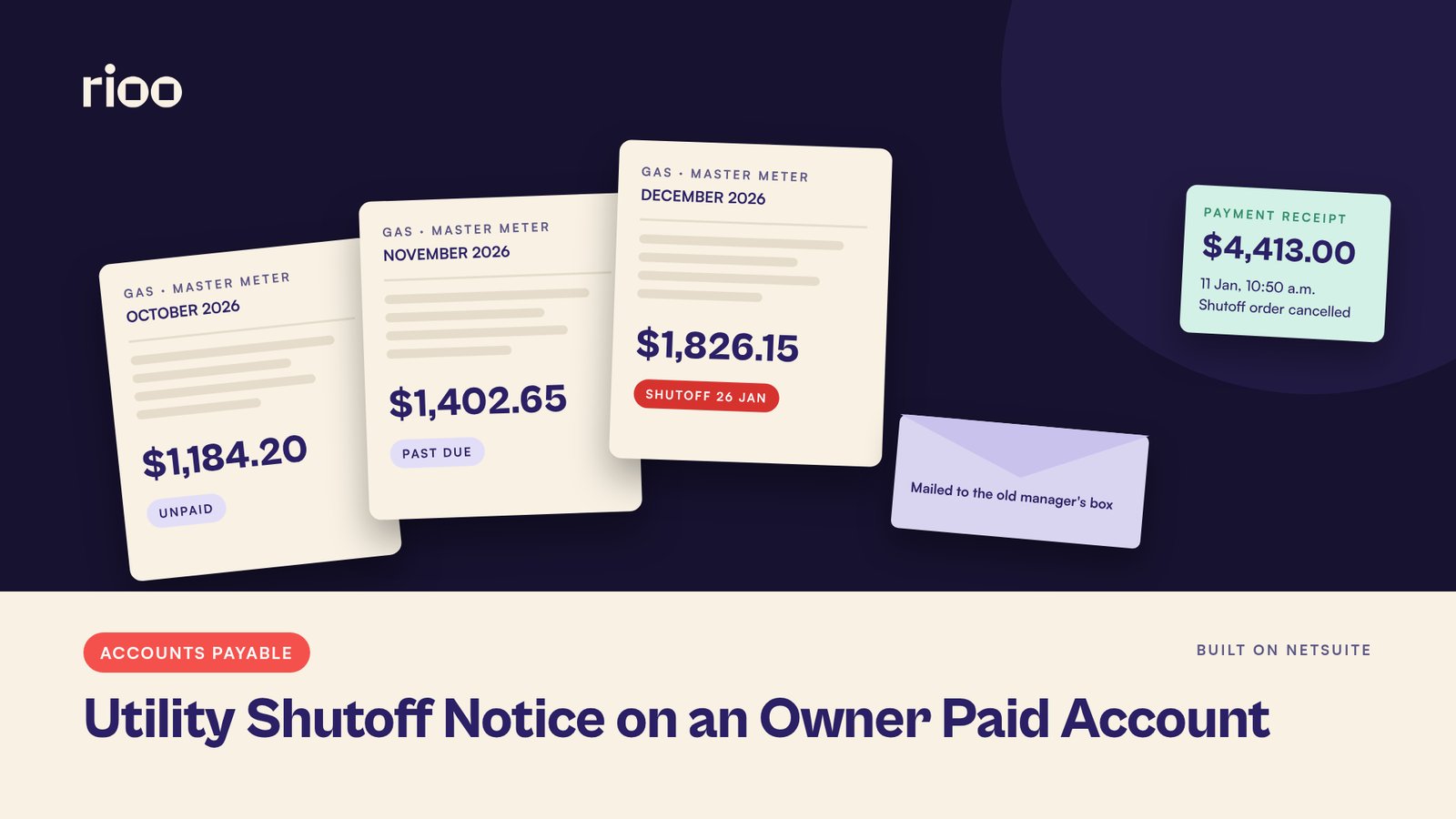
At 8:10 a.m. on Monday 11 January 2027, a resident texted the office a photo of a notice taped to her door. The gas company planned to shut off service on Tuesday 26 January. The notice was dated 11 January, which gave the 15 days the master meter rule requires.
The AP lead called the utility at 8:40 a.m. Three bills were unpaid.
| Bill | Amount |
|---|---|
| October 2026 | $1,184.20 |
| November 2026 | $1,402.65 |
| December 2026 | $1,826.15 |
| Total past due | $4,413.00 |
Two causes came out on the same call. The billing address was still the old manager's post office box. The autopay card on file had expired in September, when the owner changed banks.
The amount was above the $2,500 emergency limit in the management agreement, so the controller emailed the owner at 9:20 a.m. The owner approved at 10:15 a.m. AP paid $4,413.00 by phone from the operating account at 10:50 a.m. The rep cancelled the shutoff order and emailed a confirmation. The resident notice went up at 1:00 p.m. A $66.20 late charge arrived on the next bill. AP posted it on its own line for the owner and manager to settle.
By Friday, the account had a new billing address, a second notice contact and a monthly approval step in place of the old card. The gas account was also added to the property's utility register, which had not existed before.
How owner paid accounts fall behind
Missed utility bills tend to have ordinary causes. Match each one to a control.
| Cause | Control that catches it |
|---|---|
| Bills still go to a former manager or seller | Change every billing address in the first week of a takeover or acquisition |
| Autopay card expired or bank changed | Pay utilities through approved bills, or review autopay methods each quarter |
| Vacant unit accounts nobody owns | Add the account at move out and remove it at move in |
| House meters left off the list | Walk the site with the meter list once a year |
| A disputed bill put on hold | Pay the undisputed part and log the dispute with a follow up date |
| Bill coded to the wrong property | Match the service address on every bill to the register |
Vacant units are a common gap. The utility transfer turnover timeline shows how to book the owner's start date at move out so service never lapses. Disputes need their own trail, and the utility billing dispute workflow covers it.
Where the controls live in RIOO
Utility bills are vendor bills, so the controls belong in AP. In RIOO, vendor bills are NetSuite transactions linked to the property. Approval routing follows your rules by property, amount or category, with backups. Approved bills join a scheduled payment run, and the cost posts to the right property and expense category. Aging and saved searches support day to day AP control, so an account with no bill this month can show up on a list. RIOO also tracks utility usage and cost by property and unit, and can bill residents their share when your leases allow it. See property accounts payable and vendor management and utility and asset management in RIOO.
The utility account register
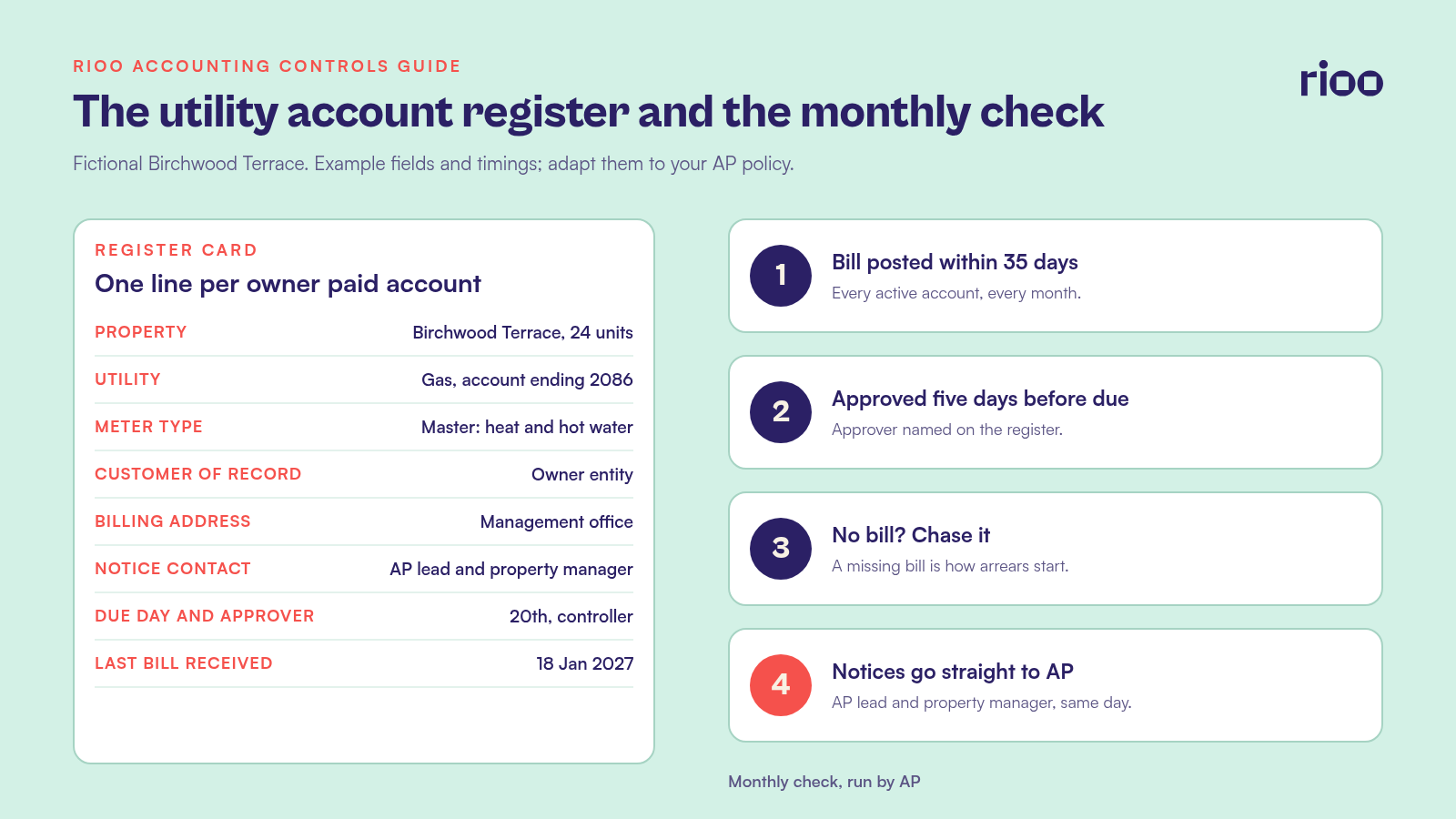
One list per property stops these surprises. Keep it with your AP records, where the whole team can see it. Record these fields for every account the owner pays:
- Property and service address
- Utility, account number and meter number
- Meter type: master, house or individual
- Customer of record, by legal entity
- Billing address and a second notice contact
- Due day, payment method and approver
- Last bill received and last payment date
Then run one monthly check. Every active account should have a bill posted within 35 days. If one does not, chase it, because a missing bill is how a past due balance starts. Approve bills at least five days before the due date. Route any disconnection notice straight to the AP lead and the property manager on the day it arrives.
Shutoff notice FAQ
Can a utility shut off a building when tenants paid their rent?
The utility bills its customer of record. If that is the owner and the bill goes unpaid, the utility can start a shutoff, subject to state notice rules. Residents' rent payments do not reach the utility unless a state law lets them redirect money.
How much notice do tenants get?
It depends on the state and the meter. In California, it is at least 10 days for individual meters in the owner's name, 7 for a detached single family home, and 15 for master meters. Check the rule for each state you manage in.
Who pays the late fees and reconnection charges?
Your management agreement should say. If it does not, record the charges on their own line and agree with the owner who bears them. Never pass them to residents unless the lease and the law allow it.
Should we pay the full balance or a minimum?
Pay what stops the order and keeps the account current. If part of a bill is in dispute, pay the undisputed amount and get the utility's agreement in writing.
What if service is already off?
Pay, ask for emergency reconnection, and tell residents when service will return. Check on residents who rely on heat, power or hot water for health reasons, and offer help while you wait.