






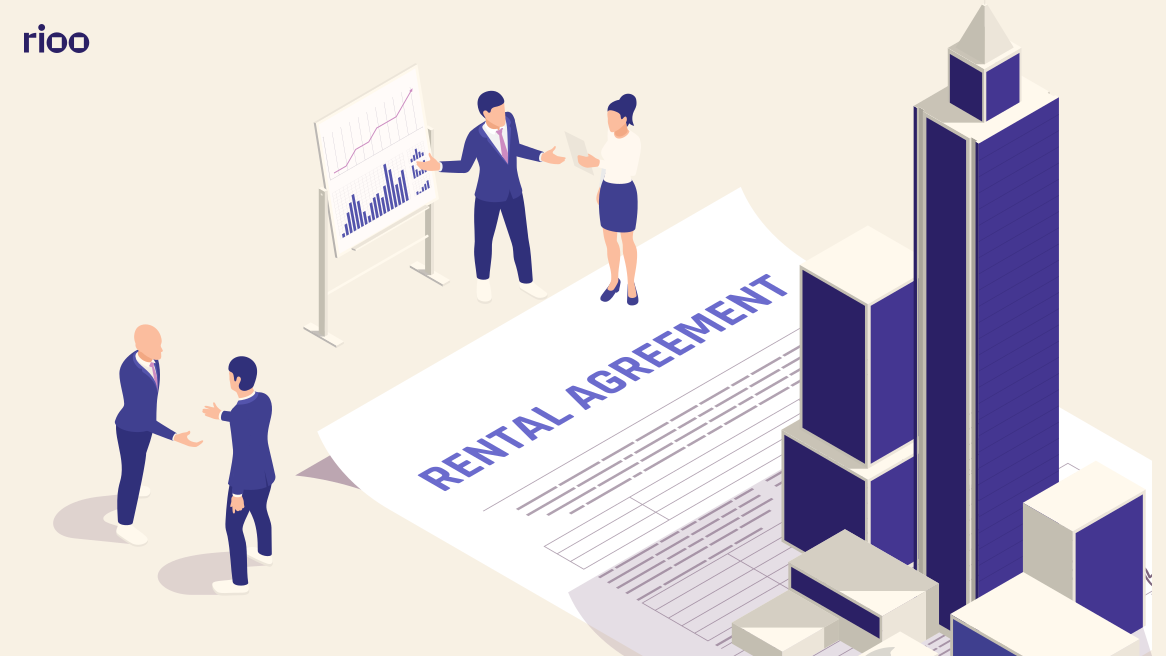
Somewhere in almost every UAE property office there is a folder called "FINAL contract template v7 (USE THIS ONE)". It gets copied for each new tenancy, edited by hand, and occasionally sent out with last year's rent, the wrong unit number, or a clause that quietly contradicts the emirate's tenancy rules. At five units, that's an embarrassment waiting to happen. At five hundred, it's a legal and operational risk being reproduced daily — because in the UAE, a tenancy contract isn't just an agreement between two parties. It's the document your registration, your rent enforcement and your dispute position all stand on.
Lease agreement software in the UAE generates tenancy contracts from the data you already hold — unit, tenant, rent, term, payment schedule — using the correct format for each emirate, tracks versions and renewals, and connects the signed contract to registration (Ejari in Dubai, Tawtheeq in Abu Dhabi) and to rent collection, instead of leaving it in a Word folder.
Key Takeaways
- A UAE tenancy contract has to satisfy its emirate's system, not just the parties: Dubai contracts feed Ejari registration, Abu Dhabi tenancies are registered by the landlord's side in Tawtheeq, and Sharjah contracts go through municipality attestation.
- Hand-edited templates are the single biggest source of contract errors at portfolio scale — wrong rent, wrong dates, stale clauses — and every error surfaces later, at registration, renewal or dispute.
- Software closes the gap by generating the contract from the lease record itself: the rent in the contract IS the rent in the system, so the document, the registration and the cheque schedule can never disagree.
- Renewals are where the payoff compounds: notice deadlines, updated terms and addenda generated on time, with the version history to prove what was agreed and when.
- Choose by scale: template generators serve single landlords; portfolio operators need the contract living inside their property management system, connected to screening, registration tracking and rent collection.
What does a compliant tenancy contract need in the UAE?
The UAE's requirements differ by emirate, and the contract is the input to each system:
| Emirate | The system | What that means for the contract |
|---|---|---|
| Dubai | Ejari (Dubai Land Department) | The tenancy is registered in Ejari; the contract's details — parties, unit, rent, term — must match what's filed, and renewals must be re-registered. See the Dubai Land Department for the framework |
| Abu Dhabi | Tawtheeq (ADREC, via TAMM) | The landlord's side registers the contract; the registered value now also caps future pricing under the 2026 freeze — so contract accuracy has direct money consequences |
| Sharjah | Municipality attestation | Contracts are attested with the municipality; the 3-year no-increase rule makes the recorded rent and start date critical |
| Other emirates | Municipal registration | Same principle: the contract is a filed document, not a private one |
Two practical constants across all seven: contracts are typically bilingual (Arabic carries legal weight, English carries the working relationship), and the payment schedule — cheque counts and dates, or instalment terms — belongs in the contract itself, matching what's actually collected. General tenancy guidance is on the official UAE government portal.
Template, generator, or software? The three ways to create a lease
-
A template (Word or PDF, edited per tenancy) is free and fine for one property. Its failure mode is human: every field is retyped, every clause is touchable, and version 7 becomes version 9 without anyone deciding it should.
-
An online contract generator asks a form's worth of questions and produces a clean, correctly formatted contract. Better — but it's a point solution: the generator doesn't know your unit, your tenant's screening result, or your renewal calendar. The contract is born correct and then lives alone.
-
Lease management software inverts the flow: the lease record comes first — unit, tenant, rent, term, payment schedule — and the contract is generated from it. That single inversion removes the whole error class: the document can't disagree with the system because the system wrote the document. It also makes everything downstream automatic — the registration tracker knows the dates, the rent collection schedule knows the cheques, and the renewal alert knows the deadline.
What should lease agreement software actually do? The 7-point checklist
- Generate contracts from lease data, in the emirate-appropriate format, bilingual where needed — no retyping, ever.
- Control clauses centrally: one approved clause library, so a legal update reaches every future contract the day it's made, and nobody edits terms unit by unit.
- Track registration: Ejari and Tawtheeq details and expiries held against each contract, with alerts — the registration step itself stays with DLD channels or TAMM, but nothing about it depends on memory.
- Run renewals as workflow: notice deadlines surfaced in time (90 days in Dubai), terms updated against the applicable rent rules, addenda generated and versioned.
- Connect to screening: an approved applicant (see our tenant screening guide) flows into a contract without re-entering a single detail.
- Keep the audit trail: every version, every amendment, every signature date — the history a rent dispute committee will ask for.
- Feed the money side: the contract's payment schedule becomes the receivables schedule, so collection starts right because the contract was right.
Where RIOO fits
RIOO — property management software built natively on NetSuite, used across the US, Canada, Australia, the UAE and the UK to manage 180,000+ units — handles contracts and renewals inside its Leasing module: the lease record generates the contract, registration details and expiries live on that record with alerts, and the payment schedule flows straight into rent collection and the ledger. For UAE operators, that means the tenancy contract, the Ejari or Tawtheeq tracking and the cheque schedule are one connected record instead of three separate documents.
How to choose for your situation
One or two properties: a good template or an online generator, used carefully, is honestly enough. A growing portfolio: the moment contract errors, missed renewals or registration lapses have happened more than once, the template era is over — you need the contract living inside the system that runs the tenancy. Comparing full platforms? Our round-up of the best property management software in the Dubai covers the market, lease workflows included.
Conclusion
In the UAE, the tenancy contract is load-bearing: registration stands on it, rent enforcement stands on it, and in a dispute it's the first document anyone reads. Treating it as a Word file that gets hand-edited a few hundred times a year is a risk no growing operator needs to keep taking. Generate contracts from the lease record, control the clauses centrally, let renewals and registrations run on alerts instead of memory — and the folder called "FINAL v7" can finally be archived for good.
FAQs
Q1. What is lease agreement software?
Lease agreement software generates tenancy contracts from lease data — unit, tenant, rent, term and payment schedule — using approved clauses and the correct format for the emirate, then tracks versions, renewals and registration details on the same record instead of in separate documents.
Q2. Is a digital tenancy contract valid in the UAE?
Digitally created contracts are standard practice across the UAE; what matters is that the contract is properly executed by the parties and registered in the emirate's system — Ejari in Dubai, Tawtheeq in Abu Dhabi, or municipal attestation elsewhere. For high-value or unusual tenancies, legal review of execution formalities is sensible; this article is general information, not legal advice.
Q3. Do tenancy contracts in the UAE need to be in Arabic?
Contracts are commonly bilingual, with Arabic and English side by side. Arabic text is what authorities and courts work with, which is a further argument for generating contracts from controlled templates rather than editing translations by hand.
Q4. What happens if the contract and the Ejari registration don't match?
Mismatches surface at the worst moments — licence renewals for commercial tenants, rent disputes, or renewal filings. Generating the contract from the same record the registration is tracked on is the structural way to prevent the two from disagreeing.
Q5. Can lease software handle renewals automatically?
Good software runs renewals as workflow: it surfaces the notice deadline in time, applies the emirate's rent rules to the proposed terms, generates the renewal or addendum from the updated lease record, and keeps every version in the audit trail.
Q6. What is RIOO?
RIOO is property management software built natively on NetSuite, Oracle's cloud ERP. It combines leasing and contract workflows, tenant screening, property accounting, maintenance and tenant portals in one system, and manages 180,000+ units across the US, Canada, Australia, the UAE and the UK.