Short answer: the lease commencement date is when the lease term starts, which usually means the day the tenant gets the right to use the space. The rent commencement date is the first day the tenant has to pay rent. The gap between the two is often a free rent or fit out period. Leasing, billing and accounting each care about a different date, so every lease record should store both, plus the facts that set them.
Many disputes about these dates start the same way. The lease says "Commencement Date" in one clause and "Rent Commencement Date" in another. The property system has one field for both. This guide explains what each date means and how to calculate it. It also covers what can move the dates and how to set up records so leasing, billing and finance read the same answer.
What is the lease commencement date?
The lease commencement date is the day the lease term begins. Many commercial leases define it with a trigger rather than a fixed day. Common triggers include:
- A fixed calendar date written into the lease.
- The day the landlord delivers the premises with the agreed work finished.
- The day the tenant takes possession or gets access to start its own work.
- The earlier of two events, such as delivery or the day the tenant opens for business.
The commencement date matters because the lease term is measured from it. The expiry date, renewal option windows and many notice periods are counted from this day. If commencement moves by three weeks, every date that hangs off it moves too.
Lease execution is a separate date
The execution date is the day both parties sign. It creates the contract, but it does not start the term. A lease signed in March for a unit delivered in June has a March execution date and a June commencement date. Keep both, because some obligations, like a deposit due on signing, run from execution.
What is the rent commencement date?
The rent commencement date is the first day the tenant owes base rent. In a simple residential lease, it is usually the same day the term starts. In commercial leases it often comes later, because the landlord gives the tenant time to fit out the space before paying.
Leases set rent commencement in a few typical ways:
- A set number of days or months after lease commencement, such as 90 days.
- The earlier of a fixed period or the day the tenant opens for trade.
- A fixed date, sometimes with an outside date that applies even if fit out runs late.
Also check whether rent commencement covers all charges. Some leases start base rent later but bill operating cost recoveries, service charges or utilities from the commencement date. Others delay everything. The clause that answers this question is often a long way from the rent clause, so read the whole lease.
Lease commencement vs rent commencement: a side by side view
| Question | Lease commencement date | Rent commencement date |
|---|---|---|
| What starts? | The lease term and the tenant's right to use the space | The obligation to pay base rent |
| Typical trigger | Delivery, possession or a fixed date | A period after commencement, opening for trade, or a fixed date |
| Who watches it most? | Lease administration and legal | Billing and accounts receivable |
| What depends on it? | Expiry date, options, notice windows | First invoice, rent schedule, rent steps if tied to rent start |
| Accounting relevance | Often drives when lessor revenue recognition starts | Drives cash billing, not always revenue timing |
A worked example
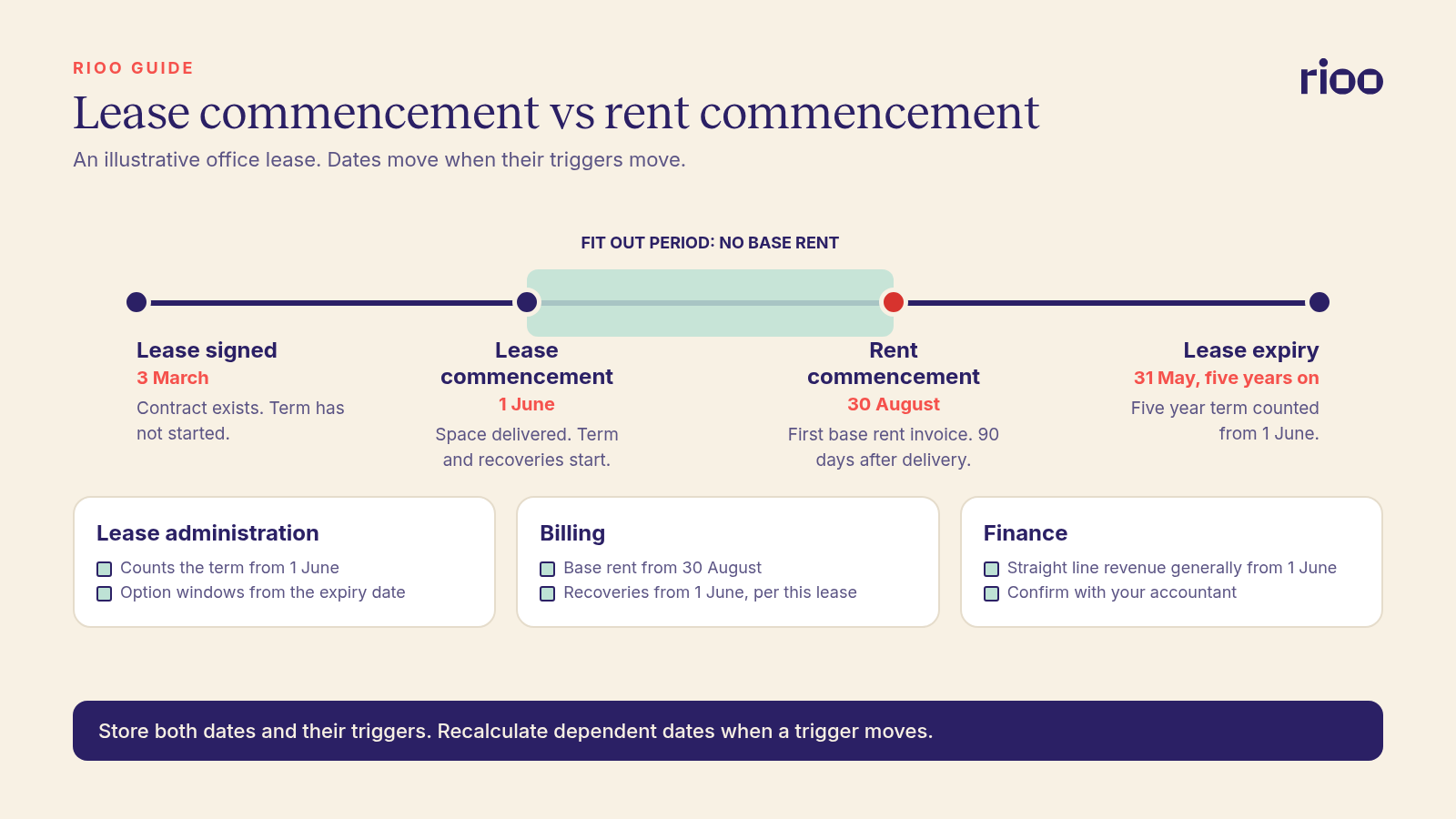
Here is a simple office lease to show how the dates fit together. The numbers are illustrative.
- Lease signed on 3 March.
- Landlord delivers the suite with base building work done on 1 June. The lease says the term starts on delivery, so lease commencement is 1 June.
- The tenant gets 90 days to fit out before rent starts. Rent commencement is 30 August.
- The term is five years from lease commencement, so the lease expires on 31 May five years later.
- Base rent is $12,000 a month. Operating cost recoveries are billed from 1 June.
In this lease, billing should send the first base rent invoice for 30 August, prorated to the end of that month, and should bill recoveries from June. Lease administration should count option notice windows from the 31 May expiry. Finance should check how its accounting policy treats the 90 days with no base rent, which we cover below.
Now imagine delivery slips to 22 June because a contractor runs late. Lease commencement moves to 22 June. Rent commencement moves to 20 September. The expiry date moves to 21 June. If your system stored only one date that someone typed in March, all of those downstream dates are now wrong.
What can move these dates?
Dates written as triggers will move when the trigger moves. Watch for these events:
- Late delivery by the landlord. If work is not finished, commencement usually waits. Some leases give the tenant extra free rent days for each day of delay.
- Early access. A tenant who gets in early to install cabling may or may not trigger commencement. The lease should say which. If it is silent, agree it in writing.
- Tenant delay. Some leases say that if the tenant causes a delay, commencement happens on the day it would have happened without the delay.
- Amendments. An expansion or a change to the work letter often resets dates. Update the record when the amendment is signed, not at the next renewal.
- Opening for trade. In retail, rent often starts on opening day or after a fixed period, whichever comes first.
How to record both dates without errors
The fix is mostly about the data model and a short sign off step. This process works for most commercial portfolios.
- Abstract both dates and their triggers. Capture the clause text, the trigger event, and the calculated date. A field that says "1 June" without the reason cannot be checked later. Our lease abstraction checklist lists the other fields worth capturing at the same time.
- Mark each date as estimated or confirmed. Until the trigger happens, the date is an estimate. Billing should not run on an estimate without a review.
- Get a commencement date memo. Many leases ask both parties to sign a short letter that confirms the actual commencement, rent commencement and expiry dates. Send it within a few weeks of delivery and store it with the lease.
- Calculate dependent dates from the confirmed date. Expiry, option windows and rent steps should be calculated from the source date, so they update together when it changes.
- Hand off to billing with a checklist. Billing needs the first rent date, the proration rule, which charges start when, and any free rent or abatement months.
- Tell finance about the gap. Finance needs the commencement date, the rent schedule and any incentives to set up revenue schedules.
Why finance cares about the gap
For lessors reporting under US GAAP (ASC 842) or IFRS 16, revenue for an operating lease is generally recognised on a straight line basis over the lease term. The lease term for accounting purposes generally starts when the lessor makes the space available for the tenant to use. That point can be well before rent commencement.
In practice this means a free rent or fit out period is usually spread across the whole term, rather than showing as zero revenue for the first months. Using the example above, total base rent over the term is divided across all 60 months from June, including the 90 days with no cash rent. The difference between revenue recognised and cash billed builds up as a straight line rent receivable.
The exact answer depends on the lease terms, who controls the space during fit out, and your accounting policy, so confirm the treatment with your auditor or accountant. What operations can do is make sure finance gets the right date. Our guides on free rent and rent abatement accounting and tenant improvement allowance accounting go deeper on the journal entries.
Common mistakes to avoid
- Using one field for both dates. This is a common cause of a wrong first invoice or a wrong expiry date.
- Starting billing on the signing date. Execution is not commencement.
- Forgetting recoveries. Base rent may wait, while service charges or utilities do not.
- Not updating after a delay. If delivery slips, every calculated date should be rechecked.
- No signed confirmation. Without a commencement memo, the dates can be argued years later, often at renewal or sale.
- Finance learning the date at month end. Revenue schedules set up late lead to catch up entries and questions from auditors.
Who owns each step?
| Step | Owner | Output |
|---|---|---|
| Abstract dates and triggers | Lease administration | Lease record with estimated dates |
| Confirm delivery | Property or project manager | Delivery date with evidence |
| Commencement memo | Lease administration and tenant | Signed letter on file |
| First invoice and rent schedule | Billing or AR | Charges set up from confirmed dates |
| Revenue schedule | Property accounting | Straight line schedule from lease commencement |
Where RIOO fits
RIOO is property management software built natively on Oracle NetSuite. Lease records, tenant charges and the general ledger live in one system, so the dates your leasing team confirms are the same dates billing and finance use. With commercial lease administration in RIOO, the commencement date, the billing start date and the expiry date sit on the lease record. Rent schedules and straight line rent revenue recognition are driven from those same records. When a date changes, there is one record to update rather than three systems to reconcile.
Frequently asked questions
Is the lease start date the same as the commencement date?
Usually, yes. "Lease start date" and "lease commencement date" are used to mean the day the term begins. Check the definitions clause, since some leases use their own terms.
Can rent commencement come before lease commencement?
It is rare. Rent normally follows the start of the term. If a lease seems to say otherwise, ask the drafter to confirm before billing.
Does the expiry date run from lease commencement or rent commencement?
Most commercial leases measure the term from lease commencement. Some measure it from rent commencement so the tenant gets a full term of paid occupancy. The lease clause decides, so record which one applies.
What is a commencement date memo?
It is a short letter signed by landlord and tenant that confirms the actual commencement, rent commencement and expiry dates once they are known. It removes doubt later.
Do free rent months reduce revenue in the first year?
Under straight line recognition, free rent is generally spread across the lease term, so revenue is recognised from lease commencement even when no cash rent is billed. Confirm the treatment with your accountant.